

What Is Generative Engine Optimization?
Generative engine optimization (GEO) focuses on improving your brand’s visibility and accuracy in AI‑driven platforms and answers. Whereas SEO targets organic rankings on traditional search engines, GEO prepares your content to be cited, recommended and synthesised by large language models such as ChatGPT, Gemini and Google’s AI Overviews.
With conversational AI tools generating answers for millions of users, GEO helps ensure your expertise is included even when no click occurs.
Key Principles of Generative Engine Optimization
- GEO aims to make your content part of the conversation, not just rank pages.
- SEO provides the foundation for GEO, but GEO extends optimisation to AI platforms and focuses on citation and visibility.
- Closing the “synthesis gap” involves creating fact‑dense content that AI can understand and remix into answers.
- Fact‑density and entity clarity help AI models extract and attribute your content accurately.
- Tracking performance requires monitoring mentions across AI platforms and adjusting your strategy based on emerging engines.
How does GEO differ from traditional SEO?
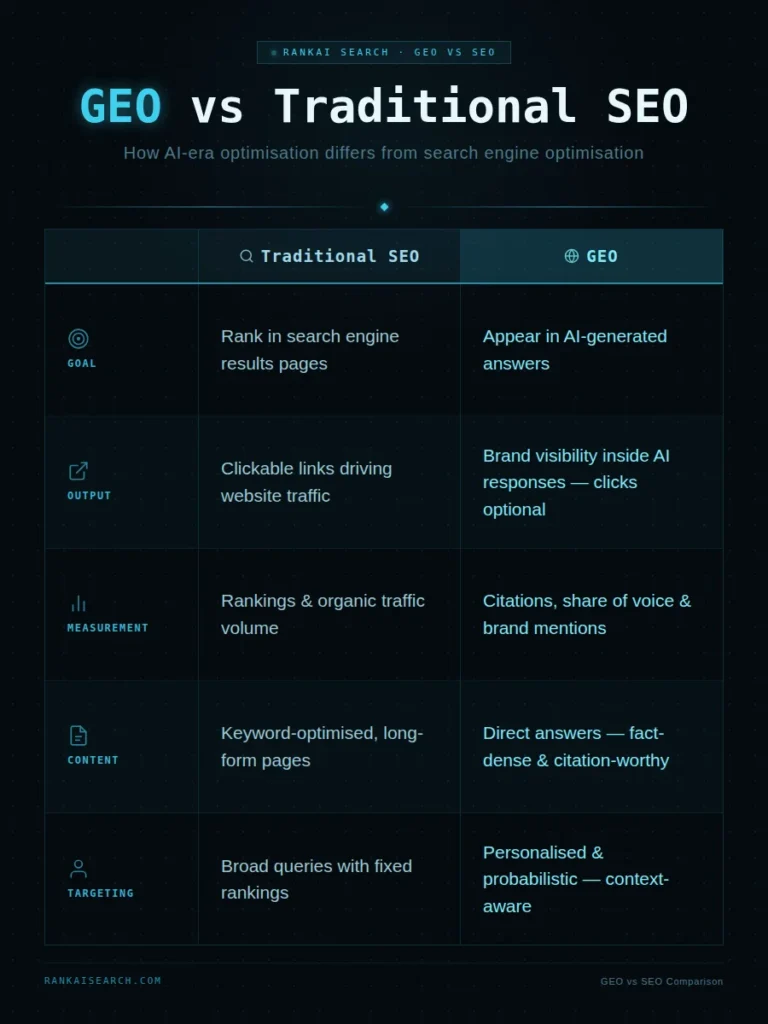
SEO optimises your website to rank in search engine results. It emphasises keyword research, on‑page optimization, technical health and backlinks. GEO builds upon these fundamentals but broadens the goal: to have your information included in AI‑generated answers.
Seer Interactive notes that GEO focuses on improving visibility and accuracy in AI platforms like ChatGPT and Google’s AI Overviews. The differences include:
- Output – SEO drives traffic through clickable links, whereas GEO delivers brand visibility within AI responses where clicks may not occur.
- Measurement – SEO success is measured by rankings and traffic; GEO success is measured by citations, share of voice and brand mentions.
- Content format – GEO requires direct answers, clear structure and context. It emphasises fact‑density and citation‑worthiness.
- Personalization – AI responses are personalised and probabilistic, so optimization must consider user context.
What is the “synthesis gap” and how do you close it?
The synthesis gap refers to the difference between how AI models synthesise information and how content is traditionally written. AI systems blend multiple sources into a single answer; if your content lacks clarity or context, it may be misrepresented or omitted. To close this gap:
- Front‑load key facts – Place crucial statistics and statements early in the section. AI models often extract from the beginning of paragraphs.
- Provide full context – Use explicit nouns and avoid vague pronouns. This helps AI understand who or what you’re referring to.
- Be precise – Provide accurate data and definitions. Avoid fluff and ambiguous language.
- Use citations and references – Linking to credible sources strengthens your authority.
- Maintain consistent formatting – Use question‑based headings and short paragraphs to make content easy to parse.
How does fact‑density engineering increase citation probability?
Fact‑density engineering involves packing each section of your content with important facts, definitions and context. When AI models scan content, they prioritise sections rich with meaningful information.
Including statistics, definitions and examples increases the chance your content will be selected.
For example, quoting credible reports such as Gartner’s prediction that traditional search volume will drop 25 % by 2026 or noting that more than 67 % of businesses use AI to support SEO efforts adds authoritative details. Balance density with readability by using bullet points and tables where appropriate.
What is the “citation gap” and how can you fix it?
The citation gap occurs when AI models use information from your site without attributing it, or when your content fails to gain mentions despite being authoritative. To fix the gap:
- Improve clarity – Make your sentences self‑contained and avoid vague references. AI systems can only cite what they can parse.
- Enhance authority signals – Increase backlinks from credible sources and include author bios. AI trusts well‑cited sources.
- Monitor mentions – Use tools to see where your content is used without citation and reach out to publishers to request credit.
- Update robots.txt – Allow AI bots to crawl your site so they can attribute your content properly.
Why does multimodal GEO matter?
AI systems increasingly process not only text but also images and videos. Multimodal GEO ensures your visual assets are optimised for AI understanding. This includes:
- Alt text and captions – Describe images using clear language and relevant entities.
- Structured data for images and videos – Use schema markup such as ImageObject or VideoObject to provide context.
- Transcripts for videos – Provide text transcripts so AI can index the content.
- High‑quality visuals – Use original images and diagrams to illustrate concepts; these may be included in AI answers.
By optimising multimedia content, you increase the chances that AI models will cite your visuals when responding to queries.
How do you track GEO performance?
Tracking GEO performance involves monitoring mentions and citations across AI platforms. Because AI answers are personalised and dynamic, you need tools that can detect when your content is used. This includes:
- AI citation trackers – Platforms like Semrush AI Tracking, Ahrefs Brand Radar and other emerging tools show where your brand appears in AI answers.
- Share of voice metrics – Measure how often your brand is mentioned compared with competitors.
- Engagement and conversions – Monitor leads and conversions resulting from AI answer mentions. Even if clicks are fewer, brand exposure can drive offline or assisted conversions.
Conclusion: GEO for sustainable AI visibility
Generative engine optimization ensures your expertise is included in AI‑generated answers, complementing traditional SEO. As AI platforms proliferate, being cited matters as much as being ranked.
By closing the synthesis and citation gaps, engineering fact‑dense content and embracing multimodal optimization, you prepare your brand for an AI future. RankAISearch offers GEO services that integrate these strategies into a coherent plan, helping you dominate AI search results.
If you want your brand to be cited more often in AI-generated answers, RankAISearch can help. We build professional GEO, SEO, and AI visibility strategies that improve how your content is structured, understood, and surfaced across platforms like ChatGPT, Gemini, and Google AI Overviews, helping you strengthen both search presence and citation potential.
Frequently Asked Questions (FAQs)
What is generative engine optimization (GEO)?
GEO is the practice of optimising your content so AI systems such as ChatGPT, Gemini and Google AI Overviews can find, understand and cite it in their answers.
How does GEO differ from SEO?
SEO focuses on rankings and traffic, while GEO focuses on citations and visibility within AI answers. GEO builds on SEO but emphasises extractability and authority.
Why do facts and entities matter in GEO?
AI models rely on clear facts and context to synthesise answers. Fact‑dense content with explicit entities increases the chance of citation and reduces misinterpretation.
Do I need to optimise images and videos for GEO?
Yes. AI tools increasingly use multimodal input. Providing alt text, transcripts and structured data helps them understand and cite your visuals.
How can I track GEO performance?
Use AI citation trackers like Semrush AI Tracking and Ahrefs Brand Radar. Measure share of voice and monitor conversions that arise from AI‑generated mentions.