

What Is Large Language Model Optimization and How Does It Work?
Large Language Model Optimization (LLMO) is the strategic process of structuring your content and brand presence so AI platforms like ChatGPT, Claude, and Gemini recommend your business when users ask relevant questions. Gartner projects that traditional search engine volume will drop 25% by 2026 as AI chatbots and virtual agents handle more queries, and ChatGPT alone reached 400 million weekly active users by February 2025. Businesses not optimized for LLMs risk becoming invisible in the AI-driven conversations where purchase decisions now happen.
Unlike traditional SEO, which targets keyword rankings, LLMO focuses on semantic understanding, contextual relevance, and recommendation-worthiness across AI platforms. RankAISearch covers how LLMO works, which signals AI platforms evaluate, and the strategies that make your brand the answer AI systems trust and cite.
Why Do Large Language Models Matter for Business Visibility?
AI platforms are replacing traditional search as the primary channel for information discovery, and businesses not optimized for LLMs are at risk of becoming invisible in the conversations where purchase decisions happen.
LLMs evaluate four core signals when deciding which brands to recommend:
| Signal | What AI Evaluates | Why It Matters |
| Authority | Frequency and quality of citations from credible sources | Determines recommendation confidence |
| Contextual Relevance | Semantic match between content and user query intent | Determines when your brand gets cited |
| Trust | Consistency of brand information across platforms | Prevents AI from discarding conflicting signals |
| E-E-A-T | Experience, expertise, authoritativeness, trustworthiness | Core evaluation framework across major LLMs |
When AI platforms cannot identify clear signals of your expertise, they recommend competitors instead. As AI adoption grows, that gap widens.
How Do Large Language Models Generate Brand Recommendations?
LLMs generate brand recommendations by evaluating training data signals, contextual relevance, and trust indicators simultaneously. Understanding each factor helps you structure your content and brand presence to meet these evaluation criteria.
The Role of Training Data and Real-Time Information
LLMs learn which brands to recommend from vast training datasets that include websites, published articles, academic papers, reviews, and social media. The training process identifies which sources consistently provide accurate, valuable information and which brands are frequently cited in authoritative contexts.
These models prioritize brands that:
- Appear regularly in high-quality, credible content
- Are cited as solution providers in authoritative publications
- Maintain consistent information across platforms
- Build a history of authoritative content over time
Appearing in high-quality datasets creates compounding advantages. When training data includes your brand as an authoritative source on specific topics, that association persists across model updates and improvements.
Contextual Relevance and Semantic Understanding
LLMs evaluate contextual relevance rather than matching exact keywords. They understand the meaning behind queries and can interpret different ways of asking the same question. When someone asks about “improving AI visibility” or “getting recommended by ChatGPT,” the model understands these relate to the same underlying need.
Content performs well for contextual relevance when it:
- Addresses concepts comprehensively, not just specific keyword phrases
- Answers the question being asked rather than just matching its words
- Uses natural language that covers related terms and synonyms
- Provides genuine value rather than keyword-optimized filler
Trust Signals and Authority Indicators
LLMs recognize specific trust signals when evaluating which brands to recommend. Citations from authoritative sources carry significant weight. When respected publications, industry experts, or academic sources reference your business, it signals credibility that AI models factor into their assessments.
Key trust signals LLMs evaluate:
- Citations and backlinks from respected publications and high-authority websites
- Brand mentions across multiple platforms, especially in positive contexts
- Consistent information across your website, industry profiles, and partner mentions
- E-E-A-T indicators including author bios, credentials, and evidence-based content
What Are the Core Strategies for Large Language Model Optimization?
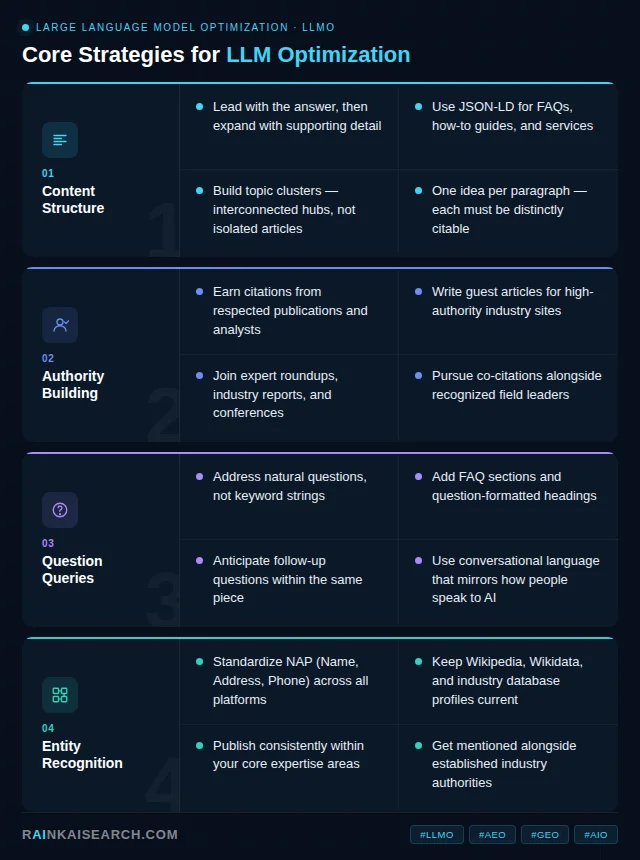
Effective LLMO requires four coordinated strategies: structuring content for AI comprehension, building authority across digital touchpoints, optimizing for question-based queries, and strengthening brand entity recognition. Each strategy reinforces the others.
Structuring Content for AI Comprehension
Clear, hierarchical content structures with descriptive headings and logical flow help AI platforms extract and understand your content. Organize each section around a single clear purpose and ensure ideas flow logically from one to the next.
Apply these content structure principles:
- Lead with the answer. State the core answer at the beginning, then expand with supporting detail.
- Use JSON-LD structured data. Mark up FAQs, how-to guides, products, services, and organizational information.
- Build topic clusters. Create interconnected content hubs that thoroughly address specific subject areas rather than isolated, scattered articles.
- Write one idea per paragraph. Each paragraph must carry a single, distinct, citable idea.
Building Authority Across Digital Touchpoints
Consistent brand presence across multiple platforms strengthens the signals AI models use to evaluate authority. Maintain active, professional profiles on your website, LinkedIn, industry-specific networks, and knowledge bases.
Priority actions for building authority:
- Earn citations from respected publications, industry analysts, and thought leaders
- Write guest articles for high-authority industry publications
- Participate in expert roundups, industry reports, and conference speaking engagements
- Pursue mentions and co-citations alongside recognized leaders in your field
Optimizing for Question-Based Queries
Creating content that directly answers common industry questions aligns with how users interact with AI platforms. Identify the questions your target audience asks, then create comprehensive content that provides clear, actionable answers.
Practical steps for question-based optimization:
- Write content that addresses natural question patterns, not keyword strings (“How can I optimize my business for AI platforms?” not “AI optimization tips”)
- Add FAQ sections and question-formatted headings throughout your content
- Anticipate follow-up questions and address them within the same piece of content
- Use complete sentences and conversational language that mirrors how people speak to AI assistants
Enhancing Brand Entity Recognition
Consistent NAP (Name, Address, Phone) information across all platforms is the foundation of strong brand entity signals. Inconsistencies confuse AI systems and weaken your entity recognition.
Steps to strengthen entity recognition:
- Standardize your business name, address, and contact details across every platform
- Maintain updated profiles on Wikipedia, Wikidata, and relevant industry databases
- Build consistent brand associations by regularly publishing content tied to your core expertise areas
- Pursue mentions alongside established industry authorities to signal your market positioning
What Are the Technical Foundations for LLMO Success?
LLMO requires three technical components to work: proper semantic markup, accessible content architecture, and data syndication. Each ensures AI crawlers can find, process, and accurately understand your content.
Semantic HTML and Structured Data Implementation
Proper HTML5 semantic elements help AI crawlers understand your content structure. Use semantic tags like