

AI Audit Tool: AI Search Optimization and Digital PR

AI audit tool templates map brand visibility across ChatGPT, Google AI Overviews, Gemini, Perplexity, and Claude, tracking citation frequency, review sentiment, and content gaps. SEO directors use these frameworks to score authority signals, benchmark competitors, and prioritize fixes, turning scattered AI mentions into a structured, repeatable optimization roadmap for generative search platforms.
Key Takeaways
- AI audit tools accelerate research, document analysis, and workflow standardization for internal audit teams.
- Auditors evaluate AI platforms using 4 criteria: authority, workflow fit, document intelligence, governance controls.
- AI-powered auditing identifies risk environments through automation, data analysis, and large language model processing.
- Validated AI audit outputs strengthen compliance frameworks while reducing manual review time significantly.
What is an AI audit tool and why use one?
An ai audit tool evaluates artificial intelligence systems for performance, compliance, and ethical standards. These tools make the difference between AI systems that deliver reliable results and those that pose hidden risks. Organizations need systematic approaches to examine data quality, algorithmic behavior, and governance controls across their AI implementations.
How does a site audit for AI differ from traditional SEO audits?
A site audit for ai checks how well a brand’s content is understood, retrieved, and recommended by AI platforms like ChatGPT, Google AI Overviews, Gemini, and Perplexity. Traditional SEO audits focus on search engine crawlers and keyword rankings. AI audits examine whether content structure, entity relationships, and authority signals align with how generative engines extract and summarize information.
What do AI readiness templates cover?
Ai readiness templates provide structured frameworks for assessing AI system maturity. These templates typically include:
- Data quality and bias evaluation criteria
- Algorithmic transparency and explainability checks
- Governance and compliance documentation requirements
- Performance monitoring and incident response protocols
Why use an AI audit tool now?
AI audit tools help teams accelerate research, analyze documents, and standardize workflows efficiently. Without regular audits, organizations risk deploying systems that produce unreliable outputs or violate emerging regulations. RankAISearch offers AI visibility audits that help brands adapt to how customers discover and evaluate businesses online. The cost of skipping an audit shows up as lost visibility, compliance gaps, and eroded stakeholder trust.
How to use ai audit tool effectively
- Define audit scope — Identify which AI systems, platforms, or content assets require evaluation.
- Select evaluation criteria — Choose performance metrics, compliance requirements, and ethical standards relevant to the deployment context.
- Run diagnostic scans — Execute automated checks on data pipelines, model outputs, and content retrieval patterns.
- Document findings — Record compliance gaps, performance anomalies, and visibility issues in a structured report.
- Implement remediation — Address identified risks through content optimization, governance updates, or model retraining.

How to use an AI audit tool step by step?
An ai audit tool follows a structured process to evaluate brand visibility across generative search engines. The European Data Protection Board’s AI auditing checklist emphasizes that these frameworks examine data quality, algorithmic performance, and compliance standards. SEO directors should approach the process as a repeatable cycle, not a one-time check.
Step 1: Define the audit scope
Identify which AI platforms matter most — ChatGPT, Google AI Overviews, Gemini, Perplexity, Claude, or Copilot. Specify the content types to evaluate: product pages, blog posts, review profiles, or knowledge graph entries. A narrow scope produces actionable results faster than a broad sweep.
Step 2: Assess content structure with readiness templates
AI readiness templates help determine whether existing content is structured for AI retrieval. These templates check for clear headings, schema markup, entity relationships, and answer-friendly formatting. Content that lacks structure rarely earns citations from AI systems.
Step 3: Run the audit to find citation gaps
Execute the site audit for ai to identify missing citations, unlinked brand mentions, and weak authority signals. The tool scans how often AI platforms reference the brand and whether those references come from trusted sources. Gaps in third-party validation directly reduce recommendation likelihood.
Step 4: Prioritize fixes by impact
Review the audit report and rank issues by their effect on AI visibility. Consistent positive reviews across trusted platforms make a brand a safer recommendation for AI systems to make. Fix high-impact gaps first — citation deficits on authoritative domains, missing structured data, or negative sentiment clusters.
Step 5: Implement changes and re-audit
Apply the prioritized fixes, then run the audit again to measure improvement. Tracking visibility changes over time reveals which optimizations actually move the needle on AI recommendations.
How often should teams run an AI audit?
Quarterly audits catch shifts in AI platform algorithms and competitor citation patterns. Monthly checks work better for brands in fast-moving industries where review sentiment or news coverage changes rapidly.
What distinguishes an AI audit from a traditional SEO audit?
Traditional SEO audits focus on crawlability, keyword rankings, and backlink profiles. An AI audit evaluates how generative engines interpret, summarize, and recommend brand content. A fundamentally different retrieval process that demands different optimization signals.
What templates make AI audits faster and easier?
AI audit templates accelerate evaluations by providing pre-built checklists for data quality, algorithmic performance, and compliance. These structured frameworks replace ad-hoc reviews with repeatable, measurable processes. Without templates, teams waste hours reinventing assessment criteria for each audit cycle.
What do AI audit templates include?
AI audit templates typically contain standardized scoring systems that auditors can customize for specific use cases. Template builders allow teams to plan audits, perform self-inspections, and reuse questions across engagements. This consistency ensures every evaluation covers the same critical dimensions, from bias detection to model transparency.
How do AI readiness templates differ from audit templates?
AI readiness templates focus on content structure rather than system performance. These templates help brands organize information so AI search engines can easily retrieve and recommend it. A readiness template might include checks for clear entity relationships, consistent terminology, and authoritative source citations.
What should a site audit for AI template cover?
A site audit for AI template should include checks for structured data markup, citation sources, and content authority signals. The template guides auditors through verifying that pages contain machine-readable metadata, properly attributed claims, and evidence of topical expertise. These elements determine whether AI platforms confidently recommend a brand’s content.
How to use AI audit tool templates effectively
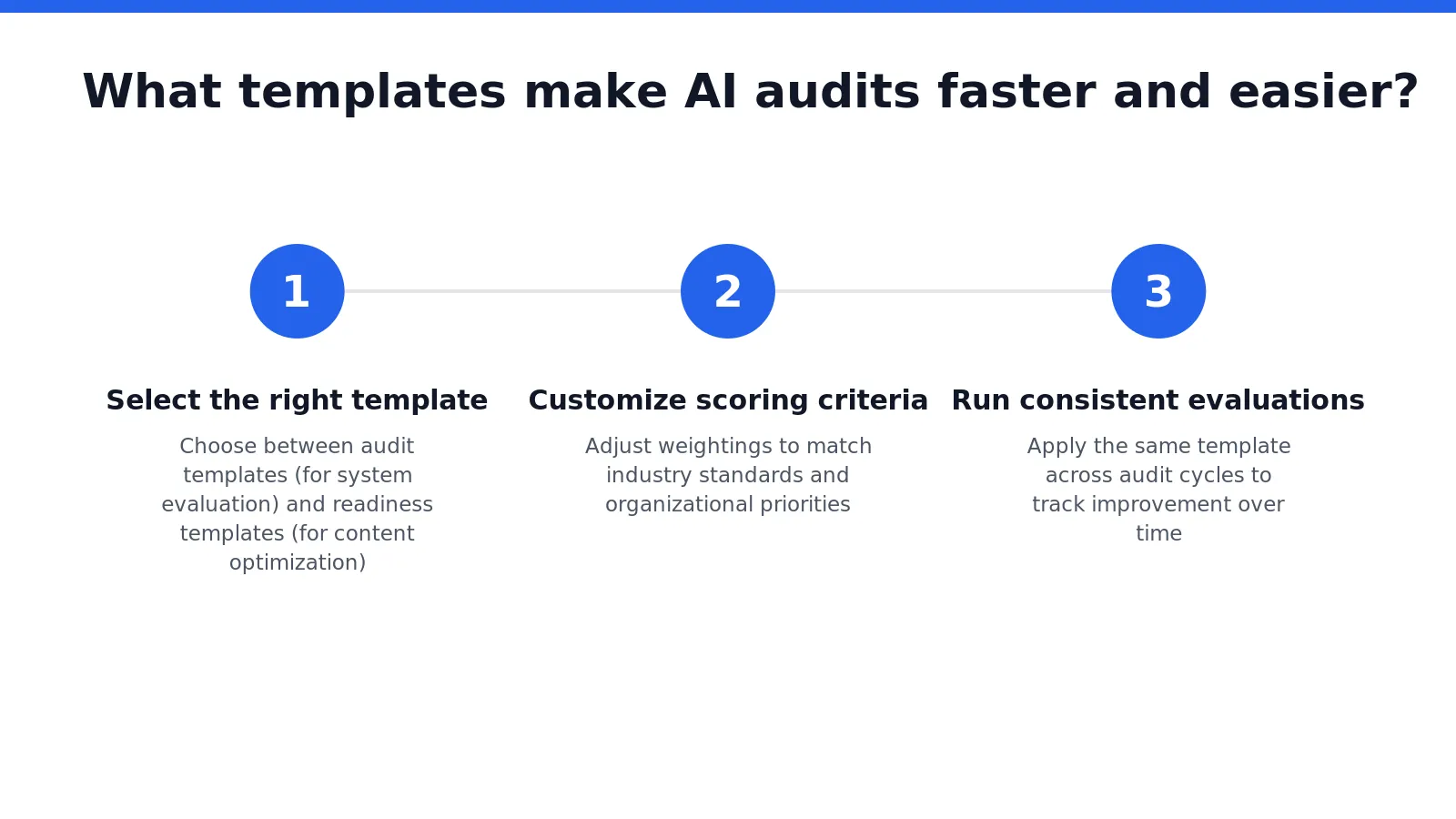
How to use ai audit tool templates effectively follows a three-step process:
- Select the right template — Choose between audit templates (for system evaluation) and readiness templates (for content optimization)
- Customize scoring criteria — Adjust weightings to match industry standards and organizational priorities
- Run consistent evaluations — Apply the same template across audit cycles to track improvement over time
Teams that skip template customization risk evaluating the wrong signals. A generic checklist misses the specific data quality thresholds or compliance requirements that matter most to a particular deployment.
Conclusion
In closing, AI audit tools and templates represent essential infrastructure for brands navigating the evolving landscape of generative search. By systematically evaluating your visibility across ChatGPT, Google AI Overviews, Gemini, Perplexity, Claude, and similar platforms, you gain the clarity needed to strengthen authority, earn trusted citations, and position your content where AI systems confidently recommend it. The frameworks and templates covered here empower you to take control of your AI search presence. Adapt to how customers truly discover your business today.