

What AI SEO Mistakes Should You Avoid?
AI tools offer efficiency but can lead to serious mistakes if used carelessly. Many marketers rely too much on automation, resulting in generic content that damages credibility and rankings. This article highlights six frequent AI SEO mistakes and explains how to avoid them using a human‑in‑the‑loop approach.
Key takeaways:
- AI content without human review often lacks depth, originality and accuracy.
- Over‑optimisation and keyword stuffing make content sound unnatural and harm rankings.
- Missing trust signals like author bios and citations erode authority and user confidence.
- Neglecting technical SEO—speed, mobile usability and structured data—prevents visibility.
- AI should supplement, not replace, human expertise. A balanced workflow ensures quality.
Mistake 1: Thinking “more AI content” is a strategy
Some believe that generating large amounts of AI‑written content will boost rankings. However, volume without quality hurts performance. Asking AI to write full articles often produces repetitive, shallow text. Search engines prioritise high‑quality, user‑centric content. Instead of scaling indiscriminately, use AI to support research and drafting, then refine with human insight.
Mistake 2: Falling into the AI fluff trap
AI can produce verbose paragraphs that say little. This fluff fails to provide value and wastes readers’ time. Avoid filler by ensuring each paragraph communicates one complete idea. Remove repetitive phrases and focus on actionable insights. Use bullet points or tables when appropriate to convey complex information clearly.
Mistake 3: Missing trust signals
Content that lacks author attribution, references or real examples appears generic and faceless. Trust signals like author bios, professional credentials and credible citations demonstrate expertise. Google’s E‑E‑A‑T guidelines emphasise Experience, Expertise, Authority and Trust. Add these signals to build credibility and differentiate your content from generic AI outputs.
Mistake 4: Technical neglect
AI cannot fix technical problems such as slow page speed, broken links or missing schema markup. Neglecting these issues can limit your visibility.
Perform regular technical audits, improve site speed, ensure mobile responsiveness and implement structured data like FAQ and Article schema. Allow AI bots to crawl your site by reviewing robots.txt.
Mistake 5: Over‑optimisation and robotic tone
AI‑generated content may overuse keywords or repeat phrases, making it sound robotic. Over‑optimisation triggers penalties and alienates readers.
Focus on semantic relevance rather than repeating keywords. Write naturally, using synonyms and related terms. Ask yourself whether the content would be engaging to a human reader.
Mistake 6: Failing to use a human‑in‑the‑loop workflow
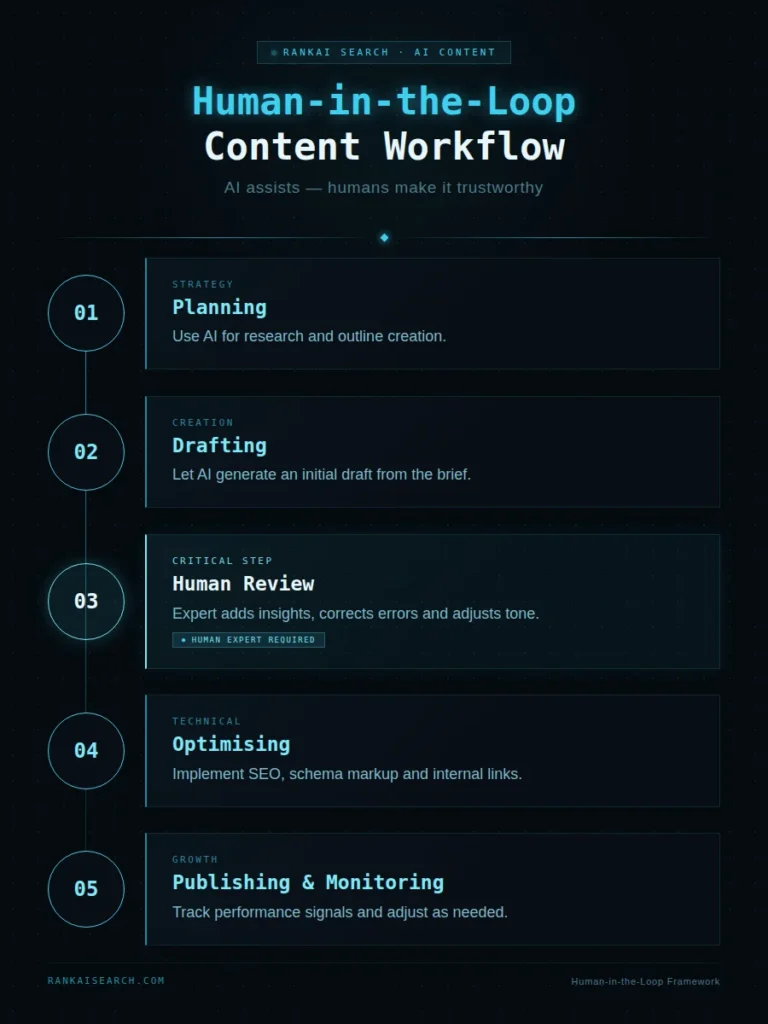
AI should assist, not replace, writers. Copying AI content without editing is risky. A human‑in‑the‑loop workflow includes:
- Planning – Use AI for research and outline creation.
- Drafting – Let AI generate a draft if needed.
- Reviewing – A human expert adds insights, corrects errors and adjusts tone.
- Optimising – Implement technical SEO, schema and internal links.
- Publishing and monitoring – Track performance and adjust as needed.
A safer, scalable way to use AI in SEO
To harness AI effectively:
- Set clear guidelines – Define voice, tone and style requirements before using AI.
- Use AI for insights – Employ AI to identify content gaps, generate topic ideas and outline structures.
- Maintain quality control – Always review and edit AI outputs. Add unique perspectives and verify facts.
- Combine AI with data – Use real keyword data, analytics and audience research to guide content decisions.
- Measure results – Monitor rankings, engagement and AI citations to refine your process.
Conclusion: Human‑driven AI SEO
AI can accelerate your SEO workflow, but over‑reliance and poor implementation lead to common mistakes. By avoiding fluff, adding trust signals, maintaining technical health and keeping humans in the loop, you can leverage AI as a powerful ally. RankAISearch offers guidance on integrating AI into your SEO strategy safely and effectively.
If you want to avoid costly AI SEO mistakes and build a strategy that actually supports long-term visibility, RankAISearch can help. We create professional SEO and GEO strategies that combine AI efficiency with human oversight, stronger content quality, and search-focused planning so your brand performs better across Google, AI Overviews, and generative search platforms.
Frequently Asked Questions (FAQs)
Why is unedited AI content risky?
AI‑generated drafts often contain repetitive phrases and lack depth. Without human review, you risk publishing inaccurate or low‑quality content.
How can I avoid over‑optimisation?
Focus on semantic relevance rather than repeating keywords. Use natural language and synonyms. Avoid stuffing keywords into headings and paragraphs.
What trust signals should I include?
Add author bios, professional credentials, references and external citations to demonstrate expertise and authority.
Is AI useful for technical SEO?
AI can help identify issues but cannot fix them automatically. You must audit your site regularly and implement technical improvements manually.
How do I incorporate AI into my workflow safely?
Use AI for research and drafting, but always involve a human editor to refine content. Set guidelines, verify facts, and ensure the final article meets quality standards.