

AI Platform Comparison: Sourcing in Generative Engine Optimization

ChatGPT, Google AI Overviews, and Perplexity each source and cite content differently, according to Rank AI Search’s analysis spanning August 2024 to June 2025. Perplexity leans on real-time web retrieval, Google AI Overviews favors established domain authority, and ChatGPT blends training data with browsing, producing distinct citation patterns SEO Directors must track for cross-platform visibility.
Key Takeaways
- Each AI platform—ChatGPT, Perplexity, Gemini, Google AI—sources from different data corpuses with minimal citation overlap.
- AI search engines weight source types differently, requiring distinct optimization strategies for each platform’s unique ranking algorithms.
- Citation patterns shifted significantly between August 2024 and June 2025, demanding continuous monitoring of AI visibility trends.
- Brands must optimize content across multiple AI platforms simultaneously, as ranking on one engine doesn’t guarantee visibility on others.
Why do AI platforms cite sources differently?
AI search is not one channel. ChatGPT, Perplexity, Gemini, and Google’s AI features each draw from a different corpus and weight source types differently. A BrightEdge analysis found the overlap between the sources two engines cite for the same topics ran as low as 16%. The instinct to rank on Google and expect AI to follow mostly does not hold. The engines disagree with Google and with each other.
How do retrieval systems differ between platforms?
Each AI platform uses a distinct retrieval system. Model differences in training data, indexing methods, and ranking algorithms create separate citation ecosystems. A source that appears prominently in one engine’s answer may be completely invisible to another. This fragmentation means brands cannot rely on a single optimization strategy.
What does this mean for brand visibility?
The low overlap between platforms creates both risk and opportunity. A brand that earns citations across multiple engines gains compound visibility. RankAISearch helps brands earn citations, mentions, and authority, allowing AI platforms to confidently recommend their businesses. A platform analysis of where a brand currently appears reveals gaps that targeted content and authority-building can fill.
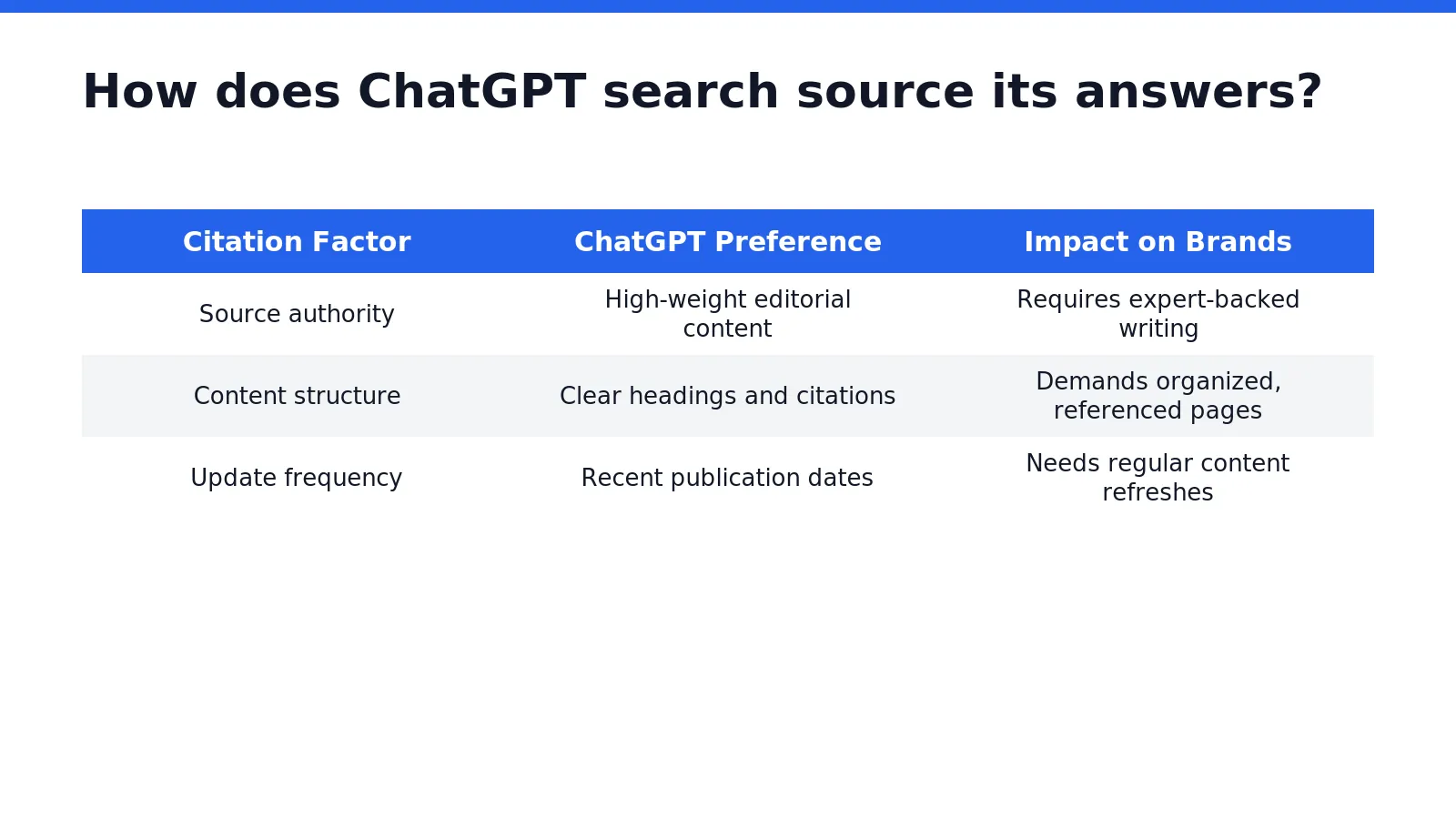
How does ChatGPT search source its answers?
ChatGPT sources answers through a distinct citation pattern that differs sharply from other AI platforms. New research reveals drastically different citation patterns between major AI platforms, with ChatGPT showing unique preferences in how it retrieves and attributes information. An analysis across ChatGPT, Google AI Overviews, and Perplexity from August 2024 to June 2025 uncovers distinct patterns in how each platform sources information, making ai platform comparison essential for brands targeting visibility.
What types of sources does ChatGPT prioritize?
ChatGPT favors high-authority, well-structured content from established domains. The platform weights editorial publications, academic sources, and official documentation more heavily than user-generated content. This means brands need content that reads as authoritative and fact-based rather than promotional.
How do model differences affect citation behavior?
Model differences between ChatGPT versions change how the system selects sources. Newer models show improved ability to evaluate source credibility and attribute claims to specific publications. The platform analysis from August 2024 to June 2025 reveals that ChatGPT increasingly favors sources with clear authorship, publication dates, and cited evidence within the content itself.
RankAISearch specializes in Generative Engine Optimization (GEO) and Answer Engine Optimization (AEO) to help brands make their content easier for AI systems to understand, retrieve, and recommend. Without structured optimization, brands lose visibility in ChatGPT answers that competitors capture through properly formatted, authority-driven content.
What sources does Google AI Overviews prefer?
Google AI Overviews draws from a distinct corpus that often differs from what other AI platforms cite. Systems like Google AI Overviews, ChatGPT Search, Perplexity, Copilot, Claude, and Gemini each retrieve information, verify it, and decide which pages are worth citing through different mechanisms. That citation gap, overlap running as low as 16% between engines citing the same topic, means a page one engine cites is frequently invisible to the others.
How does Google AI Overviews source selection differ from ChatGPT?
Google AI Overviews prioritizes authoritative, structured content from established domains with clear entity relationships. The platform favors pages with explicit subject-verb-object statements that make machine-readable connections between brands, products, and attributes. ChatGPT Search, by contrast, weights conversational tone and user-generated content more heavily. This model differences mean content optimized for one platform may rank poorly on another without targeted adjustments.
What makes a source rankable in Google AI Overviews?
A platform analysis of citation patterns reveals Google AI Overviews prefers content with verified claims, recent publication dates, and clear topical authority signals. Pages that answer specific questions directly in the first paragraph see higher citation rates. The system also favors sources with consistent internal linking structures and schema markup that helps AI parse entity relationships. Without these elements, even high-quality content may remain invisible to Google’s AI retrieval system.
RankAISearch helps businesses improve visibility across Google AI Overviews and other AI-powered search platforms by aligning content with each system’s unique retrieval logic.
How does Perplexity choose its citations?
Perplexity selects citations through a distinct retrieval and evaluation process that differs from other major AI platforms. An analysis of ChatGPT, Google AI Overviews, and Perplexity from August 2024 to June 2025 uncovered distinct patterns in how each platform sources information. Perplexity prioritizes sources that provide direct, verifiable answers with clear authorship and recency signals.
The way different AI platforms retrieve, evaluate, and cite sources is not exactly the same. These differences matter for businesses pursuing visibility in AI-generated answers. A page that earns a citation in Perplexity may remain invisible in ChatGPT or Gemini, and vice versa.
Why do citation patterns differ across AI platforms?
Each platform weights source types differently. Perplexity tends to favor:
- Real-time web content with fresh publication dates
- Primary sources and original reporting over aggregated content
- Pages with clear structure, headings, and direct answer formatting
- Established domains with consistent publishing histories
How can brands improve Perplexity citations?
RankAISearch helps brands strengthen their online authority and earn trusted citations and mentions across AI platforms. The agency focuses on making content easier for AI systems to understand, retrieve, and recommend. That means structuring pages for direct answers, building authoritative backlinks, and maintaining consistent publishing cadence.
For marketing teams, the practical takeaway is straightforward. Perplexity rewards content that answers questions directly and cites its own sources clearly. Brands that optimize for this behavior gain visibility where competitors remain absent.
What role do reviews play in AI recommendations?
Reviews directly shape whether an AI engine recommends a brand. AI systems factor in review volume, average rating, and sentiment, signals that shape how AI recommends brands. These signals help AI determine whether a brand deserves a spot in an answer.
How do AI engines evaluate review quality?
AI engines treat reviews as a trust signal. Consistent positive reviews across trusted platforms make a brand a safer recommendation for an AI to make. Reviews help AI systems understand whether real customers trust a business, product, or service. Google has stated that more reviews and positive ratings can improve a business’s local visibility, underscoring the broader link between reviews and AI recommendations.
What review patterns influence AI recommendations most?
Three review patterns carry the most weight in ai platform comparison scenarios:
- Volume of reviews – A high number of reviews signals broad customer engagement and reduces the risk of a skewed sample.
- Average rating – Higher ratings directly correlate with stronger AI recommendation likelihood.
- Sentiment consistency – Repeated praise for specific attributes (fast service, durable products, helpful support) gives AI systems language they can summarize and cite.
These model differences matter because each AI platform weights review signals differently. A platform analysis of ChatGPT, Perplexity, and Google AI Overviews reveals that Google’s systems place heavier emphasis on review volume. Local rating signals, while ChatGPT and Perplexity prioritize sentiment consistency and the specificity of reviewer language.
Brands that ignore review signals lose visibility in AI-generated answers. The connection between customer experience and AI recommendation is direct: reviews translate real-world satisfaction into machine-readable trust data.
Which review sites do AI platforms cite most?
AI platforms pull review data from a narrow set of high-authority sources rather than every review site on the web. Repeated praise for fast service, easy setup, durable products, or helpful support gives AI systems language they can summarize into recommendations. Reviews can influence AI brand recommendations by connecting real customer experience to specific buyer needs, a link that matters when AI tools answer commercial questions about which brand best fits a given need.
How do review patterns affect AI citation decisions?
Consistent positive reviews across trusted platforms make a brand a safer recommendation for AI engines. When multiple reviewers mention the same strength — fast shipping, responsive support, product durability — AI systems recognize that language as a signal of reliability. Brands earning this pattern across platforms like Google Reviews, Trustpilot, and G2 see higher citation rates in AI-generated answers.
Which review signals carry the most weight with AI?
RankAISearch helps brands earn citations and mentions across AI platforms through strategies like HARO link building and Reddit management. These approaches build the kind of structured authority that AI systems recognize when selecting sources for answers.
How can brands optimize for multiple AI platforms?
Optimizing for multiple AI platforms requires a strategy that accounts for how each system selects, evaluates, and cites sources differently. A BrightEdge analysis found the overlap between sources two AI engines cite for the same topics ran as low as 16%. That means a brand ranking well in ChatGPT may remain invisible to Perplexity or Google AI Overviews. Understanding these model differences directly shapes content strategy, technical setup, and overall Generative Engine Optimization (GEO) approach.
What is the baseline requirement for AI visibility?
A strong website serves as the non-negotiable foundation. Without one, there is nothing for AI systems to cite. Every platform — ChatGPT, Gemini, Claude, Copilot — pulls from indexed web content. Brands must ensure core pages load quickly, use clear heading structures, and contain authoritative, well-sourced information. Technical SEO fundamentals like schema markup and mobile responsiveness support this baseline.
How does platform analysis inform content strategy?
Platform analysis reveals distinct citation preferences across AI engines. ChatGPT favors editorial content and well-structured articles. Perplexity prioritizes recent, fact-dense sources with clear attribution. Google AI Overviews draws heavily from authoritative domains with strong topical expertise. A single content piece rarely satisfies all four systems. Brands benefit from creating modular content — core facts that appear across formats, with platform-specific framing for each engine.
RankAISearch offers AI visibility audits and content optimization to help brands adapt to how customers discover, evaluate, and connect with brands online. The approach treats each AI platform as a distinct channel requiring tailored optimization, not a single target.
What is the first step to improve AI visibility?
The first step to improve AI visibility is a comprehensive audit of how AI platforms currently perceive and represent a brand. RankAISearch specializes in this exact process, analyzing a brand’s presence across ChatGPT, Google AI Overviews, Gemini, Perplexity, Claude, and Copilot. Without this baseline assessment, any optimization effort operates without direction or measurable benchmarks.
Why does an AI visibility audit matter?
AI search is not a single channel. A BrightEdge analysis found that the overlap between sources two AI engines cite for the same topics ran as low as 16%. An audit reveals which platforms cite a brand, which ignore it, and what content gaps exist. This data transforms guesswork into a targeted strategy.
What does the audit process include?
RankAISearch evaluates several critical dimensions during an audit:
- AI platform comparison of citation patterns across major engines
- Model differences in how each system retrieves and weights sources
- Platform analysis of content structure, authority signals, and technical accessibility
The audit also examines review signals, backlink profiles, and structured data. Consistent positive reviews across trusted platforms make a brand a safer recommendation for AI systems. RankAISearch’s values encompass ethical practices and transparency, delivering sustainable results through customized growth strategies.
How does LinkedIn fit into AI visibility?
RankAISearch helps founders and businesses build stronger LinkedIn profiles and personal brands. A well-optimized LinkedIn presence creates authority-driven content that AI engines recognize as credible. This generates qualified leads while strengthening the broader digital footprint that AI systems evaluate when deciding which brands to recommend.
Conclusion
In closing, understanding how AI platforms source and cite content fundamentally shapes how brands approach visibility in this evolving landscape. As these systems become the primary discovery channel for customers, businesses must optimize their content for AI comprehension while building genuine authority through trusted citations and mentions. The brands that succeed are those adapting their strategies to align with how AI systems evaluate, retrieve, and recommend information—making transparency, relevance, and credibility non-negotiable priorities in the age of generative search.