

Link Building Comparison: Impact on AI Mentions

In this link building comparison, link strategies determine whether AI engines treat a brand as an authoritative entity or an irrelevant citation. Backlinks transfer PageRank and strengthen crawlability, while unlinked brand mentions build entity recognition and contextual trust. AI systems weigh mention frequency and consistency over raw link volume, so diversified citation-building outperforms traditional link schemes for earning inclusion in generative answers.
Key Takeaways
- Brand mentions without hyperlinks strengthen entity recognition and increase AI inclusion probability across platforms.
- Backlinks transfer link equity and authority, directly improving PageRank flow and website crawlability for AI systems.
- Unlinked mentions build contextual trust with AI models like ChatGPT, Gemini, and Claude without requiring clickable links.
- Strategic link building combines both mention types to maximize visibility across ChatGPT, Google AI Overviews, and Perplexity simultaneously.
Why Do AI Mentions Depend on Link Strategy?
AI mentions depend on link strategy because brand mentions and backlinks serve fundamentally different functions in modern search. Brand mentions are textual references to a company without required hyperlinks. Backlinks are clickable hyperlinks that transfer link equity and authority. This distinction determines whether a brand earns visibility through entity prominence or structural link validation.
How Do Brand Mentions and Backlinks Differ for AI Visibility?
Brand mentions strengthen entity recognition, contextual trust, and AI inclusion probability. Backlinks strengthen PageRank flow, crawlability, and competitive keyword rankings. The two strategies operate on different validation mechanisms:
Search engines validate backlinks through link graphs and authority scoring. Large Language Models validate brand mentions through entity frequency, sentiment, and contextual co-occurrence. A RankAISearch [AI visibility strategy](https://rankaisearch.com/?p=2189) reveals that brands relying solely on backlinks miss the [artificial intelligence optimization](https://rankaisearch.com/what-is-artificial-intelligence-optimization/) signals that AI platforms use to determine recommendation worthiness.
What Role Does a Backlink Review Play in AI Strategy?
A backlink review remains essential for traditional search performance, but as [AI search increasingly shapes traditional search traffic](https://rankaisearch.com/is-ai-search-replacing-traditional-search-traffic/), backlinks alone no longer guarantee AI visibility. RankAISearch helps brands earn citations, mentions, and authority, allowing AI platforms to confidently recommend their businesses. The most effective approach combines both strategies: backlinks for crawlability and keyword rankings, brand mentions for entity recognition and AI inclusion.
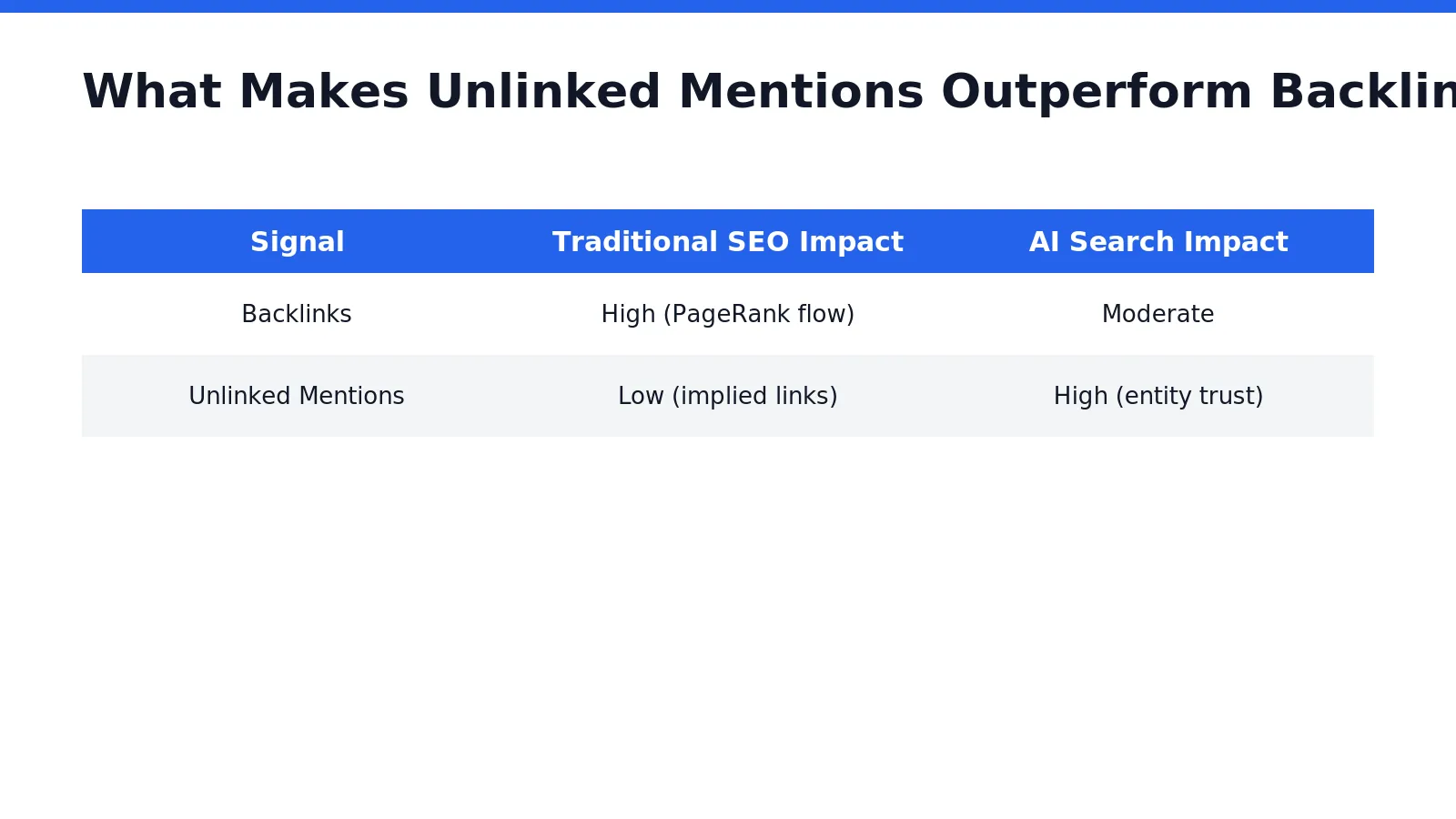
What Makes Unlinked Mentions Outperform Backlinks?
An unlinked brand mention occurs when an authoritative website, news article, blog, or other online source references a brand without adding a hyperlink. These mentions outperform backlinks in AI search because Large Language Models read context and entity relationships, not link graphs. Traditional search engines validate authority through clickable links, but AI systems validate trust through contextual references.
Google’s patent US8682892B1 distinguishes “Express Links” (clickable hyperlinks) and “Implied Links” (references without a hyperlink). Both function as “independent incoming links” for ranking purposes. This distinction matters because AI search engines treat unlinked mentions as the strongest visibility factor, even though classic SEO previously dismissed them as secondary signals.
Why Do AI Engines Prefer Mentions Over Links?
AI answer engines cannot click hyperlinks during generation. Instead, these systems parse text for brand names, product terms, and contextual trust signals. A mention inside a reputable industry publication carries more weight than a link buried in a footer. Backlinks remain essential for traditional search results, but unlinked mentions build the entity recognition that AI systems rely on for recommendations.
How Should Marketers Balance Both Signals?
Marketers should continue building high-quality, authoritative backlinks while simultaneously pursuing unlinked mentions through HARO responses and digital PR. Comparing the two approaches shows why relying on backlinks alone misses half the picture: the strongest ai signals for inclusion come from a combination of consistent brand references and high-quality backlinks. RankAISearch specializes in AI link building and HARO link building to help brands earn these trusted citations and mentions.
Why a Balanced Strategy Outperforms Either Approach Alone
For SEO specialists, this comparison between traditional backlinks and brand mentions now determines where authority lives in AI search, and it changes how off-page resources should be allocated. Backlinks remain essential for crawlability and competitive keyword rankings, but they do not directly teach AI systems what a brand represents. Brand mentions, by contrast, give Large Language Models the contextual language they need to recommend a business.
The practical takeaway: a balanced strategy that pairs high-quality backlinks for structural authority with consistent brand mentions for entity prominence outperforms either approach alone. Brands that ignore this balance risk losing AI-driven visibility to competitors who understand that mentions, not just links, shape algorithmic recommendations.
Conclusion
In closing, the strategic deployment of diverse link-building approaches fundamentally reshapes how AI systems discover, evaluate, and amplify your brand’s authority. Whether through HARO placements, Reddit engagement, or AI-native link strategies, each tactic strengthens your digital footprint across generative platforms. The brands that thrive in this evolving landscape recognize that visibility isn’t just about ranking—it’s about earning the trust signals that make AI systems confident recommending them. By aligning your link strategy with how modern search engines operate, you position your business where customers actively seek solutions.