AI and SEO are no longer separate disciplines. AI tools assist with keyword research, topic clustering, content creation and performance monitoring. Yet human strategy and quality control remain essential.
More than 67 percent of businesses already use AI for SEO tasks. At the same time, Google still values high‑quality content, authority and technical excellence. The practical playbook for 2026 blends AI efficiency with SEO fundamentals, focusing on intent, clarity and trust.
Core Principles for Mastering AI-Driven SEO in 2026
AI supports SEO by helping with research, content generation and data analysis, but it cannot replace human insight.
Core SEO pillars—content quality, technical optimisation and backlinks—remain critical.
AI search writes answers and synthesizes information; the goal is to be cited in AI overviews and conversational responses.
Topic clusters, semantic depth and fact density help AI models understand and cite your content.
Speed, structure and crawlability remain technical foundations for both SEO and AI visibility.
Measuring success requires tracking rankings, traffic, citations and mentions across search and AI platforms.
What changed and what didn’t?
The biggest shift is that AI systems now act as intermediaries between users and content. Generative engines interpret queries, assemble responses and decide which sources to cite. This has increased zero‑click searches and lowered reliance on keyword matching.
However, the fundamentals of SEO still apply: search engines evaluate relevance, authority and user experience. You still need solid content, trustworthy links and a technically sound site. The difference is in how you structure and present information to make it extractable for AI.
What are the foundations of a high-performing content?
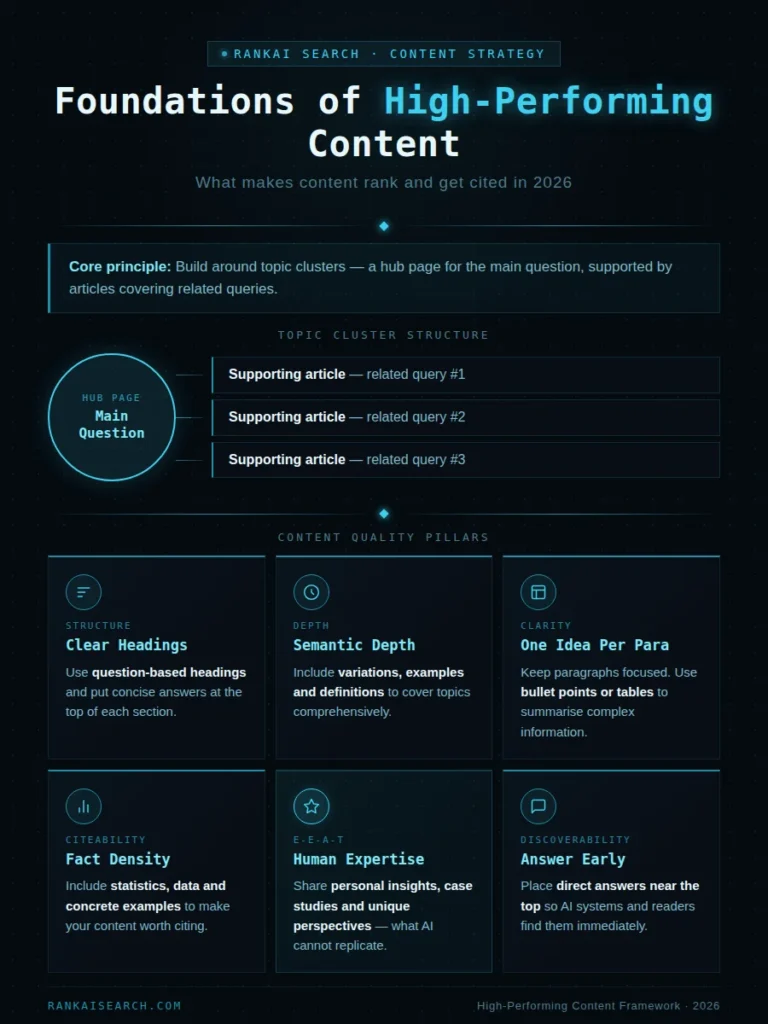
High‑performing content in 2026 is built around topic clusters. Each cluster contains a hub page answering the main question and supporting articles that address related queries. Use clear, question‑based headings and write concise answers early in the piece. Include semantic variations, examples and definitions to build depth.
Ensure every paragraph communicates one idea and use bullet points or tables to summarise complex information. Fact density—providing statistics, examples and data—makes your content more citable. Human expertise remains vital: share personal insights, case studies and unique perspectives.
What are the technical foundations?
Technical optimisation underpins both SEO and AI visibility. Ensure your site loads quickly and is mobile‑friendly. Use descriptive URLs, internal links and a logical information architecture.
Add structured data (Article, FAQ, HowTo, Product) to reinforce intent and make your pages easier to interpret. Regularly audit for crawl errors, broken links and duplicate content. Implement secure protocols (HTTPS) and comply with accessibility guidelines. A technically sound site helps search bots index your pages and gives AI models reliable data to reference.
How do you monitor visibility across search and AI?
Measuring performance requires more than tracking organic rankings. Use SEO tools to monitor keyword positions, traffic and conversions. Complement them with AI visibility tools that track citations and mentions across ChatGPT, Perplexity and AI overviews.
Watch for patterns in the questions users ask and adjust your content accordingly. Keep an eye on share of voice within AI responses: how often your brand appears relative to competitors. Consider user engagement metrics (time on page, scroll depth) as indicators of content quality.
How does RankAISearch help teams implement this fast?
RankAISearch combines AI‑powered tools with human expertise. The team conducts a comprehensive SEO and AI audit, develops custom topic clusters and content strategies, and implements structured data and schema.
They provide training on using AI tools responsibly and help track visibility across both traditional search and AI platforms. Their support accelerates implementation, so your team can focus on growth rather than technical details.
Modern Search Success Depends on Blending AI Efficiency With SEO Foundations
AI and SEO now work side by side, not as separate strategies. In 2026, brands need to do more than publish content and hope it ranks. They need content that is useful, well-structured, technically sound, and easy for both search engines and AI systems to interpret.
While AI can speed up research, clustering, drafting, and monitoring, strong results still depend on human strategy, editorial judgment, and clear trust signals. Businesses that combine AI efficiency with SEO fundamentals like content quality, technical performance, semantic depth, and authority building will be in a much stronger position to earn visibility across Google, AI Overviews, and conversational search platforms.
The real advantage comes from treating AI as a tool within a smarter search strategy, not as a replacement for one. If you want a clearer and more effective strategy for search in 2026, RankAISearch can help. We create professional SEO and GEO strategies that combine AI-powered workflows with human expertise, helping brands improve content quality, strengthen technical foundations, and grow visibility across traditional search, AI Overviews, and generative search platforms.
Frequently Asked Questions (FAQs)
Do I still need traditional SEO if I use AI tools?
Yes. AI can assist with research and content creation, but core SEO principles such as quality content, technical optimisation and backlinks remain essential.
How can I make my content more citable by AI models?
Write direct answers at the top, use question‑based headings, provide semantic depth and include structured data.
What tools should I use to track AI citations?
Use emerging AI visibility tools that monitor mentions in ChatGPT, Perplexity and Google’s AI overviews. Combine these with traditional SEO analytics for a complete picture.
Can AI replace human writers?
AI can draft content and analyse data, but human expertise ensures accuracy, nuance and trust. Unedited AI content often lacks depth and may include errors.
How often should I update my content?
Update your key pages regularly to maintain freshness and relevance. AI systems favour up‑to‑date information and may deprioritise outdated pages.