
Search engines still follow a three‑step process of crawling, indexing and serving results. Crawling means automated bots discover and download content on web pages. Indexing analyses the content to determine relevance and stores it in a database. Serving matches user queries with indexed pages and displays the most relevant results. In 2026, this process has an extra layer: AI overviews.
These AI‑generated summaries compile information from multiple sources to answer questions more efficiently than traditional lists and cite the sources they use. Understanding how search engine works helps you optimise for both the crawling pipeline and the new AI synthesis layer.
Key takeaways:
- Modern search involves three stages: crawling, indexing and serving. Crawlers discover content; indexing analyses it; serving matches queries with relevant pages.
- AI overviews are AI‑generated summaries that appear at the top of search results. They stitch together information from multiple sources and cite the pages that best answer the question.
- AI search writes answers rather than ranking pages. It interprets intent, pulls insights from credible sources and delivers a synthesized response.
- To be included in AI overviews, pages need clear structure, direct answers and strong semantic relevance. Signals such as expertise, clarity, topical depth and structured data influence eligibility.
- Search and chat serve different needs. Traditional search lists options; conversational AI provides a single synthesized answer. Users often use both for different stages of their research.
- Technical readiness matters. Sites must be crawlable, fast, structured and authoritative to perform well in both organic search and AI‑generated responses.
What makes search in 2026 a blend of crawling and AI assistance?
Google and other engines still operate on a foundation of crawling and indexing. Crawlers (bots such as Googlebot) discover pages by following links and sitemaps, downloading text, images and videos from the web. Indexing then analyses this content, determines canonical versions and stores the information.
Serving uses algorithms to match a user’s query with relevant results, considering location and device. In 2026, this entire pipeline is augmented with AI that interprets queries and generates concise overviews. The AI layer sits on top of the traditional index, using natural language processing and entity recognition to synthesize information across sources.
How does crawling and indexing work in modern search?
Crawling remains the first step. Google’s bots systematically download content from across the web. They render pages and run JavaScript to capture dynamic content. Indexing then evaluates the text, images and videos, interprets the topics and entities, and stores the data in an enormous database.
The index is continuously updated, and pages that are blocked or unreachable are excluded. When a user enters a query, the search engine’s algorithms examine the index to find the most relevant pages based on authority, freshness and intent.
Content that is well structured, easy to crawl and semantically rich is more likely to be indexed correctly and served both in organic results and AI overviews.
How are AI overviews synthesised in Google results?
AI overviews are Google’s AI‑generated summaries that appear above organic results. They gather information from multiple pages and assemble a concise answer, citing the sources that provide the most useful information.
By 2026, these overviews influence click‑through rates, brand visibility and lead generation. Google selects sources based on expertise, clarity and extractability. Pages with direct answers in the first paragraph, question‑based headings, deep topic coverage and clear structure are more likely to be chosen.
Adding structured data such as Article, FAQ and HowTo schema further clarifies intent and improves extractability.
Why do users choose search vs chat in 2026?
AI‑driven search acts like an editor. It interprets a user’s intent, pulls information from multiple sources and delivers a single synthesized response. Traditional search lists links and gives users the freedom to explore.
Users often start with an AI overview to get a quick answer, then switch to organic results for depth or verification. Chat interfaces allow follow‑up questions in a conversational flow, while search results provide multiple perspectives.
Understanding these preferences helps businesses create content that works in both formats.
How can you prepare your site for the AI transition?
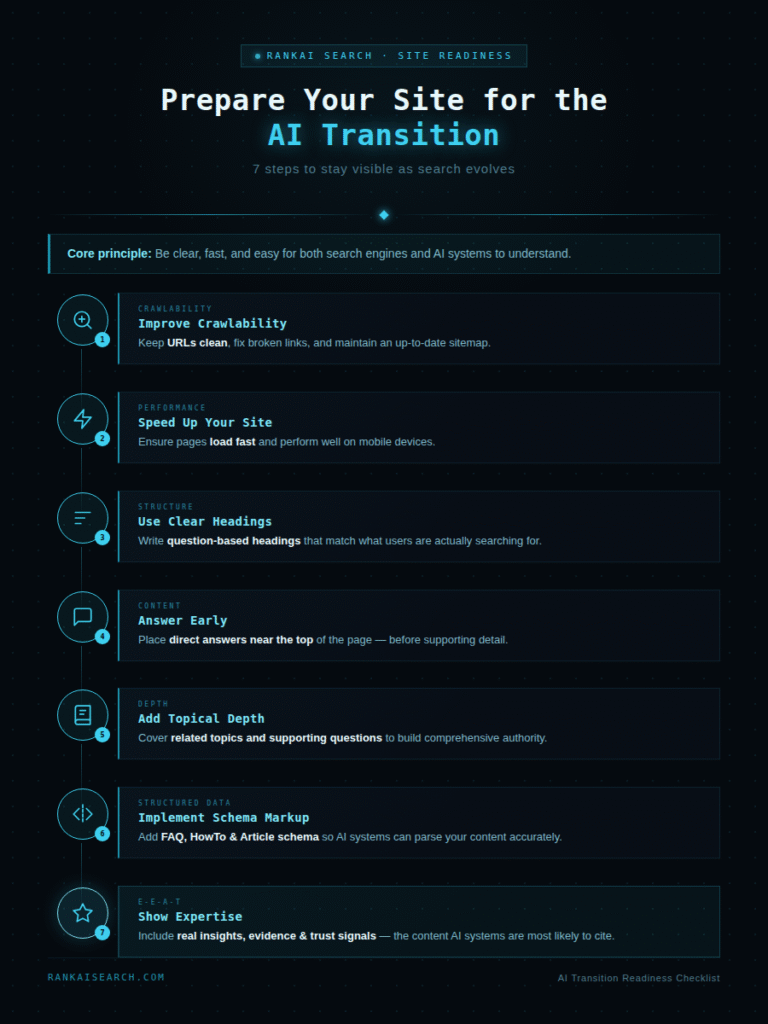
To stay visible as search evolves, your site needs to be clear, fast, and easy for both search engines and AI systems to understand. Focus on these basics:
- Improve crawlability: Keep URLs clean, fix broken links, and maintain your sitemap.
- Speed up your site: Make sure pages load fast and work well on mobile.
- Use clear headings: Write question-based headings that match search intent.
- Answer early: Place direct answers near the top of the page.
- Add depth: Cover related topics and supporting questions.
- Use schema: Add structured data to improve clarity.
- Show expertise: Include real insights, evidence, and trust signals.
What should you fix first on your site?
Start with the changes that have the biggest impact on visibility and usability:
- Check indexation: Make sure key pages can be crawled and indexed.
- Fix technical blockers: Review robots.txt, noindex tags, and crawl errors.
- Update key page intros: Answer the main query clearly in the opening lines.
- Improve headings: Make headings more specific and intent-driven.
- Add FAQs: Include common questions with direct answers.
- Strengthen topic coverage: Expand supporting pages and internal links.
- Add schema markup: Help search engines understand your content better.
Stronger Search Visibility Starts With Smarter Site Foundations
Search in 2026 is no longer just about ranking pages. It blends the classic mechanics of crawling and indexing with AI‑powered synthesis. By understanding how search engine works and preparing your site accordingly, you can secure visibility in both organic results and AI overviews.
Clear structure, semantic depth and first‑party expertise make your content easier for bots and AI models to interpret. If you want help auditing your technical setup and optimising for the AI layer, the RankAISearch team offers tailored strategies and implementation support.
If you want to improve your visibility across both traditional search and AI-driven results, RankAISearch can help. We build professional SEO and GEO strategies that strengthen your site structure, improve content clarity, and help your brand stay visible in Google, AI Overviews, and other generative search experiences.
Frequently Asked Questions (FAQs)
What are the main parts of a search engine?
Search engines operate in three stages: crawling, indexing and serving. Crawling discovers pages; indexing analyses and stores them; serving matches queries with relevant results.
How are AI overviews different from featured snippets?
Featured snippets pull a single excerpt from one page. AI overviews synthesize information from multiple sources and cite them in a cohesive answer.
Do AI overviews replace organic results?
No. AI overviews appear above traditional results but still link to the pages they draw from. Organic listings remain important for depth and exploration.
Is chat search better than traditional search?
Chat interfaces allow conversational follow‑ups and synthesized responses. Traditional search provides a list of options. Users use both depending on whether they want a quick answer or to explore multiple perspectives.
How can I ensure my site appears in AI overviews?
Provide a direct answer in the first paragraph, use question‑based headings, build deep topic clusters and add structured data. Demonstrate expertise with original insights and strong citations.