

How to Optimize Your Brand for Perplexity AI in 2026
Perplexity AI cites sources directly in its answers, replacing the traditional list of blue links for a growing share of users worldwide. The platform surpassed 100 million monthly active users in 2025, with rapid adoption across North America, Europe, and Asia-Pacific. Brands that structure content for citation visibility are being selected ahead of competitors with higher domain authority, and those with active optimization strategies report stronger growth in AI citations.
This guide covers how to structure content, implement technical optimizations, build authority, and measure performance so Perplexity AI selects your brand as a citation source across your target topics.
What Is Perplexity AI and Why Should Businesses Care?
Perplexity AI is a conversational answer engine that synthesizes information from multiple web sources and delivers it as a single, cited response. Unlike Google, which returns a ranked list of links, Perplexity shows the answer directly, with numbered citations users can trace to original sources.
The platform uses natural language processing to interpret what users are actually asking, including vague or multi-part questions. This shifts the discovery model from keyword matching to question-based retrieval.
The competitive implication is direct. When someone asks Perplexity about your industry, your competitors may be cited instead of you. Early adoption of AI answer engine optimization gives you a structural visibility advantage in a channel that is still relatively uncrowded.
How Does Perplexity AI Rank and Cite Sources?
Perplexity AI selects sources based on three primary factors: content authority, query relevance, and freshness. Domain authority, backlink profiles, author credentials, and content accuracy all contribute to whether a page is selected for citation.
Citation happens in real time. When a user submits a query, Perplexity scans its index for relevant content, evaluates each source for quality and authority, and extracts the most appropriate pieces to reference. A page may be cited for one query and excluded from another depending on how precisely the content matches the specific question asked.
Technical quality is a direct citation factor alongside content. Fast page speeds, mobile optimization, clean HTML, valid structured data, SSL certificates, and clear site architecture are all evaluated as trust signals. Pages that are easy to crawl and parse have a consistently higher chance of being cited.
What Makes Content Citation-Worthy on AI Answer Engines?
Citation-worthy content answers a specific question completely, in a format AI can extract and present without modification. Four factors determine whether content meets this standard.
| Factor | What It Means | Why It Matters for Citation |
| Structured Data | Schema markup for Articles, FAQs, HowTo, and Reviews | Gives AI explicit signals about content type, author, and publication date |
| Clear Formatting | Short paragraphs, descriptive headings, one idea per section | Allows AI to extract individual sections as standalone citations |
| Expert Signals | Author bios, original research citations, credible external sources | Helps AI classify content as authoritative within a topic area |
| Statistical Backing | Specific data points with named sources | Content with recent statistics is cited more often than opinion-based content |
RankAISearch (rankaisearch.com) specializes in optimizing content for AI answer engines across AEO, GEO, AIO, LLMO, and SEO disciplines. The agency works with global clients to build citation visibility on Perplexity AI, Google AI Overview, and emerging answer platforms.
What Are the Core Strategies for Perplexity AI Optimization?
Four strategies drive consistent citation visibility on Perplexity: answer-first structure, conversational keyword targeting, topical authority building, and schema markup implementation. Applying all four together produces compounding results that no single tactic achieves alone.
- Answer-first structure: State the key takeaway in your opening sentence, then provide supporting detail. If the conclusion comes last, the content is unlikely to be cited. Perplexity often surfaces a single paragraph as a citation, so each paragraph must work on its own.
- Conversational keyword targeting: Optimize for how people phrase questions in natural language. Instead of “budget hotel NYC,” target “what are the best budget hotels in New York for families?” Tools like AlsoAsked and AnswerThePublic surface the exact question formats you can map directly to content headings.
- Topical authority: Cover your subject area comprehensively, not just through a single high-performing page. AI systems favor sites that demonstrate consistent expertise across a topic cluster. If you sell accounting software, publish guides on tax compliance, bookkeeping best practices, and financial reporting.
- Schema markup: Apply the appropriate schema to every key page type. Use Article schema for blog posts, FAQPage schema for question-based content, HowTo schema for instructional guides, and Product schema for service pages. Structured data helps Perplexity categorize and extract your content accurately.
How Should You Structure Content for AI Citation?
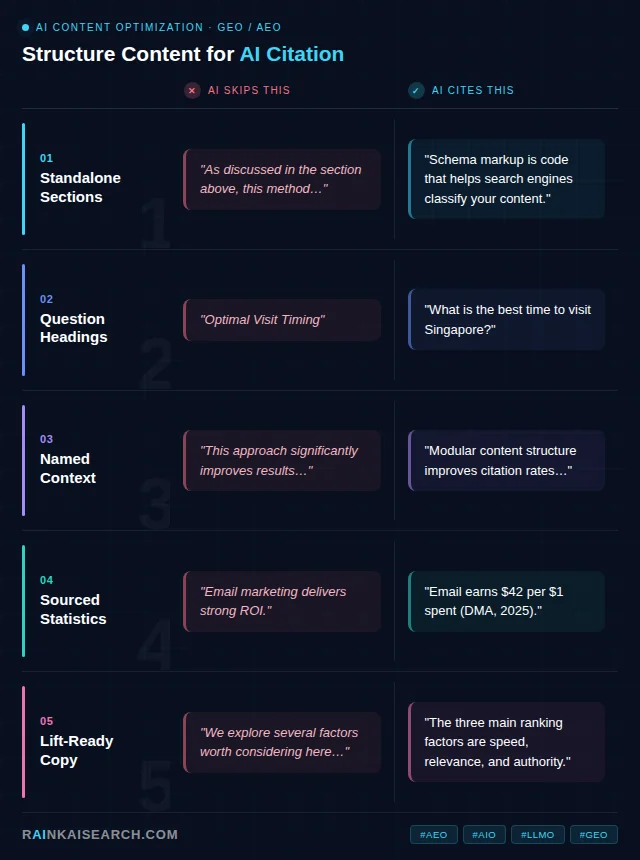
Structure content so each section functions as a standalone answer without requiring context from earlier sections. This modular approach makes individual paragraphs and headings usable as direct citations.
- Use question-format headings: “What is the best time to visit Singapore?” outperforms “Optimal Visit Timing” because it matches the natural query pattern AI systems evaluate. When headings mirror search queries, content-to-query matching improves directly.
- Write standalone paragraphs: Each paragraph must carry one complete, self-contained idea. If a paragraph references “this approach” without naming the approach, it cannot function as a standalone citation. Include enough context within each paragraph so it makes sense when extracted on its own.
- Lead every claim with sourced data: “Email marketing delivers an average ROI of $42 for every $1 spent, according to 2025 data from the Data and Marketing Association” is citable. “Email marketing delivers strong ROI” is not. Specific, sourced information is selected more frequently than unsupported general claims.
What Technical Optimizations Matter Most?
Page speed is the most direct technical citation factor. The average cited page loads 67 percent faster than pages that are not cited. Compress images, minimize code, enable browser caching, and use a content delivery network to consistently hit a sub-2-second load time.
Mobile optimization is a citation prerequisite, not an enhancement. Over 70 percent of Perplexity AI queries originate from mobile devices. Your site must render correctly on phones and tablets, with readable text, functional navigation, and no horizontal scrolling. Responsive, mobile-first development is required for AI visibility.
Clean site architecture helps AI crawlers find and evaluate your content. Use logical URL structures, maintain a clear navigation hierarchy, and ensure all key pages are linked from somewhere on your site. Excessive JavaScript that blocks content indexing reduces crawlability and citation likelihood.
XML sitemaps and a correctly configured robots.txt guide crawlers to your highest-value content. Submit updated sitemaps regularly, include all public pages you want cited, and use robots.txt to exclude low-value or private pages. Structured data across key pages reinforces how each page should be categorized by the AI index.
Which Content Formats Perform Best on Perplexity AI?
Five content formats are cited most frequently by Perplexity AI: comparison guides, how-to content, data-driven research, expert interviews, and FAQ sections. Each format matches a distinct query pattern that AI systems are designed to resolve.
| Format | Matched Query Type | Key Requirements |
| Comparison guides | “X vs Y,” “which is better” | Side-by-side criteria, objective analysis |
| How-to content | “How do I,” “steps to” | Numbered steps, stated prerequisites, concise instructions |
| Data-driven research | Stat lookups, trend queries | Original data, named methodology, citable figures |
| Expert interviews | Opinion and insight queries | Direct quotes, exclusive perspectives, named experts |
| FAQ sections | Specific “what,” “how,” “why” questions | FAQPage schema, real customer questions, standalone answers |
FAQ sections are structurally optimized for AI extraction. Each question-and-answer pair is a self-contained unit Perplexity can cite directly. Source your questions from real customer queries and tools like AnswerThePublic, and always apply FAQPage schema to these sections.
How Do You Build Authority for AI Answer Engine Visibility?
Authority for AI citation is built through four activities: thought leadership content, quality backlink acquisition, original research publication, and verified author credentials.
Publish in-depth analyses and contribute original ideas to your industry’s public conversation. When content demonstrates deep knowledge and fresh thinking consistently over time, AI systems classify the domain as authoritative and cite it more frequently than competitors with shallower content libraries.
Earn backlinks from respected industry publications, educational institutions, and government sites. Links from authoritative sources in your sector carry the most weight, as they signal topical relevance alongside domain authority. Each quality backlink compounds over time as a credibility signal.
Publish original research and compile statistics that do not exist elsewhere. When your site is the origin of a data point, you earn citations from both human writers and AI systems. This primary-source status is a durable citation advantage that aggregator sites cannot replicate.
Establish verified author credentials through detailed bios and AuthorPage schema. Connect content to specific authors with relevant experience and qualifications. When AI systems can verify that content comes from qualified experts, citation likelihood increases relative to anonymously authored content.
How Do Backlinks Influence AI Citation?
Backlink quality matters more than volume for AI citation. Ten backlinks from highly respected industry sites carry more authority than hundreds of links from low-quality directories.
Topical relevance of linking domains is as important as their authority. If you operate a legal firm, backlinks from law publications, bar associations, and legal education sites signal clear topical expertise. Links from unrelated industries contribute less to the expertise signals AI systems use to evaluate your content.
Editorial links earned through quality content and media coverage outperform paid links or link exchanges. AI systems weight naturally acquired backlinks more heavily than manufactured ones. Building editorial links through original research and expert commentary is the most durable long-term strategy.
Domain authority signals recognized by AI systems include site age, consistent publishing history, technical health, and overall backlink quality. These signals compound over time, making early optimization considerably more valuable than delayed action.
How Do You Measure Success in Perplexity AI Optimization?
Measure success through four tracking methods: direct citation monitoring, referral traffic analysis, content pattern review, and growth benchmarking against industry targets.
| Method | What to Track | What It Tells You |
| Citation monitoring | Search Perplexity for target keywords; document when and how your brand appears | Which content gets cited, for which query types, and how citations are framed |
| Referral traffic | Source-specific segments in Google Analytics for Perplexity | Whether cited users find your content valuable enough to visit your site |
| Content pattern analysis | Format, topic, word count, and publication date for every cited page | Which content attributes to prioritize and replicate |
Common Pitfalls to Avoid in AI Answer Engine Optimization
The five most damaging mistakes in Perplexity AI optimization are keyword stuffing, thin content, poor mobile experience, missing structured data, and infrequent content updates.
Keyword stuffing and over-optimization reduce citation likelihood. AI systems recognize unnatural keyword usage and deprioritize content that serves search engines over readers. Write naturally, vary phrasing, and focus on answering questions completely rather than hitting arbitrary keyword density targets.
Thin content without depth or originality is the most common reason pages are skipped for citation. AI systems favor comprehensive, unique content that provides real value. Content that repackages widely available information without adding new insight will not compete with more authoritative sources.
Neglecting mobile experience and page speed directly reduces citation chances. With over 70 percent of Perplexity queries originating from mobile devices, a poor mobile experience signals quality issues to the AI index. Regular performance audits are required maintenance, not optional improvements.
Ignoring structured data leaves AI systems to interpret your content without explicit guidance. Schema markup is one of the most direct signals you can send about your page’s purpose and context. Every key page type should have the appropriate schema implemented.
Failing to update content regularly signals that information may be outdated. Regularly refreshed content gets cited 2.8 times more often than pages not updated in over a year. Review key pages quarterly, refresh statistics, and update publication dates.
What Is the Future of Perplexity AI and Answer Engine Optimization?
Perplexity AI is evolving toward more complex, multimodal, and voice-integrated search experiences. Multi-part queries are becoming the norm, and by late 2026, Perplexity is increasingly integrated with smart speakers and vehicle systems. Content must deliver clear, concise answers that remain coherent when read aloud. AI systems also increasingly incorporate images, charts, and diagrams alongside text, making image optimization with descriptive alt text and schema markup a citation factor, not just an SEO hygiene task.
The competitive landscape for AI visibility is less saturated now than it will be within two years. Businesses that implement comprehensive AEO, GEO, and LLMO strategies today will be significantly harder to displace as the channel matures.
RankAISearch helps businesses build citation visibility across Perplexity AI, Google AI Overview, and emerging answer platforms. If you are ready to make your brand discoverable in AI-generated answers, get in touch with the RankAISearch team to get started.
Frequently Asked Questions
How long does it take to see results from Perplexity AI optimization?
Most businesses see initial citations within 2 to 3 months of implementing optimization strategies. Consistent visibility typically takes 4 to 6 months to establish. Technical fixes and structured data implementation tend to show results faster than authority-building efforts, which compound over a longer timeline.
Can small businesses compete with larger brands on AI answer engines?
Yes. AI systems prioritize content quality and relevance over domain size. If your content answers a specific question more completely than a larger competitor’s page, Perplexity will cite you instead. Focus on niche expertise and comprehensive answers within your specific topic area to compete effectively regardless of brand size.
What types of content are most likely to be cited by Perplexity AI?
How-to guides, comparison articles, data-driven research, and FAQ content are cited most frequently. Content that directly answers a specific question in a clear, factual format performs best. Articles with statistics, expert insight, and structured formatting consistently see the highest citation rates across industries.
Do I need different strategies for Perplexity versus ChatGPT or Google AI Overview?
Core principles overlap across platforms, but each weights factors differently. Google AI Overview favors pages already ranking well in traditional search. ChatGPT relies more on training data and may not cite real-time sources. Perplexity emphasizes live web sources with clear citations. A comprehensive strategy addresses all three platforms but applies different tactical priorities to each.
How often should I update my content for optimal AI visibility?
Update your most important pages at least quarterly. For time-sensitive topics, monthly updates are more appropriate. Even minor updates such as refreshing statistics, adding recent examples, or expanding a section signal freshness to AI systems. Regularly updated content gets cited 2.8 times more often than pages unchanged for over a year.
Is Perplexity AI optimization different from traditional SEO?
Perplexity AI optimization shares foundations with traditional SEO but emphasizes different elements. Both value quality content and technical health. AI optimization adds specific requirements around answer formats, conversational language, and citation-ready paragraph structure that traditional SEO does not prioritize.
What role does user engagement play in AI citation rankings?
Engagement signals such as time on page and click-through rate provide indirect influence on citation likelihood. When users find cited content valuable and spend time engaging with it, this reinforces quality signals over time. Engagement is not as direct a ranking factor as in traditional search, but it contributes to the domain authority assessments that affect citation selection.
How do I know which pages on my site are being cited by Perplexity AI?
Monitor referral traffic in Google Analytics by creating segments for Perplexity as a traffic source. Run regular searches on Perplexity for your target keywords and document which pages appear as citations. Track cited content by format, topic, and publication date to identify patterns you can replicate across other pages on your site.