

SEO vs AI Search: What Matters in 2026?
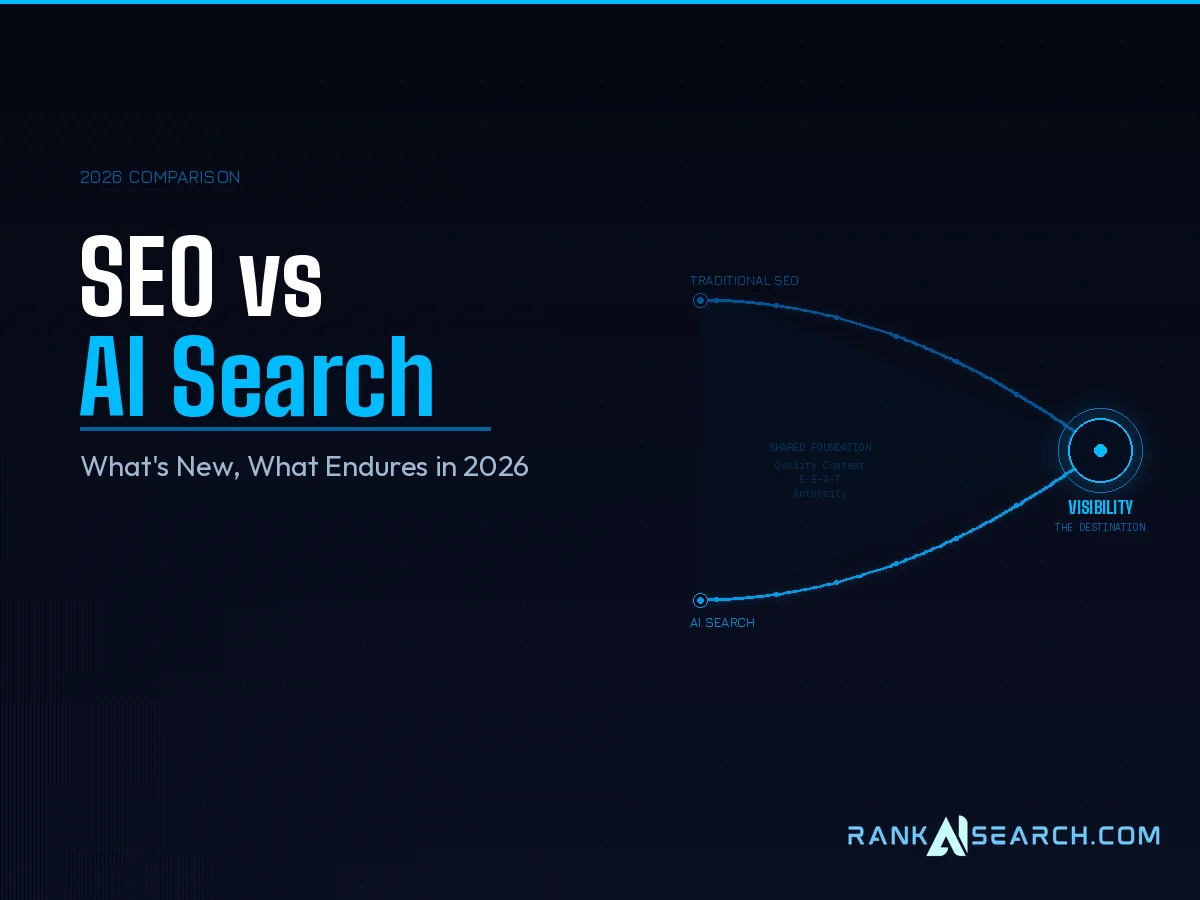
Search engine optimization (SEO) focuses on improving a website’s visibility in search engine results through content quality, technical performance, and backlinks. AI search, however, refers to AI‑powered systems that synthesize answers for users, such as Google’s AI Overviews, ChatGPT and Perplexity.
In 2026, both coexist. SEO drives organic traffic, while AI search delivers direct answers that may or may not result in clicks. Understanding the differences allows you to adapt your strategy for both channels.
Key 2026 Strategy Takeaways for SEO and AI Search
- SEO fundamentals—high‑quality content, on‑page optimization and technical performance—still matter.
- AI search emphasises concise, answer‑focused content and authority signals.
- Traditional metrics like rankings and traffic remain important but are joined by new metrics such as AI citations and share of voice.
- Users increasingly turn to conversational interfaces, so optimising for natural language queries is essential.
- Combining SEO and AI strategies creates a comprehensive approach to discovery and brand visibility.
What aspects of traditional SEO still work?
The fundamentals of SEO continue to underpin online visibility:
- High‑quality content – Google prioritises content that demonstrates expertise and satisfies user intent. AI also values authoritative, factual content.
- On‑page optimization – Title tags, meta descriptions, header tags and internal links help search engines understand your content and remain relevant for AI systems.
- Technical SEO – Site speed, mobile responsiveness and secure connections are essential. A fast, accessible site makes it easier for both search engines and AI crawlers to index your content.
- Backlinks and authority – High‑quality backlinks signal trust to search engines and AI models.
These elements form the base upon which AI‑focused strategies build.
What has changed with the rise of AI search?
AI search introduces several shifts:
- Zero‑click interactions – Users increasingly receive answers directly in AI Overviews or chat interfaces. Nearly 60 % of Google searches end without a click. This means visibility now depends on being cited in those answers.
- Semantic and contextual understanding – AI models interpret language based on context rather than exact keyword matches. Writing naturally and covering related concepts improves your chances of appearing in AI answers.
- Personalization – AI answers can vary based on user context, making optimization less predictable.
- New metrics – Success is measured by citations, mentions and share of voice in AI answers, not just rankings.
How should you optimise differently for SEO vs AI?
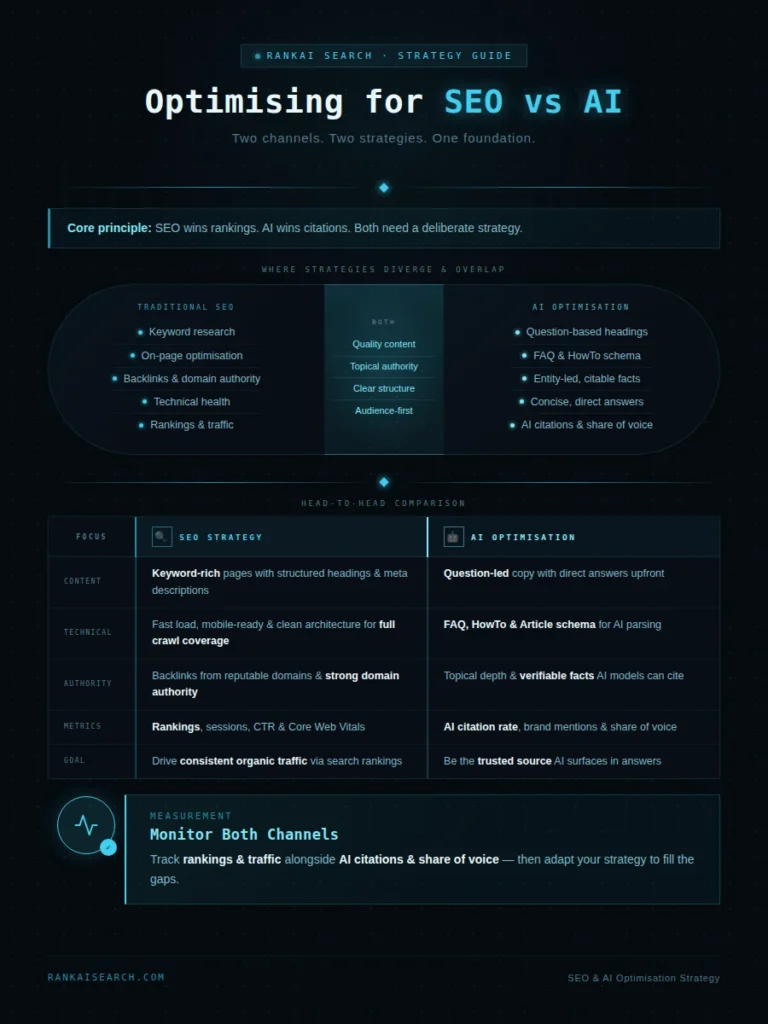
Optimising for SEO and AI requires complementary approaches:
- For SEO: Continue conducting keyword research, optimising on‑page elements and building backlinks. Ensure your site is technically sound and provides valuable content.
- For AI: Use question‑based headings and concise answers. Implement structured data like FAQ and HowTo schema. Focus on entities, context and citation‑worthy facts. Build topical authority so AI models recognise your expertise.
- Monitor both metrics: Track rankings and traffic alongside AI citations and share of voice. Use this data to adjust your strategy and fill gaps.
What stays the same across SEO and AI?
Certain principles apply to both:
- User intent – Whether in search or conversation, the goal is to satisfy user intent. Content should answer the user’s question clearly and thoroughly.
- Authority and trust – Expertise, credibility and trust signals are crucial. Google’s E‑E‑A‑T guidelines remain important, and AI models favour reliable sources.
- Structured information – Organising content with clear headings, bullet points and schema helps both search engines and AI systems parse your content.
- Human oversight – AI can assist with drafting and analysis, but humans ensure accuracy, nuance and creativity.
How do you measure success in a blended SEO and AI world?
Track both traditional and AI‑specific metrics:
- Rankings and traffic – Monitor your position on SERPs and the volume of organic visits.
- Engagement – Look at bounce rate, time on page and conversions to gauge content effectiveness.
- AI citations – Use AI tracking tools to see how often your content is mentioned in AI answers.
- Share of voice – Measure how frequently your brand appears compared with competitors in AI and search results.
- Lead quality – Evaluate the quality of leads from both search clicks and AI mentions.
Why optimise for both SEO and AI?
Search behaviour is fragmenting across search engines and AI platforms.
Relying on one channel risks losing visibility as the landscape evolves. Optimising for both ensures your content is discoverable whether users click links or receive answers directly.
Combined, SEO and AI strategies build a resilient presence that adapts to new technologies.
Conclusion: Integrating SEO and AI strategies in 2026
SEO and AI search are complementary, not mutually exclusive. High‑quality content, technical excellence and authority remain fundamental, while AI optimization introduces new requirements like structured data, concise answers and citation monitoring.
By blending these approaches, you maintain relevance across traditional search and emerging AI platforms. RankAISearch helps businesses integrate SEO and AI strategies for comprehensive visibility.
If you want a strategy that balances traditional SEO with the growing impact of AI search, RankAISearch can help. We create professional SEO and GEO strategies that help brands strengthen visibility across Google, AI Overviews, and generative search platforms by aligning proven search fundamentals with modern AI-focused optimization.
Frequently Asked Questions (FAQs)
How is AI search different from traditional SEO?
Traditional SEO aims to rank pages in search results, while AI search provides direct answers through conversational models and AI overviews. AI search relies on context, semantics and authority more than keyword matching.
Do SEO fundamentals still matter?
Yes. High‑quality content, technical SEO and backlinks remain critical. These elements provide the foundation for both SEO and AI visibility.
What new metrics should I monitor?
In addition to rankings and traffic, monitor AI citations, share of voice and leads from AI mentions.
Can I optimise for SEO and AI simultaneously?
Absolutely. Use question‑based headings, structured data and concise answers to satisfy AI, while maintaining the quality and depth required for SEO.
Will AI replace traditional search?
AI is reshaping search behaviour, but traditional search remains important. The two channels complement each other, and optimising for both ensures broader visibility.