

Why Is AEO Important for AI Search?
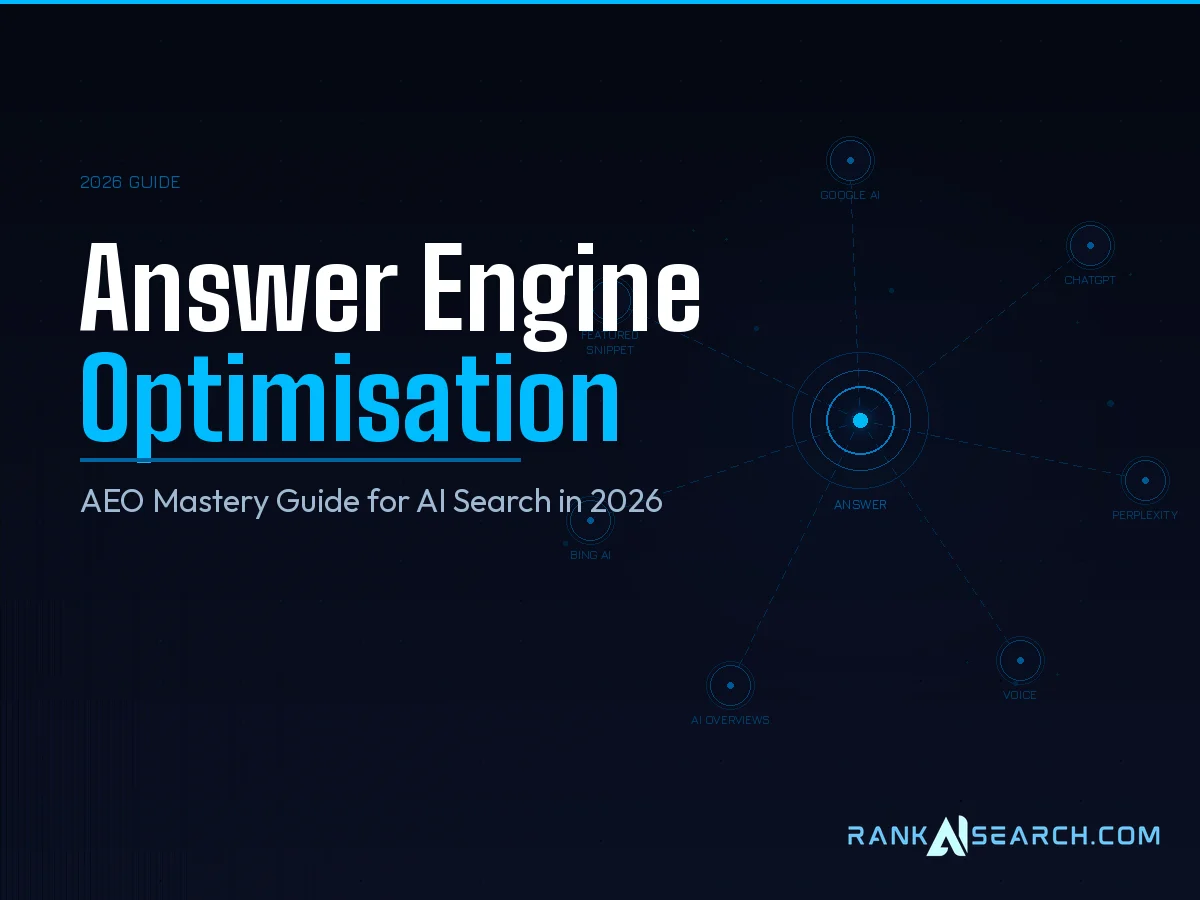
Answer engine optimisation (AEO) is the discipline of engineering your content so that AI‑powered tools, such as ChatGPT, Perplexity, Google AI Overviews and voice assistants, can easily understand, trust and cite it as a direct answer to user queries.
Unlike traditional SEO, which aims to rank pages in a list of results, AEO focuses on extractability and citation. The goal is to become the authoritative source that AI systems choose when delivering concise answers to users.
This matters because users are increasingly getting information from AI summaries without clicking links. AEO ensures your brand is present in those critical moments of discovery.
Core Principles of Answer Engine Optimization
- AEO structures content for AI extraction. Clear, atomic paragraphs and direct answers improve citation likelihood.
- AEO differs from SEO: while SEO seeks rankings, AEO targets visibility in AI responses and zero‑click interactions.
- Implementing structured data such as FAQ and Speakable schema helps answer engines interpret and quote your content.
- Fact‑density and entity clarity increase the chances of being cited by AI models.
- Gartner predicts that traditional search volume will drop 25 % by 2026 as AI answer engines grow, making AEO an essential strategy for future visibility.
How is AEO different from SEO?
Traditional SEO focuses on ranking web pages in search engine results using backlinks, keywords and on‑page optimisation. AEO, on the other hand, prioritises being selected as the answer by AI systems. It requires precise, trustworthy and easily parseable content. In AEO:
- Primary ranking metric – Visibility is measured by AI citations rather than SERP position.
- Trust signals – Citation authority and E‑E‑A‑T matter more than link quantity.
- User input – Queries are conversational and contextual rather than keyword‑based.
- Success benchmark – Success is measured by how often your brand is mentioned in AI answers and the resulting influence.
- Ranking transparency – AI answers are probabilistic and personalised, so rankings can vary widely.
Because AI responses synthesise data, your content must be clear, accurate and aligned with user intent to be selected.
What structured data supports AEO?
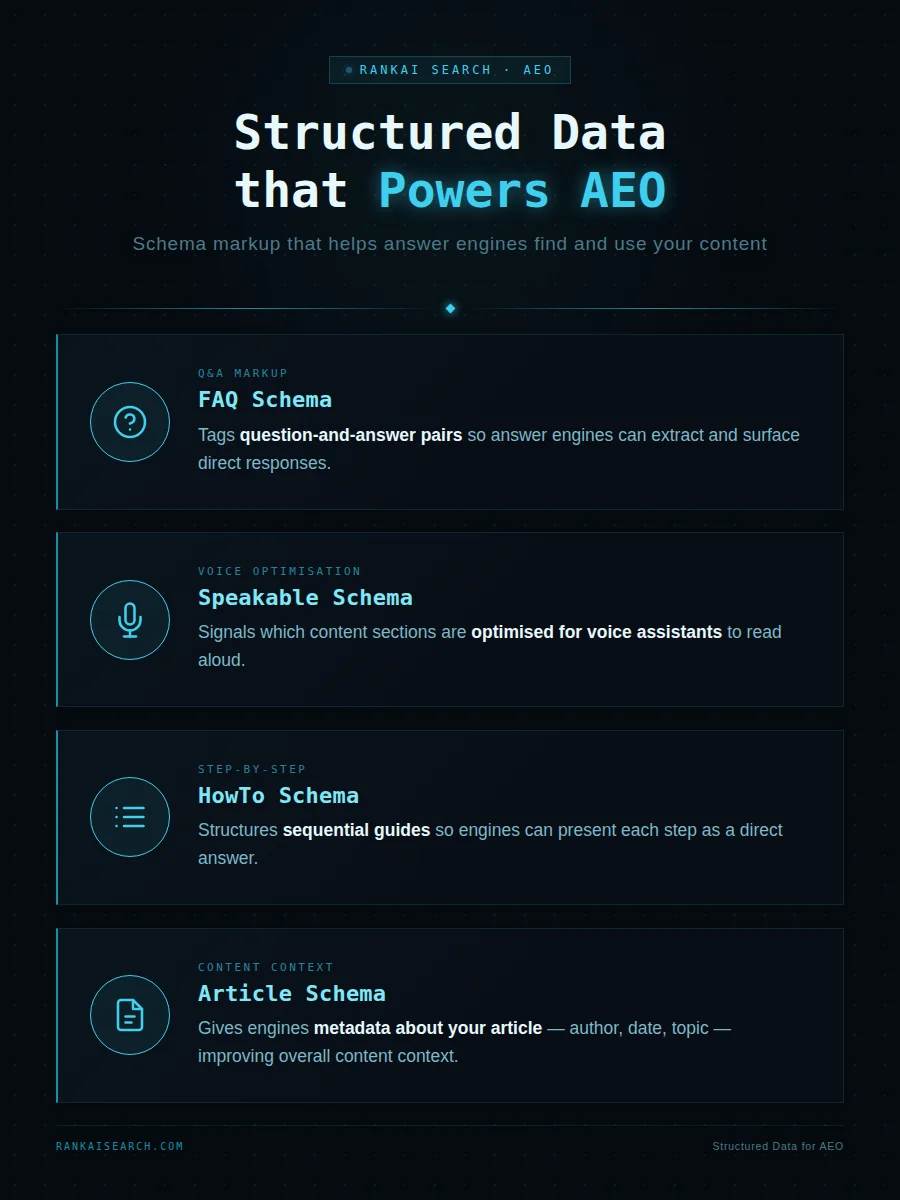
Structured data, or schema markup, helps machines interpret your content. For AEO, consider implementing:
- FAQ schema – Marks up question‑and‑answer sections, making them easier for answer engines to extract.
- Speakable schema – Indicates which parts of your content are suitable for voice assistants.
- HowTo schema – Structures step‑by‑step guides.
- Article schema – Provides basic information about your article and improves context.
Use these markups along with clear headings and short paragraphs. The Atak Interactive framework emphasises that structuring content is critical for AI readability.
How should you chunk content for “snippability” and citations?
Content chunking means breaking your article into small, self‑contained sections that answer one question. Follow these guidelines:
- Start each section with a question as the heading and answer it in the first sentence. This front‑loads value and makes it easier for AI models to extract the answer.
- Keep paragraphs short and focused on one idea. Long paragraphs make it hard for AI to extract information.
- Use bullet points or numbered lists to summarise steps or key points. Lists are easy to parse.
- Include relevant entities and context to help AI understand relationships.
- Maintain consistency in formatting throughout your site.
How do you win in zero‑click SERPs and AI answers?
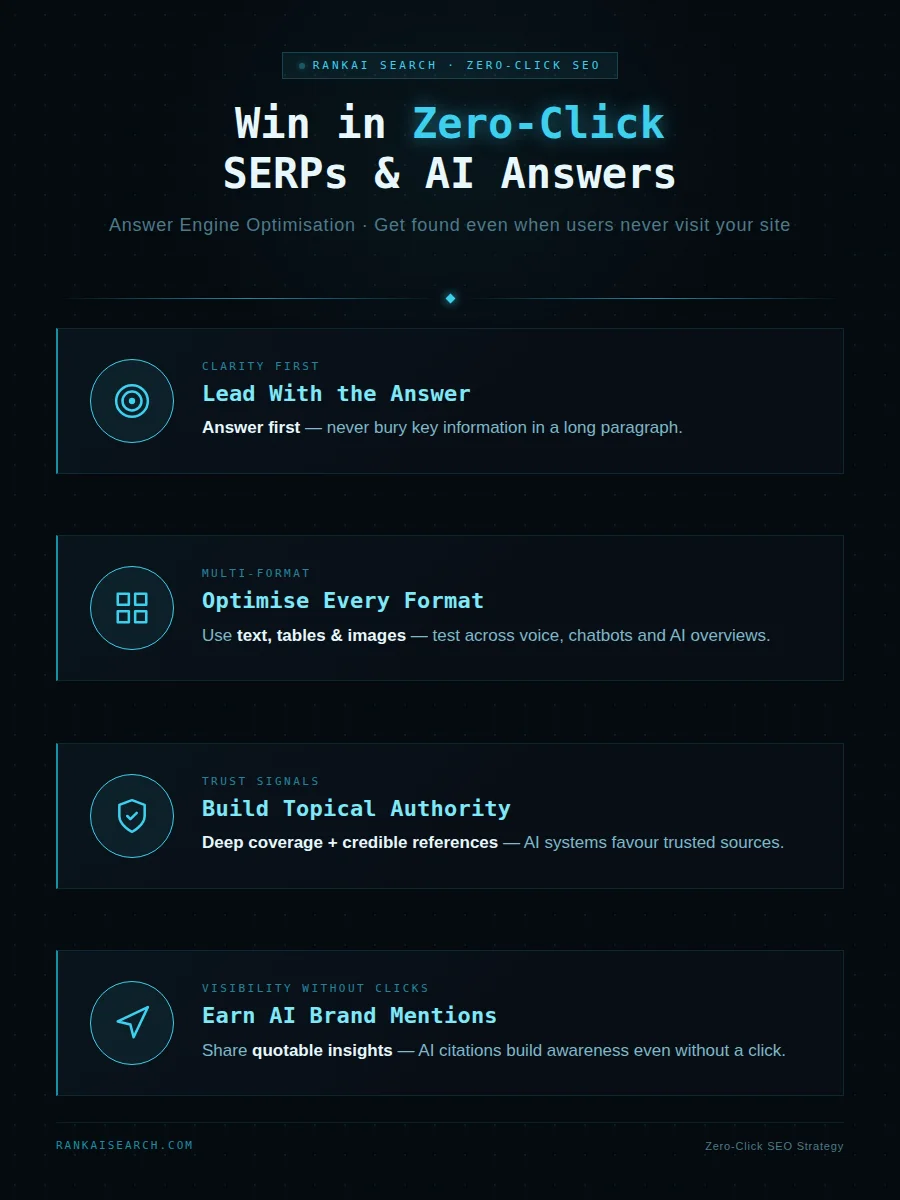
Zero‑click SERPs occur when users get the information they need without clicking through to a website. To win in these scenarios:
- Provide complete answers – Give the most important information upfront. Do not bury the answer in the middle of a long paragraph.
- Optimise for multiple formats – Use text, tables and images that AI can interpret. Test how your content appears in voice assistants, chatbots and AI overviews.
- Focus on authority – Build topical authority through comprehensive coverage and credible references. AI systems prefer trusted sources.
- Encourage brand mentions – Being cited in AI answers builds awareness even without a click. Provide memorable insights or statistics that others might quote.
What does an AEO checklist look like?
Use this checklist to improve your answer engine optimisation:
- Identify common questions in your industry and frame them as headings.
- Write concise answers at the start of each section.
- Add FAQ, Speakable and HowTo schema where appropriate.
- Ensure your site is accessible to AI crawlers and has a clean robots.txt.
- Include author bios and references to reinforce trust.
- Monitor citations and mentions using AI visibility tools.
- Update content regularly to maintain accuracy and relevance.
Conclusion: Why AEO is essential for 2026
Answer engine optimisation prepares your brand for a future where AI answers dominate. As Gartner predicts, traditional search volume may decline by 25 % by 2026, and over 400 million people use OpenAI products weekly.
Ensuring your content is structured, authoritative and easy to extract allows you to stay visible and build trust even when users do not click. By adopting AEO now and partnering with RankAISearch, you position your brand for success in a zero‑click, AI‑driven environment.
Frequently Asked Questions (FAQs)
What is answer engine optimisation?
AEO is the practice of structuring your content so that AI systems like ChatGPT, Perplexity and Google AI Overviews can easily extract and cite it as a direct answer.
How does AEO differ from SEO?
SEO focuses on ranking pages in search results, whereas AEO focuses on appearing in AI‑generated answers. AEO emphasises extractability, concise answers and citation authority.
What schema markup is important for AEO?
FAQ, Speakable, HowTo and Article schema help AI understand your content structure and improve the chances of citation.
Do I still need backlinks for AEO?
Yes. Credible backlinks strengthen your authority and make AI more likely to trust and cite your content.
How do I measure AEO success?
Track citations, mentions and the frequency with which AI systems quote your content. Use tools like Semrush AI Tracking and Ahrefs Brand Radar to monitor visibility.