
Artificial intelligence optimisation (AIO) is the umbrella strategy designed to make your content discoverable, usable and favourable within AI‑driven systems. AIO includes Generative Engine Optimisation (GEO) and Answer Engine Optimisation (AEO), but it goes further by considering all AI intermediaries between you and your audience.
In essence, AIO means optimising for search engines, large language models, voice assistants, and any AI platform that helps users find information. With search behaviour fragmenting across platforms and AI models synthesising answers, AIO ensures consistent visibility across every discovery channel.
Key takeaways:
- AIO is a mindset shift: you optimise for AI intermediaries, not just search engines.
- AIO covers content discoverability, structure, semantic clarity, citation worthiness and user intent alignment.
- SEO remains the foundation, but AEO, GEO and AIO build on it to address emerging AI platforms.
- Building topical authority and providing comprehensive, structured content is critical.
- AIO emphasises both human and machine collaboration—AI for speed, humans for insight and trust.
How does AIO combine SEO, AEO and GEO?
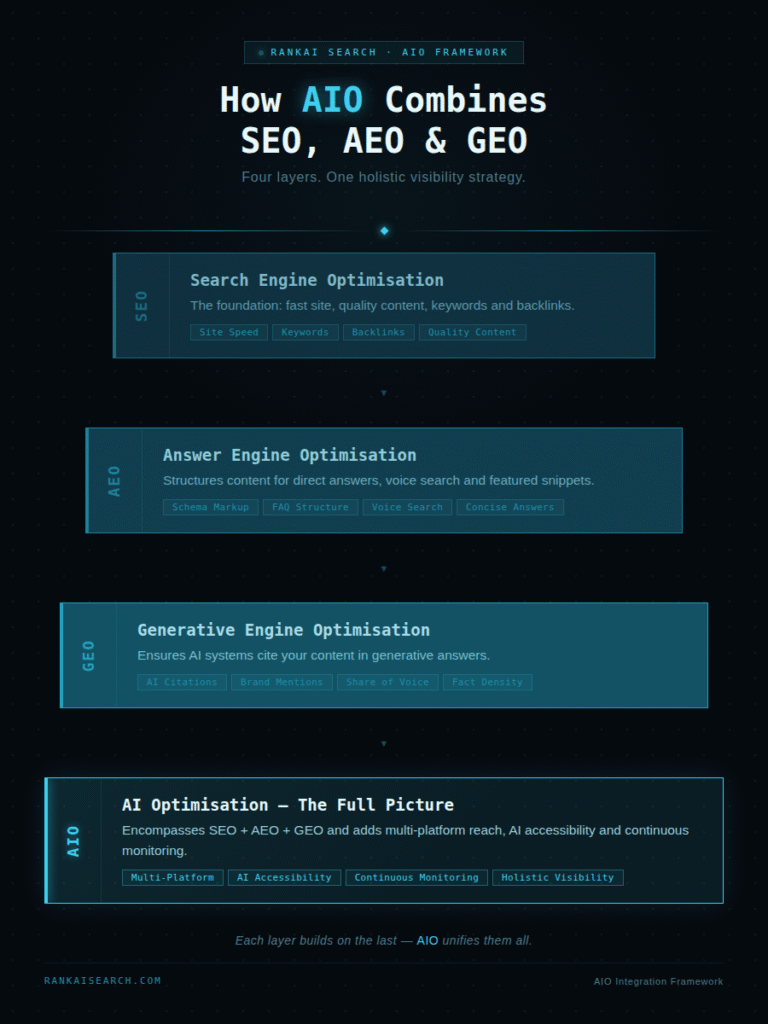
AI Optimisaiton ties all optimisation strategies together. Here’s how it integrates the others:
- SEO – Provides the foundation: fast site, quality content, keywords, backlinks.
- AEO – Builds on SEO by structuring content for direct answers and voice search. It uses schema markup and clear, concise paragraphs.
- GEO – Expands the reach by ensuring AI systems cite your content in generative answers.
- AIO – Encompasses all of the above and adds multi‑platform optimisation, AI accessibility and continuous monitoring.
Together, these layers create a holistic approach to visibility in both traditional search and emerging AI channels.
What falls under AIO?
AIO includes:
- Content discoverability – Ensuring AI crawlers can access and index your content. Review your robots.txt for AI bots.
- Content structure – Using clear headings, short paragraphs, bullet points and schema so AI can parse and extract information.
- Semantic clarity – Writing with explicit nouns and clear context. Avoid vague pronouns and ambiguous references.
- Citation worthiness – Building authority through expertise, E‑E‑A‑T signals and credible references.
- User intent alignment – Mapping content to the real questions users ask AI and search engines.
- Platform‑specific optimisation – Tailoring content for different AI platforms (e.g., ChatGPT for conversational queries, Perplexity for research, Google AI Overviews for summarised answers).
How do humans and machines work together in AIO?
AIO recognises that AI can assist with research, analysis and drafting, but human expertise is crucial for accuracy, nuance and trust.
AI helps identify patterns, generate outlines and suggest topics; humans refine content, add unique insights and ensure compliance with ethical guidelines.
This human‑in‑the‑loop approach aligns with E‑E‑A‑T principles and prevents the publication of generic or incorrect information.
How do you build topical authority and entity‑first content?
Topical authority means covering your core topics comprehensively. Create content clusters with pillar pages and related subtopics. Use internal links to connect articles, making it clear how they relate.
An entity‑first approach focuses on people, places and concepts rather than just keywords. Mention relevant entities, provide definitions and explain relationships. This helps AI models understand context and increases citation likelihood. The Atak article recommends going deep rather than broad and becoming the “Wikipedia of your niche”.
Why is multimodal optimisation part of AIO?
AI systems increasingly process images, videos and audio. AIO requires optimising these formats with alt text, transcripts, captions and structured data. Provide clear descriptions for visual content and ensure accessibility.
Multimodal optimisation improves your chances of being cited in voice assistants and AI answers that incorporate multimedia.
What is the future of search according to AIO?
Search behaviour has fragmented and discovery now happens across multiple platforms. Traditional metrics like traffic and rankings remain important but are no longer the sole indicator of success.
The new goal is visibility: being present when users ask AI tools about your industry.
Companies that embrace AIO, optimising content for all AI‑driven discovery channels, will maintain relevance as search continues to evolve.
Conclusion: The AIO roadmap RankAISearch recommends
Artificial intelligence optimisation integrates SEO, AEO and GEO into one comprehensive strategy. By ensuring content discoverability, structure and clarity, aligning with user intent and leveraging both human and machine strengths, AIO prepares your brand for an AI‑first search landscape.
RankAISearch supports businesses in auditing their content, building topical authority and implementing AIO strategies to future‑proof their visibility.
If you want to build a stronger strategy for visibility across both search engines and AI-powered platforms, RankAISearch can help. We create professional AIO, SEO, and GEO strategies that connect content, technical optimisation, and AI-readiness so your brand is better positioned across Google, AI Overviews, and generative search experiences.
Frequently Asked Questions (FAQs)
What is artificial intelligence optimisation (AIO)?
AIO is the overarching strategy of optimising content, structure and signals so AI systems—search engines, answer engines and generative models—can discover, understand and favour your brand.
How does AIO differ from SEO?
SEO focuses on rankings in search engines. AIO expands this to include all AI intermediaries, such as large language models and voice assistants, ensuring visibility across platforms.
Why are humans still important in AIO?
AI assists with research and drafting, but humans ensure accuracy, nuance and trust. Human expertise is necessary to meet E‑E‑A‑T guidelines and avoid generic content.
What steps should I take to implement AIO?
Audit your technical set‑up, create comprehensive content clusters, implement schema and structured formatting, allow AI bots to crawl your site, and monitor AI citations and user feedback.
Is AIO only for large companies?
No. Even small businesses benefit from AIO by gaining visibility in AI answers and new discovery channels. Early adopters can build a competitive advantage.