

What Is LLM Optimization in AI Search?
LLM optimization (LLMO) stands for large language model optimization. It is the practice of making your brand, content and data more visible in AI‑generated answers from tools like ChatGPT, Claude, Gemini and Perplexity.
While SEO focuses on search engines and AEO/GEO address answer and generative platforms, LLMO broadens the strategy to optimise for any large language model. These models synthesise information without always linking back to sources, so you must ensure your content is trustworthy, structured and easy to reference.
As AI‑driven search becomes mainstream, LLMO helps you remain part of the conversation when users ask questions in natural language.
Essential Pillars of LLM Optimization
- LLMO is the evolution of SEO, focusing on visibility in AI‑generated answers and recommendations.
- The three pillars of LLMO are authoritative content, structured data and tracking AI citations.
- LLMO requires technical accessibility, including making sure AI crawlers can access your site.
- E‑E‑A‑T principles (Experience, Expertise, Authority, Trust) remain essential for credibility.
- Tracking AI citations helps you measure progress and adapt your strategy.
How is LLMO different from SEO?
SEO helps you rank on search engine results pages. LLMO ensures your brand is included in AI responses. The differences include:
- Objective – SEO aims to drive clicks, while LLMO aims to get cited and recommended in AI answers and conversations.
- Scope – LLMO covers all large language model platforms, not just search results. This means optimising for ChatGPT, Gemini, Perplexity and other AI assistants.
- Signals – In addition to traditional SEO signals like backlinks, LLMO emphasises structured data, clear language and authoritative sources.
- Metrics – LLMO success is measured by AI citations, mentions and share of voice rather than purely traffic metrics.
What are the pillars of LLM optimization?
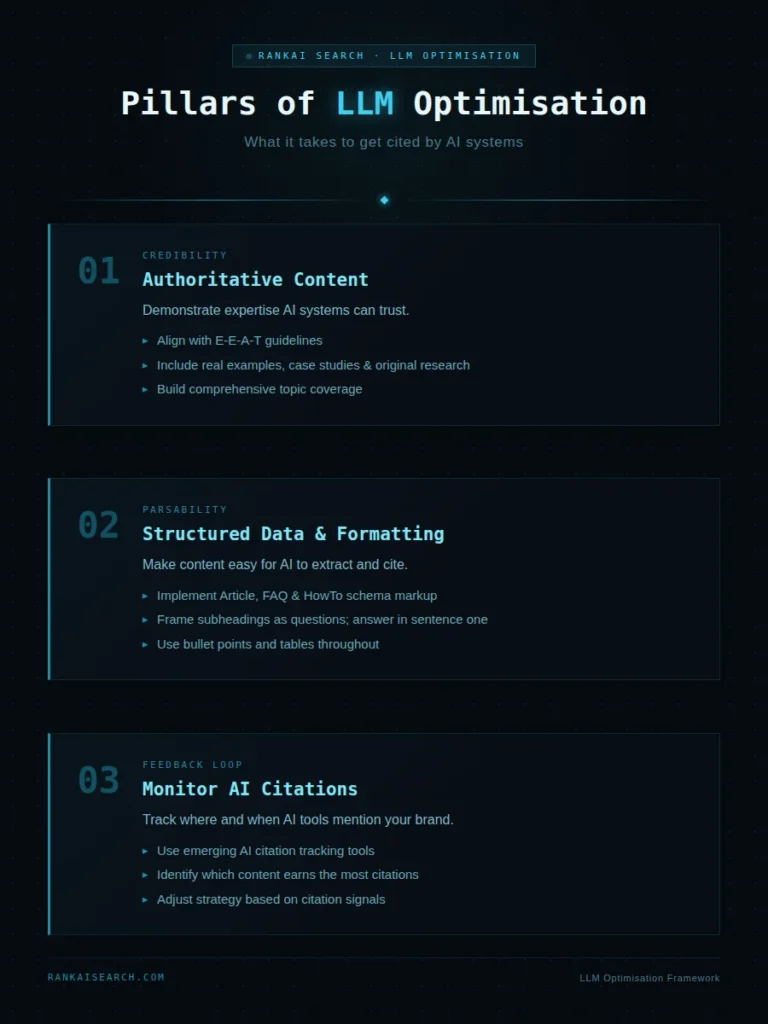
- Authoritative content – Create comprehensive resources that demonstrate expertise and authority. Align with E‑E‑A‑T guidelines. Use real examples, case studies and original research to stand out.
- Structured data and clear formatting – Implement schema markup like Article, FAQ and HowTo. Frame subheadings as questions and start answers in the first sentence. Use bullet points and tables to make information easy to parse.
- Monitoring AI citations – Track how often AI tools mention or cite your brand using emerging tracking tools. Monitoring provides feedback on which content pieces are effective and where adjustments are needed.
What is llms.txt and how does it help?
Some organizations propose using a file called llms.txt to guide AI crawlers toward important pages and away from sensitive or irrelevant content. Similar to robots.txt for web crawlers, llms.txt could specify which URLs large language models should prioritise for training or retrieval.
By curating this file, you can ensure AI systems see your most authoritative resources. While llms.txt is still emerging, staying informed and adopting it early can give you a competitive edge in LLMO.
How do you build semantic routing and ground truth for LLMs?
Semantic routing involves tagging and structuring your money pages, such as product pages or key guides, so AI models recognise them as authoritative. Use internal links, anchor text and schema to signal importance. Ground truth refers to the accurate, well‑maintained information that models rely on. To build ground truth:
- Maintain updated content – Keep critical information current and correct. AI models can propagate outdated data if your pages are not refreshed.
- Use entity relationships – Link related entities and concepts within your site to reinforce context.
- Encourage external citations – Participate in industry publications and events to build recognition beyond your own site.
Where should you start with RankAISearch?
- Assess your AI readiness – Determine whether your site is accessible to AI crawlers and if your content is structured for extraction.
- Create authoritative resources – Develop in‑depth guides, case studies and thought leadership pieces on your core topics.
- Implement schema and question‑based headings – Use structured data and question headings to facilitate extraction.
- Monitor citations – Use AI tracking tools to see where your brand is mentioned and adjust content accordingly.
- Stay updated – LLMO is a rapidly evolving field. Work with RankAISearch to keep pace with changes and refine your strategy.
Conclusion: Embrace LLMO to stay visible
Large language models are changing how information is discovered and consumed. LLM optimization ensures your brand remains visible in AI‑generated answers by focusing on authoritative content, clear structure and continuous tracking.
By adopting LLMO today, you position your business to thrive in an AI‑first search environment and ensure that your expertise is part of the conversation across platforms.
If you want your brand to be more visible in AI-generated answers, RankAISearch can help. We create professional LLMO, SEO, and GEO strategies focused on authoritative content, structured data, AI accessibility, and citation tracking so your business is better positioned across platforms like ChatGPT, Gemini, Claude, and Perplexity.
Frequently Asked Questions (FAQs)
What is LLM optimization (LLMO)?
LLMO stands for large language model optimization. It is the practice of making your brand, content and data more visible in AI‑generated answers from tools like ChatGPT, Claude and Gemini.
How is LLMO different from SEO?
SEO focuses on ranking pages in search results. LLMO aims to get your content cited and recommended inside AI answers, emphasising structured data and authority.
What are the pillars of LLMO?
Authoritative content, structured data and monitoring AI citations are the three pillars. These help AI systems trust and extract your information.
What is llms.txt?
llms.txt is a proposed file similar to robots.txt that guides AI crawlers towards preferred pages. It can help you highlight important resources for training and retrieval.
Do small businesses need LLMO?
Yes. Optimising for AI answers early can give small businesses a visibility advantage when competitors have not yet adapted.