

AI Visibility Report Template Essentials

A structured AI Visibility Strategy: Building Brand Authority in Brands turns scattered observations into a decision-ready record, covering five core sections: a snapshot header, prompt log, sampling rules, gap analysis, and a next-action queue with owners. Agencies and in-house teams use this format to connect visibility scores to specific gap types, then link each gap to a concrete fix rather than a vague dashboard number.
Key Takeaways
AI visibility reports measure whether pages become easier for ChatGPT, Gemini, and Claude to find and cite your content.
Decision-ready reports track what was checked, what appeared, what changed, and assign ownership of each action item.
Combine AI platform mentions, citations, and rankings into one unified report showing directional business impact on traffic and leads.
Effective templates eliminate noise by focusing on one core question: did AI systems gain better access to your brand?
What goes into an AI visibility report template?
An effective ai visibility report template answers one core question: did the brand’s pages become easier or harder for AI systems to find, interpret, and cite? Every section in the template exists to serve that single purpose. The most useful report is a structured document that connects scores to gap types. Gap types to specific next actions.
Five sections cover everything a monthly report needs. Each section serves a distinct function in the visibility analysis.
Snapshot header — Provides the reporting period, brand name, and a one-line summary of the month’s trend (improved, declined, or stable).
KPI scorecard — Lists the key performance indicators tracked across AI platforms, such as citation frequency, mention sentiment, and answer inclusion rate.
Page-level breakdown — Shows which individual pages gained or lost AI visibility, with the specific queries that triggered each change.
Gap classification summary — Groups visibility gaps by type (content missing, authority insufficient, citation absent) so teams know what to fix first.
Action items — Translates each gap into a concrete next step with an owner and deadline.
How does a visibility checklist differ from a report template?
A visibility checklist focuses on pre-audit preparation rather than post-audit reporting. The checklist tells teams what to gather before running the analysis: which AI platforms to test, which queries to sample, and which competitor brands to benchmark against. The report template then organizes those findings into a decision-ready document.
What makes an ai audit template actionable?
An ai audit template becomes actionable when it classifies each gap by type. A gap labeled “missing structured data” points to a technical fix. A gap labeled “no third-party citations” indicates a need for link-building or other citation strategies. RankAISearch helps brands earn those citations, mentions, and authority, allowing AI platforms to confidently recommend their businesses. Without gap classification, the audit produces data but no direction.
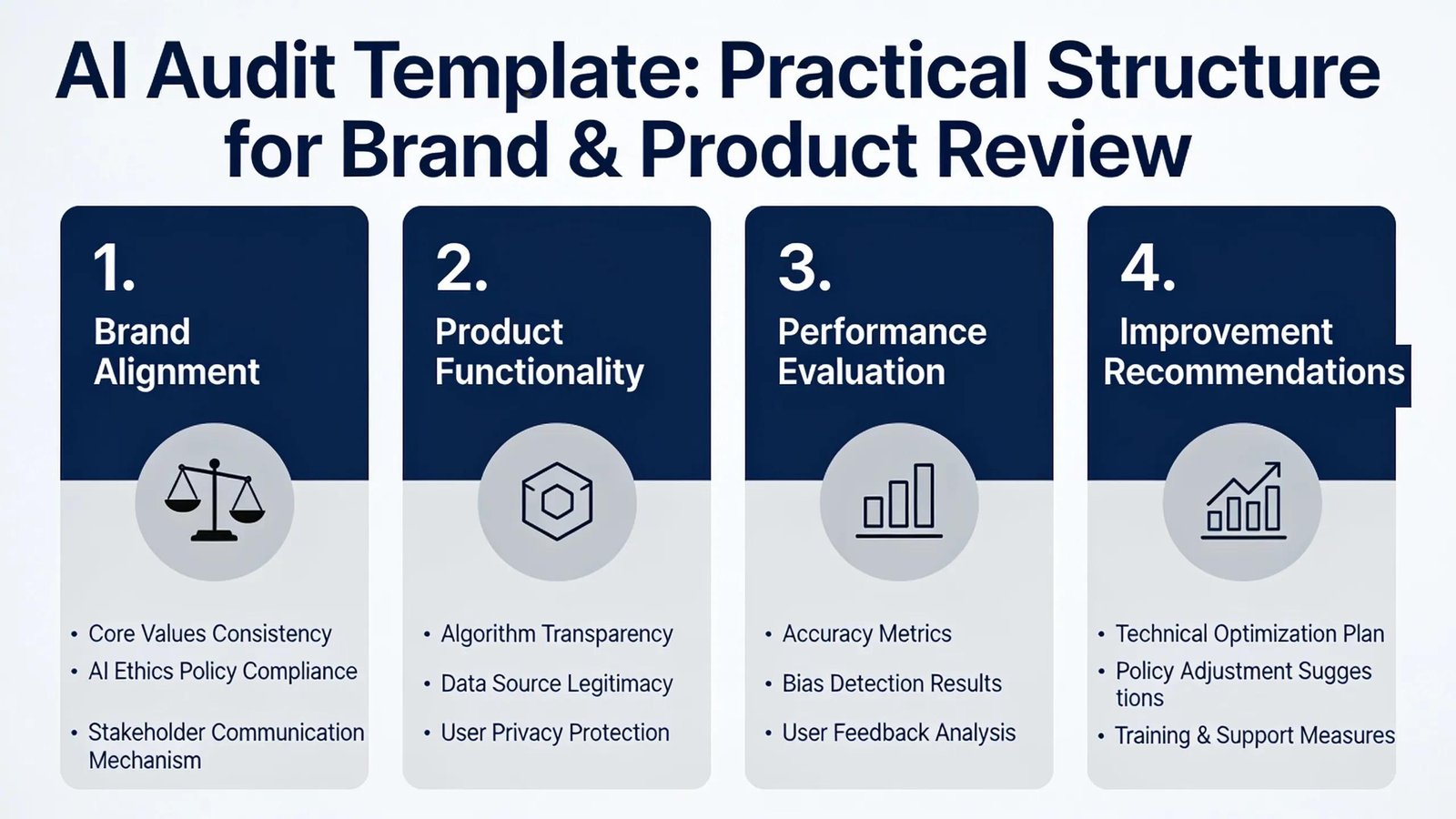
How do you build an AI audit template?
An AI audit template provides a practical structure for reviewing how a brand, its products, and its competitors appear across AI-generated answers. RankAISearch specializes in Generative Engine Optimization (GEO), Answer Engine Optimization (AEO), and AI SEO, helping brands strengthen online authority and earn trusted citations. Building an effective template requires a repeatable process that connects observations to specific next actions.
What sections belong in an AI audit template?
A complete template should include five core sections. The snapshot header records the date, engine version, and query set used. A KPI scorecard tracks citation frequency, sentiment, and answer completeness. The page-level breakdown maps which URLs appear in AI responses and which do not. A gap classification summary categorizes missing citations by type — authority gaps, content gaps, or relevance gaps. Finally, action items assign owners and deadlines for each fix.
How does a visibility checklist support the audit?
A visibility checklist for SEO teams tests whether current SEO activity truly covers AI visibility, AEO, and GEO. This checklist ensures the audit catches blind spots that traditional SEO reports miss. Teams run through each point before the audit begins, confirming that crawlability, structured data, entity clarity, and citation sources are all accounted for. Missing any point signals a gap that the audit must investigate further.
Define the query set — list the commercial questions buyers ask most often.
Run each query across ChatGPT, Gemini, Perplexity, and AI Overviews.
Record every brand mention — note whether the brand appears as a primary recommendation, a supporting citation, or not at all.
Classify each gap — authority, content, or relevance — using the gap classification summary.
Assign an owner and deadline to every action item before closing the audit.
What is an AI citation checklist?
An AI citation checklist verifies that a brand’s content meets the technical. Editorial criteria AI systems use when deciding which sources to cite. The checklist covers structured data markup, entity clarity in the opening content, third-party citation sources like HARO mentions, and consistent brand language across platforms. RankAISearch uses this checklist during audits to identify why a brand gets overlooked in AI answers. What content changes would fix the omission. A free ai visibility template combining the audit structure, visibility checklist, and citation checklist is available from RankAISearch to help teams start their first audit without building everything from scratch.

What should a visibility checklist track?
A visibility checklist captures how a brand appears across both traditional search and AI-powered platforms, then connects those metrics to business results. The checklist exists to answer three questions: is the brand visible, is it showing up where buyers search on Google, and is it appearing on AI platforms like ChatGPT, Gemini, and AI Overviews. Missing any of these channels means the picture of brand visibility stays incomplete.
RankAISearch tracks visibility across ChatGPT, Google AI Overviews, Gemini, Perplexity, Claude, Copilot, and other AI-powered search platforms. An ai visibility report template fills the gap between raw data and decision-ready insights.
What makes a visibility checklist useful for executives?
Executives do not need every daily metric. They need enough to confirm or rule out a visibility problem. The visibility checklist should answer three things: are certain pages appearing, are citations growing or shrinking, and do those shifts correlate with traffic or leads.
How often should teams run the checklist?
Monthly versions focus on score movement and in-progress fixes. Quarterly versions zoom out to trend direction and whether completed actions actually changed anything. A free ai visibility template keeps both cadences consistent without reinventing the format each cycle.
Conclusion
In closing, an AI visibility report template and checklist transforms how you understand your presence across the platforms where customers now search. By systematically tracking your performance in ChatGPT, Google AI Overviews, Gemini, Perplexity, Claude, and beyond, you gain clarity on what’s working and where optimization opportunities exist. The brands winning in generative search aren’t leaving visibility to chance—they’re measuring, refining, and building authority with intention. Your roadmap to AI-powered discovery starts with knowing exactly where you stand today.