

How to Measure Your Brand’s Visibility in AI Search
A brand can rank in search and still be invisible inside AI-generated answers. AI platforms may choose different sources, cite third-party pages, or recommend competitors with clearer entity signals. Measuring AI search visibility helps marketers understand where the brand stands across AI answer surfaces.
The goal is to measure both presence and quality. A useful report shows how often AI platforms mention the brand, whether they cite the right pages, and whether the information is accurate. This guide explains how to track AI visibility across prompts, platforms, competitors, and conversions.
How Do You Measure AI Search Visibility?
| Metric | What it captures |
|---|---|
| Citation frequency | How often AI platforms cite or source your site |
| AI share of voice | Your mention share versus competitors |
| Sentiment accuracy | Whether the brand is described correctly |
| AI referral traffic | Visits AI platforms send to your site |
AI search visibility is the measurable presence of a brand inside AI-generated answers, citations, recommendations, summaries, and referral paths. Google launched dedicated Search Generative AI performance reports in Search Console in June 2026, confirming that AI visibility now needs separate reporting from traditional organic performance.
This shift is why AI visibility now warrants its own reporting layer. (Source: Google Search Central, 2026)
AI visibility measurement should not rely on one metric. A brand can be mentioned often but described incorrectly, cited rarely but receive strong AI referrals, or appear in one platform while competitors dominate another.
Which Metrics Should You Include in Your AI Visibility Framework?
You should include citation frequency, AI share of voice, sentiment accuracy, AI referral traffic, and conversion quality in your framework. These metrics separate visibility, competitiveness, message quality, and business value.
A useful AI visibility framework measures what AI engines say, what they cite, who they recommend, and what users do after clicking. AI search can influence decisions before a user reaches your site, so traffic alone undercounts the channel.
Adobe reported that traffic to U.S. retail websites from generative AI sources rose 1,200% in February 2025 compared with July 2024 — growth that shows why AI referral measurement should sit beside citation and prompt tracking in modern performance reporting. (Source: Adobe, 2025)
Citation Frequency
Citation frequency is the rate at which AI platforms cite, link, or source your website in answers to monitored prompts. It shows whether your content is being used as support, not only whether your brand is mentioned. Track it at the platform, prompt, URL, and intent level — a citation from a high-intent vendor-selection prompt is more valuable than one from a broad educational prompt.
AI Share of Voice
AI share of voice is your brand’s share of mentions or citations compared with competitors across a defined prompt set. It shows whether AI platforms treat your brand as a meaningful option in the category. Keep the formula consistent: if your brand appears in 18 out of 100 tracked brand mentions and competitors receive the remaining 82, your AI mention share of voice is 18%.
Sentiment and Factual Accuracy
Sentiment and factual accuracy measure whether AI platforms describe your brand correctly and in the right context. A positive answer can still damage trust if it invents pricing, names the wrong audience, or lists services you do not offer. Score accuracy before sentiment — a neutral but correct mention is more useful than a flattering answer built on false details.
AI Referral Traffic
AI referral traffic measures visits from AI platforms such as ChatGPT, Perplexity, Claude, Gemini, and Copilot. It shows the portion of AI visibility that turns into website sessions.
Google Analytics traffic-source dimensions include source and medium fields, including referral traffic, which site owners can use to analyze sessions from external referring sources. (Source: Google Analytics Help, 2026)
AI referral tracking should include landing pages and conversions. A low-volume AI channel can still matter if visitors arrive with high intent and convert at a strong rate. 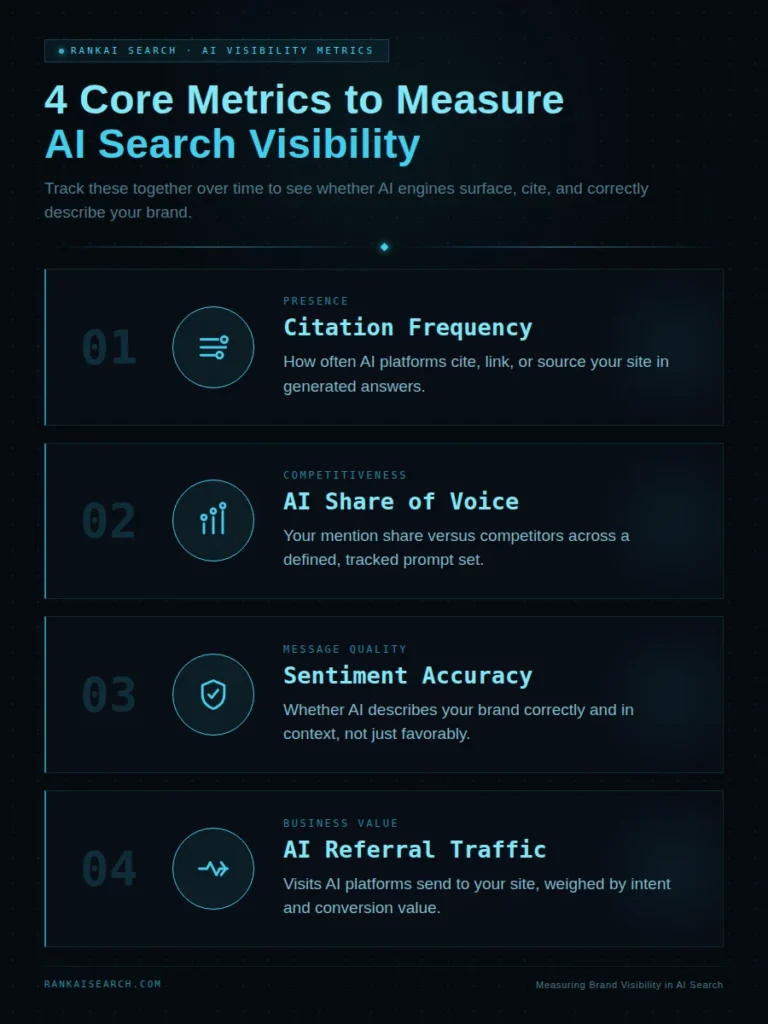
How Do You Choose the Right Prompts to Monitor?
You choose prompts by mapping the questions buyers ask before discovering, comparing, trusting, or choosing a provider. The best prompt set includes commercial, informational, branded, competitor, and problem-aware questions. Prompt selection controls the quality of AI visibility data — a weak set can make a brand look visible for low-value questions while missing the prompts that influence buying decisions.
Generative AI answer systems can return different sources from traditional organic rankings. Ahrefs found that 38% of Google AI Overview citations came from pages ranking in the top 10 organic results, which means prompt-level AI citation tracking cannot rely only on standard ranking data. (Source: Ahrefs, 2026)
Use a balanced prompt library:
| Prompt type | Suggested volume |
|---|---|
| Commercial prompts | 20 to 30 |
| Informational prompts | 10 to 20 |
| Competitor comparison prompts | 10 |
| Branded accuracy prompts | 10 |
| Problem-specific prompts | 5 to 10 |
| Industry-specific prompts | 5 to 10 |
How Can You Establish an AI Visibility Baseline?
You establish an AI visibility baseline by testing the same prompt set across the same AI platforms on the same date range and recording mentions, citations, competitors, sentiment, and errors. The baseline becomes the starting point for measuring change.
A baseline prevents random prompt tests from becoming misleading anecdotes. AI answers can vary by platform, model, location, personalization, web access, and time, so the first measurement must be controlled.
A 2026 academic study of Google AI Overviews decomposed responses into 98,020 atomic claims and found that 11.0% were unsupported by cited pages — which is why baseline measurement should include both citation presence and claim accuracy. (Source: Xu, Iqbal, and Montgomery, 2026)
A baseline should be repeated on a fixed schedule. Monthly testing gives enough time for content, citations, and AI retrieval patterns to shift.
How Do You Track Brand Citations Across AI Platforms?
You track brand citations by running a fixed prompt set across each target AI platform and recording whether your brand, website, or third-party mentions appear as sources. The tracking system should separate citations from mentions, because the two signals mean different things: a citation is source attribution, while a mention is a brand name appearing in the answer. A brand can be mentioned without being cited, and it can be cited without being recommended.
Citation tracking should happen at the URL level. A homepage citation, service-page citation, case-study citation, and blog citation each reveal a different content strength. Track these citation outcomes:
- Owned website cited
- Third-party page cited about your brand
- Competitor website cited
- Neutral publisher cited
- Review or directory source cited
- No visible citation
- Brand mentioned without source attribution
How Should You Compare Your Visibility With Competitors?
You should compare AI visibility with competitors by tracking the same prompts, platforms, dates, and scoring rules for every brand in the category. This creates a fair view of who AI systems mention, cite, and recommend. Competitor comparison matters because AI answers usually present a short list of options — a brand can improve its own visibility and still lose category share if competitors improve faster.
Competitor analysis should identify why competitors appear. They may have stronger service pages, more third-party mentions, clearer entity information, better documentation, or more citable evidence. Compare visibility by prompt category:
- Category recommendations
- Product or service comparisons
- Problem-solving prompts
- Industry-specific prompts
- Branded accuracy prompts
- Review and reputation prompts
How Can You Evaluate the Accuracy of AI Brand Mentions?
You evaluate accuracy by checking whether AI platforms describe your brand’s category, services, products, people, locations, pricing, proof, and competitors correctly. A visible brand mention is only valuable when the information is correct, so accuracy measurement should use a structured scoring system that prevents teams from treating every mention as equal.
AI systems can make brand errors when public sources conflict. Outdated profiles, old pricing pages, inconsistent service descriptions, and weak About pages can all feed inaccurate summaries. Accuracy audits should create action items — the fix may involve updating owned pages, correcting third-party profiles, adding structured data, or publishing clearer service pages.
Use a simple scoring model:
| Score | Meaning |
|---|---|
| 2 points | Fully accurate |
| 1 point | Partially accurate |
| 0 points | Inaccurate or missing |
| Flag | Fabricated claim |
| Flag | Outdated claim |
| Flag | Unsupported comparison |
How Do You Measure Traffic and Conversions From AI Search?
You measure traffic and conversions from AI search by segmenting sessions from AI platforms, reviewing landing pages, and connecting those sessions to conversions. Referral traffic shows only the click-through portion of AI visibility, so it should be analyzed with citation and mention data. AI search often influences users before they click — a user may see your brand in an AI answer, then search your brand name later, visit directly, or convert through another channel.
Reuters reported that Adobe Analytics found U.S. shoppers referred from LLMs generated 53% more revenue per visit than shoppers from non-AI sources in May 2026, which shows why AI referral traffic should be evaluated by value, not only by volume. (Source: Reuters, 2026)
Add common AI referral sources to reporting views:
| AI referral source | AI referral source |
|---|---|
| chatgpt.com | gemini.google.com |
| openai.com | copilot.microsoft.com |
| perplexity.ai | microsoft.com |
| claude.ai | poe.com |
| anthropic.com | you.com |
How Should You Report AI Search Performance Over Time?
You should report AI search performance with a monthly scorecard that tracks visibility, citations, accuracy, competitor share, referral traffic, and content opportunities. The report should show directional change instead of isolated screenshots. Monthly reporting works because AI visibility changes as platforms update models, indexes, retrieval behavior, and source selection — a consistent cadence makes trend lines more useful than one-off tests.
A 2026 log-based study on ChatGPT referral traffic found that raw ChatGPT referrals grew 5.7x on one high-traffic domain, while untreated pages grew 3.5x over the same window — which shows why reports should separate platform-wide growth from content-specific improvement. (Source: Watanabe and Nakayashiki, 2026)
Monthly Visibility Scorecard
A monthly visibility scorecard summarizes the metrics leadership needs to see. It should be short enough to read quickly and detailed enough to support decisions, and it should include trend direction — a single month can show movement, but multiple months reveal whether the strategy is working.
Trends, Gains, and Content Opportunities
Trends, gains, and content opportunities explain what changed and what to do next. This section should connect performance movement to specific prompts, pages, sources, and competitors. Content opportunities should come from observed AI gaps — if competitors appear for the same prompt repeatedly, their cited sources can reveal what your site is missing. Useful opportunity categories include:
- Prompts where competitors appear but your brand does not
- Prompts where your brand is mentioned but not cited
- Prompts where your brand is cited through third-party sources
- Pages that earn citations across platforms
- Pages that need stronger evidence
- Incorrect brand facts that need entity cleanup
- New content topics based on repeated AI gaps
Which Mistakes Can Make AI Visibility Data Misleading?
AI visibility data becomes misleading when teams use inconsistent prompts, ignore platform differences, count mentions as citations, or report screenshots without a baseline. Bad measurement can make visibility look stronger or weaker than it really is. AI outputs are variable, so measurement needs controlled prompts, repeated tests, and consistent scoring — a single impressive answer is not a performance trend. Avoid these reporting habits:
- Testing prompts manually without a template
- Recording only favorable answers
- Mixing branded and non-branded prompts
- Ignoring location and personalization
- Changing scoring rules midstream
- Reporting raw growth without controls
What Should You Remember About Measuring AI Search Visibility?
You should remember that AI search visibility is measured through mentions, citations, competitor share, accuracy, referral traffic, and conversions. No single metric explains whether AI platforms understand, trust, and surface your brand.
AI measurement should connect visibility to business outcomes. A brand that wins citations for low-intent prompts may still need work on buyer prompts, comparison prompts, and service-selection prompts. AI visibility measurement should become part of regular search reporting — it gives marketers a clearer view of how brand discovery changes when buyers use AI answers instead of traditional results pages.
Are You Ready to Build a Clearer AI Search Measurement Strategy?
AI visibility is easier to improve when you can see which prompts, platforms, citations, and competitors shape your results. A consistent measurement framework turns scattered AI mentions into useful performance data.
RankAISearch can help you build a practical tracking system around the metrics that matter most to your brand. Start measuring AI visibility with clearer benchmarks, stronger comparisons, and more actionable reporting.
Frequently Asked Questions About AI Search Visibility Metrics
What is AI search visibility?
AI search visibility is how often and how accurately your brand appears in AI-generated answers, citations, recommendations, and source links. It measures presence inside platforms such as ChatGPT, Gemini, Claude, Perplexity, Copilot, and Google AI Overviews.
The metric matters because buyers can evaluate brands without visiting traditional search results. AI answers can influence discovery, comparison, trust, and purchase intent.
Which AI platforms should you monitor?
You should monitor the AI platforms your buyers use to ask commercial and research questions. Most brands should start with ChatGPT, Google AI Overviews, Gemini, Claude, Perplexity, and Microsoft Copilot.
Platform choice should match audience behavior. A B2B SaaS company may prioritize ChatGPT, Perplexity, and Google AI surfaces, while a consumer brand may also monitor Gemini and Copilot.
How often should you measure AI search visibility?
You should measure AI search visibility monthly as a default cadence. Monthly tracking captures directional movement without overreacting to daily answer variation.
High-competition brands can also run weekly checks for priority prompts. Weekly testing is useful during launches, campaigns, rebrands, or major content updates.
What is AI share of voice?
AI share of voice is your brand’s percentage of total mentions or citations across a tracked prompt set compared with competitors. It shows how much of the AI answer space your brand owns.
The metric should be calculated by prompt category and platform. A single overall number can hide weak visibility in high-value buying prompts.
How can you identify traffic from AI search engines?
You can identify AI search traffic by reviewing referral sources, landing pages, source and medium dimensions, and custom AI referral groupings in analytics. Common sources include ChatGPT, Perplexity, Claude, Gemini, Copilot, Poe, and You.com.
AI influence will not always appear as referral traffic. Some users see the brand in an AI answer and return later through branded search, direct traffic, or another channel.
Can you measure AI visibility without a dedicated tracking tool?
Yes, you can measure AI visibility without a dedicated tracking tool by using a spreadsheet, a fixed prompt set, manual platform tests, and analytics data. This is enough to build an early baseline.
A dedicated tool becomes useful when the prompt set grows, competitor tracking expands, or reporting needs automation. Manual tracking should still define metrics clearly.
Why do AI citations change between repeated prompts?
AI citations change because platforms update models, retrieval systems, indexes, personalization, and source-selection behavior. Small prompt changes can also produce different cited sources.
This is why repeated testing matters. A trend across many prompts is more reliable than one answer from one session.
How long does it take to see improvements in AI search visibility?
AI visibility improvements usually take weeks to months because platforms need time to crawl, retrieve, evaluate, and surface improved content. The timeline depends on authority, content quality, prompt competition, and platform behavior.
Brands with strong authority and clear content can see movement faster. New or weak brands need more time to build source credibility and entity consistency.