

GEO vs AEO vs LLMO: Which AI Optimization Should You Use First?

Brand visibility strategy determines the sequence: businesses lacking basic AI presence start with GEO, since it covers foundational citation-readiness across ChatGPT, Perplexity, and Claude. AEO follows once structured content exists, targeting featured snippets and direct answers. LLMO overlaps both, optimizing specifically for large language model citations, which makes GEO the practical starting point for most CMOs and Marketing Directors.
Key Takeaways
- GEO optimizes content for AI platforms like ChatGPT, Gemini, and Claude to generate responses using your material.
- AEO targets direct-answer features and voice search results, positioning your brand as the immediate solution.
- LLMO focuses on making content understandable to large language models, strengthening AI system retrieval and recommendations.
- Start with GEO first, then layer AEO and LLMO strategies to dominate across all AI-powered search platforms.
What do GEO, AEO, and LLMO actually mean?
Three acronyms define modern AI visibility. Generative Engine Optimization (GEO) focuses on making content usable by AI systems like ChatGPT, Claude, or Google AI Overviews. Answer Engine Optimization (AEO) optimizes for direct-answer features including featured snippets and voice search. Large Language Model Optimization (LLMO) optimizes for being cited inside AI-generated answers from tools such as ChatGPT, Perplexity, and Claude. These strategies overlap significantly, but each targets a different discovery mechanism.
How do GEO, AEO, and LLMO differ?
Which approach matters most for a brand?
The geo vs aeo vs llmo choice depends on where target audiences search. Brands losing organic traffic to zero-click results need GEO and LLMO to stay visible inside AI answers. Brands competing for featured snippets should prioritize AEO. The distinction between generative vs answer vs llm optimization continues shrinking as AI platforms converge, but the execution differs in practice. AEO demands question-answer formatting while GEO and LLMO require structured, citeable content that AI models trust.
RankAISearch specializes in all three approaches to help brands earn citations and mentions that AI platforms confidently recommend. Each strategy feeds the same goal: appearing inside the AI answers that increasingly replace traditional search results.
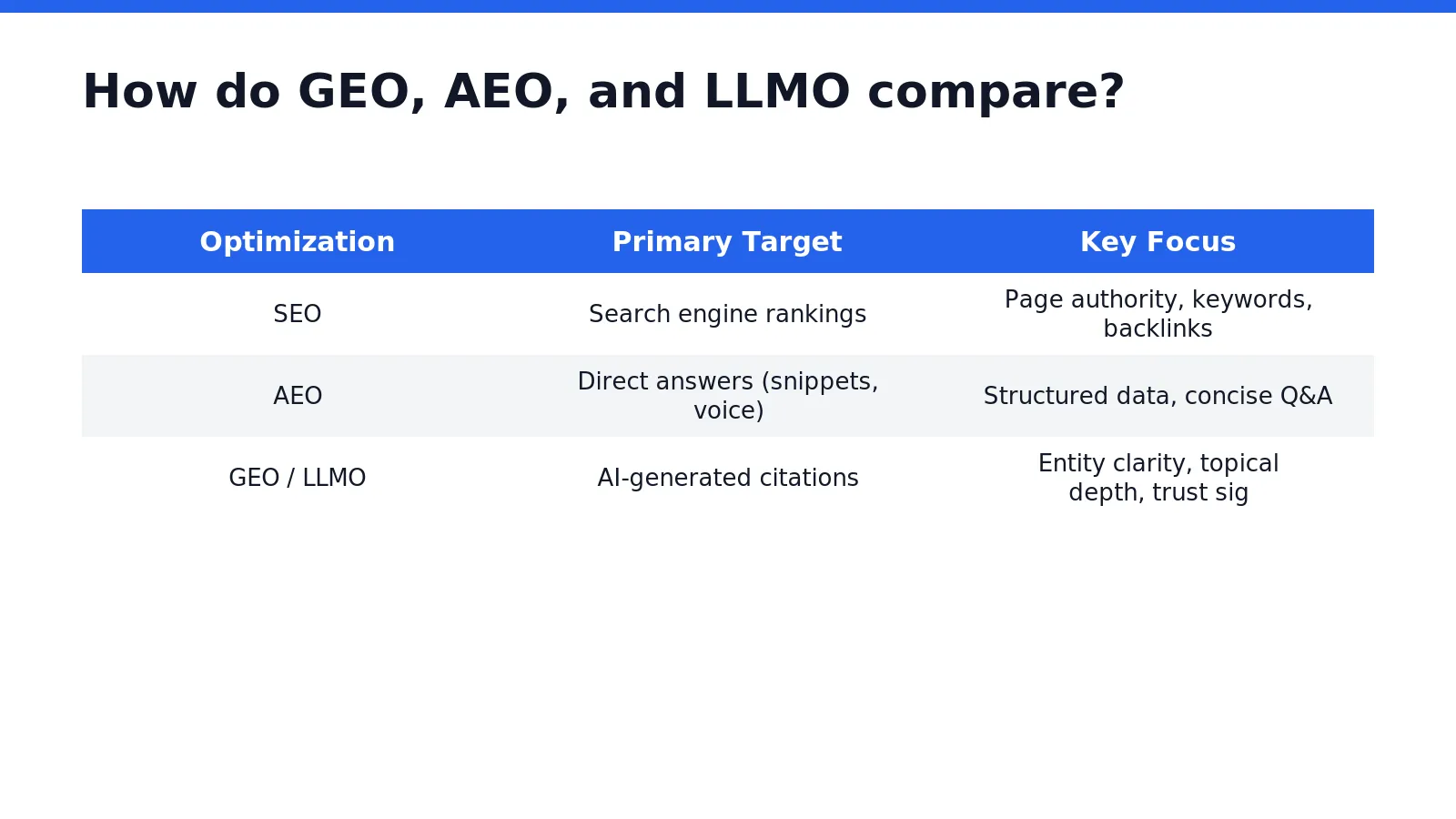
How do GEO, AEO, and LLMO compare?
GEO, AEO, and LLMO target different discovery paths but share a converging playbook. SEO optimizes content for ranking in traditional search results. AEO (Answer Engine Optimization) targets direct-answer features like featured snippets and voice search. GEO (Generative Engine Optimization) and LLMO (Large Language Model Optimization) both optimize for citation inside AI-generated answers from tools like ChatGPT, Perplexity, and Google AI Overviews.
The honest reality, which most acronym-led marketing hides, is that these approaches are largely converging on the same methods. Differences come down to emphasis, not technique. SEO prioritizes page-level ranking signals. AEO focuses on structuring content for instant extraction. GEO and LLMO optimize for how AI systems understand, retrieve, and recommend information.
Which optimization path should a brand prioritize first?
Prioritize AI efforts based on where the target audience currently searches. If customers still use traditional Google search heavily, SEO remains the foundation. If voice queries or featured snippets drive traffic, AEO takes priority. For brands losing visibility to AI-generated answers, GEO and LLMO become urgent. RankAISearch helps businesses strengthen online authority and make content easier for AI systems to understand, retrieve, and recommend across all three paths.

Which AI optimization should you prioritize first?
The answer depends on where a brand’s current visibility gaps sit. The question is not whether to optimize for AI search, but which AI optimization to prioritize first. AI search traffic grew 527% year-over-year between January 2024 and May 2025, according to ZipTie.ai. Zero-click searches, which provide answers without requiring a click, hit 69% by May 2025. These numbers signal a structural shift, not a temporary trend.
GEO vs AEO vs LLMO each address a different part of the discovery funnel. Generative vs answer vs LLM optimization overlap in practice, but the starting point differs by brand maturity. A business with strong traditional SEO rankings but declining organic traffic needs GEO first, since AI platforms are already citing competitors in their answers. A brand with no direct-answer presence needs AEO to capture featured snippets and voice queries.
How does a brand decide which AI optimization to start with?
RankAISearch helps businesses adapt to how customers discover, evaluate, and connect with brands online. The agency starts with an AI visibility audit that maps where a brand appears (or disappears) across ChatGPT, Google AI Overviews, Gemini, Perplexity, and Claude. That audit reveals the specific layer where visibility is weakest.
What does prioritizing AI efforts look like in practice?
A brand that earns strong review signals and consistent citations across trusted platforms becomes a safer recommendation for AI systems. RankAISearch helps brands earn those citations, mentions, and authority, allowing AI platforms to confidently recommend their businesses. The geo aeo llmo comparison matters less than the gap analysis: fix the layer where the brand is invisible first, then layer the others on top.
Conclusion
The choice between GEO, AEO, and LLMO comes down to building a comprehensive strategy that positions your brand where AI systems actively discover and recommend businesses. Start with an audit of your current visibility, prioritize the optimization approach that addresses your biggest gap, then layer in complementary tactics as your authority grows. The brands winning in AI search aren’t waiting for the perfect moment; they’re adapting now, earning the citations and mentions that make AI platforms confident in recommending them. Your visibility across ChatGPT, Google AI Overviews, Gemini, Perplexity, and Claude depends on it.