

Is AI Search Replacing Traditional Search Traffic?
Search traffic is no longer only about who gets the first blue link. A user can now ask a full question and receive a direct AI-generated answer before scanning traditional results. AI search is not fully replacing traditional search, but it is taking over more simple informational and research moments.
The traffic that remains may be more intentional. Users still click when they need to buy, compare, verify, book, contact, or evaluate a brand more deeply. This guide explains how AI search and traditional search now work together in the buyer journey.
Is AI Search Replacing Traditional Search Traffic?
AI search is changing rather than replacing traditional search. Informational queries increasingly get answered directly in AI results, lowering some click-through, while commercial and navigational searches still drive traffic. The shift means visibility now includes being cited, not just ranked.
Traditional search still matters because users still search for brands, products, stores, reviews, comparisons, transactions, and local services. AI search changes the path between query and website by placing synthesized answers before or beside traditional links.
The practical shift is from rank-only visibility to answer visibility. A brand can influence a buyer by being cited in an AI answer even when the user does not click.
| Search Model | Main User Experience | Marketer Impact |
|---|---|---|
| Traditional search | Ranked links and snippets | Traffic depends on rankings and click-through |
| AI Overviews | Synthesized answer above or near results | Some answers happen without a click |
| AI Mode | Conversational search experience | Users may refine inside the interface |
| ChatGPT Search | AI answer with source links | Referral traffic can be smaller but high intent |
| Perplexity | Answer-first search with citations | Source selection matters more than rank alone |
| Copilot | AI answer with web grounding when enabled | Microsoft ecosystem visibility matters |
| Gemini | AI-assisted discovery across Google surfaces | Brand presence can shape research earlier |
How Is AI Search Changing the Way People Find Information?
AI search is changing discovery by turning many searches into answer-first experiences. Users can ask a full question, read a synthesized response, compare options, and refine the query without clicking multiple blue links.
This changes how information is selected. Traditional search gives users a list of sources to evaluate, while AI search chooses sources, summarizes them, and presents a smaller set of cited or implied references.
Google introduced dedicated Search Console reporting for AI Overviews, AI Mode, and generative AI features in Discover in June 2026. This confirms that generative visibility is now a measurable search surface. (Source: Google Search Central Blog, 2026)
| Discovery Behavior | Traditional Search Pattern | AI Search Pattern |
|---|---|---|
| Learning a topic | User clicks several guides | AI summarizes the topic |
| Comparing options | User opens multiple results | AI lists trade-offs |
| Checking facts | User scans snippets and pages | AI gives direct answers |
| Finding sources | User chooses links manually | AI selects citations |
| Refining research | User enters new searches | User asks follow-up prompts |
| Evaluating brands | User visits review and vendor sites | AI blends reviews, sources, and summaries |
AI search also compresses the research journey. One prompt can combine category education, comparison, use case, and recommendation intent.
Which Search Queries Are Most Likely to Lose Clicks?
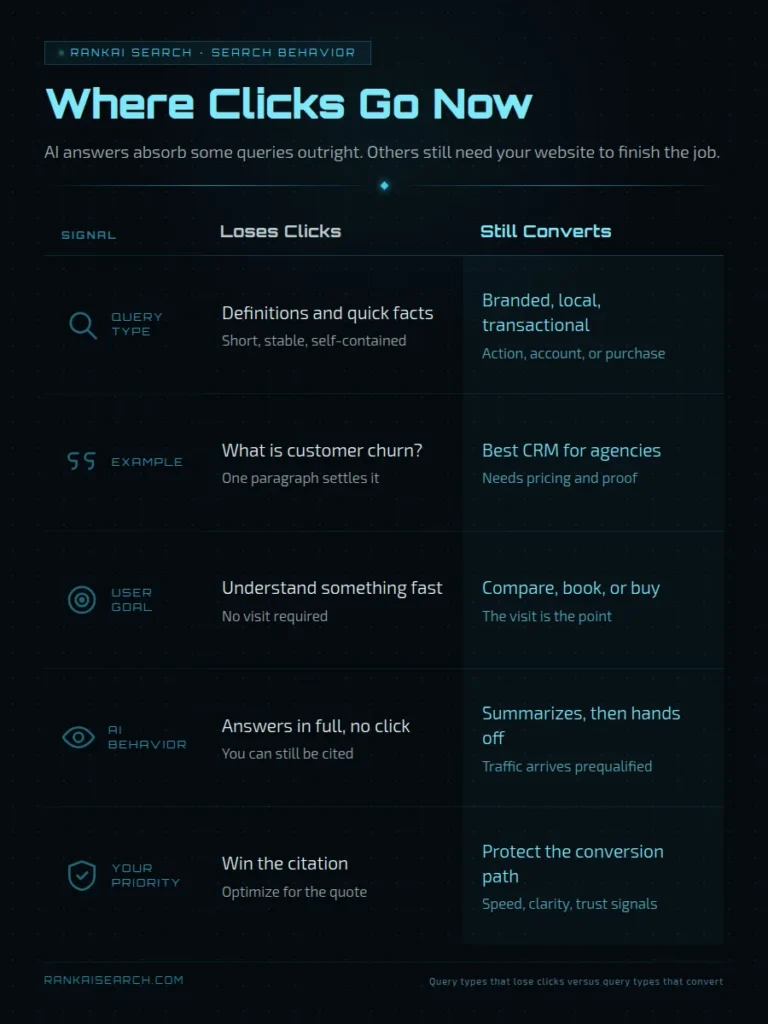
Queries most likely to lose clicks are simple informational queries, definition queries, factual lookups, and broad research questions that AI can answer directly. These queries often do not require a website visit when the answer is short and complete.
Click loss is not equal across all query types. A user asking “What is customer retention?” may stop after an AI summary, while a user asking “best customer retention software for SaaS” may still compare vendors.
Pew Research Center found that Google users clicked a traditional search result in 8% of visits when an AI summary appeared, compared with 15% when no AI summary appeared. (Source: Pew Research Center, 2025)
AI summaries are strongest at reducing clicks when the user needs a quick answer. They are weaker at replacing clicks when the user needs a product, purchase, booking, file, tool, account, or exact brand.
| Query Type | Click Risk | Why It Loses Clicks |
|---|---|---|
| Definition | High | AI can answer in one paragraph |
| Simple fact | High | User needs one data point |
| Basic how-to | Medium to high | AI can summarize steps |
| Broad research | Medium | AI can synthesize sources |
| Comparison | Medium | User may still click for proof |
| Commercial | Lower | User often needs details and trust |
| Navigational | Low | User wants a specific site |
| Transactional | Low | User needs to act on a site |
Simple informational and research queries need a different goal. The goal is not only the click, but also being cited as the source of the answer.
Simple Informational Queries
Simple informational queries are short questions with direct answers. These include definitions, dates, formulas, basic explanations, and common how-to steps.
A simple informational page can still create value if it earns a citation. The brand benefit moves from session volume to awareness, authority, and source influence.
| Simple Query | AI Can Often Answer Because |
|---|---|
| “What is AI search?” | The answer is definitional |
| “What is schema markup?” | The concept can be summarized |
| “How does two-factor authentication work?” | The steps are standard |
| “What is customer churn?” | The definition is stable |
| “What does noindex mean?” | The answer is technical but short |
Research and Comparison Queries
Research and comparison queries lose some clicks when AI systems summarize trade-offs. They still send users to websites when the decision is high value, complex, or risky.
Comparison content should make the brand easy to cite and hard to ignore. A strong page includes criteria, limitations, examples, sources, and decision guidance.
| Research Query | Website Click Still Matters When |
|---|---|
| “Best CRM for agencies” | Buyer needs pricing, demos, and proof |
| “HubSpot vs Salesforce” | Buyer needs detailed feature trade-offs |
| “Alternatives to Asana” | Buyer needs screenshots and migration detail |
| “Best law firms for startups” | Buyer needs credibility and contact options |
| “Top ecommerce analytics tools” | Buyer needs integrations and use cases |
Which Searches Still Send Users to Websites?
Searches that still send users to websites include branded, navigational, transactional, local, product, booking, account, support, and high-consideration commercial searches. These searches require action, verification, purchase, login, contact, or deeper evaluation.
AI can summarize information, but it cannot replace every website interaction. A user still needs a website to buy a product, request a demo, book an appointment, compare plan details, download a resource, access an account, or confirm current policies.
Commercial visits may become fewer but more qualified. A user who arrives after an AI recommendation may already understand the category and the shortlist.
| Search Type | Why It Still Sends Traffic |
|---|---|
| Branded search | User wants the official site |
| Product search | User needs specifications and pricing |
| Local search | User needs location, hours, booking, or contact |
| Transactional search | User needs to buy or sign up |
| Support search | User needs instructions or account help |
| Comparison search | User needs deeper proof |
| Legal or financial search | User needs source verification |
| Demo intent | User needs a form, calendar, or sales contact |
The strongest traffic pages should be protected. These pages should load quickly, answer clearly, and show trust signals before competitors or AI summaries satisfy the user.
Why Can Search Visibility Grow While Organic Traffic Falls?
Search visibility can grow while organic traffic falls because AI results can show, summarize, or cite a page without sending the user to the site. The page gains exposure, but the session never appears as an organic click.
This creates a measurement gap. Traditional SEO reporting often treats the click as the main value event, while AI search can create influence before the click.
A brand can be more visible inside search while its organic sessions decline. This is common when AI answers satisfy informational intent but still mention or cite the brand.
| Metric | What Can Increase | What Can Fall |
|---|---|---|
| Impressions | Page appears more often | Click-through rate can decline |
| AI citations | Brand gets referenced | Organic sessions can decline |
| Brand recall | More users see the name | Direct attribution can weaken |
| Search demand | More users ask related questions | Fewer users click results |
| Conversion rate | Visitors may be more qualified | Total traffic may shrink |
| Assisted influence | AI shapes the decision | Analytics may miss the source |
Marketers need to separate visibility from traffic. A decline in clicks does not always mean the brand lost influence.
How Does AI-Generated Traffic Differ From Traditional Search Traffic?
AI-generated traffic differs from traditional search traffic because it often arrives after the user has already received a summary, recommendation, or comparison. The visit can be more informed, but the volume may be smaller and attribution may be harder.
Traditional search traffic often begins with a user scanning results. AI-generated traffic often begins after the AI system has narrowed the user’s thinking.
AI referrals can be high intent because the AI answer may prequalify the user. A buyer who clicks after asking a detailed prompt may arrive with clearer intent than a user from a broad keyword.
| Attribute | Traditional Search Traffic | AI-Generated Traffic |
|---|---|---|
| Entry point | Ranked result or snippet | AI answer, citation, or recommendation |
| User context | User still compares sources | User may already have a summary |
| Volume | Larger in most analytics accounts | Smaller but growing |
| Intent | Varies by keyword | Often prompt-driven and specific |
| Attribution | Easier through organic source data | Often fragmented by referrer |
| Conversion path | Search result to page | AI answer to page |
| Measurement challenge | Rankings and CTR | Mentions, citations, and hidden influence |
AI-generated traffic should be analyzed by engagement, lead quality, and assisted conversion. Raw sessions alone can understate its value.
What Happens When AI Answers a Question Without a Click?
When AI answers a question without a click, the user may still learn from the cited or summarized source. The website loses a session, but the brand can still gain awareness, trust, and influence if it appears in the answer.
Zero-click behavior existed before generative AI through snippets, maps, calculators, panels, and direct answers. AI search expands zero-click behavior by answering more complex questions in one response.
A no-click answer can still create demand. The user may later search the brand directly, visit through another channel, or mention the AI recommendation in a sales call.
| No-Click Outcome | What It Means |
|---|---|
| Brand mention | User sees the brand without visiting |
| Source citation | User can verify the claim if needed |
| Category education | User learns the concept from the answer |
| Delayed visit | User returns later through branded search |
| Assisted conversion | AI influences the decision off-site |
| Lost ad revenue | Publisher loses monetized pageview |
| Reduced attribution | Analytics misses the influence |
No-click visibility should be measured differently. The goal is to track whether the brand appears, how accurately it appears, and whether demand later moves through other channels.
How Should Marketers Measure Search Performance During This Shift?
Marketers should measure search performance with rankings, impressions, clicks, click-through rate, AI mentions, AI citations, AI referrals, brand demand, assisted conversions, and revenue quality. Traditional organic traffic is no longer enough.
Measurement should show both discoverability and influence. A brand can be absent from AI answers while ranking well, or cited in AI answers while receiving fewer clicks.
AI performance should be tracked by prompt set, not only keyword set. Prompts often combine intent, audience, comparison, and context in one query.
| Measurement Area | Metric | Why It Matters |
|---|---|---|
| Traditional SEO | Rankings | Shows classic visibility |
| Traditional SEO | Impressions | Shows search exposure |
| Traditional SEO | Clicks | Shows traffic delivery |
| Traditional SEO | CTR | Shows click loss or gain |
| AI visibility | Mentions | Shows whether the brand appears |
| AI visibility | Citations | Shows which sources are used |
| AI traffic | Referrals | Shows direct AI-driven visits |
| Brand impact | Branded search | Shows delayed demand |
| Business impact | Leads or revenue | Shows commercial value |
Rankings, Impressions, and Organic Clicks
Rankings, impressions, and organic clicks still matter because traditional search remains a major discovery and conversion channel. These metrics show whether pages are visible and whether users still choose them.
A falling CTR with stable rankings can signal AI summary pressure, SERP feature crowding, or a shift in intent. It does not automatically mean the page lost relevance.
| Traditional Metric | What To Watch |
|---|---|
| Average position | Ranking stability |
| Impressions | Demand and visibility |
| Organic clicks | Traffic delivered |
| CTR | Click efficiency |
| Query mix | Intent changes |
| Landing pages | Pages losing or gaining traffic |
| Branded search | Downstream demand |
AI Mentions, Citations, and Referrals
AI mentions, citations, and referrals measure whether AI systems are using or recommending the brand. These metrics show answer visibility that rankings alone cannot capture.
Track the same prompts over time across Google AI features, ChatGPT, Perplexity, Gemini, Claude, and Copilot. Record whether the answer names the brand, links the brand, cites the brand’s page, or cites a third-party source.
| AI Metric | What To Record |
|---|---|
| Brand mention | Whether the brand appears |
| Citation URL | Which source supports the answer |
| Competitor mention | Which brands appear instead |
| Sentiment | Whether the brand is described accurately |
| Source freshness | Whether citations are current |
| Referral source | Whether visits arrive from AI tools |
| Prompt class | Informational, commercial, local, or support |
How Should Your Content Strategy Adapt to AI Search?
Your content strategy should adapt by creating pages that answer direct questions, explain trade-offs, provide citable evidence, and satisfy both AI extraction and human evaluation. AI search rewards content that is clear, specific, current, and useful.
The biggest change is that content must work at the passage level. A strong page needs quotable answer blocks, question headings, direct definitions, tables, examples, and source-backed claims.
Google says its guidance for generative AI experiences is still rooted in creating helpful content and making pages accessible to Google Search systems. (Source: Google Search Central, 2026)
Marketers should avoid writing only for broad keywords. AI prompts often include audience, context, comparison, constraints, and desired outcome.
| Content Shift | Traditional SEO Focus | AI Search Focus |
|---|---|---|
| Keyword targeting | Short keyword phrases | Natural-language questions |
| Page goal | Rank and earn clicks | Rank, cite, and influence |
| Content unit | Full page | Passage and page |
| Evidence | Helpful for trust | Essential for citation |
| Structure | Headings and sections | Answer-first passages |
| Optimization | SERP position | Mentions, citations, and referrals |
| Maintenance | Periodic refresh | Continuous source accuracy |
Which Pages Should You Protect and Prioritize?
You should protect and prioritize pages that drive revenue, support buying decisions, earn links, appear in AI answers, or answer high-intent questions. These pages carry the highest risk and upside during the shift from click-based search to answer-based discovery.
Not every page deserves the same level of investment. A glossary page may lose clicks but still build authority, while a pricing page or comparison page may still convert high-intent users.
Prioritization should consider query type and business value. Informational pages need citation strategy, while commercial pages need click protection and conversion clarity.
| Page Type | Priority Reason | Main Action |
|---|---|---|
| Product pages | Revenue and conversion | Improve specs, proof, and structured data |
| Service pages | Lead generation | Answer buyer questions directly |
| Comparison pages | Commercial evaluation | Explain trade-offs and proof |
| Pricing pages | Budget validation | Keep pricing clear and current |
| Local pages | Contact and booking | Update NAP, hours, services, and reviews |
| Support pages | Customer retention | Make instructions crawlable and current |
| Research pages | Citation authority | Add sources, methods, and summaries |
| Glossary pages | Definition visibility | Add concise, citable definitions |
Protect pages with conversion paths first. Prioritize pages already losing clicks but still earning impressions or AI citations.
How Can You Earn Visibility in Both AI and Traditional Search?
You can earn visibility in both AI and traditional search by combining SEO fundamentals with answer-first content, source credibility, structured pages, internal links, and entity clarity. The same page should be crawlable, rankable, quotable, and useful.
AI visibility does not replace technical SEO. Search engines and AI retrieval systems still depend on crawl access, indexability, page quality, content relevance, and source trust.
This means ranking alone is not enough. A brand should also create the kind of passages and sources AI systems can select independently.
| Visibility Layer | Traditional Search Role | AI Search Role |
|---|---|---|
| Technical SEO | Enables crawling and indexing | Enables retrieval |
| Content quality | Supports ranking | Supports answer selection |
| Structured data | Clarifies page meaning | Supports machine interpretation |
| Internal links | Distributes authority | Connects entities and topics |
| Citations | Supports trust | Supports source selection |
| Brand entity | Improves recognition | Improves answer consistency |
| Freshness | Protects ranking relevance | Protects answer accuracy |
A dual strategy should serve both users and machines. The page should answer clearly, prove claims, and make the next action obvious.
What Mistakes Should Marketers Avoid When Responding to AI Search?
Marketers should avoid abandoning SEO, overreacting to traffic drops, blocking important crawlers without a plan, publishing thin AI-targeted content, ignoring citations, and measuring only organic sessions. These mistakes reduce visibility across both search systems.
The most dangerous response is treating AI search as separate from search fundamentals. AI systems still need accessible, useful, trusted, and well-structured source material.
Marketers should not create low-value pages for every AI prompt variation. Better results come from strong pages that answer clusters of related questions with evidence and clarity.
| Mistake | Better Response |
|---|---|
| Stop SEO investment | Adapt SEO for AI search surfaces |
| Chase every AI prompt | Prioritize prompts tied to business value |
| Publish thin answer pages | Build authoritative topic pages |
| Ignore traditional rankings | Keep ranking and click data |
| Ignore AI citations | Track mentions and sources |
| Block crawlers reactively | Review crawler policy strategically |
| Hide useful content behind gates | Publish crawlable summaries |
| Measure only sessions | Track visibility, influence, and revenue |
AI search requires more discipline, not more content volume. Quality, proof, and source clarity matter more as answers become compressed.
What Should You Remember About AI Search and Traditional Traffic?
You should remember that AI search changes traffic patterns, but it does not erase the need for traditional search visibility. Marketers now need to earn rankings, citations, mentions, referrals, and qualified demand.
AI search creates a wider visibility model. A brand can influence users through an AI answer, a cited source, a review summary, a product recommendation, or a follow-up prompt.
| Principle | Practical Action |
|---|---|
| AI search reduces some clicks | Track CTR by query type |
| Traditional search still converts | Protect commercial and navigational pages |
| Citations matter | Build citable passages and sources |
| Mentions matter | Track brand presence in AI answers |
| Traffic quality matters | Measure engagement and conversion |
| Source accuracy matters | Refresh outdated pages and profiles |
| SEO still matters | Keep pages crawlable, useful, and structured |
The new search strategy is not SEO versus AI. It is SEO plus AI visibility, measured with a broader set of signals.
Adapting Your Search Strategy for Evolving User Behavior
AI search is changing how users discover information, compare brands, and decide when a website visit is necessary. A balanced strategy must protect high-value organic traffic while also building visibility through AI citations, mentions, recommendations, and qualified referrals.
RankAISearch can help identify which pages are most vulnerable to click loss and which have the strongest opportunities for AI visibility. This creates a clearer path for adapting your content, measurement, and search priorities without abandoning the SEO foundations that continue to drive conversions.
Schedule an AI search assessment with RankAISearch to evaluate your current visibility and prepare your strategy for the changing search journey.
Frequently Asked Questions About AI Search and Traditional Search Traffic
Will AI search eventually replace Google and other search engines?
AI search will not replace all traditional search behavior in the near term. It will absorb more informational and research behavior while traditional search continues to support navigation, transactions, local actions, and product discovery. Search engines are also adding AI features inside traditional search. The replacement is better understood as convergence, not a clean switch.
Which websites are most vulnerable to losing organic traffic?
Websites most vulnerable to losing organic traffic are sites that depend heavily on simple informational queries. Definition sites, basic how-to publishers, fact lookup pages, and low-differentiation content libraries face higher risk. Sites with unique tools, original data, strong brands, communities, products, and commercial value are better protected. Their pages give users reasons to click beyond the summary.
Does appearing in an AI answer still benefit a brand without a click?
Yes, appearing in an AI answer can benefit a brand without a click. The brand can gain awareness, perceived authority, and shortlist consideration. The value depends on accuracy and prominence. A positive cited mention is more useful than an uncited or incorrect mention.
Are commercial searches less affected by AI-generated answers?
Yes, commercial searches are generally less affected than simple informational searches. Buyers often still need pricing, demos, reviews, screenshots, specifications, comparisons, and checkout pages. AI can influence the shortlist before the click. The website still matters when the user needs proof or action.
Is traffic from AI tools more valuable than standard organic traffic?
Traffic from AI tools can be more valuable when the user arrives after a specific recommendation or comparison. These visitors may already understand the problem and the shortlisted options. It is not always more valuable. Compare engagement, conversion rate, pipeline quality, and assisted revenue instead of assuming AI traffic is better.
How can you identify visits coming from AI search platforms?
You can identify AI search visits by reviewing referral sources, source and medium reports, server logs, and landing page patterns. Common sources may include chatgpt.com, perplexity.ai, copilot.microsoft.com, gemini.google.com, and other AI platforms. Some AI influence will not appear as referral traffic. Ask sales teams, add self-reported attribution fields, and monitor branded search changes.
Should marketers reduce their investment in traditional SEO?
No, marketers should not reduce traditional SEO without evidence from their own data. Traditional SEO still supports crawling, indexing, rankings, branded discovery, local visibility, commercial pages, and AI retrieval. The smarter move is to expand SEO. Add AI citation tracking, answer-first content, source authority work, and prompt-based visibility measurement.
How can businesses forecast traffic as AI search adoption grows?
Businesses can forecast traffic by segmenting pages by query intent, AI exposure, current CTR, revenue value, and citation opportunity. Informational pages should be modeled differently from commercial, local, branded, and transactional pages. Use scenarios instead of one forecast. Model conservative, moderate, and aggressive click-loss cases while tracking AI mentions and conversions.