

AI SEO vs Traditional SEO: Which Strategy Wins
Traditional SEO targets rankings on Google through keywords, backlinks, and page structure. AI SEO optimizes content for engines like ChatGPT, Perplexity, and Gemini that summarize answers instead of listing links. Marketers pursuing AI SEO prioritize clear entity statements, structured facts, and citation-worthy authority signals over keyword density alone.
Key Takeaways
- AI SEO and traditional SEO solve different visibility problems; most businesses need both strategies simultaneously.
- Traditional SEO drives clicks through search results; AI SEO earns citations inside ChatGPT, Gemini, and Perplexity answers.
- AI platforms like Google AI Overviews, Claude, and Copilot require optimized content for confident business recommendations.
- Generative Engine Optimization strengthens online authority through citations, mentions, and AI-readable content structures.
What is the core difference between AI SEO and traditional SEO?
Traditional SEO focuses on improving a website to rank higher in search engine results pages (SERPs) and drive clicks. AI SEO focuses on optimizing content so it gets cited inside AI-generated answers from tools like ChatGPT, Gemini, and Google’s AI Overviews. The two disciplines solve different visibility problems, and most businesses need both.
AI SEO vs traditional SEO isn’t a competition — it’s a complement. Treating them as an either-or choice leads businesses to under-invest in one at real cost. Traditional SEO optimizes for a human clicking a link. AI SEO optimizes for an AI model extracting and summarizing a brand’s information without a click at all.
How do the tactics differ between the two?
When marketers compare AI SEO tactics to traditional ones, the shift becomes clear. Traditional SEO relies on keyword density, meta tags, backlinks, and internal linking to signal relevance to search engine crawlers. AI SEO prioritizes clear, authoritative, and structured content that an LLM can easily parse, summarize, and cite. The goal shifts from ranking a page to becoming a trusted source an AI model recommends.
What changes with AI search for content strategy?
What changes with AI search is the measurement of success. Traditional SEO tracks impressions, click-through rates, and organic traffic. AI SEO tracks citation frequency, brand mentions inside AI answers, and referral traffic from zero-click queries. RankAISearch helps brands earn those citations and mentions, building the authority that allows AI platforms to confidently recommend a business.

What changes with AI search for your current strategy?
Traditional SEO still runs on keyword relevance, backlink authority, technical performance, and E-E-A-T — none of that has become obsolete. What changes with AI search is the addition of a second visibility layer. AI SEO gets a business cited inside AI-generated answers on platforms like Google AI Overviews, ChatGPT, and Perplexity — often without a click at all. A brand can rank #1 in Google search results yet remain invisible inside an AI summary.
How does AI search optimization differ from traditional SEO?
Traditional SEO optimizes content for search engine result pages (SERPs) to drive clicks to a website. AI search optimization vs SEO centers on a different goal: earning direct citations inside AI-generated responses. RankAISearch specializes in Generative Engine Optimization (GEO), Answer Engine Optimization (AEO), AI SEO, and LLM Optimization. Disciplines that make content easier for AI systems to retrieve and recommend. The tactics overlap but the success metric shifts from click-through rate to citation frequency.
What stays the same when comparing AI SEO tactics?
When marketers compare AI SEO tactics to traditional methods, the foundational elements remain unchanged. Technical performance, authoritative backlinks, and demonstrated expertise still matter. The difference lies in how AI systems process content. AI models favor clear, structured, and directly answer-focused writing over keyword-dense prose. SEO vs AI search strategies converge on authority signals but diverge on content format and retrieval logic.
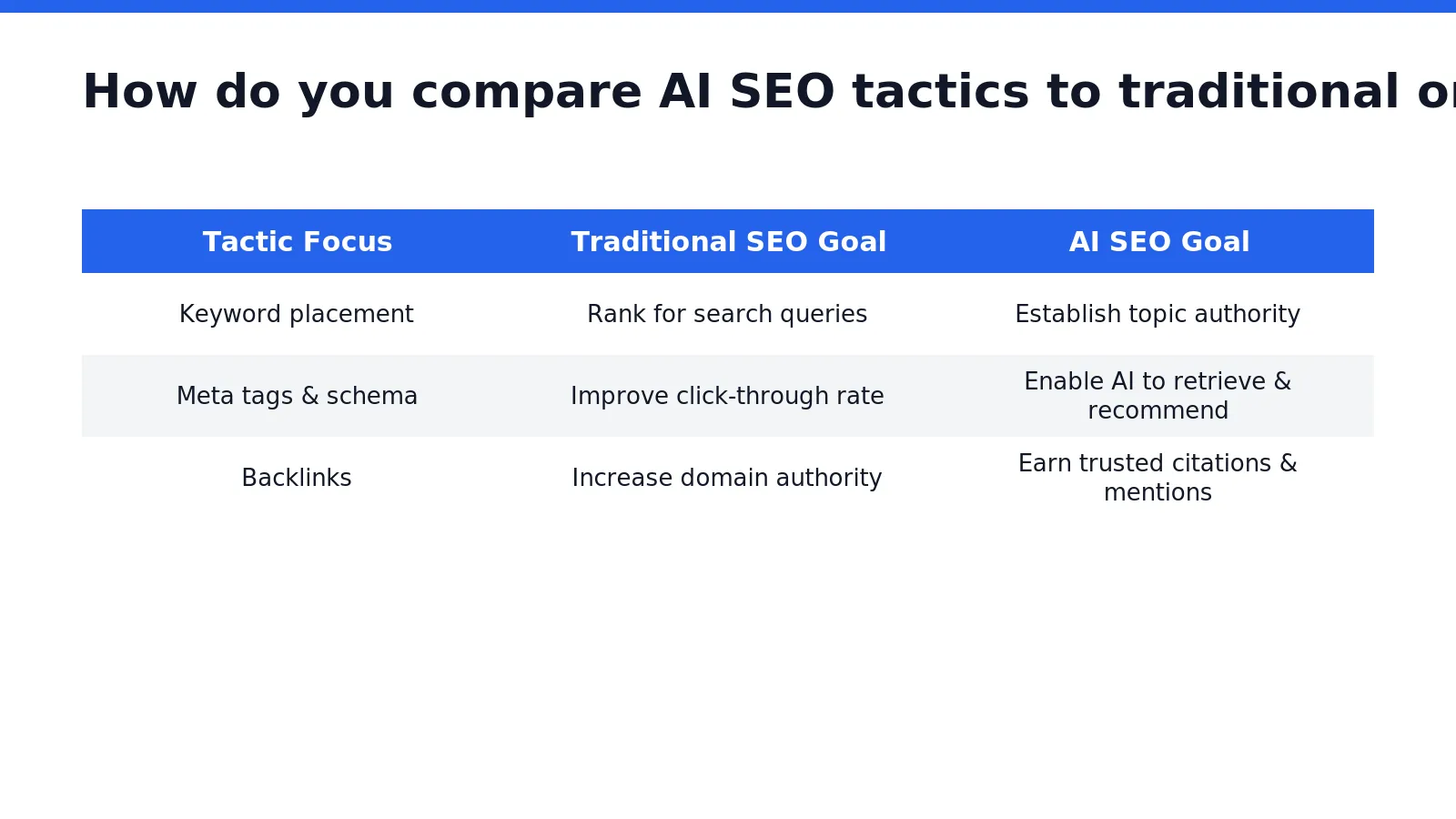
How do you compare AI SEO tactics to traditional ones?
Traditional SEO tactics and AI SEO tactics aim at entirely different discovery problems. Traditional SEO focuses on cosmetic website changes — like keyword density, alt tags, internal linking, meta tags, and schema markup — to push a page up search engine results pages and earn a click. AI search optimization vs SEO analysis reveals that AI tactics shift the focus away from surface-level signals onto authority and substantive content quality.
What changes with AI search compared to traditional search?
What changes with AI search is the ranker itself. Traditional search crawls keywords, backlinks, and on-page tags. AI-powered tools like ChatGPT look for authority and trustworthiness — the very factors traditional SEO often neglects. A page can have perfect meta descriptions and still lose visibility in AI answers if the content lacks credible sources or verified claims.
How do traditional tactics fall short against AI search?
Seo vs ai search comparisons highlight one critical gap: cosmetic fixes don’t build trust. A brand that pours resources into internal linking and schema but ignores authority-building loses ground when ChatGPT needs a source to cite. Compare AI SEO tactics to traditional ones by asking whether each tactic builds credibility or just signal surface shine.
RankAISearch helps brands close this gap — strengthening online authority, earning trusted citations, and making content easier for AI systems to understand and recommend across ChatGPT, Google AI Overviews, Gemini, and Perplexity.
Conclusion
In closing, the shift from traditional SEO to AI SEO represents a fundamental evolution in how businesses earn visibility and trust online. While foundational SEO principles remain valuable, the rise of AI-powered search platforms demands a new strategic approach—one that prioritizes content clarity, authority building, and optimization for how AI systems understand and recommend information. Brands that embrace both strategies, adapting their visibility efforts across traditional search and generative engines, position themselves to thrive in an increasingly AI-driven discovery landscape.