

How Is Zero-Click Search Changing Digital Marketing Strategy?
Zero click search has shifted the primary goal of digital marketing from earning clicks to earning visibility. Over 57% of desktop searches and 77% of mobile searches end without a click. AI-generated answer formats now appear on more than 30% of all search result pages.
Brands that structure content for extraction and AI citation maintain visibility even when users never click through to their websites. This guide covers how zero click search works, how it affects brand authority and conversion, and which optimization strategies earn placement across Google AI Overview, ChatGPT, and Perplexity.
What Is Zero Click Search and Why Does It Matter?
Zero click search occurs when users receive complete answers directly on search results pages, without visiting any website. Google delivers these answers through:
- Featured snippets: Direct answers pulled from a webpage and displayed at the top of results
- Knowledge panels: Brand or entity overviews sourced from structured data
- AI Overviews: Synthesized responses generated from multiple sources
AI platforms like ChatGPT and Perplexity extend this further by delivering conversational responses that eliminate browsing entirely.
Zero click results determine which brands get recognized as trusted sources. Visibility here shapes brand perception and influences purchase decisions made hours or days later, even without a single click.
How Has Search Behavior Evolved from Click-Based to Answer-Based?
Search behavior has shifted from clicking multiple links to expecting one complete answer on the results page. The table below shows how user expectations have changed:
| Old Search Behavior | New Search Behavior |
| Click multiple links to compare sources | Expect one complete answer on the results page |
| Deep reading of full articles | Scanning for key facts |
| Long-form exploration across multiple pages | Single-result interaction |
| Keyword-based queries | Conversational, question-based queries |
Marketing strategies that prioritize immediate clarity now align with how AI systems select and surface information.
How Does Zero Click Search Impact Your Brand Visibility?
Zero click search creates a paradox for digital marketers: brand impressions can increase even as website traffic falls. The two most significant effects are on how traffic is measured and how authority is built.
Traffic Loss and Opportunity
A featured snippet can generate thousands of impressions while delivering only a fraction of those as clicks. Users who see your brand in zero click results may return directly later, bypassing search entirely.
Track these signals instead of relying on click data alone:
- Featured snippet appearance frequency
- Knowledge panel presence
- AI-generated answer mentions
- Impression share by topic area
- Branded search volume growth
Authority and Trust Signals
Being cited in zero click results builds credibility that paid advertising cannot replicate. According to Edelman’s Trust Barometer, search engines rank among the most trusted information sources globally.
AI citations function as endorsements:
- Perplexity referencing your research signals topical authority
- Google AI Overview citing your content validates your expertise
- Repeated mentions across multiple queries build lasting brand familiarity
How Do You Optimize Content for Zero Click Search?
Optimizing for zero click search means structuring content so AI systems can extract, cite, and recommend it accurately. Two core areas drive the most impact: information architecture and question-based keyword targeting.
Structuring Information for Direct Answers
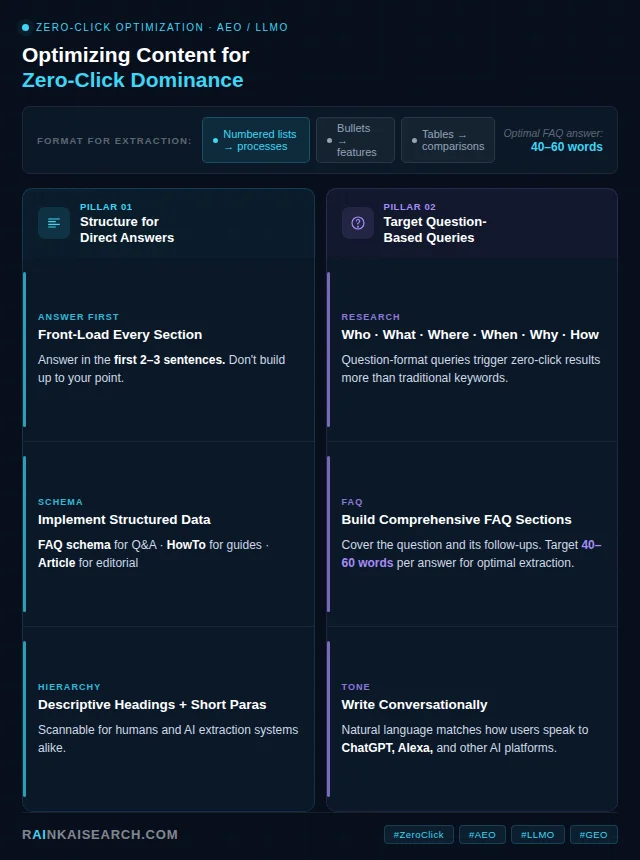
Lead each section with a complete, standalone answer in the first two sentences. Background and supporting detail follow the direct answer; they never precede it.
Content formatting that earns zero click placement:
- Short paragraphs (2 to 3 sentences maximum)
- Numbered lists for processes and step-by-step instructions
- Bulleted lists for features, benefits, and comparisons
- Tables for multi-attribute data
Schema markup helps search engines interpret your content’s structure. Implement the type that matches your format:
| Schema Type | Best For | Zero-Click Benefit |
| FAQ Schema | Question-and-answer pairs | Increases featured snippet eligibility |
| HowTo Schema | Step-by-step instructions | Triggers rich results for process queries |
| Article Schema | Editorial and news content | Improves indexing accuracy and classification |
Targeting Question-Based Queries
Queries starting with who, what, where, when, why, and how trigger zero click results more frequently than traditional keyword phrases.
To maximize featured snippet capture:
- Answer each question completely in 40 to 60 words
- Cover follow-up questions users are likely to ask next
- Write in conversational language that mirrors how people speak
- Avoid keyword strings; write for voice search and AI interactions
Adapting Digital Marketing Strategies for Zero-Click Search
Adapting to zero click search means redefining what success looks like and building content that serves multiple AI platforms simultaneously. Two strategic areas drive the most impact: KPI restructuring and multi-platform content design.
Redefining Success Metrics Beyond Traffic
Replace click-focused KPIs with metrics that reflect zero click performance:
| Metric | What It Measures | Why It Matters |
| Impression count | How often your brand appears in results | Shows true visibility beyond click data |
| Featured snippet capture rate | Frequency of winning snippet positions | Direct indicator of zero click performance |
| AI mention frequency | Citations across ChatGPT, Perplexity, AI Overview | Measures authority across AI platforms |
| Branded search volume growth | Users searching your brand name directly | Signals awareness and recall lift |
| Visibility share | Your brand’s proportion of impressions in a topic | Benchmarks presence against competitors |
Survey customers about how they discovered your brand to connect zero click exposure to actual conversions.
Building Multi-Platform Optimization Strategies
Each major AI platform uses different algorithms, but all prioritize authoritative, well-structured content. To serve Google AI Overview, ChatGPT, and Perplexity simultaneously:
- Use a pyramid structure: key answer first, supporting detail after
- Build topic clusters, not isolated articles
- Update content regularly with fresh, verified statistics
- Maintain consistent terminology across all pages in a cluster
What Role Does Answer Engine Optimization Play in Zero Click Success?
Answer Engine Optimization (AEO) is the practice of structuring content so AI systems can extract, cite, and recommend it in response to user queries. AEO goes beyond traditional SEO by optimizing for how platforms like ChatGPT, Perplexity, and Google AI Overview interpret and present information. RankAISearch, a global agency specializing in AEO, GEO, AIO, LLMO, and SEO, develops these strategies for brands competing across AI-first platforms.
The brand that AI cites most consistently wins more lasting authority than the brand that simply ranks highest.
AEO and traditional SEO serve different but complementary functions:
| Traditional SEO | Answer Engine Optimization (AEO) | |
| Primary goal | Rank for clicks | Earn citations and featured placement |
| Success metric | Click-through rate, organic traffic | Impression share, AI mention frequency |
| Content format | Long-form articles, keyword targeting | Structured, extractable answer chunks |
| Optimization target | Search ranking algorithms | AI extraction and recommendation systems |
| Typical result timeline | 3 to 6 months for ranking gains | 60 to 90 days for featured snippet capture |
Core AEO content practices:
- Cite authoritative sources with verifiable data points
- Keep terminology consistent throughout each piece
- Write plain, direct sentences AI systems can reproduce accurately
- Structure each paragraph to answer one specific question
How Do You Convert Zero Click Visibility into Business Results?
Zero click visibility drives business results through brand awareness accumulation and content designed to pull users deeper into the funnel. Two levers determine how effectively visibility becomes revenue: awareness compounding and intentional click incentives.
Brand Awareness as a Conversion Driver
Repeated exposure to your brand across featured snippets and AI answers builds recognition that persists long after a search session ends. The Branding Journal shows familiarity significantly increases brand preference at the point of purchase.
Zero click visibility compounds awareness through:
- Repeated brand name appearances across related queries
- Association between your brand and specific topic areas
- Reduced friction when users eventually visit your site or reach out
Strategic Call-to-Action Placement
Provide complete answers to earn zero click placement, then give users a reason to go further. After addressing a basic question, reference:
- Exclusive data or proprietary research available on your site
- Advanced guides or case studies that require a deeper read
- Interactive tools users can only access by visiting your website
Frame these as natural next steps, not promotional prompts. This approach maintains zero click eligibility while converting awareness into qualified traffic.
How Do You Future-Proof Your Marketing for AI-First Search?
Future-proofing for AI-first search means building content that serves multiple formats as search becomes more conversational, multimodal, and personalized. Brands that invest in multi-format content now maintain visibility as these modalities expand.
Content formats that extend zero click reach:
- Video: Clear verbal explanations AI can transcribe and reference
- Infographics: Descriptive alt text that explains visual information in full
- Podcasts: Detailed show notes covering key topics in structured form
Technical fundamentals that remain constant regardless of platform changes:
- Thorough, accurate answers to real user questions
- Consistent schema markup implementation
- Clean site structure and fast mobile performance
- Regular content updates with fresh, sourced statistics
Frequently Asked Questions
What percentage of searches result in zero clicks?
Over 57% of desktop searches and 77% of mobile searches result in zero clicks. Informational queries are most affected; transactional searches still generate substantial click-through rates.
How can businesses benefit from zero click search results?
Businesses gain brand visibility, authority signals, and trust-building exposure even without immediate clicks. Featured placement positions your brand as an industry expert and creates top-of-funnel awareness that drives conversions later in the buyer journey.
Does zero click search mean the end of website traffic?
Zero click search reduces traffic for informational queries but does not eliminate it. Users seeking deeper information, products, or services still visit websites. Transactional and navigational queries continue driving meaningful click traffic.
What types of content perform best in zero click environments?
Direct question answers, structured how-to guides, comparison articles with clear data, and comprehensive FAQ sections perform best. Answers formatted in 40 to 60 words with question-based headings and proper schema markup earn featured snippet placement most consistently.
How do you measure success when users don’t click through to your site?
Measure success through impression counts, featured snippet capture rate, brand mention frequency in AI answers, visibility share, and branded search volume growth. Track AI citation frequency across ChatGPT, Perplexity, and Google AI Overview, and survey customers about how they discovered your brand.
Should businesses still invest in traditional SEO if zero click search dominates?
Yes. Traditional SEO remains the foundation for zero click success. Technical optimization, quality content, and authority building all contribute directly to featured snippet capture and AI citation eligibility. The most effective approach combines traditional SEO with AEO.
How does zero click search affect paid advertising strategies?
Zero click search makes paid advertising more valuable for capturing transactional intent, while organic zero click results handle informational queries. Focus paid campaigns on commercial keywords where users are ready to act. Brand awareness from zero click exposure often improves paid ad performance and lowers cost per acquisition.
How long does it take to see results from zero click optimization?
Zero click optimization can produce measurable featured snippet gains in 60 to 90 days. AI citation visibility in ChatGPT or Perplexity depends on content authority and topical depth, and typically takes longer. Brands building topical authority across content clusters see faster gains than those publishing in isolation.