

LLM Providers: Which Models Favor Citations

LLM Providers: Which Models Favor Citations
Perplexity favors external citations most heavily, since web search stays enabled by default, unlike OpenAI and Gemini in comparable testing. A 5.17-million-domain citation analysis found citation behavior varies by provider, shaping how brands earn mentions. Marketers targeting AI visibility should prioritize source quality signals that align with each model’s distinct citation and retrieval patterns.
Key Takeaways
- OpenAI, Gemini, and Perplexity models generate over 5.17 million domain citations across research responses.
- LLM providers demonstrate varying citation preferences, with some models prioritizing external sources more consistently than others.
- Deep research agents synthesize information from hundreds of web sources, requiring robust source attribution and verification systems.
- Citation accuracy directly impacts your brand’s visibility when AI platforms recommend your content to users seeking authoritative answers.
Which LLM providers cite external sources most?
A study of 5.17 million domain citations across OpenAI, Gemini, and Perplexity reveals that commercial websites dominate llm providers citation patterns. Findings show that commercial domains dominate model outputs, while academic and government sources remain significantly underrepresented. This pattern holds consistently across all three major llm providers, letting commercial content crowd out less discoverable sources.
Why do commercial domains dominate LLM citations?
Commercial websites publish content optimized for discoverability, with clear structure, frequent updates, and broad topical coverage. Academic and government domains often use dense formatting, paywalled content, or specialized language that model citation behavior struggles to parse. The study’s analysis of llm review patterns shows that AI systems favor sources with high accessibility and consistent publishing cadence.
How can brands improve their citation rates?
RankAISearch helps brands earn citations, mentions, and authority, allowing AI platforms to confidently recommend their businesses. The strategy involves:
- Creating content structured for AI retrieval, with clear headings and factual claims
- Building citations across commercial domains that llm providers already favor
- Monitoring model citation behavior to identify which source types drive visibility
For a deeper look at how this works, explore LLM Optimization services.
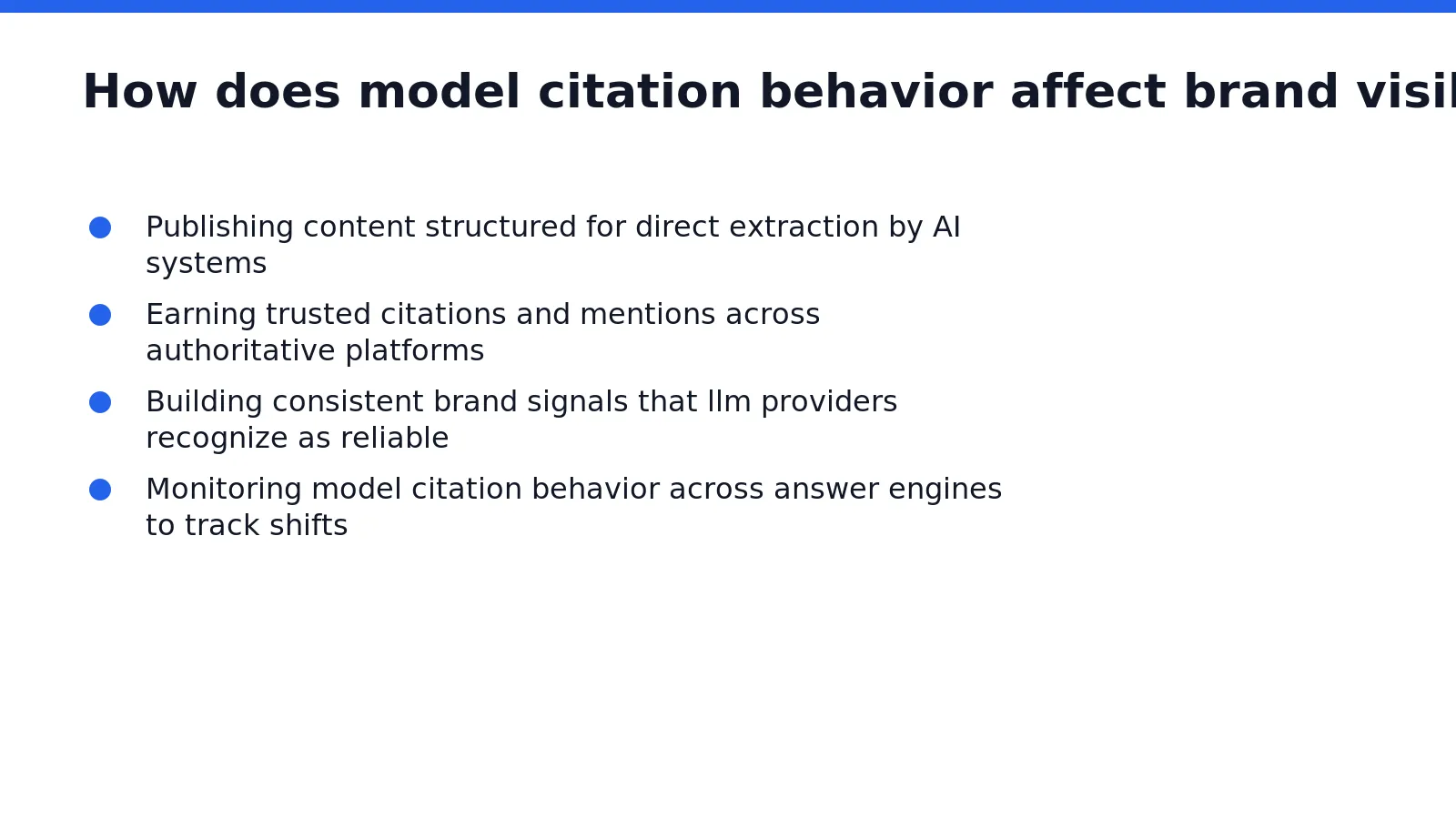
How does model citation behavior affect brand visibility?
Model citation behavior determines whether an AI answer engine names a brand at all. Large language models power deep research agents that synthesize information from hundreds of web sources into cited reports, yet those citations cannot be reliably verified. A brand can rank on page one of Google but may not be mentioned in the answers provided by ChatGPT, Perplexity, or Gemini.
The core problem sits in how current systems validate sources. Existing approaches either trust models to self-cite accurately, which risks bias, or employ retrieval-augmented generation (RAG) that does not validate source accessibility, relevance, or factual consistency. Neither path guarantees a brand’s content earns a mention.
Why do unverified citations hurt brand visibility?
Unverified citations create a visibility lottery. When an AI system cannot confirm a source’s accessibility or factual consistency, the model falls back on whatever content it recognizes most readily. Brands with clear, structured, authority-rich content win that recognition. Brands without it disappear from answers entirely.
How can brands improve their citation odds?
RankAISearch specializes in Generative Engine Optimization (GEO), Answer Engine Optimization (AEO), AI SEO, and LLM Optimization to strengthen online authority. The practical playbook includes:
- Publishing content structured for direct extraction by AI systems
- Earning trusted citations and mentions across authoritative platforms
- Building consistent brand signals that llm providers recognize as reliable
- Monitoring model citation behavior across answer engines to track shifts
Every llm review of a brand’s digital footprint should start with one question: does the content survive AI verification? If not, the brand loses visibility it never sees reported. Learn more about this approach in our guide on AI optimization.

What should an llm review of citation sources reveal?
An llm review of citation sources must reveal exactly which pages earn brand citations across AI platforms. How that citation share shifts over time. Tools like AirOps track brand citations across ChatGPT, Perplexity, and Google, showing marketers which content earns AI mentions and which loses ground. Without this data, teams cannot diagnose why a brand disappears from AI-generated answers.
Why does citation share matter for brand visibility?
A brand can rank on page one of Google and still disappear from the answers buyers receive from ChatGPT, Perplexity, and Gemini. Model citation behavior varies significantly across llm providers, meaning a brand cited by one AI system may go completely unmentioned by another. Citation share reveals which platforms favor a brand’s content and which ignore it entirely.
What should brands track in an llm review?
- Citation frequency per platform — how often each AI system references the brand
- Source page performance — which specific URLs earn citations across different models
- Citation share trends — whether brand mentions increase or decrease month-over-month
- Competitor citation gaps — where rival brands appear but the client does not
RankAISearch helps brands adapt to this changing discovery landscape through AI visibility audits and content optimization. These audits reveal exactly where citation gaps exist and which content adjustments close them. Get started with our AI Visibility Strategy: Building Brand Authority in Brands.
Conclusion
In closing, understanding which LLM providers prioritize external citations empowers brands to align their content strategy with the platforms their audiences trust most. As AI systems continue evolving toward transparency. Source attribution, businesses that earn genuine citations and establish authority gain a competitive edge in generative search results. The brands that adapt their visibility strategy to these citation-favoring models position themselves for sustained discovery. Credibility across the AI-powered search landscape.
Model Citation Behavior Across Major LLM Providers
Understanding model citation behavior across leading llm providers requires dissecting the technical frameworks and retrieval mechanisms that drive which sources are cited during AI-driven response synthesis. At the core of this process is Retrieval-Augmented Generation (RAG), an approach that combines generative language capabilities with retrieved knowledge from external databases or web indexes.
RAG works by first querying an index or search engine of curated documents or web pages relevant to a user prompt, then conditioning the language model’s generated output on the retrieved snippets. This blending allows the model to ground its responses in factual content rather than relying purely on pre-trained knowledge.
A critical factor in model citation behavior is the freshness and scope of these indexes. Providers vary widely in how often their indexes are crawled and updated. For example, some maintain near-real-time web crawling architectures that ensure very recent content can be retrieved and cited, while others rely on static snapshots which can lag behind current events.
Moreover, crawler designs impact the breadth and depth of indexed content. Aggressive crawling strategies can capture a wider range of domains, including niche or long-tail content, whereas conservative crawlers focus on authoritative, high-traffic domains, often prioritizing commercial websites. This informs the available pool of llm citation sources and, consequently, how commonly different types of sites are reflected in AI responses.
When synthesizing answers, ai model citations are typically chosen based on model confidence and retrieval ranking scores. The system selects snippets that best fit the query context, balancing relevance with diversity to avoid redundancy while maximizing informativeness. The chosen citations often appear inline or as footnotes, when supported, embedding trusted source URLs within AI-generated text to bolster credibility.
Given these nuanced layers—RAG mechanism, index freshness, crawler architecture, and citation selection algorithms—brands seeking AI visibility must appreciate how varying model citation behavior shapes the discoverability and mention potential across different llm providers.
Comparative Breakdown: OpenAI ChatGPT vs Perplexity vs Gemini vs Claude
The landscape of llm providers is diverse, with each model adopting distinct strategies around source parsing, search integration, and citation generation. This comparative breakdown highlights key differences among OpenAI ChatGPT, Perplexity, Gemini, and Claude based on observed behaviors and industry data.
Perplexity’s default enabled web search explains its higher citation rates, highlighting the advantage of live external retrieval in model citation behavior. OpenAI ChatGPT’s hybrid approach offers flexibility but may reduce citation frequency. Gemini and Claude emphasize internal knowledge with selective citation, impacting their visibility patterns.
How to Optimize Content Sources for LLM Citation Engines
To improve your presence as preferred llm citation sources and influence model citation behavior, brands can undertake targeted optimizations designed for AI reception and extraction. Key actionable steps include:
- Implement Structured Data and Schema Markup: Use schema.org standards such as Article, FAQPage, and Organization to clarify entity context and enable AI systems to parse content semantics more effectively.
- Produce Clear, Fact-Driven Content: Emphasize accurate statistical data, named entities, and unambiguous claims. Structured facts facilitate direct AI snippet extraction and trustworthy citations.
- Maintain Up-to-Date Indexed Content: Regularly update pages with fresh, relevant information to align with crawler recency expectations. Index freshness influences whether content appears in live AI retrieval.
- Optimize for Accessibility and Crawlability: Ensure content is easily navigable without paywalls or excessive scripts that hinder AI crawlers. Remove barriers like CAPTCHAs and use HTML standards to simplify parsing.
- Earn Authoritative Mentions: Cultivate backlinks and digital mentions from trusted commercial and educational domains. This strengthens the site’s profile in AI knowledge graphs influencing ai model citations.
- Use Explicit Entity Definitions: Create dedicated pages or sections defining key products, services, and brand terms with precise vocabulary aligned to AI ontologies to improve recognition.
- Encourage Open Sharing and Syndication: Facilitate wide content distribution to increase the likelihood of appearing in various AI provider indexes and retrieval pools.
By applying these optimizations, content creators can significantly improve their chances of being favored by llm providers during both retrieval and citation stages, boosting AI-driven brand visibility.
Frequently Asked Questions on LLM Providers & Citations
Why do some LLM models cite competitor brands instead of mine?
This typically results from differences in model citation behavior driven by the provider’s retrieval index and the authority signals tied to competing brands. If competitor content is more extensively cited, structured, or frequently updated, AI systems will prioritize those over less visible brands. Ensuring your content aligns with llm citation sources preferences and maintains authoritative mentions is critical for citation inclusion.
How quickly do updates to my website reflect in LLM indexes?
The latency varies by llm providers and their crawler architectures. Models like Perplexity with near real-time crawling may reflect site changes within days or hours. Others reliant on snapshot-based knowledge have weekly or monthly delays. Regularly monitoring index freshness within your llm review workflows helps understand specific update cycles.
What role do Wikipedia and Wikidata play in AI model citations?
Wikipedia and Wikidata are highly trusted, openly accessible knowledge bases heavily used by many llm providers. Their structured data and broad coverage make them common sources for ai model citations. However, reliance on these sources varies; models with more extensive live web search tend to supplement Wikipedia with up-to-date commercial and news content.
How can I track my brand’s citation share-of-voice across LLM platforms?
Effective tracking requires tools tailored for llm review of citations, such as AirOps or proprietary AI visibility platforms. These analyze references to your brand within AI-generated answers across providers, monitor citation frequency, and identify gaps vs competitors. Integrating regular citation share audits into your SEO and AI content strategy ensures actionable insights aligned with evolving model citation behavior.
Boost Your Brand’s AI Visibility with Expert LLM Optimization
Stay ahead in AI-powered search by aligning your content with model citation behavior from leading llm providers. Partner with RankAISearch for tailored LLM Optimization services designed to elevate your llm citation sources and maximize authoritative mentions.