

How AI Search Optimization Transforms Business Visibility
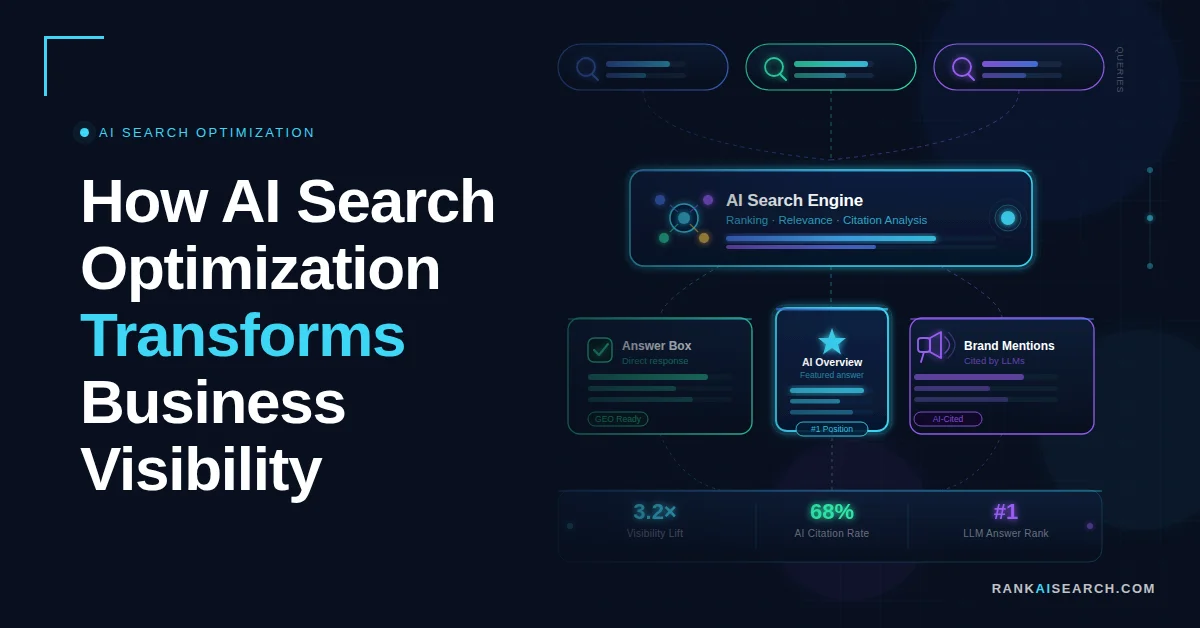
AI search optimization is the practice of making brand content discoverable, citeable, and recommended by AI-powered answer engines. Platforms like Google AI Overview, ChatGPT, and Perplexity now deliver answers directly to users. They no longer simply list websites.
Search behavior has shifted. Users no longer type fragmented keywords into a search bar. They ask complete, conversational questions and expect immediate answers from large language models (LLMs).
Businesses that do not adapt risk disappearing from those conversations entirely. This happens regardless of how well they rank in traditional search.
RankAISearch is a global AI search optimization agency. It specializes in Answer Engine Optimization (AEO), Generative Engine Optimization (GEO), Artificial Intelligence Optimization (AIO), and Large Language Model Optimization (LLMO). This guide explains what AI search optimization is, why it matters, and how to implement it.
What Is AI Search Optimization and Why Does It Matter?
AI search optimization is the process of structuring content so that AI-powered answer engines can extract, verify, and confidently cite it. It matters because answer engines now serve as the primary information interface for a growing share of users. Only the most authoritative and clearly structured sources earn citations.
Three forces make AI search optimization essential for businesses today:
- Zero-click search behavior: A growing share of queries end without a user clicking any link. The answer engine delivers a complete response directly on the results page. Businesses not cited in those responses receive no visibility at all.
- Conversational query patterns: Users phrase searches as natural questions, not keyword fragments. Answer engines evaluate content for intent alignment, not keyword density.
- Authority-based filtering: Answer engines do not list every relevant result. They select a small number of sources they consider authoritative and accurate. Citation is a competitive advantage, not a default outcome.
Traditional SEO aims to rank on a list. AI search optimization aims to become the answer.
Businesses that earn consistent AI citations build compounding brand authority that grows over time.
The Five Pillars of AI Search Optimization
| Pillar | Full Name | Focus | Primary Goal |
|---|---|---|---|
| AEO | Answer Engine Optimization | Content structure and extractability | Be cited as the direct answer |
| GEO | Generative Engine Optimization | Source selection by generative models | Be synthesized into AI-generated responses |
| AIO | AI Optimization | Entity recognition and knowledge graph signals | Build machine-readable authority |
| LLMO | Large Language Model Optimization | Natural language patterns and reasoning structure | Align content with how LLMs evaluate quality |
| SEO | Search Engine Optimization | Technical accessibility and crawlability | Ensure AI systems can access and index content |
1. Answer Engine Optimization (AEO): Structuring Content for AI Citation
AEO is the practice of formatting content so that AI answer engines can extract direct, authoritative responses to user questions.
AEO prioritizes semantic clarity, standalone section completeness, and citation worthiness over keyword optimization.
AEO content follows three principles:
- Each section opens with the core answer, without preamble.
- Supporting detail follows the answer, not the other way around.
- Every section reads as a complete unit that retains meaning when lifted out of context.
Content that performs well in AEO contains specific facts, credible data points, and unique insights. Vague observations and keyword-padded filler reduce the probability of citation.
2. Generative Engine Optimization (GEO): Influencing What AI Generates
GEO is the discipline of optimizing content for inclusion in AI-generated responses. The goal is for a generative model to draw on a brand’s content as a primary source when composing an answer.
GEO goes beyond discoverability. AEO focuses on being findable. GEO focuses on being selected and synthesized.
Generative models assign credibility based on several signals:
- Citation patterns across the web
- Entity recognition and consistency
- Factual accuracy and source diversity validation
GEO techniques include:
- Publishing statistics-backed content that generative models can reference with confidence
- Consistently defining brand entities across all owned and earned content
- Earning third-party mentions that validate authority for AI retrieval systems
- Using formats and structures that align with how generative models summarize sources
GEO is not about gaming AI systems. It is about meeting the quality and credibility standards that AI systems were designed to surface. Brands that invest in genuine expertise and clear communication are the brands GEO rewards.
3. Artificial Intelligence Optimization (AIO): Building Machine-Readable Authority
AIO addresses how machine learning models evaluate and classify content sources. It focuses on entity recognition, knowledge graph integration, and topical authority signals.
Entity recognition is foundational. AI systems identify and categorize entities such as people, organizations, products, locations, and concepts. They also map the relationships between those entities.
Clearly defining entities through schema.org markup, consistent naming conventions, and contextual associations helps AI systems accurately categorize and retrieve a brand’s content.
Topical authority develops through consistent, comprehensive publishing within a defined domain. The more a brand demonstrates expertise through quality content, the more frequently AI platforms assign it authority status. Authority status drives citation frequency.
4. Large Language Model Optimization (LLMO): Writing for How AI Thinks
LLMO addresses how LLMs process and prioritize source material when generating responses. LLMO techniques align content with the natural language patterns and reasoning structures that LLMs recognize as high quality.
LLMs favor content that demonstrates clear reasoning and uses precise language to make specific claims. They deprioritize content that hedges excessively or relies on vague generalities.
Practical LLMO techniques include:
- Opening paragraphs with direct answers
- Organizing content in logical question-to-answer progressions
- Using concrete examples rather than abstract claims
- Providing actionable guidance users can apply immediately
These are not tricks. They are the characteristics of genuinely well-written content, which is exactly why LLMs recognize them.
5. Search Engine Optimization (SEO): The Technical Foundation
Traditional SEO remains the technical foundation of all AI visibility work. Answer engines rely on crawlable, indexable content to understand what a brand covers.
Strong technical SEO includes site speed, clean crawl architecture, canonical structure, and mobile optimization. These elements ensure AI systems can access and process content without barriers.
SEO ensures content is accessible. AEO, GEO, AIO, and LLMO ensure it is citation-worthy. Neither works as well without the other.
How Do Answer Engines Differ from Traditional Search Engines?
Answer engines and traditional search engines differ in what they return, how they evaluate content, and what success looks like for the businesses they surface.
| Traditional Search Engines | Answer Engines | |
|---|---|---|
| Output | Ranked list of links | Synthesized, conversational response |
| User behavior | Click a result, visit a page, read content | Receive a complete answer without clicking |
| Query format | Fragmented keyword strings | Complete natural-language questions |
| Evaluation criteria | Keyword relevance and backlink authority | Semantic meaning, authority signals, content completeness |
| Business success metric | Click-through traffic volume | Citation frequency in AI-generated responses |
Conversational queries define how users interact with answer engines. They ask complete questions and expect contextual understanding. Content written in keyword fragments is poorly matched to this format.
Keyword matching carries minimal weight on answer engines. Semantic meaning, authority signals, and content completeness carry significantly more. Content that provides the most thorough and accurate answer is prioritized regardless of keyword usage.
What Are the Key Components of an Effective AI Optimization Strategy?
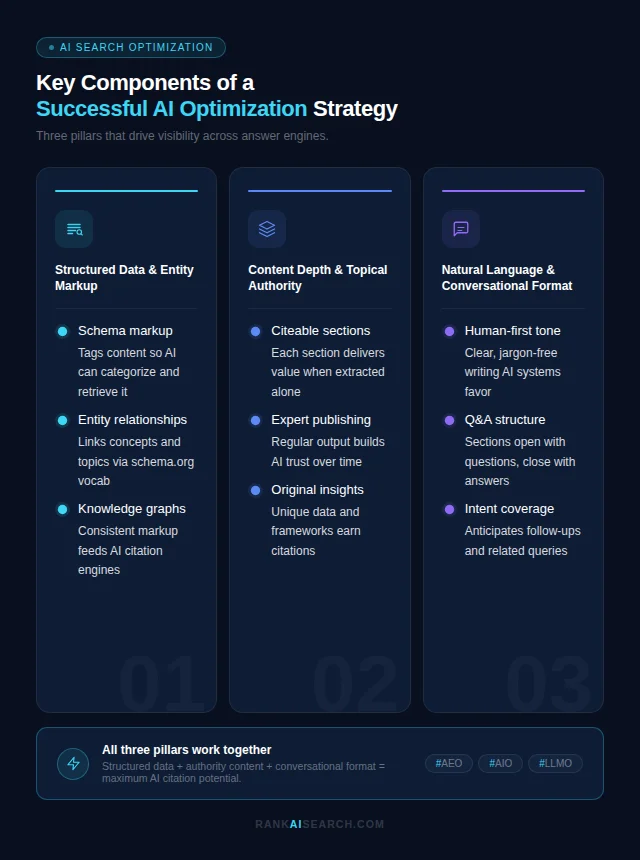
The three core components are structured data and entity markup, content depth and topical authority, and natural language structure. Each addresses a different layer of how AI systems access, evaluate, and cite content.
Structured Data and Entity Markup
Structured data bridges human-readable content and machine-readable understanding. Schema markup, implemented using schema.org vocabulary, tells AI systems what content covers, who created it, and how it relates to other entities in the knowledge graph.
Implementing structured data for articles, FAQs, how-to guides, and organizational profiles increases the precision with which AI systems categorize and retrieve content.
Entity markup ensures AI systems associate content with the correct authority context. Clearly defining a brand’s name, domain, location, and expertise prevents content from being treated as anonymous information.
Content Depth and Topical Authority
Comprehensive content is the single most important factor in AI citation eligibility.
Answer engines need content that fully addresses questions in standalone sections. Each section should deliver complete value independently. This requirement changes how content is architected from the first draft.
Topical authority develops through sustained, consistent publishing within a defined subject domain. Sporadic publishing on loosely related topics does not build authority. Deep, regular coverage of a defined topic area does.
Citation-worthy content includes original data, expert analysis, practical frameworks, and unique perspectives. The higher the informational density and the more distinctive the insight, the stronger the citation signal the content sends.
Natural Language and Conversational Structure
AI search optimization content should read the way people ask questions. Complete sentences, logical progression, and direct language are the standard.
Question-based section headings align content structure with how users interact with answer engines. Opening each section with the answer to its heading question makes the content immediately useful for AI extraction.
Natural language optimization does not mean sacrificing authority or depth. It means eliminating jargon that blocks understanding and removing filler that dilutes meaning. Precision, not complexity, defines effective AI-optimized writing.
Strategies for Scaling AI Visibility Globally and Regionally
Global and regional AI visibility both depend on the same core principles: authority, clarity, and citability. The execution differs by scope.
Global visibility requires establishing topical authority that transcends geographic boundaries. Content must address questions that international users ask. Structured data should clearly identify a brand’s services and expertise without assuming geographic context.
Regional visibility requires market-specific content. A professional services firm targeting Southeast Asian markets should address region-specific legal frameworks, business practices, and regulatory requirements. Answer engines serving users in those markets prioritize sources that demonstrate genuine regional expertise.
Multilingual content strategies multiply AI visibility potential. Publishing authoritative content in multiple languages positions a brand to earn citations across a wider range of query types and user demographics.
What Metrics Should You Track for AI Search Success?
AI search optimization requires a different measurement framework than traditional SEO.
| Metric | What It Measures | Why It Matters |
|---|---|---|
| AI citation frequency | How often AI platforms reference or quote your content | Indicates authority recognition across AI systems |
| AI Overview appearances | Rate your content surfaces in AI-generated featured responses | Shows sustained presence in high-visibility positions |
| Brand mention sentiment | Whether AI describes your brand positively, neutrally, or negatively | Reveals how AI perceives and represents your brand |
| Voice search visibility | Performance on conversational, voice-format queries | Leading indicator of overall AI search visibility |
| AI-referred engagement quality | Depth of engagement and conversions from AI-driven clicks | Confirms whether cited content delivers on its authority signal |
Traditional SEO metrics such as organic traffic, keyword rankings, and domain authority remain useful as context. However, they are lagging indicators in an AI-first environment. The metrics above provide earlier and more accurate signals of AI search optimization effectiveness.
Common Challenges in AI Search Optimization and How to Overcome Them
The three most common challenges are adapting keyword-driven content for AI extraction, balancing AEO with traditional SEO priorities, and keeping pace with rapidly evolving AI algorithms.
Adapting Existing Content for Answer Engine Citation
Most existing web content was written for traditional SEO. It is keyword-driven and structured for rankings, not for AI extraction.
Adapting it for AI citation requires a systematic audit and restructuring process. A line-by-line rewrite is rarely necessary.
The most effective approach:
- Identify your highest-value content by existing authority signals such as traffic, backlinks, and rankings.
- Evaluate each piece through an AI extraction lens. Does it open with a direct answer? Are its sections self-contained? Does it contain specific, citable facts?
- Prioritize restructuring pieces that already have authority momentum. They respond to optimization most quickly.
Balancing AEO with Traditional SEO
AEO and SEO are complementary, not competing.
The tension most businesses feel comes from historical SEO practices such as keyword density tactics, anchor text manipulation, and thin content. These practices are incompatible with AI optimization.
Resolving that tension means retiring those practices, not choosing between disciplines.
Maintain technical SEO fundamentals including crawlability, site speed, and schema markup. Rebuild content creation processes around AEO principles. Quality, authority-signal content serves both systems simultaneously.
Staying Current as AI Algorithms Evolve
AI platforms update their retrieval and recommendation systems continuously.
No optimization strategy should be built around gaming specific algorithmic behaviors. Those behaviors change.
Build instead around the constant signals that all AI systems reward: accuracy, completeness, authority, and clarity. These are not algorithmic quirks. They are the design goals of every major AI search system.
Future Trends in AI Search Optimization
The AI search landscape is evolving across several dimensions that will reshape optimization requirements over the next 12 to 36 months.
| Trend | What Is Changing | Optimization Implication |
|---|---|---|
| Multimodal search | Answer engines now process images, video, and audio | Visual content needs precise alt text, captions, and structured metadata |
| Personalized AI recommendations | Generative systems tailor responses to individual user history and preferences | Content must address multiple audience segments and use-case scenarios |
| Social proof signals | AI systems increasingly factor in user ratings and community-validated information | Authentic engagement, verified reviews, and positive sentiment strengthen authority |
| Predictive answer delivery | AI systems surface content based on predicted needs, not just explicit queries | Comprehensive topical coverage captures proactive AI visibility |
How to Get Started with AI Search Optimization
Getting started with AI search optimization follows four stages.
| Stage | Phase | Key Actions | Outcome |
|---|---|---|---|
| 1 | AI Visibility Audit | Search your brand and core topics across Google AI Overview, ChatGPT, and Perplexity. Document where you appear, how you are described, and what sources AI systems currently cite instead of you. | Baseline assessment and competitive benchmark |
| 2 | Gap Analysis | Identify topics where you have genuine expertise but no AI visibility. Map entity gaps where your brand is poorly defined or inconsistently named across the web. | Prioritized list of high-value optimization opportunities |
| 3 | Phased Implementation | Begin with structured data and schema markup. Restructure high-priority existing content. Build new content architected for AI extraction. Develop entity authority through consistent publishing. | AI-ready content foundation with growing citation signals |
| 4 | Measurement and Iteration | Track citation frequency, AI Overview appearances, and brand mention sentiment. Measure results at 60, 90, and 180 days. Adjust strategy based on which topics and formats generate the strongest citation response. | Continuous improvement informed by real performance data |
Businesses that begin AI search optimization now establish authority baselines that become progressively harder for competitors to displace.
Answer engine authority compounds over time. The brands that AI systems learn to trust first are the brands they continue to cite as those systems scale.
Take Control of Your AI Visibility
AI search optimization is not an emerging trend. It is the current state of digital discovery for a growing share of the world’s information-seeking population.
Businesses that establish AI citation authority now will compound that advantage as answer engine adoption accelerates. Those that delay will find it progressively harder to displace the sources that AI systems have already learned to trust.
RankAISearch helps businesses worldwide build the authority, content structure, and entity clarity needed to earn consistent citations across Google AI Overview, ChatGPT, Perplexity, and the AI-powered platforms that will define digital visibility over the next decade.
Our integrated approach combines AEO, GEO, AIO, LLMO, and technical SEO to position brands to be recommended, not just ranked.
To begin your AI visibility audit or explore a customized optimization strategy, contact our team at RankAISearch.
Frequently Asked Questions
What is the difference between SEO and AI search optimization?
SEO earns rankings in a list of links. AI search optimization earns citations inside AI-generated answers. Both use content quality as the foundation, but the optimization signals, structures, and success metrics are different.
They are complementary. Strong technical SEO ensures AI systems can access your content. AEO and GEO ensure that content gets cited.
What is GEO and how does it differ from AEO?
AEO structures content so AI systems can extract and cite a specific passage. GEO goes deeper: it influences which sources a generative model selects when composing an answer from scratch.
Well-structured AEO content is more likely to be selected for GEO synthesis. The two work together.
How long does it take to see results from AI search optimization?
Initial AI citations can appear within 60 to 90 days for well-structured content in low-competition query areas. Consistent citation across a topic domain typically takes four to six months.
Optimizing existing high-authority pages delivers the fastest results. Building compound authority across a full topic area is a six- to twelve-month investment.
Can small businesses benefit from AI search optimization?
Yes. Answer engines evaluate content quality and expertise, not business size or budget. A small firm that deeply covers a narrow topic will outperform a large competitor publishing generic content in the same space.
Niche focus is an advantage. Narrow topical authority is easier to establish and easier for AI systems to recognize.
Which AI platforms should businesses prioritize?
Start with Google AI Overview, ChatGPT, and Perplexity. These three reach the broadest audiences and represent the most common entry points for AI-assisted discovery.
Content optimized for these platforms transfers well to vertical-specific AI tools. Prioritize the platform where your target audience is most active.
Is traditional SEO still relevant in an AI-first search landscape?
Yes. AI systems cannot cite content they cannot access. Page speed, crawl architecture, mobile optimization, and canonical structure remain prerequisites for any AI visibility strategy.
Treat SEO as the technical layer. Build AEO, GEO, AIO, and LLMO on top of it.
What type of content earns the most AI citations?
Content that opens with a direct answer, contains verifiable facts, and uses clear conversational language earns the most citations. Original research, expert analysis, and detailed how-to guides consistently outperform broad overview articles.
The deciding factor is informational density. Content gets cited when it says something specific that AI systems cannot find stated more clearly elsewhere.
How does voice search relate to AI search optimization?
Voice queries are complete questions in conversational language. Content optimized for AI citation, direct answers, clear structure, natural phrasing, is already optimized for voice. No separate voice strategy is needed. AI search optimization covers both.