

Generative Engine Optimization Statistics (2026): Our Data From 118 AI Answers, Plus Verified Public Figures
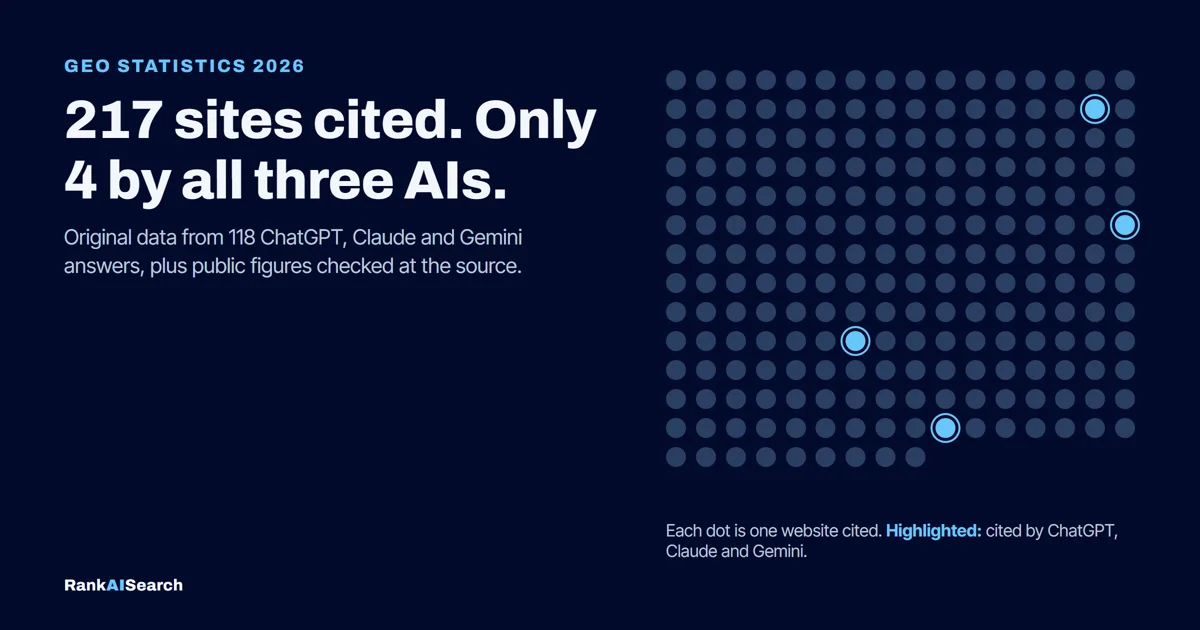
In short: Most generative engine optimization (GEO) statistics pages repeat the same numbers without saying where they came from or when. This page does two things differently. First, it shares our own data from 118 real AI answers collected in October 2026, split by platform. Second, every public figure below links to the original publisher, with the date its data was collected. The headline: AI answers are volatile (most cited sites changed between three runs of the same question), the three big AI assistants rely on different sources, and local sites matter for local questions.
Our GEO data: what ChatGPT, Claude and Gemini cite
How we collected it
- Study 1 (20 October 2026): 10 questions a business owner might ask when looking for AI SEO or GEO help or a free AI visibility tool. Each was asked of ChatGPT, Claude and Gemini three times, with live web search on: 90 answers. Five questions were searched from Singapore and five with no location set [1].
- Study 2 (16 October 2026): 10 “best [local service] in [area], Singapore” questions (aircon servicing, dental clinics, renovation, plumbers and others), asked of the same three AIs once: 28 usable answers [2].
- We used each provider’s API models with web search (ChatGPT: gpt-5.4-mini; Claude: haiku-5.5; Gemini: 3.8-flash). These aren’t identical to the consumer apps, which can use larger models and personalization.
- “Cited” means a source the AI attached to its answer.
1. The same question gives different sources almost every time
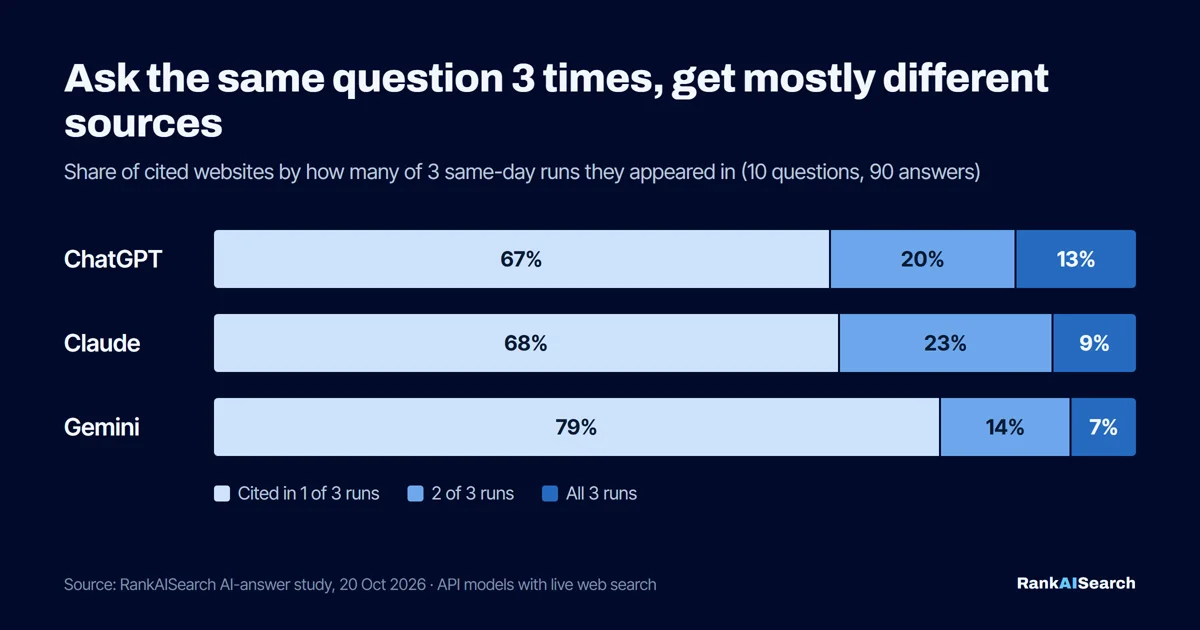
When we asked the same question three times on the same day, 67–79% of the sites cited appeared in only one of the three answers. Only 7–13% appeared in all three [1].
| Platform | Sites cited in only 1 of 3 runs | Sites cited in all 3 runs |
|---|---|---|
| ChatGPT | 67% | 13% |
| Claude | 68% | 9% |
| Gemini | 79% | 7% |
SE Ranking saw the same pattern in Google AI Mode: only 9.2% of linked URLs matched across three same-day runs of a query [9].
What it means: one check of an AI answer is a snapshot, not a ranking. Test a fixed list of questions, repeat them, and count how often you appear.
2. Each AI uses a different set of sources
Across our 90 answers the three AIs cited 217 different websites. Only 4 were cited by all three [1].
| Platform | Answers with sources | Average sites cited per answer | Different sites cited |
|---|---|---|---|
| ChatGPT | 30 of 30 | 3.3 | 51 |
| Claude | 26 of 30 | 5.0 | 81 |
| Gemini | 29 of 30 | 7.1 | 116 |
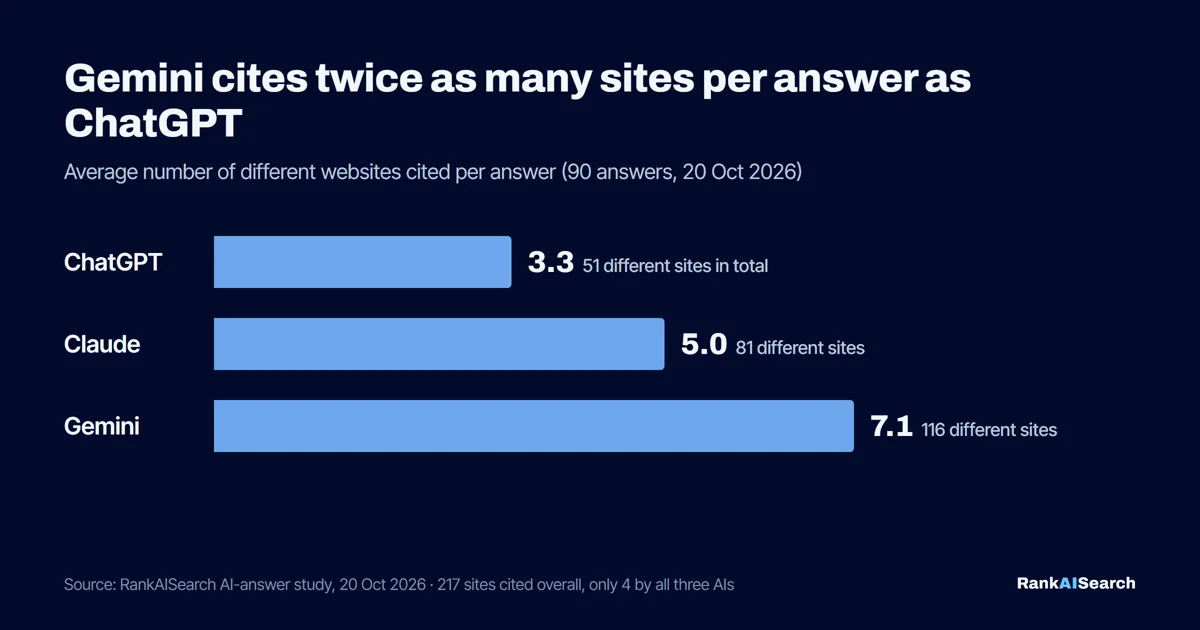
Our Singapore local-services scan showed the same split: ChatGPT cited about 3 sites per answer, Claude about 5 and Gemini about 6, and 89 different sites appeared across 28 answers [2].
Google’s own AI features differ too. Ahrefs found AI Overviews and AI Mode cited the same pages only 13.7% of the time for the same searches [8].
What it means: “AI visibility” isn’t one number. Track each platform separately.
3. ChatGPT leaned on a directory; Claude on “best of” lists
- For questions about choosing an agency, ChatGPT cited clutch.co 36 times, about a quarter (26%) of all ChatGPT citations in the study [1].
- 44% of Claude’s cited pages were list-style pages (“best”, “top”, “agencies”, “companies” in the URL), against 14% for ChatGPT [1]. (We couldn’t classify Gemini’s links this way: they arrive as Google redirect links without the page path.)
- Reddit and YouTube barely appeared for these business questions: 2 Reddit and 6 YouTube citations out of 603 cited links, all six YouTube links from Gemini [1].
What it means: for business-service questions, being listed accurately on the directories and comparison pages each AI reads matters as much as your own website.
4. Local sites dominate local answers
- On the five questions searched from Singapore, 36% of ChatGPT’s citations and 42% of Gemini’s came from Singapore (.sg) websites. Claude, which we couldn’t give a location to, cited .sg sites 18% of the time [1].
- In the local-services scan, one Singapore listings site, threebestrated.sg, was cited in 15 of 28 answers (7 of 10 questions) by all three AIs, and wherecrowded.sg in 9 of 28 [2].
What it means: for local questions, the AIs read local listing and review sites heavily. Accurate local listings are part of AI visibility. (Our guide on getting recommended by ChatGPT in Singapore covers this step.)
Limits
Small samples (90 + 28 answers), two topics, two dates, API models rather than consumer apps, and citations rather than every page read. Treat these as directional findings, not industry averages. For transparency: our own business was named in 0 of the 90 answers in Study 1.
Verified generative engine optimization statistics from public sources
Each figure below links to its original publisher. We left out numbers we couldn’t trace to the original source.
How many people use AI search
- AI Overviews has over 2.5 billion monthly active users, according to Google (May 2026) [3].
- AI Mode passed 1 billion monthly active users, according to Google (July 2026) [4].
- AI platforms sent an average of 770.7 million referral visits a month to websites worldwide between June 2025 and May 2026 (Similarweb panel data; Similarweb notes this is a floor, because some visits arrive without referral data) [10].
- ChatGPT’s share of generative AI web traffic fell from about 76% to about 53% between June 2025 and May 2026, though its total visits kept growing (Similarweb, web traffic only) [11].
Clicks
- Google users clicked a normal search result in 8% of visits when an AI summary appeared, against 15% when it didn’t. They clicked a link inside the AI summary in about 1% of visits (Pew Research Center; 900 US adults, 68,879 searches, March 2025) [5]. That’s a fall of roughly 47%, not the “54%” some pages repeat.
- An AI Overview correlates with a 58% lower average click-through rate for the top-ranking page (Ahrefs; 300,000 keywords, December 2023 vs December 2025, desktop) [6].
- About 60% of searches now end without the user going on to another website, according to a Bain & Company consumer survey (December 2024, 1,117 people; self-reported) [12].
Citations and rankings
- 37.9% of URLs cited in AI Overviews also ranked in the top 10 (Ahrefs; 863,000 results pages, March 2026). Ahrefs’ July 2025 study found about 76%; Ahrefs says it has since improved how it detects citations, so part of the change may be measurement [7].
- 14% of URLs linked in Google AI Mode also ranked in the organic top 10 (SE Ranking; 10,000 US keywords, June 2025) [9].
The research that named GEO
- The original GEO paper found its methods could raise a source’s visibility in AI answers by up to 40% (Aggarwal et al., 2023; published at KDD 2024) [13]. Two caveats: it measured how much of the answer drew on a source, not traffic, and it tested 2023-era engines.
Statistics to stop repeating
While checking other GEO statistics pages, we found figures that are wrong, out of date or unsourced:
- “Clicks dropped 54% (from 15% to 8%).” The Pew figures work out to a drop of about 47% [5].
- “99% of AI Overviews cite top-10 pages.” We couldn’t find a source. Ahrefs’ 2026 data says 37.9% [7].
- “76% of AI Overview citations come from the top 10.” That was Ahrefs’ July 2025 figure; its 2026 update is 37.9% [7].
- “Search volume will drop 25% by 2026.” That was a Gartner forecast from February 2024, not a measurement.
- “GEO increases traffic by 40%.” The GEO paper measured share of the AI answer, not traffic [13].
- “60% of searches are zero-click” quoted as measured behavior. Bain’s figure is from a survey of what people say they do [12].
Run the same check on your business
The method behind Study 1 is the same one our free AI visibility checker uses: it asks ChatGPT, Claude and Gemini a question your customers would ask, with live web search set to your country, and shows whether you’re mentioned and which sites they cite instead. Because answers vary, run it more than once.
For what to do with the results, see How to Optimize for AI Overviews and How to Rank in Google AI Mode.
Published 20 October 2026. We’ll refresh our own data and the public figures as new studies are published.
Sources
- [1] RankAISearch, AI-answer study, October 20, 2026 (90 answers; method above)
- [2] RankAISearch, Singapore local-services citation scan, October 16, 2026 (28 answers; method above)
- [3] Google, Sundar Pichai at I/O 2026 (May 19, 2026)
- [4] Google, Alphabet Q2 2026 earnings remarks (July 22, 2026)
- [5] Pew Research Center, Google users are less likely to click on links when an AI summary appears in the results (July 22, 2025)
- [6] Ahrefs, Update: AI Overviews Reduce Clicks by 58% (February 4, 2026)
- [7] Ahrefs, Update: 38% of AI Overview Citations Pull From The Top 10 (March 2, 2026)
- [8] Ahrefs, AI Overviews vs AI Mode
- [9] SE Ranking, AI Mode research (August 29, 2025)
- [10] Similarweb, AI referral traffic by industry (September 3, 2026)
- [11] Similarweb, Generative AI statistics (July 29, 2026)
- [12] Bain & Company, Goodbye Clicks, Hello AI: Zero-Click Search Redefines Marketing (February 19, 2025)
- [13] Aggarwal et al., GEO: Generative Engine Optimization (arXiv, 2023; KDD 2024)