

How to Get Your Local Business Recommended by AI Tools
“Who should I call near me?” is now a question people ask AI tools, not just search engines. The businesses that appear are often the ones with stronger profiles, clearer reviews, and more consistent local data. Local SEO for AI search helps your business become easier for AI systems to identify and recommend.
That visibility depends on more than one listing. AI tools may compare your Google Business Profile, website, directories, reviews, photos, and third-party mentions before naming you. This guide explains how to improve those sources and make your business more visible in AI-generated local recommendations.
How Do You Get Your Local Business Recommended by AI Tools?
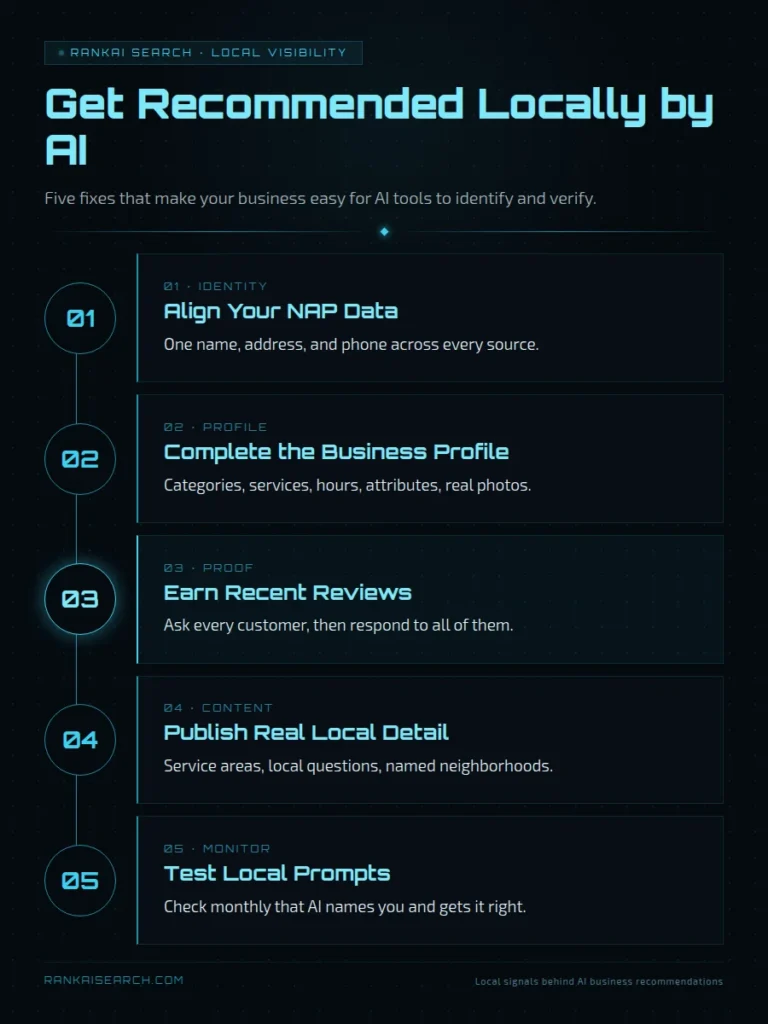
To get your local business recommended by AI tools, keep your name, address, and phone consistent everywhere, maintain a complete Google Business Profile, gather genuine reviews, and publish locally relevant content. AI engines lean on these trusted local signals.
Local AI recommendations depend on whether a business is easy to identify, verify, compare, and match to the user’s location or need. A business with inconsistent addresses, weak reviews, thin service pages, or outdated hours gives AI systems weaker evidence.
Google says local results are mainly based on relevance, distance, and prominence. It also says complete and detailed business information helps Google better understand a business and match it to relevant searches. (Source: Google Business Profile Help, 2026)
| Local AI Signal | What To Improve | Why It Helps |
|---|---|---|
| NAP consistency | Name, address, phone | Confirms business identity |
| Google Business Profile | Categories, services, hours, photos, reviews | Supports map and local discovery |
| Reviews | Volume, recency, quality, responses | Shows customer proof |
| Local content | Service pages, area pages, FAQs | Matches local customer questions |
| Structured data | LocalBusiness, Organization, Service | Clarifies machine-readable facts |
| Citations | Yelp, Bing Places, Apple Business, directories | Reinforces business details |
| Website trust | Contact page, proof, location signals | Supports verification |
Where Do AI Tools Find Information About Local Businesses?
AI tools find local business information from maps, business profiles, directories, official websites, review platforms, local content, and third-party sources. The more consistent those sources are, the easier it is for AI systems to describe and recommend the business accurately.
Local recommendations are source-dependent. An AI answer may draw from a map profile, a review platform, a cited website, a directory listing, or a search result summary.
A local business should not rely on one profile. AI systems can compare signals from many sources before deciding which businesses to mention.
| Source Type | Example | What It Contributes |
|---|---|---|
| Map platforms | Google Maps, Apple Maps, Bing Maps | Location, hours, directions, categories |
| Business profiles | Google Business Profile, Apple Business, Bing Places | Official business details |
| Review platforms | Google reviews, Yelp, TripAdvisor, industry sites | Reputation and customer proof |
| Official website | Homepage, service pages, location pages | Source-of-truth content |
| Local directories | Chamber pages, local business directories | Citation consistency |
| Social profiles | Facebook, Instagram, LinkedIn | Brand activity and contact details |
| Local press | News, event pages, sponsorships | Local prominence |
Local AI visibility improves when these sources agree. Conflicting hours, names, phone numbers, or service descriptions can weaken confidence.
Maps, Business Profiles, and Local Directories
Maps, business profiles, and local directories identify where the business exists and what category it belongs to. These sources are often the first evidence layer for local recommendations.
A complete profile helps AI systems and search platforms answer location-based prompts. It can clarify whether the business has a storefront, serves customers at their location, accepts appointments, offers delivery, or operates in a service area.
| Platform | What To Maintain |
|---|---|
| Google Business Profile | Categories, services, hours, reviews, photos |
| Apple Business | Place card, photos, organization details |
| Bing Places | Business listing and map details |
| Yelp | Business details, photos, categories, reviews |
| Address, hours, services, messaging | |
| Industry directories | Category-specific trust signals |
| Local chamber pages | Community relevance |
Official Websites and Third-Party Sources
Official websites and third-party sources explain what the business does, who it serves, and why it deserves trust. A business profile can confirm existence, but the website provides deeper context.
Third-party sources can validate the business beyond its own claims. Reviews, local press, partner pages, professional associations, and directory listings give AI systems external evidence.
| Source | Best Use |
|---|---|
| Homepage | Defines the business and service area |
| Contact page | Confirms NAP and hours |
| Service pages | Explains what customers can book or buy |
| Location pages | Connects services to cities or neighborhoods |
| Review sites | Shows customer experience |
| Press mentions | Supports local prominence |
| Partner pages | Confirms relationships and credibility |
How Should You Optimize Your Google Business Profile?
You should optimize your Google Business Profile by completing every accurate field, choosing precise categories, listing services, adding attributes, uploading real photos, keeping hours current, and responding to reviews. A complete profile gives Google and AI systems clearer local business evidence.
Google Business Profile is often the strongest controllable local source for a business. It helps define the business category, location, services, hours, photos, reviews, and customer actions.
A profile should match the real-world business. Keyword stuffing, fake locations, duplicate listings, or incorrect categories can create trust problems and policy risk.
| Profile Element | Optimization Standard |
|---|---|
| Primary category | Choose the most specific real category |
| Secondary categories | Add only relevant supporting categories |
| Services | List real services customers can buy |
| Business description | Explain the business clearly |
| Hours | Keep regular and holiday hours current |
| Photos | Add real exterior, interior, team, and product photos |
| Attributes | Add accurate accessibility, payment, and service attributes |
| Reviews | Ask genuine customers and respond professionally |
Business Categories, Services, and Attributes
Business categories, services, and attributes help local systems understand what the business is and which customer needs it can meet. These fields connect the business to relevant local prompts.
Categories should describe the business type, not every product or feature. Services and attributes can provide the extra detail without distorting the main category.
| Field | Good Example | Weak Example |
|---|---|---|
| Primary category | “Emergency plumber” | “Home services” |
| Service | “Drain cleaning” | “Best plumbing help” |
| Attribute | “Wheelchair accessible entrance” | Unsupported claim |
| Description | “Family dental clinic in Austin” | Keyword-stuffed city list |
| Service area | Real cities served | Areas never served |
Photos, Updates, and Accurate Operating Details
Photos, updates, and operating details show that the business is real, active, and useful to customers. AI tools need current evidence when answering local intent prompts.
Photos should show what customers can expect. Exterior photos help people recognize the location, while interior, team, product, and service photos add context.
| Detail | Why It Matters |
|---|---|
| Exterior photo | Helps customers identify the location |
| Interior photo | Shows atmosphere and accessibility |
| Team photo | Supports trust |
| Product photo | Shows what customers can buy |
| Service photo | Shows work quality |
| Holiday hours | Prevents wrong visit expectations |
| Business updates | Shows recent activity |
Why Does Consistent NAP Information Matter for AI Search?
Consistent NAP information matters because AI systems use name, address, and phone data to identify the correct local business across sources. NAP means name, address, and phone number.
A local business can look less reliable when one source shows an old phone number, another shows a former address, and another uses a different business name. Inconsistent data can also cause AI tools to merge, confuse, or overlook business facts.
NAP consistency should cover both exact details and formatting. The business does not need identical punctuation everywhere, but the core identity should be unmistakable.
| NAP Field | What To Standardize |
|---|---|
| Business name | Legal or customer-facing name |
| Address | Street, suite, city, state, ZIP code |
| Phone | Primary local number |
| Website | Canonical URL |
| Hours | Regular and holiday hours |
| Service area | Real areas served |
| Category | Main business type |
| Location status | Storefront, service-area, or hybrid |
How Can Reviews Improve Your Chances of Being Recommended?
Reviews improve your chances of being recommended because they provide customer proof, service context, reputation signals, and real language about what the business does well. AI systems can use reviews to understand customer experience and match businesses to user needs.
Reviews help answer questions that business owners may not address directly. Customers mention wait times, staff behavior, quality, pricing, atmosphere, accessibility, parking, delivery, and service outcomes.
BrightLocal’s 2026 Local Consumer Review Survey found that 2 in 5 consumers read reviews every time they look for a business. The survey also found that old reviews matter less to consumers, which makes review recency important for local trust. (Source: BrightLocal, 2026)
Review quality matters more than review count alone. A business with recent, specific, genuine reviews can be easier to recommend than a business with many old or vague reviews.
| Review Signal | Why It Helps AI and Customers |
|---|---|
| Review volume | Shows enough customer experience |
| Review recency | Shows current performance |
| Star rating | Gives quick reputation context |
| Review text | Explains strengths and problems |
| Owner responses | Shows active customer care |
| Keywords in reviews | Reflects real customer language |
| Photos in reviews | Adds visual proof |
Ask for reviews ethically:
- Request reviews after real customer interactions
- Do not offer incentives for positive reviews
- Make the review link easy to find
- Respond to positive and negative reviews
- Flag policy-violating reviews through official channels
- Use review feedback to improve operations
What Local Content Helps AI Match Your Business to Customer Needs?
Local content that explains your services, service areas, customer problems, local conditions, and common buying questions helps AI match your business to relevant customer needs. It connects what your business offers with where customers are located and why they may need your services.
Useful local content includes detailed service pages, location pages, local FAQs, pricing guides, case studies, comparison pages, and customer reviews. Each page should answer real questions in plain language and include specific details about the areas you serve.
Avoid thin location pages that only replace one city name with another. Strong pages provide original local information, service availability, customer proof, operating details, and clear next steps.
| Content Type | What It Helps AI Understand |
|---|---|
| Service page | What the business offers |
| Location page | Where the business serves customers |
| FAQ page | Which questions the business answers |
| Case study | Proof of local work |
| Pricing guide | Cost expectations |
| Neighborhood guide | Local relevance |
| Comparison page | Buyer decision support |
| Review page | Customer proof |
Location and Service Area Pages
Location and service area pages explain where a business operates and which services are available in each area. These pages are useful for businesses that serve multiple cities, neighborhoods, or regions.
Each page should include real local detail. Thin pages that only replace one city name with another can reduce trust and create low-value content.
| Page Element | What To Include |
|---|---|
| Area served | City, neighborhood, or region |
| Service offered | Specific services available there |
| Local proof | Projects, reviews, photos, or examples |
| Contact path | Phone, form, booking, directions |
| Operating details | Hours, emergency availability, travel area |
| Customer questions | Local FAQs |
| Internal links | Related services and nearby locations |
Local Questions, Problems, and Use Cases
Local questions, problems, and use cases help AI systems match the business to conversational prompts. A customer may ask for the best dentist for anxious patients, an emergency plumber open now, or a bakery that makes allergy-friendly cakes.
The page should answer these questions directly. AI systems can extract clear answers more easily from direct headings, short paragraphs, and FAQ sections.
| Local Prompt | Content To Add |
|---|---|
| “Who fixes burst pipes near me?” | Emergency plumbing page |
| “Best dentist for kids in [city]” | Pediatric dentistry section |
| “Restaurant with vegan options near [area]” | Menu and dietary page |
| “Same-day appliance repair in [city]” | Same-day service details |
| “Wedding florist in [neighborhood]” | Portfolio and local venue examples |
How Can You Show That Your Business Is Relevant to a Specific Area?
You can show local relevance by connecting your business to real locations, local customers, local proof, and area-specific services. AI tools need evidence that your business is not just keyword-targeting a place but actually serves that place.
Local relevance can come from your address, service area, photos, reviews, case studies, local partnerships, event pages, and locally specific content. A real footprint is stronger than repeated city keywords.
Local relevance should be supported by proof on and off the website. A service-area claim is stronger when reviews, project examples, and profiles mention the same area.
| Local Relevance Signal | Example |
|---|---|
| Address | Storefront or office location |
| Service area | Cities or neighborhoods served |
| Local reviews | Customers mention the area |
| Project examples | Work completed in that location |
| Photos | Real local job sites or storefront |
| Partnerships | Local organizations or vendors |
| Events | Community involvement |
| Local landing pages | Useful area-specific content |
Avoid fake local signals. Do not create addresses, offices, or location pages for areas the business does not serve.
Which Local Listings and Citations Should You Maintain?
You should maintain listings and citations on platforms that customers, search engines, maps, and AI systems may use to verify your business. The most important listings usually include Google Business Profile, Apple Business, Bing Places, Yelp, Facebook, industry directories, and local organizations.
A citation is a public mention of a local business’s name, address, phone number, website, or business details. Citations help confirm the business exists and operates in a specific category or area.
Citation quality matters more than adding the business to every directory. A few accurate, trusted, category-relevant listings are more useful than dozens of outdated or low-quality listings.
| Listing Type | Why It Matters |
|---|---|
| Google Business Profile | Google Search and Maps visibility |
| Apple Business | Apple Maps, Siri, and Apple surfaces |
| Bing Places | Bing Maps and Microsoft ecosystem visibility |
| Yelp | Reviews, photos, business details |
| Social proof and local discovery | |
| Industry directories | Category-specific relevance |
| Local chamber pages | Local legitimacy |
| Appointment platforms | Booking and service proof |
Audit listings at least quarterly. Business moves, new phone numbers, holiday hours, rebrands, and service changes can make old citations inaccurate.
How Does Your Website Support AI-Generated Local Recommendations?
Your website supports AI-generated local recommendations by acting as the source of truth for your services, location, team, hours, proof, and customer actions. AI systems need a clear official website to confirm what third-party sources say.
A strong local website explains what the business does better than a profile can. It should include service pages, location pages, contact details, reviews, photos, credentials, FAQs, and clear calls to action.
The website should make local details visible, not only hidden in schema. Users and AI systems both need readable evidence on the page.
| Website Element | Local AI Value |
|---|---|
| Homepage | Defines the business and location |
| Contact page | Confirms address, phone, hours, and directions |
| Service pages | Explains what customers can buy |
| Location pages | Connects services to specific areas |
| About page | Shows team, history, and trust |
| Reviews page | Collects customer proof |
| FAQ page | Answers local buying questions |
| Structured data | Clarifies business facts for machines |
Use consistent local language across the site. The homepage, footer, contact page, schema, and business profiles should not describe different service areas.
What Can You Do to Build Stronger Local Trust Signals?
You can build stronger local trust signals by showing proof that real customers, local organizations, and trusted platforms recognize your business. Trust signals help AI systems and customers decide whether the business is credible enough to recommend.
Local trust is built through consistent evidence. Reviews, certifications, awards, local press, photos, staff bios, guarantees, insurance details, and association memberships can all support credibility.
Google says verified Business Profiles can help customers find and build greater trust in a business, and verified owners can manage business information shown across Google. (Source: Google Business Profile Help, 2026)
Trust signals should be specific. A badge without context is weaker than a license number, certifying body, award date, customer review, or local case study.
| Trust Signal | What To Show |
|---|---|
| Licenses | License type and issuing body |
| Certifications | Current certification details |
| Reviews | Genuine customer feedback |
| Case studies | Local results and examples |
| Team bios | Real people and expertise |
| Photos | Storefront, team, work, products |
| Awards | Local or industry recognition |
| Associations | Chamber, trade group, nonprofit involvement |
How Can You Monitor What AI Tools Say About Your Business?
You can monitor AI answers by testing local prompts across AI tools, recording whether your business appears, checking citations, and tracking accuracy. Monitoring shows whether AI systems understand your business correctly.
Local AI monitoring should use prompts that real customers ask. A dentist, plumber, restaurant, florist, gym, or law firm should each test prompts that match its own services and local buying intent.
Track both presence and accuracy. Being recommended with the wrong hours, address, or service details can still hurt customer trust.
| Monitoring Field | What To Record |
|---|---|
| Prompt | Exact local question |
| AI tool | ChatGPT, Gemini, Perplexity, Copilot, Claude |
| Location setting | City, neighborhood, or near-me context |
| Business appears | Yes or no |
| Position | First, middle, or last |
| Competitors | Which businesses appear instead |
| Citation | Source URL where available |
| Accuracy | Correct or incorrect details |
Use monthly monitoring as a default. Test more often after a move, rebrand, service launch, negative review pattern, or major website change.
Which Problems Can Keep Your Business Out of AI Recommendations?
Problems that can keep your business out of AI recommendations include inconsistent NAP data, incomplete profiles, weak reviews, thin local content, wrong categories, outdated hours, poor website clarity, and limited local proof. These issues make the business harder to verify or match to customer prompts.
Many local visibility problems start with unclear data. AI systems can struggle when a business has duplicate profiles, old addresses, conflicting phone numbers, or service pages that do not explain the local offer.
Google says Business Profile information can be updated from sources such as user reports and licensed content when existing details appear incorrect or outdated. This means external inconsistency can create real profile accuracy problems. (Source: Google Business Profile Help, 2026)
The problem is often not one missing tactic. It is usually a pattern of weak or conflicting local evidence.
| Problem | Why It Hurts |
|---|---|
| Inconsistent NAP | Weakens business identity |
| Incomplete GBP | Reduces local context |
| Wrong category | Matches the wrong searches |
| Few recent reviews | Weakens reputation proof |
| Thin location pages | Provides little local evidence |
| No service details | Makes offers unclear |
| Outdated hours | Creates bad customer experience |
| Duplicate listings | Splits or confuses signals |
| No local photos | Reduces real-world proof |
Fix the highest-risk issues first:
- Wrong address
- Wrong phone number
- Wrong hours
- Wrong category
- Duplicate listings
- Outdated website service details
- Missing review responses
- Thin location pages
What Should You Remember About Local SEO for AI Search?
You should remember that local SEO for AI search depends on consistent business data, complete profiles, genuine reviews, useful local content, and visible local proof. AI tools recommend businesses they can identify, verify, and match to the user’s needs.
Local SEO for AI search is not separate from traditional local SEO. It builds on the same core signals, then adds stronger content clarity, entity consistency, and prompt-based monitoring.
| Principle | Practical Action |
|---|---|
| Keep data consistent | Align NAP across profiles and website |
| Complete key profiles | Maintain Google, Apple, Bing, Yelp, and social listings |
| Build review proof | Earn genuine reviews and respond professionally |
| Publish local content | Answer customer questions by service and area |
| Strengthen trust | Add photos, credentials, case studies, and proof |
| Use structured data | Add LocalBusiness and service markup |
| Monitor AI answers | Track recommendations, competitors, and accuracy |
Local AI visibility is an operating habit. Businesses that maintain accurate data and current proof give AI systems better material to recommend.
Are You Ready to Strengthen Your Local Visibility Across AI Tools?
Local AI visibility depends on more than appearing in one directory or maintaining a single business profile. AI tools compare information across your website, maps, reviews, listings, and third-party mentions to determine whether your business is relevant, trustworthy, and suitable for a local recommendation.
When those sources contain consistent business details, current operating information, strong customer proof, and clear service-area content, AI systems have more reliable evidence to work with. Conflicting details, outdated profiles, or thin local pages can make even an established business harder to identify and recommend.
Talk to RankAISearch about your local AI visibility to find the gaps across your profiles, content, citations, and trust signals and determine which improvements should be prioritized first.
Common Questions About AI Local Search Recommendations
Which AI tools recommend local businesses?
Many AI tools can recommend local businesses when users ask location-based or service-based questions. These include ChatGPT, Gemini, Perplexity, Copilot, Claude with web search, Google AI experiences, and map-based assistants. Each platform may use different sources. That is why local businesses need consistent information across profiles, maps, reviews, websites, and directories.
Does a Google Business Profile help with AI search visibility?
Yes, a Google Business Profile helps with AI search visibility because it gives Google and connected search experiences structured local business information. It also supports Maps visibility, reviews, photos, hours, services, and customer actions. A complete profile is not enough by itself. The website, reviews, citations, and local proof should support the same business details.
Can a service-area business appear in AI recommendations?
Yes, a service-area business can appear in AI recommendations when its service areas, services, contact details, and proof are clear. It does not need a public storefront if the business model serves customers at their locations. The service area should be accurate. Do not list cities or regions the business cannot realistically serve.
How many reviews does a local business need to compete?
A local business needs enough recent, genuine, and specific reviews to support trust in its category. There is no universal review count because competition differs by industry and location. A plumber in a competitive city may need more review proof than a specialist in a smaller market. Review quality, recency, sentiment, and detail matter beside volume.
Do responses to customer reviews influence local visibility?
Responses to customer reviews can support trust because they show that the business is active and attentive. They also give customers more context about how the business handles praise, complaints, and service issues. Responses should be professional and specific. Avoid defensive replies, private customer details, or repeated generic templates.
Should local businesses create separate pages for every location?
Local businesses should create separate pages only for real locations or real service areas with useful local content. A location page should help customers understand services, availability, proof, and contact options for that area. Do not create thin duplicate pages for every city name. Low-value pages can weaken trust and user experience.
How can you correct wrong business details shown by AI tools?
You correct wrong business details by fixing the source facts on your website, Google Business Profile, Apple Business, Bing Places, Yelp, and other visible listings. Then test the same AI prompts again to see whether the answer changes. If an AI answer cites a wrong source, update or request a correction on that page. If no citation appears, search the wrong phrase to find where the error exists online.
How long does it take to improve local visibility in AI search?
Local AI visibility can improve over weeks to months after profile, review, website, and citation updates. The timing depends on crawl frequency, platform behavior, competition, and how inconsistent the old data was. Critical corrections can appear faster on profiles you control. Broader AI recommendation changes usually need repeated source consistency and stronger local proof.