


How Do AI Search Engines Evaluate Content Quality and Authority?
You publish a thorough, well-written article and watch it sit on page one of Google, yet ChatGPT and Perplexity never mention it when users ask the exact question your page answers. The reason is that AI search engines evaluate content quality and authority differently from traditional search: they read your content for meaning, verify its accuracy against trusted sources, and weigh the credibility of the author and domain before deciding whether to cite it.
This guide explains the quality signals AI platforms analyze, the authority indicators that shape their recommendations, the structural and technical factors that make content extractable, and how to align your strategy with these standards.
What Makes Content Quality Different in AI Search Versus Traditional Search?
AI search reads and interprets content for meaning, while traditional search matches keywords and counts links. AI platforms assess context, factual accuracy, and logical consistency before citing a page, where traditional algorithms could rank a page on keyword density and backlink volume alone.
The shift is measurable in how much of search now runs through AI. The feature appeared on 6.49% of Google queries in January 2025, climbed to 24.61% by July, then stabilized near 15.69% by November 2025 (Source: Semrush, 2025).
The core differences between the two systems:
| Factor | Traditional Search | AI Search |
| Primary signal | Keywords, backlinks, technical factors | Meaning, accuracy, expertise |
| Content evaluation | Surface-level matching | Reads and interprets like a human |
| Optimization method | Technical tactics | Substantive quality and authority |
| Manipulation resistance | Vulnerable to keyword stuffing | Detects thin and manipulated content |
Surface-level keyword optimization no longer works because these systems detect when content lacks substance or games the system. They prioritize material that genuinely helps users, holds logical coherence, and demonstrates real expertise.
What Core Quality Signals Do AI Search Engines Analyze?
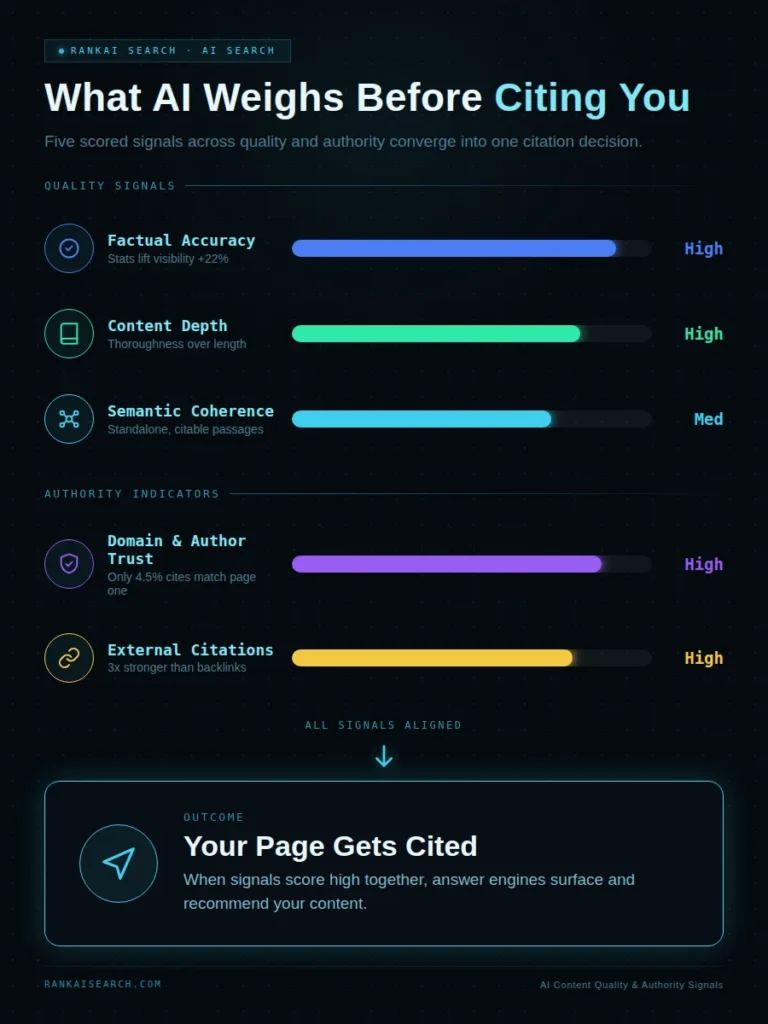
AI search engines analyze three core quality signals: factual accuracy, content depth, and semantic coherence. Each signal measures whether your content is reliable, complete, and logically organized enough to extract a confident answer.
These signals work together. A page can be accurate but shallow, or thorough but disorganized, and either gap weakens its chances of being cited.
How Does Factual Accuracy and Source Verification Work?
AI platforms cross-reference your content against trusted databases and established knowledge sources. They check whether your facts align with verified information from authoritative sites, academic research, and official documentation.
Citing credible sources strengthens reliability, and the data shows AI systems reward it directly. Adding statistics can increase AI visibility by 22%, and using direct quotations can boost it by 37% (Source: The Digital Bloom, 2025).
To demonstrate factual reliability:
- Back up claims with specific data rather than general assertions
- Reference original research and link to the source document, not a homepage
- Provide clear attribution and context when citing statistics or studies
- Avoid statements you cannot verify, since contradictions of accepted facts get flagged as unreliable
How Does Content Depth and Comprehensiveness Affect Evaluation?
AI systems favor thorough, well-researched content over articles that skim the surface. They identify when a piece truly covers a topic versus when it repeats basic information available everywhere.
Length is not the deciding factor: thoroughness is. AI platforms prefer comprehensive content that fully addresses a topic regardless of word count, and longer queries reflect this, with searches of eight or more words roughly seven times more likely to trigger an AI Overview than very short queries (Source: We Are TG, 2026).
Create comprehensive yet accessible content by breaking complex topics into clear sections, explaining technical terms when needed, and providing examples that illustrate key points. Address related questions users have and explore different aspects of your main topic.
How Does Semantic Coherence and Topical Relevance Get Measured?
Natural language processing lets AI evaluate logical flow and topic consistency. These systems check whether your content holds clear relationships between concepts and stays focused on the stated topic.
Jumping between unrelated ideas or including irrelevant sections hurts semantic quality. AI platforms prefer material where each paragraph connects logically to the next and every section supports the main topic.
Improve semantic structure with these practices:
- Use clear transitions between connected ideas
- Keep a consistent focus throughout the piece
- Place related concepts near each other
- Build each section on the ones before it
- Cut tangents that distract from your core message
What Authority Indicators Influence AI Recommendations?
Three authority indicators shape AI recommendations: domain trustworthiness, author expertise, and citation patterns. AI systems weigh who published the content, who wrote it, and who else references it.
Authority in AI search is not earned page by page. It compounds across your entire domain, your authors, and the sources that cite you back.
How Do Domain Authority and Trustworthiness Factor In?
AI platforms assess overall domain credibility by examining your entire site, not just individual pages. They evaluate whether you consistently publish accurate, helpful information or whether your site contains misleading or low-quality material.
Historical content quality builds algorithmic trust, and one strong article on an otherwise weak site rarely gets cited. The pull toward established authority is structural: only 4.5% of AI Overview URLs directly match a page-one organic result, which shows AI draws from deeper pages on already-trusted domains (Source: The Digital Bloom, 2025).
Establish and maintain domain authority by:
- Publishing consistently high-quality content over time
- Regularly updating existing material
- Removing or improving outdated pages
- Focusing on topics where you have genuine expertise
Why Does Author Expertise and Credentials Matter?
AI search engines prioritize content from recognized experts because knowledge and experience improve accuracy. When someone with relevant credentials writes about their field, AI systems treat that content as more authoritative.
Author bios, credentials, and demonstrated knowledge help AI platforms verify expertise. This matters most for Your Money or Your Life topics like health and finance, where verified authorship, credible study citations, and visible credentials are deciding factors in whether AI trusts a source (Source: Surfer, 2025).
Showcase expertise in ways AI can recognize by including detailed author bios with specific qualifications, linking to professional profiles, highlighting relevant experience, and keeping the author’s content quality consistent. First-person insights from actual experience carry more weight than generic information anyone could write.
How Do Citation Patterns and External References Work?
AI evaluates both the sources you cite and who cites you. Linking to high-quality, relevant external sources shows you have done the research and understand the broader context of your topic.
Being cited by other authoritative content boosts perceived authority more than traditional link building. Branded web mentions correlate three times more strongly with AI visibility than backlinks do (Source: Ahrefs via PR News, 2025).
Build a citation strategy by creating original research or data that others want to reference, citing your own sources thoroughly, linking to the most authoritative references available, and producing content that advances understanding of your topic rather than rehashing existing information.
What Structural Elements Do AI Systems Prioritize?
AI systems prioritize three structural elements: clear information hierarchy, answer-focused architecture, and technical accessibility. Structure determines how easily an AI can parse your content and extract a clean answer.
A well-organized page gives the system more places to draw from, which is why AI Overviews pull an average of 10.2 links from four unique domains per response (Source: The Digital Bloom, 2025).
How Does a Clear Information Hierarchy Help?
Logical heading structures help AI systems understand your content organization and identify key points. Proper headings let AI quickly determine what each section covers and how the pieces relate.
Create scannable sections with these rules:
- Use descriptive headings that clearly indicate what follows
- Keep related information together under one heading
- Organize content from general to specific
- Make each heading accurately represent the content beneath it
What Is Answer-Focused Content Architecture?
Answer-focused content architecture means designing each section to address a user query directly instead of making readers hunt for the answer. AI platforms favor material where the key information appears clearly and early.
Structure information for easy extraction by starting sections with direct answers, supporting those answers with explanation and context, and making each section understandable in isolation. AI often extracts a single paragraph or section, so each one should work independently.
How Does Technical Optimization Affect AI Crawlers?
Technical optimization determines whether AI systems can access and process your content at all. Clean code, fast loading speeds, and mobile responsiveness remove the barriers that block AI crawlers, while structured data helps them identify facts, dates, people, and relationships.
Facilitate AI content evaluation with these technical foundations:
- Ensure the site loads quickly and works on all devices
- Use clean HTML without excessive scripts or errors
- Implement relevant structured data and schema markup
- Keep content accessible without login requirements or paywalls
What User Engagement Metrics Do AI Platforms Consider?
AI platforms consider user interaction signals like dwell time, bounce rate, and content satisfaction to judge quality. High bounce rates suggest your content does not match what users expected, while long dwell times indicate users are getting value.
Engagement matters more as AI absorbs the click. When an AI summary appears, click rates are nearly halved, at 8% versus 15% for results without one, so the visits you do earn need to satisfy users quickly (Source: Pew Research via ALM Corp, 2026).
Create content that generates positive user signals by:
- Writing clearly and organizing information logically
- Including relevant examples and visuals
- Addressing the actual questions users have
- Providing useful information rather than fluff
How Often Should You Update Content for AI Search?
Update frequency depends on the topic, but regularly refreshed content wins because AI platforms check publication and update dates to recommend current information. Outdated information can mislead users, so AI systems treat freshness as a quality signal.
The right cadence varies by subject:
| Content Type | Update Cadence | Reason |
| News and current events | Frequent, ongoing | Accuracy depends on recency |
| Technical and standards-based | When best practices change | Outdated methods mislead users |
| Evergreen | Annual review | Remains relevant with minor edits |
Maintain relevance by updating statistics and examples, adding new developments, refreshing outdated sections, and clearly showing the last update date. Do not change the date without improving the content, because AI systems detect superficial updates.
How Do E-E-A-T Principles Apply to AI Content Evaluation?
E-E-A-T stands for Experience, Expertise, Authoritativeness, and Trustworthiness, and these four principles remain central to how AI platforms evaluate content. Google introduced the framework, but it applies broadly across AI search.
Each principle maps to a concrete practice:
- Experience: Share first-hand knowledge and specific examples from real situations
- Expertise: Use accurate detail and proper terminology that shows deep subject knowledge
- Authoritativeness: Build a strong reputation and earn citations from other quality sources
- Trustworthiness: Be transparent about limitations, cite reliable sources, and correct errors promptly
Implement E-E-A-T for answer engine optimization by highlighting relevant credentials, providing specific information that shows expertise, building your domain’s reputation through consistent quality, citing reliable sources, being transparent about authorship, and correcting errors as soon as you find them.
How Do You Align Your Content Strategy With AI Quality Standards?
Align your strategy by writing for humans first, since clear and helpful content that serves readers also performs well with AI systems. Avoid writing to manipulate AI algorithms, because these systems detect thin content, inconsistencies, and unnatural writing.
This advice is grounded in how AI sources its answers. RankAISearch is a global agency specializing in AEO, GEO, AIO, LLMO, and SEO, and the data consistently points to a single conclusion: own the sources AI already trusts. Across ChatGPT, Gemini, and Perplexity, 86% of AI citations come from sources brands already manage, such as their own websites and listings (Source: Yext, 2025).
Build a framework for AI-optimized content with these steps:
- Start with genuine expertise in your topics
- Research thoroughly before writing
- Structure content to answer specific questions clearly
- Cite authoritative sources and maintain factual accuracy
- Review and update material on a regular schedule
The core principle stays constant as these systems advance: create genuinely helpful, accurate, authoritative content, and AI systems will recognize and recommend it. To put this framework into practice, work with a specialist who tracks how AI evaluates your content.
Frequently Asked Questions
How do AI search engines determine if content is trustworthy?
AI search engines verify facts against established knowledge bases and analyze citation patterns, domain history, and author credentials. They also monitor whether other authoritative sources cite your material, where branded mentions and earned citations carry particular weight.
What is the difference between quality signals for traditional SEO and AI search?
Traditional SEO focuses on keywords, backlinks, and technical factors like page speed, while AI search analyzes content meaning, factual accuracy, logical coherence, and genuine expertise. Traditional SEO responds to technical tactics, but AI search requires substantive quality and real authority that tactics alone cannot fake.
Do AI platforms prefer longer or shorter content?
AI platforms prefer content that fully addresses the topic, regardless of length. Short content works when it completely answers a simple question, while complex topics need detailed coverage, so the key is thoroughness rather than a specific word count.
How important are citations and references for AI search rankings?
Citations and references are very important for AI search because they demonstrate research, support factual claims, and place your content within a broader knowledge context. Quality matters more than quantity, so citing authoritative, relevant sources strengthens credibility more than a high volume of weak links.
Can AI search engines detect low-quality or manipulated content?
Yes, AI search engines detect low-quality content through multiple signals, identifying thin content, factual inconsistencies, keyword stuffing, and unnatural writing. They also detect content generated without expertise, so manipulation tactics that fooled traditional algorithms rarely work on modern AI systems.
How often should I update content to maintain AI search visibility?
Update frequency depends on your topic: news needs frequent updates, technical subjects need updates when standards change, and evergreen content may only need an annual review. Focus on keeping information accurate and current, since changing the date without improving the content gets detected as a superficial update.
What role does author expertise play in AI content evaluation?
Author expertise plays a significant role, especially for high-stakes topics like health and finance where accuracy matters most. AI systems look for relevant credentials, consistent quality across an author’s work, and recognition from others in the field, so clear author attribution and detailed bios help verify expertise.
Does ranking on page one of Google guarantee an AI citation?
No, ranking on page one does not guarantee an AI citation, since holding a top organic spot offers only an 8% chance of being cited within an AI Overview. AI systems often pull from deeper pages on authoritative domains, so entity authority and citability matter as much as ranking position.