

Why Do AI Answer Engines Prioritize Certain Brands Over Others?
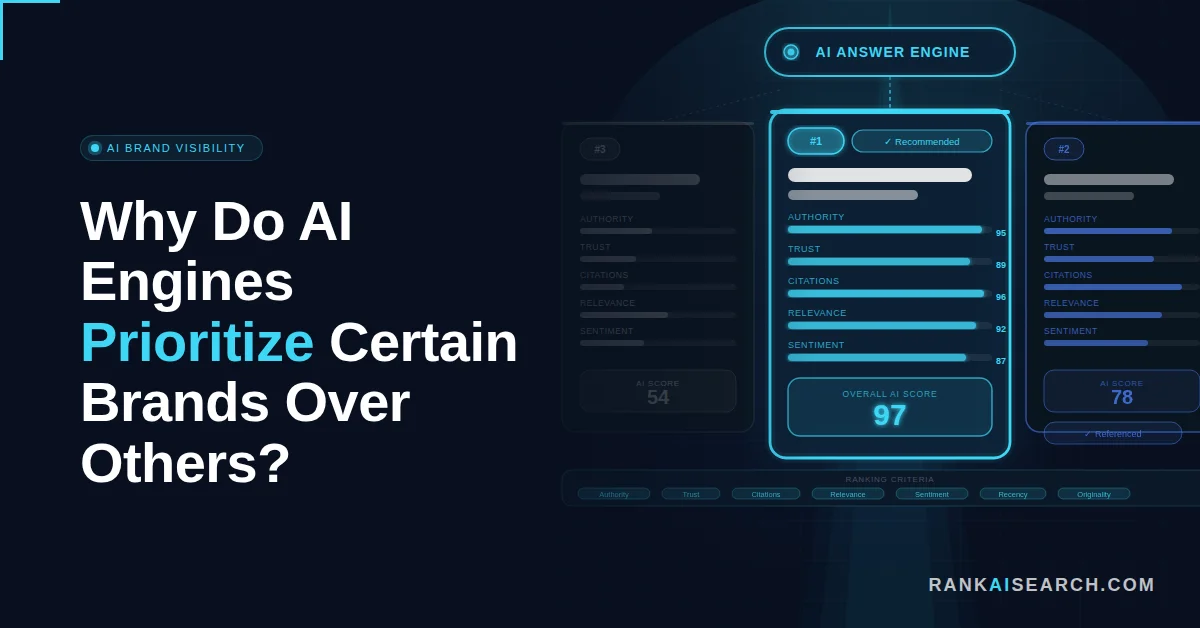
You’ve asked ChatGPT, Perplexity, or Google’s AI Overviews a question and noticed the same brands keep showing up. It’s not luck, and it’s not ad spend. AI answer engines follow specific patterns when deciding which brands to recommend, and most businesses have no idea those patterns exist.
The shift is already underway. Traditional search engine volume is projected to drop 25% by 2026 as users move toward AI-powered answers. Brands that understand how AI selects its recommendations are capturing visibility that their competitors are losing by default. This guide breaks down every factor AI platforms evaluate and exactly what you can do to show up in their answers.
How Do AI Answer Engines Select Brands?
AI answer engines select brands by evaluating how easily they can extract, verify, and present information to users. This process is fundamentally different from traditional search.
| Traditional Search | AI Answer Engines |
| Displays 10+ options for users to choose from | Selects and recommends specific brands directly |
| Ranks pages by relevance and backlinks | Ranks brands by extractability and entity authority |
| Users evaluate sources themselves | AI validates sources and presents one answer |
| Rewards keyword optimization | Rewards structured, standalone information |
| Passive link to content | Active citation of your brand by name |
Brands that dominate AI-generated answers have reduced ambiguity across every signal they send. AI systems cite them because they can validate, extract, and present their information with confidence.
According to Gartner (2024), traditional search engine volume is projected to drop 25% by 2026. AI-generated answers now appear across a growing share of high-intent queries. The brands appearing in those answers are not there by accident.
How Does Structured Data Help AI Recognize Your Brand?
Structured data acts as a translation layer between your content and AI systems. It tells AI platforms exactly what your content represents, reducing processing complexity and increasing citation likelihood.
According to Google Search Central (2023), pages with correctly implemented structured data are significantly more likely to earn rich results and AI-accessible visibility.
The schema formats most effective for AI visibility:
| Schema Type | What It Signals to AI |
| Organization | Brand identity, service area, and contact details |
| LocalBusiness | Location-based information for geo-specific queries |
| Article | Editorial content AI can cite as an authoritative source |
| FAQ | Direct question-and-answer pairs ready for extraction |
| Product | Commercial relevance, pricing, and availability |
| Review | Third-party credibility from independent sources |
| BreadcrumbList | Site structure and content hierarchy |
How Does Entity Recognition Determine Brand Authority?
Entity recognition determines whether AI systems view your brand as a legitimate, authoritative source. AI does not just read your website; it cross-references your brand across the entire web.
A strong entity profile requires:
- Consistent NAP data: Your name, address, and phone number must match exactly across all platforms
- Authoritative mentions: Regular citations in news publications, industry sites, and educational resources
- Topical associations: Consistent appearances alongside recognized authorities in your field
- Knowledge panel presence: A verified Google Knowledge Panel signals AI-recognizable entity status
- Cross-platform coherence: Brand information on social profiles, directories, and third-party sites must align
AI models trust entities that appear reliably across multiple authoritative sources with consistent, verifiable information.
What Content Quality Factors Influence AI Recommendations?
Content depth, accuracy, and structure are the primary quality signals for AI answer engines. Every piece of content should be built to be extracted, not just read. Content with cited external sources and structured formatting performs measurably better in AI-generated answers than unstructured prose.
| Quality Factor | What AI Evaluates | How to Optimize |
| Depth | Does this fully answer the question? | Cover the topic without gaps or padding |
| Accuracy | Does this align with established knowledge? | Cite authoritative sources with active links |
| Structure | Can AI extract this without surrounding context? | One idea per paragraph; lead with the answer |
| Specificity | Are claims verifiable? | Replace vague language with data and named sources |
| Freshness | Is this current? | Update content regularly and timestamp changes |
Why Do Clear, Direct Answers Win in AI Search?
AI answer engines prefer concise, standalone information chunks they can extract and present without additional context. A paragraph that fully answers a specific question outperforms one that requires surrounding text to make sense.
Formatting strategies that improve AI citation-friendliness:
- Open every section with the direct answer, not background context
- Use descriptive headings that mirror natural language questions
- Keep each paragraph to one distinct, citable idea
- Use bullet points for discrete lists
- Use tables for comparisons and multi-attribute information
Instead of optimizing for keyword phrases, optimize for complete conversational questions users might ask ChatGPT or Perplexity.
How Do Domain Authority and Trust Signals Work in the AI Era?
Domain authority still influences AI visibility, but content authority and entity recognition carry more weight than raw link metrics. Pages earning links from high-authority domains are significantly more likely to appear in AI-generated answers.
| Signal Type | Role in Traditional SEO | Role in AI Search |
| Backlinks | Direct ranking factor | Validation and entity authority signal |
| Domain Rating | Core ranking metric | Supporting credibility indicator |
| Content Authority | Secondary factor | Primary recommendation driver |
| Entity Mentions | Minor influence | Core trust signal for AI citation |
| Structured Data | Useful for rich results | Essential for AI extractability |
Prioritize mentions from recognized industry authorities over volume-based link building.
How Does Content Freshness Affect AI Recommendations?
AI answer engines prioritize recently published or updated content because users expect current answers. Content updated within the past 90 days receives preference, particularly for time-sensitive topics.
Strategies for maintaining content freshness:
- Audit existing articles quarterly for outdated statistics and examples
- Add new data points and update timestamps when making substantive changes
- Publish regular commentary on industry developments to signal active engagement
- Republish evergreen content with updated supporting evidence
AI systems track modification patterns. Brands that consistently refresh content maintain higher visibility than those with static, aging pages.
How Do User Engagement Metrics Influence AI Learning?
User behavior data influences AI recommendations through feedback loops. When users engage positively with AI-cited content, those signals reinforce the system’s confidence in recommending that brand again.
Engagement metrics AI systems factor in:
- Time on page: Signals that content satisfied the user’s query
- Scroll depth: Indicates content depth and relevance
- Return visit rate: Confirms ongoing utility beyond the first visit
- Low bounce rate: Suggests content matched user intent accurately
- Social sharing: Validates content quality through third-party distribution
Positive engagement compounds: more recommendations generate more engagement data, which generates more recommendations.
How Do Semantic Relevance and Topical Clustering Build AI Authority?
Comprehensive topic coverage signals subject matter expertise more effectively than isolated articles. According to HubSpot’s 2024 State of Marketing Report, brands with pillar-cluster content models see measurably higher organic visibility than those without.
A topical cluster that signals authority to AI includes:
- A pillar page that comprehensively covers a core topic
- Cluster articles that address specific subtopics in depth
- Internal links that connect related content with descriptive anchor text
- Consistent terminology across all related pieces
- Complementary formats such as FAQs, guides, and comparison pages
Each piece should strengthen overall topical expertise while providing standalone value.
How Does Contextual Relevance Affect AI Responses?
AI matches each query to the brand whose content most directly addresses that specific need. A brand can dominate one query type but remain invisible for another based on contextual fit.
To optimize for contextual relevance:
- Write content that answers one specific question per page or section
- Use the exact phrasing users apply when speaking to AI platforms
- Create dedicated content for long-tail queries, not just broad topics
- Avoid generic overviews; AI users expect precise, tailored answers
- Structure content around user intent, not keyword targets
What Technical Standards Do AI Systems Require?
Page speed, mobile optimization, and site health are foundational requirements for AI visibility. AI crawlers cannot recommend content they cannot access and process reliably.
Common technical barriers that block AI citations:
- Broken internal links: Interrupt content traversal and signal poor maintenance
- Slow load times: Trigger crawler timeouts before content is fully processed
- Mobile incompatibility: Flags the site as below current web standards
- Non-indexable formats: Prevent AI systems from extracting text content
- Thin or duplicate content: Reduces confidence in the page as a citable source
Google’s Core Web Vitals is the most reliable benchmark for measuring technical readiness for AI discoverability.
Why Does Brand Consistency Matter for AI Recognition?
Inconsistent information across platforms confuses AI systems and reduces their confidence in recommending your brand. AI resolves ambiguity by omitting the brand from responses entirely.
Consistency requirements for AI citation:
- NAP data: Business name, address, and phone number must match exactly across every platform
- Brand description: Service offerings and positioning should use consistent language site-wide
- Google Business Profile: Must align with website content and directory listings
- Social profiles: Bio, URL, and brand name must match primary brand assets
- Third-party directories: Outdated listings actively undermine AI confidence in your brand
How Do Reviews and Social Proof Influence AI Credibility?
Customer reviews provide third-party validation that AI systems treat as independent credibility signals. AI interprets consistent positive review patterns as evidence of reliable quality.
Where reviews matter most for AI visibility:
- Google Business Profile: Highest-weight review source for local AI queries
- Industry platforms: G2, Clutch, Trustpilot, and vertical-specific sites
- Editorial mentions: Journalist and analyst references carry more weight than user reviews
- Response behavior: Professional replies to negative reviews signal brand accountability
- Review recency: AI favors brands with active, ongoing review activity over stale review histories
How Can Brands Gain a Competitive Advantage in AI Search?
Early adoption of Answer Engine Optimization (AEO) creates lasting visibility advantages. AEO is the practice of structuring content, technical signals, and entity profiles to maximize brand citation by AI-powered platforms such as ChatGPT, Perplexity, and Google AI Overviews.
According to Salesforce’s 2024 State of Marketing Report, only 36% of marketers currently have a defined strategy for generative AI in search. Most businesses have not yet optimized for AI answer engines.
Priority actions for building AI search advantage:
- Build and verify your Google Knowledge Panel
- Implement full schema markup across all key pages
- Publish pillar-cluster content around your core service areas
- Earn citations from authoritative industry publications
- Audit and unify NAP data across all platforms
- Refresh high-value content on a regular schedule
Brands that establish strong entity profiles and citation patterns now will maintain preferential positioning as AI-powered search becomes the primary discovery method.
Frequently Asked Questions
What factors do AI answer engines use to choose which brands to recommend?
AI answer engines evaluate content quality, entity authority, structured data implementation, user engagement signals, and information recency. They prioritize brands with clear, accurate, extractable content that AI systems can verify and cite with confidence.
Technical accessibility, consistent brand mentions across authoritative sources, and strong topical expertise also influence recommendations. Brands that score across multiple signals get cited more frequently than those that optimize for only one or two factors.
How is AI search ranking different from traditional Google search ranking?
AI search selects and recommends specific brands directly in answers rather than displaying a list of options. Traditional SEO focuses on page relevance and backlinks; AI ranking emphasizes content extractability, entity recognition, and standalone answers AI can cite confidently.
Can small businesses compete with large brands in AI answer engines?
Yes. AI platforms value relevance and accuracy over brand size. A small business with comprehensive coverage of a specialized topic and strong local entity signals can outperform larger competitors in relevant queries.
Focus on niche expertise, consistent structured data, and mentions from credible industry sources. Specificity is a competitive advantage in AI search.
How long does it take for AI platforms to start recommending my brand?
Brands with established domain authority and properly implemented structured data may see AI citations within 60 to 90 days. New or less authoritative brands typically require several months of consistent optimization before gaining regular AI citations.
Entity building, content improvements, and structured data implementation all contribute to reducing that timeline.
Do backlinks still matter for AI answer engine visibility?
Backlinks still matter, but they function as authority and validation signals rather than direct ranking factors. Quality links from recognized industry authorities strengthen your entity profile and credibility, which indirectly influences AI recommendations.
Prioritize earning natural links from trusted sources in your vertical over volume-based link building.
What types of content do AI answer engines prefer to cite?
AI platforms prefer content with direct answers, recent publication dates, comprehensive topic coverage, and proper structured data. Formats like FAQ sections, step-by-step guides, and well-organized articles with descriptive headings perform best.
Each section should provide standalone value that AI can extract without needing surrounding context.
How can I track my brand’s performance in AI-generated answers?
Monitor your brand by regularly querying AI platforms with relevant industry questions. Track when and how your brand appears in responses, and use brand monitoring tools to identify citation patterns across platforms.
Analyze referral traffic from AI sources and monitor visibility changes over time to assess whether your optimization is compounding.
Is AI search optimization a one-time project or an ongoing process?
AI search optimization is an ongoing process. AI platforms continuously update their training data, ranking signals, and citation preferences. A brand that stops updating content and entity signals will lose visibility over time.
Treat AEO the same way you treat SEO: as a continuous program of content updates, technical maintenance, and authority building.