


How Do You Build an AI SEO Strategy?
AI search engine optimisation (AI SEO) is the practice of preparing your website, content and data so that both search engines and AI‑powered answer systems can find, interpret and cite your information.
Traditional SEO focuses on ranking pages in search results; AI SEO extends this by ensuring your content appears in generative answers provided by large language models.
As more people ask questions through AI tools and voice assistants, optimising for AI visibility becomes critical.
In 2024, Google introduced AI Overviews and reports suggest 60 % of searches end without a click. This shift means brands must be present where answers are delivered, not only in blue links.
Key takeaways:
- AI SEO prepares content for AI‑generated answers as well as traditional search results. It emphasises clarity, structure and authority.
- Unlike traditional SEO, AI SEO focuses on extractability and citation. Content needs to be easy for AI systems to parse and trust.
- Technical foundations such as site speed, schema markup and accessible sitemaps remain essential.
- Predictive intent, where AI anticipates follow‑up questions, requires you to cover related topics and questions in one resource.
- Measuring success includes tracking citations, mentions and conversions from AI‑generated answers in addition to rankings and traffic.
How did AI change what “SEO” means?
Artificial intelligence has altered user behaviour and search technology. People are increasingly using conversational tools like ChatGPT or voice assistants to ask questions. These systems synthesise information from various sources rather than displaying a list of links.
AI is changing how people search and that over 60% of searches may end without a click. AI‑driven search emphasises semantics and intent, so exact keyword matches matter less.
Modern SEO must account for how AI platforms interpret content, which often involves entity relationships and natural language understanding. The new definition of SEO includes optimising for answer extraction, citations and brand mentions within AI summaries.
What does AI search engine optimisation involve?
AI SEO includes several key components:
- Technical foundation – A fast, crawlable website with clean code, proper headings and schema markup. Structured data like FAQ and HowTo schema makes your content machine‑readable. Allow AI crawlers in your robots.txt file to index your pages.
- Entity and topic coverage – Use clear language and include relevant entities (people, places, concepts) to help AI models understand context. Link related pages to build topical authority.
- Direct answers – Write concise answers to common questions near the top of your sections. Answer engines prefer clear, front‑loaded information.
- Trust signals – Demonstrate expertise with author bios, references and external citations. Google’s E‑E‑A‑T guidelines emphasise Experience, Expertise, Authority and Trust.
- Continuous optimisation – Monitor AI citations, adjust to algorithm changes and update content to remain relevant. AI systems evolve quickly, and early adopters have an advantage.
How does predictive intent influence AI SEO strategy?
Predictive intent means AI anticipates what users will ask next based on context.
For example, a question about “AI search engine optimisation” might lead to follow‑up questions about tools, benefits or best practices.
To capture these queries, create comprehensive content that covers related subtopics in one resource. Use question‑based headings like “What tools support AI SEO?” or “How do you measure AI SEO?” to align with conversational prompts. This approach improves your chances of being cited in follow‑up answers.
What are the technical foundations for AI SEO?
Technical SEO remains the backbone of AI SEO. Ensure your site is mobile‑friendly, loads quickly and has no broken links. Use XML sitemaps and structured data to make it easy for crawlers and AI bots to discover and index your pages.
Schema markup, such as FAQ and HowTo, helps AI identify questions and answers within your content. Allow AI bots like GPTBot and Perplexity to access your site by reviewing your robots.txt file. Without a solid technical foundation, even the best content may not be discovered or cited.
How do you measure wins in AI SEO?
Measuring success goes beyond rankings. You should track citations in AI answers, mentions in AI Overviews and conversions from zero‑click interactions. Tools such as Semrush AI Tracking, Ubersuggest LLM Beta and Ahrefs Brand Radar can help you monitor where and how often AI systems reference your brand.
Combine these metrics with traditional analytics like traffic and conversions. Also look at engagement metrics such as time on page and shares to gauge user satisfaction. A rise in citations and qualified leads indicates your AI SEO strategy is working.
Core Principles of an Effective AI SEO Strategy
Answer Engine Optimisation (AEO) and Generative Engine Optimisation (GEO) are specialisations within AI SEO. AEO focuses on structuring content so that answer engines like ChatGPT can cite it.
GEO emphasises visibility in AI‑driven platforms and covers both the accuracy and the presence of your brand in generative answers. AI SEO integrates both by ensuring content is technically sound, semantically clear and authoritative. Traditional SEO is still important because search engines remain a primary discovery channel.
Atak Interactive underscores that SEO forms the foundation for AEO and GEO. Optimising for Google and Bing ensures your content is indexed, which remains necessary even as AI answers gain prominence.
What are your next steps for a future‑proof SEO strategy?
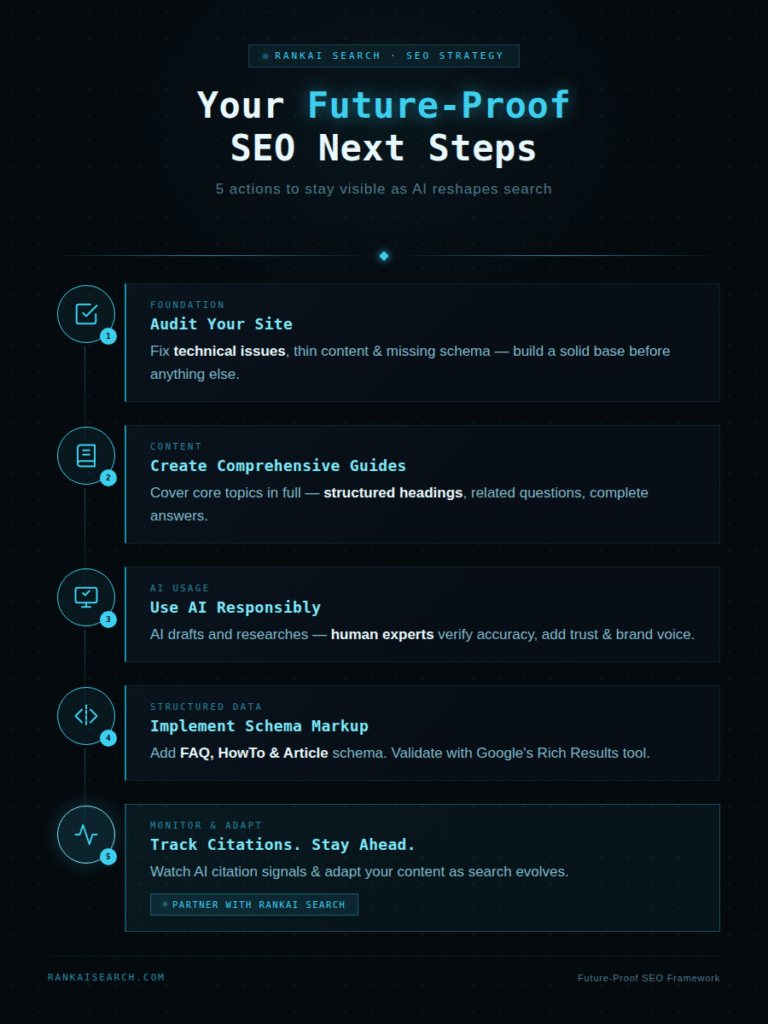
- Audit your site – Identify technical issues, thin content and missing schema. Fix these to create a strong foundation.
- Create comprehensive guides – Cover core topics fully, addressing related questions and using structured headings.
- Use AI responsibly – Employ AI for research and drafting, but involve experts to ensure accuracy and trust.
- Implement structured data – Add FAQ, HowTo and Article schema. Test using Google’s Rich Results tool.
- Monitor and adapt – Track AI citations and adjust your content and technical set‑up as AI systems evolve. Partner with RankAISearch to stay ahead of changes.
Conclusion: Why invest in AI search engine optimisation?
AI search engine optimisation extends the scope of traditional SEO to include visibility in AI‑generated answers. By structuring your content for both search engines and conversational models, you increase the chances of being discovered, cited and trusted.
A strong technical foundation, clear answers and authoritative signals are essential. With AI adoption accelerating and search behaviour shifting, investing in AI SEO now positions your brand for the future.
If your business wants to improve visibility in both traditional search and AI-powered results, RankAISearch can help. Our team creates professional SEO and GEO strategies designed to strengthen your presence across Google, AI Overviews, and generative search platforms through AI-ready content, stronger site structure, and smarter search optimisation.
Frequently Asked Questions (FAQs)
What is AI search engine optimisation?
AI SEO is the practice of optimising your website and content so that both traditional search engines and AI systems can find, understand and cite it. It goes beyond rankings to include visibility in AI‑generated answers.
How is AI SEO different from traditional SEO?
Traditional SEO focuses on ranking pages in SERPs. AI SEO extends this by optimising content for extractability and citations in AI answers. It emphasises structured data, clear language and trust signals.
Why should I worry about AI answers if I rank well on Google?
A large portion of searches now yield AI summaries where users get answers without clicking. Appearing in those summaries builds brand visibility and authority even when clicks decrease.
Do backlinks still matter in AI SEO?
Yes. High‑quality backlinks strengthen your authority, increasing the likelihood that AI systems will trust and cite your content.
How long does AI SEO take to show results?
Like traditional SEO, results may take months. However, if your content is already trusted, you might see citations in AI answers sooner. Continuous monitoring and optimisation are essential.