

How to Optimize Your Brand for ChatGPT Search
To optimize your brand for ChatGPT search, produce content that AI language models can extract and cite as direct answers. Structure, authority, and specificity determine whether ChatGPT recommends your brand or a competitor’s. ChatGPT now has 900 million weekly active users, processes 2.5 billion prompts per day, and ranks among the five most visited websites globally.
The buying journey has already moved. A March 2026 G2 survey of 1,076 B2B decision-makers found that 51% of software buyers now start research in an AI chatbot more often than Google, up from 29% eleven months earlier. 69% chose a different vendor than planned after AI chatbot guidance, one in three bought from a brand they had never heard of before, and AI-referred visitors convert at more than double the rate of organic search.
This guide covers the content, technical, and authority-building strategies that secure your brand a place inside those AI-generated answers.
What Is ChatGPT Search Optimization?
ChatGPT search optimization is the practice of structuring content so AI language models can find, understand, and recommend your brand when users ask questions. Unlike traditional search engines that return a list of links, ChatGPT delivers direct answers by pulling from sources it considers reliable and relevant.
Traditional SEO and AI search operate on different selection logic. A strong Google ranking does not guarantee AI visibility. Many pages that rank in Google’s top 10 are never cited by ChatGPT, and many pages ChatGPT cites do not rank highly in traditional search.
ChatGPT is highly selective: it cites only a fraction of the pages it retrieves during a search. Brands that structure content for direct extraction, not just discoverability, are the ones that make the cut.
Why ChatGPT Visibility Matters for Your Business
ChatGPT visibility matters because buyers across industries now use AI assistants to compare vendors, evaluate solutions, and build shortlists before ever visiting a website. Being cited in those responses positions your brand before any direct contact.
When a potential client asks ChatGPT to recommend a service provider in your category, the brands that appear in that answer capture the conversation. Those that do not are invisible at the moment the decision begins.
AI-generated recommendations also carry higher conversion value than organic search. Visitors referred from AI platforms arrive pre-qualified and informed, which shortens the sales cycle and increases close rates.
Understanding How ChatGPT Retrieves and Ranks Information
ChatGPT does not surface content at random. It evaluates sources on two dimensions: how well content answers a specific question, and how trustworthy the source appears. Answers placed early in each section are significantly more likely to be extracted and cited.
The Role of Large Language Models in Content Selection
Large language models evaluate content on comprehensiveness, accuracy, clarity, and recency. ChatGPT does not reward keyword density. It rewards natural language that thoroughly addresses a topic.
Content structure is a measurable citation factor. Pages that use semantic HTML, FAQ sections, and direct answer blocks at the top of each section receive significantly more citations than pages with dense, unbroken prose.
Semantic relevance matters more than keyword matching. ChatGPT understands meaning and context, so writing conversationally while covering subjects in depth signals quality to the model.
Why Authoritative Sources Gain Preference?
Domain authority is the single strongest predictor of AI citations. An SE Ranking study of 2.3 million pages found that high-traffic sites earn 3x more AI citations than low-traffic ones, and sites with over 32,000 referring domains are 3.5x more likely to be cited than those with fewer than 200.
Third-party presence reinforces authority signals. Domains with active profiles on review platforms and community sites earn measurably higher citation rates than those relying solely on their own website content.
Essential Strategies for ChatGPT Search Optimization
Three content practices drive the majority of AI visibility gains: structuring content for machine parsing, optimizing for how professionals phrase questions, and producing assets that other sources cite.
Structuring Content for AI Comprehension
Use descriptive headings, short paragraphs, and logical flow so AI can parse your content efficiently. Each section should address one main point completely before moving to the next.
Place a direct answer in the first 1-2 sentences of every section. Self-contained definition sentences at the start of each section increase extraction probability and make individual paragraphs more likely to be quoted in AI responses.
Break complex topics into single-concept paragraphs. This structure makes your content more likely to be cited because AI can extract specific answers without ambiguity.
Optimizing for Question-Based Queries
Commercial intent queries are significantly more likely to trigger ChatGPT’s live web search than informational ones. Content targeting buyer-stage questions needs to win the opening query of a research session, not the clarifying follow-up.
Craft comprehensive answers that satisfy user intent without requiring the reader to search elsewhere. Complete answers that include context, relevance, and practical next steps signal quality to AI platforms.
Use FAQ formats to improve AI discoverability. ChatGPT recognizes question-answer structures easily, and dedicated FAQ sections help the model match your content with similar user queries.
Building Citation-Worthy Content Assets
The majority of AI brand mentions do not come from your own website. Research by GenOptima found that 85% of brand mentions in AI responses originate from third-party pages, and brands are 6.5x more likely to be cited through external sources than through their own domain. Press coverage, industry directories, Reddit threads, and LinkedIn articles all build the citation equity that drives AI brand mentions.
Publish case studies with specific challenges faced, solutions implemented, and measurable results achieved. Detailed walkthroughs of real projects give AI platforms concrete examples to reference.
Technical Implementation for ChatGPT Visibility
Content quality alone does not guarantee AI visibility. Site architecture and structured data determine whether AI platforms can discover and interpret your content in the first place.
Enhancing Website Architecture for AI Crawlers
Organize your site with clear navigation, descriptive URLs, and logically grouped content. AI platforms explore websites systematically, so good structure helps them find and index all your content.
Use proper heading hierarchies and semantic HTML: H1 for page titles, H2 for main sections, and H3 for subsections. This signals content importance and helps AI understand how topics relate.
Page speed directly affects citation rate. Fast-loading pages are not just a user experience concern. They signal technical credibility to AI systems that evaluate page quality as part of source selection.
Leveraging Structured Data and Rich Snippets
Stacked JSON-LD Schema is one of the highest-impact technical signals for AI citation. Implementing Article, ItemList, FAQPage, and Organization schema together significantly increases citation rates compared to pages with no schema.
Use schema types that match your specific services and expertise areas. Precision in schema selection helps ChatGPT match your business with queries about specific services rather than broad categories.
Validate structured data regularly using schema testing tools to catch errors that could cause AI platforms to ignore your markup. Even minor errors in JSON-LD can eliminate the citation lift that schema provides.
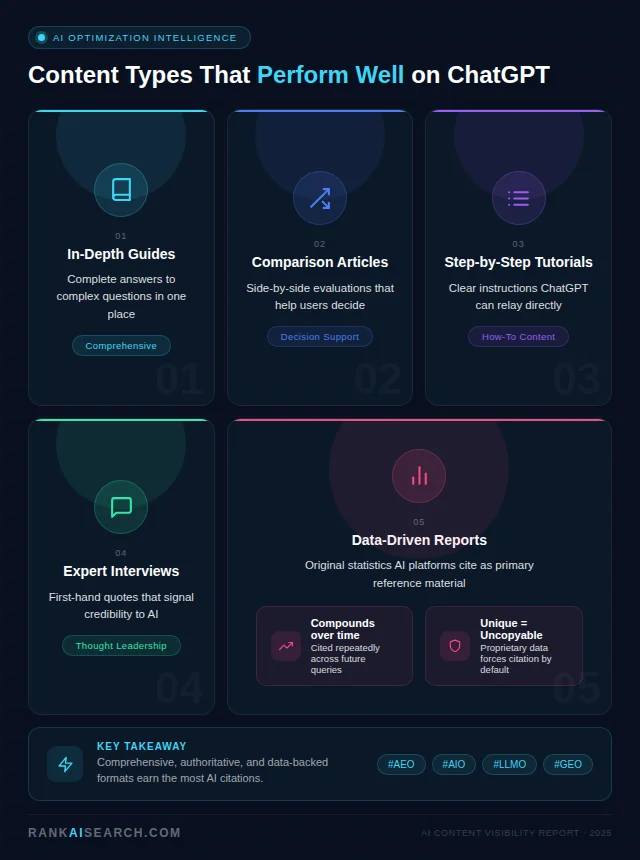
Content Types That Perform Well on ChatGPT
AI platforms favor content that educates and provides unique value in digestible formats. The formats below consistently generate the highest citation rates across platforms.
| Content Type | Why It Performs |
| In-depth guides | Cover a topic completely, giving ChatGPT one authoritative source for complex answers. |
| Comparison articles | Address a high-frequency query type; B2B users frequently ask AI to compare options. |
| Step-by-step tutorials | Solve specific problems with clear instructions AI can relay directly. |
| Expert interviews | Demonstrate authority through direct quotes and insights from credible practitioners. |
| Data-driven reports | Become reference material; original statistics are cited repeatedly across queries. |
Measuring Success in ChatGPT Search Optimization
AI search requires different measurement than traditional SEO. Tracking brand mention share, query-to-citation mapping, and referral traffic from AI platforms reveals where your optimization is working and where gaps remain.
| Signal | How to Measure |
| Brand mentions in AI responses | Query ChatGPT regularly with industry questions; record when your brand appears. |
| Referral traffic from AI platforms | Monitor analytics for visitors from ChatGPT, Perplexity, and Google AI Overview. |
| Query-to-mention mapping | Document which question formats trigger brand mentions; use findings to guide content. |
| Cross-platform visibility | Test visibility on ChatGPT, Google AI Overview, Perplexity, and emerging AI assistants. |
| Competitive mention frequency | Track how often your brand is cited relative to competitors in AI responses. |
Common Mistakes to Avoid in AI Platform Optimization
Most brands that fail to appear in AI responses make the same preventable errors. The mistakes below account for the majority of lost citation opportunities across industries.
- Over-optimizing with repetitive keywords. AI platforms detect unnatural language patterns and deprioritize keyword-stuffed pages. Write for humans first.
- Neglecting E-E-A-T signals. Without clear signals of expertise, experience, authoritativeness, and trustworthiness, well-written content still may not get cited.
- Creating shallow content. ChatGPT prefers comprehensive sources. Surface-level articles get passed over for more thorough alternatives.
- Ignoring technical SEO fundamentals. Poor site structure, slow loading speeds, broken links, and missing metadata all reduce AI discoverability.
Failing to update content regularly. Pages not refreshed at least quarterly are 3x more likely to lose their AI citations, with measurable citation decay beginning approximately 14 days after publication for time-sensitive content. Update timestamps, refresh statistics, and add new examples whenever a key claim in the article changes.
Future-Proofing Your ChatGPT Optimization Strategy
AI search is not a niche channel. It is a fast-scaling infrastructure, and the brands building authority in it now will compound that advantage as adoption continues to grow.
Multi-platform coverage is not optional. AI Overviews and ChatGPT cite different URLs the majority of the time, despite often reaching similar conclusions. A brand visible in one platform is still invisible to distinct segments of its audience.
Prepare for voice and visual AI interfaces by optimizing for conversational queries now. Voice search and multimodal AI represent the next evolution in search behavior, and content that performs well today carries into those formats.
If your brand is not appearing in AI-generated answers, you are missing the earliest stage of the buying decision. RankAISearch helps businesses worldwide build measurable visibility across ChatGPT, Google AI Overview, Perplexity, and other AI search platforms. Contact us to get started.
Frequently Asked Questions (FAQs)
What makes content rank well on ChatGPT search results?
Content ranks well on ChatGPT when it demonstrates clear expertise, answers questions completely, and comes from sources with established authority. Original research, direct definitions, and practical examples signal citation-worthiness to the model.
How long does it take to see results from ChatGPT optimization?
Most businesses see initial brand mentions within 60 to 90 days of implementing structured optimization. Building consistent authority across AI platforms takes 6 to 12 months of ongoing expert content production.
Can small businesses compete with larger brands on AI platforms?
Yes. AI platforms value depth and authority over brand size. A small business with genuine expertise on a specific topic can outperform larger competitors producing generic content.
Do traditional SEO strategies still matter for ChatGPT visibility?
Yes, but their role shifts. Site structure, mobile optimization, page speed, and content quality remain important for AI discoverability. Keyword density matters less than semantic relevance and comprehensive topic coverage.
How often should I update content for optimal AI platform performance?
Update cornerstone content quarterly, especially pages with statistics or industry data. Add new expert content at least monthly to signal active expertise to AI platforms.
What types of businesses benefit most from ChatGPT search optimization?
B2B service providers, professional consultancies, software companies, and expertise-driven businesses benefit most. These sectors rely on trust and knowledge to drive decisions, and AI recommendations carry significant weight with their buyers.
Is ChatGPT optimization different from optimizing for Google AI Overview?
Yes. ChatGPT optimization prioritizes conversational language and comprehensive answers. Google AI Overview still weights traditional ranking factors heavily alongside content quality. Expert, well-structured content satisfies both platforms.
What is the single most important factor in AI search optimization?
Citable specificity is the most important factor. AI systems select content they can extract and relay as a direct answer. Vague claims are skipped. Specific, verifiable statements, such as defined timelines, named frameworks, and concrete results, are cited.