


Do Dofollow Links Still Matter for Getting Cited by AI Search Engines?
A dofollow link used to feel like the prize in every outreach campaign. In AI search, the value of a link is no longer judged only by whether it passes traditional authority. The source, context, surrounding language, and topical relevance now matter just as much.
That shift changes how link quality should be evaluated. A trusted nofollow mention can help AI systems understand a brand better than a weak dofollow link from an unrelated page. This guide explains how dofollow, nofollow, sponsored, and UGC links affect AI search citations.
Do Dofollow Links Matter for AI Search Citations?
Dofollow links still matter, but less than they used to. AI tools cite sources based on overall topical authority, accuracy, and how often a domain is referenced across the web, not on whether any one inbound link is tagged dofollow or nofollow. A nofollow mention on a trusted site can still carry citation value.
A dofollow link can help search engines discover and evaluate a page because it acts like a normal hyperlink without a restrictive link attribute. That still matters for traditional SEO because links remain part of how search systems discover pages and understand relationships between sites.
AI search adds another layer. An AI system can use linked pages, unlinked mentions, surrounding text, third-party profiles, reviews, citations, and brand references to understand whether a source is useful.
Google says pages must be indexed and eligible to appear in Search with a snippet to qualify as supporting links in AI Overviews and AI Mode. That means classic search eligibility still matters before a page can appear as an AI-supporting source in Google Search experiences. (Source: Google Search Central, 2026)
| Signal | Traditional SEO Value | AI Search Value |
|---|---|---|
| Dofollow link | Supports discovery and authority | Supports source credibility when context is relevant |
| Nofollow link | May be treated differently by search systems | Can still provide trusted context and brand association |
| Brand mention | Secondary SEO value | Helps AI connect a brand to topics and sources |
| Relevant source | Helps link quality | Helps AI trust the citation context |
| Anchor text | Helps describe the linked page | Helps systems understand page topic |
| Surrounding text | Adds topical context | Helps AI interpret why the source matters |
| Third-party coverage | Builds authority | Supports entity and recommendation confidence |
What Does a Dofollow Link Signal to Search and AI Systems?
A dofollow link signals that one page is linking normally to another page without using an attribute that marks the link as sponsored, user-generated, or not endorsed. It can help search systems discover the page and understand that another site is referencing it.
The term “dofollow” is not an official HTML attribute. It usually means the link has no rel=”nofollow”, rel=”sponsored”, or rel=”ugc” value attached.
Google’s link best practices explain that Google can crawl links when they use a proper <a> element with an href attribute. Anchor text helps people and Google make sense of linked pages. (Source: Google Search Central, 2026)
A dofollow link is stronger when the linking page is relevant, trusted, indexed, and editorially selective. A normal link from an unrelated, low-quality page is weaker than a contextual nofollow mention from a respected industry source.
| Dofollow Link Signal | What It Can Indicate |
|---|---|
| Discovery path | Search engines can find the linked URL |
| Editorial reference | Another page chose to cite the source |
| Topic relationship | The linking and linked pages are connected |
| Authority flow | The link may support ranking signals |
| Anchor context | The link text describes the destination |
| Trust context | The source page may validate the target page |
| Citation path | AI systems may find a source trail around the page |
A dofollow link should be judged by its context. The attribute matters, but the source, placement, topic, and language around the link matter too.
How Are Dofollow, Nofollow, Sponsored, and UGC Links Different?
Dofollow, nofollow, sponsored, and UGC links differ by how the linking site describes its relationship with the destination page. The attribute helps search systems understand whether the link is editorial, non-endorsed, paid, or user-generated.
A normal link without a qualifying rel attribute is commonly called dofollow. A qualified link uses a rel value to describe the link type or the site owner’s intent.
These attributes are not content quality labels. A nofollow link can appear on an excellent article, and a dofollow link can appear on a weak page.
| Link Type | Common Meaning | Typical Example |
|---|---|---|
| Dofollow | Normal link with no restrictive rel value | Editorial link inside an article |
| Nofollow | Link without endorsement intent | Reference link a publisher does not want to endorse |
| Sponsored | Paid, sponsored, or advertising link | Paid placement or advertorial |
| UGC | User-generated content link | Forum post, comment, or community profile |
| Mixed attribute | More than one value used | rel=”ugc nofollow” in a forum comment |
Link Attributes and Their Intended Uses
Link attributes describe the nature of a link so search systems can interpret it more accurately. They are meant to improve transparency around endorsement, payment, and user-generated content.
A site should use sponsored for paid links and UGC for user-generated links. Nofollow is a broader option for links where the site owner does not want to imply endorsement.
| Attribute | Intended Use |
|---|---|
| No attribute | Normal editorial link |
| nofollow | No endorsement or association intended |
| sponsored | Paid, sponsored, affiliate, or advertising link |
| ugc | User-generated content |
| ugc nofollow | User-generated link with extra non-endorsement signal |
| sponsored nofollow | Paid link with additional non-endorsement signal |
How Search Systems Interpret Each Attribute
Search systems interpret link attributes as signals about how the link should be treated. Google changed nofollow, sponsored, and UGC to be treated as hints for crawling and ranking, rather than absolute directives in every case.
Google said in 2019 that all three attributes, sponsored, ugc, and nofollow, are treated as hints about which links to consider or exclude within Search. (Source: Google Search Central Blog, 2019)
| Attribute | Search Interpretation |
|---|---|
| Dofollow | Normal link signal |
| Nofollow | Hint that endorsement is not intended |
| Sponsored | Hint that the link is paid or sponsored |
| UGC | Hint that the link came from user content |
| Mixed values | Combined context for search interpretation |
Why Can a Nofollow Mention Still Strengthen AI Visibility?
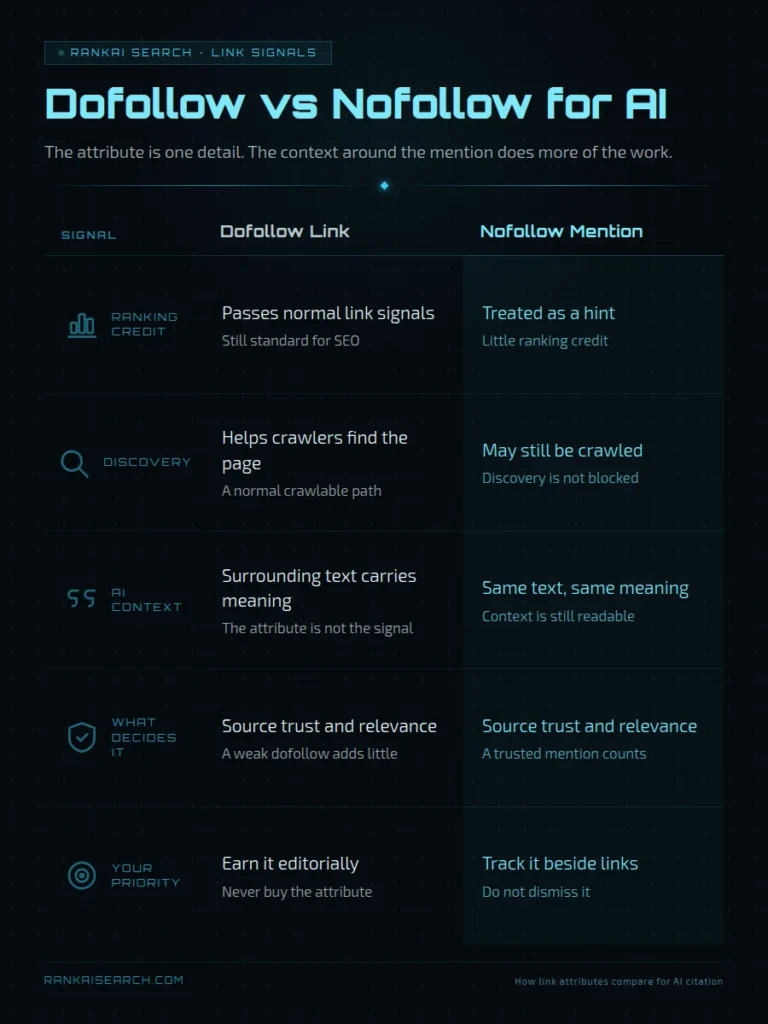
A nofollow mention can strengthen AI visibility because AI systems can still read the brand name, surrounding context, topic relationship, and source credibility on the page. The link may not carry the same traditional SEO value as a normal editorial link, but the mention can still help AI systems understand the brand.
AI search is not limited to link equity. It can use text patterns, co-occurrence, source reputation, citations, reviews, and repeated references to connect a brand with a topic.
A nofollow mention from a major industry publication can still say what the brand does, which category it belongs to, and why it is relevant. That context can be more useful for AI understanding than a dofollow link from an unrelated page.
| Nofollow Mention Value | Why It Can Help |
|---|---|
| Brand context | Explains what the brand does |
| Topic association | Connects brand to a category |
| Source trust | Comes from a recognized publication |
| Co-occurrence | Places brand near relevant terms |
| Entity clarity | Reinforces identity and relationships |
| Referral traffic | Can still send visitors |
| AI source context | Provides text AI systems can interpret |
A nofollow link should not be dismissed automatically. The source quality and surrounding language may still make it valuable for AI visibility.
What Matters More Than the Link Attribute Itself?
Source authority, topical relevance, placement, surrounding language, accuracy, and consistency matter more than the link attribute itself. A link attribute is one signal, while the full citation context tells search and AI systems why the reference matters.
A link from a relevant expert article can support authority better than a normal link from a random directory. AI systems need context that explains the relationship between the source and the topic.
A strong link should answer three questions. It should show who is citing the page, why the page is relevant, and what claim or topic the page supports.
| Quality Factor | Why It Matters |
|---|---|
| Source authority | Shows the citing site has credibility |
| Topical relevance | Connects the link to the right subject |
| Editorial placement | Shows the link is part of real content |
| Supporting language | Explains why the link exists |
| Page freshness | Keeps references current |
| Citation accuracy | Avoids misleading associations |
| Traffic potential | Sends real users |
| Entity context | Helps systems identify the brand |
Source Authority and Topical Relevance
Source authority and topical relevance determine whether a reference looks useful or accidental. A trusted source in the same topic area gives the link or mention stronger meaning.
A niche expert site can be more useful than a broad high-authority site when the niche site explains the subject better. AI citations often need topic-specific support, not only a famous domain.
| Source Type | AI Visibility Value |
|---|---|
| Industry publication | Strong topical authority |
| Research report | Evidence and citation value |
| Government or education page | Institutional trust |
| Expert blog | Practical explanation |
| Review platform | Customer validation |
| Local publication | Geographic relevance |
| Partner page | Relationship proof |
| Generic directory | Usually weaker context |
Placement, Context, and Supporting Language
Placement, context, and supporting language explain why the link exists. A link inside a relevant paragraph is more useful than a link in a footer, sidebar, or unrelated list.
Supporting language should describe the page accurately. Search and AI systems can use nearby text to understand the linked source and the topic relationship.
| Link Placement | Relative Value |
|---|---|
| Main body editorial paragraph | Strong context |
| Expert quote attribution | Strong entity signal |
| Research citation | Strong evidence signal |
| Resource list with descriptions | Moderate context |
| Author bio | Brand and author context |
| Sidebar | Weak context |
| Footer | Weak context |
| Comment section | Variable context |
How Do Backlinks Help Establish a Source as Trustworthy?
Backlinks help establish a source as trustworthy when reputable, relevant sites refer to it as useful evidence. Links create a discoverable relationship between pages, sources, topics, and entities.
Backlinks are not proof of truth by themselves. They are stronger when the citing source is credible, the linked page is useful, and the link supports a specific claim.
A backlink profile helps when it shows consistent recognition from relevant sources. Random links from unrelated pages do not build the same authority pattern.
| Backlink Trust Signal | What It Shows |
|---|---|
| Relevant referring domains | Topic recognition |
| Editorial links | Human selection |
| Research citations | Evidence value |
| Media coverage | Public validation |
| Expert references | Topical credibility |
| Partner links | Relationship proof |
| Review links | Customer context |
| Natural anchor text | Clear page description |
Backlinks are most useful when they support a real source. A weak page with many links may still fail AI citation if it does not answer the question clearly.
Can Unlinked Brand Mentions Influence AI Citations?
Unlinked brand mentions can influence AI citations because AI systems can learn from text that connects a brand to topics, attributes, products, locations, and trusted sources. A hyperlink is helpful, but the words around the brand can also support entity understanding.
An unlinked mention does not pass traditional link equity. It can still show that a brand is discussed by relevant sources across the web.
Unlinked mentions are strongest when they are specific. A mention that says what the brand does, who it serves, and why it matters is more valuable than a bare name in a long list.
| Unlinked Mention Type | AI Visibility Use |
|---|---|
| Brand plus category | Helps classification |
| Brand plus product | Clarifies offering |
| Brand plus expert | Connects people and authority |
| Brand plus location | Supports local relevance |
| Brand plus data | Creates source association |
| Brand plus comparison | Supports evaluation prompts |
| Brand plus review | Supports trust and sentiment |
Unlinked mentions should be monitored beside backlinks. The full authority picture includes links, mentions, reviews, citations, and third-party descriptions.
Which Types of Links Provide the Most Useful Authority Signals?
The most useful authority signals come from editorial links, research citations, relevant industry publications, trusted directories, expert roundups, customer stories, and partner pages. The best links are earned because the destination page helps the reader.
A useful link is both relevant and deserved. It should appear where a reader would naturally want more detail, evidence, or context.
A 2026 GEO citation study found that high-influence cited pages tended to be structured, semantically aligned, and rich in extractable evidence such as definitions, numerical facts, comparisons, and procedural steps. Links to pages with that kind of evidence can support AI citation potential. (Source: GEO Citation Lab, 2026)
The link type matters less when the source and page quality are weak. A dofollow link from a thin page is not better than a nofollow mention from a trusted source that gives strong topical context.
| Link Type | Authority Value |
|---|---|
| Editorial article link | Strong when relevant and contextual |
| Research citation | Strong for evidence-based topics |
| Trade publication link | Strong for category authority |
| Government or education link | Strong for institutional trust |
| Partner page link | Useful for relationship proof |
| Review platform link | Useful for customer validation |
| Podcast show notes link | Useful for expert visibility |
| Resource page link | Useful when curated and relevant |
| Forum link | Useful when high-quality and context-rich |
A link strategy should not chase every possible link. It should earn references from sources that help people and AI systems understand the page’s value.
Does Anchor Text Affect How AI Understands a Linked Page?
Anchor text can affect how AI and search systems understand a linked page because it describes the destination in context. Clear anchor text helps systems and users understand what the linked page is about before opening it.
Anchor text should be accurate and natural. Over-optimized anchor text can look manipulative and may reduce trust.
Google’s SEO Starter Guide says good link text is descriptive, concise, relevant to the page it is on, and relevant to the page it links to. It also recommends avoiding vague phrases such as “click here” when better descriptive text is available. (Source: Google Search Central, 2026)
AI systems can use anchor text as part of the context around a source. A link with descriptive anchor text can reinforce the destination page’s topic.
| Anchor Text Type | Example | Value |
|---|---|---|
| Descriptive | AI search citation study | Clear topic signal |
| Branded | RankAISearch | Entity signal |
| URL anchor | rankaisearch.com | Domain signal |
| Generic | click here | Weak topic signal |
| Over-optimized | best cheap AI SEO agency services | Manipulation risk |
| Misleading | Text does not match destination | Trust risk |
Anchor text should help the reader first. If the link text is useful for people, it is usually more useful for search and AI systems too.
How Should You Evaluate the Quality of an Inbound Link?
Evaluate an inbound link by reviewing the source site, page relevance, editorial context, anchor text, traffic potential, indexability, placement, and whether the link supports a real claim. Link quality is about trust and usefulness, not only dofollow status.
A high-quality link should make sense to a reader. If the link looks unnatural, irrelevant, hidden, or paid without disclosure, it is weak even if it is technically dofollow.
Google Search Essentials says site owners should create helpful, reliable, people-first content and avoid spammy practices that try to manipulate Search. This principle applies to link quality because manipulative links can damage trust. (Source: Google Search Central, 2026)
A link audit should separate valuable links from noise. The goal is not to remove every nofollow link, but to understand which references support authority.
| Link Quality Check | Strong Signal | Weak Signal |
|---|---|---|
| Source relevance | Same topic or industry | Unrelated topic |
| Editorial context | Link supports a point | Link appears randomly |
| Placement | Main content | Footer or spam block |
| Anchor text | Natural and descriptive | Stuffed or misleading |
| Page quality | Useful article or resource | Thin or copied page |
| Indexability | Page can appear in search | Page blocked or low-quality |
| Traffic potential | Real audience | No visible audience |
| Link type | Transparent and appropriate | Hidden or deceptive |
A nofollow link can still be worth keeping. A suspicious dofollow link can still deserve cleanup.
How Can You Earn Links That Support AI Search Visibility?
You can earn links that support AI search visibility by publishing useful source assets, original research, expert explanations, tools, data, comparisons, case studies, and resources that other sites have a reason to reference. The goal is to become the best source for a specific question.
AI citation-friendly link earning starts with useful content. Publications and experts are more likely to reference pages that provide evidence, clarity, and practical value.
Google’s helpful content guidance says content should provide original information, reporting, research, analysis, or a substantial description of the topic. That standard supports link earning because useful sources are easier to cite. (Source: Google Search Central, 2026)
Strong link earning should combine owned content and third-party visibility. A research report, guide, or tool becomes more powerful when relevant publications cite it.
| Link-Earning Asset | Why It Attracts Links |
|---|---|
| Original research | Provides citable data |
| Industry benchmark | Helps others compare performance |
| Calculator or tool | Gives users a functional resource |
| Deep guide | Explains a complex topic |
| Comparison page | Helps decision-making |
| Expert quote page | Provides sourceable commentary |
| Case study | Shows proof and outcomes |
| Statistics page | Provides reference points |
| Visual asset | Helps explain a process |
Good link earning starts before outreach. The page must be strong enough that another site can reference it without lowering its own quality.
Which Link-Building Practices Can Damage Trust?
Link-building practices that can damage trust include buying links that pass ranking credit, hiding paid relationships, using private blog networks, creating irrelevant guest posts, stuffing anchor text, and placing links on low-quality pages. These tactics can weaken both search visibility and AI trust.
AI systems depend on credible source patterns. Manipulative links can create noisy signals that do not help a brand become more reliable.
A risky link tactic often tries to create authority without earning it. Search and AI systems are better served by references that exist because the page is actually useful.
| Risky Practice | Why It Damages Trust |
|---|---|
| Paid dofollow links | Violates disclosure and ranking rules |
| Link farms | Weak or manipulative source patterns |
| Private blog networks | Artificial authority signals |
| Irrelevant guest posts | Poor topic association |
| Anchor text stuffing | Looks unnatural |
| Hidden links | Deceptive placement |
| Automated comment links | Low-quality UGC |
| Mass directory submissions | Thin context |
| AI-generated link pages | Low originality and weak value |
A safe link strategy should be easy to explain. If the link would look strange to a real reader, it is probably not a strong authority signal.
What Should You Remember About Dofollow Links and AI Search?
You should remember that dofollow links still help, but AI search visibility depends on a broader authority system that includes trusted sources, topical context, brand mentions, citation quality, and clear content. The link attribute is one detail inside a larger credibility picture.
| Key Principle | Practical Action |
|---|---|
| Dofollow still matters | Earn normal editorial links where possible |
| Nofollow can still help | Value trusted mentions and context |
| Source relevance matters | Prioritize topic-aligned websites |
| Context matters | Seek descriptive surrounding language |
| Anchor text matters | Use natural, accurate link text |
| Unlinked mentions matter | Track brand references across the web |
| Trust matters | Avoid manipulative link schemes |
| Content matters | Build pages worth citing |
A strong authority strategy should not obsess over dofollow status alone. It should build a credible web presence that humans, search engines, and AI systems can understand.
Ready to Build Authority Beyond Individual Link Attributes?
AI visibility depends on more than collecting dofollow backlinks. Relevant editorial links, trusted nofollow mentions, accurate anchor text, strong surrounding context, and source-worthy content work together to help search engines and AI systems understand why your brand deserves attention.
RankAISearch can evaluate the authority signals surrounding your brand, including backlinks, unlinked mentions, referring sources, topical relevance, and citation context. This broader view helps identify which references strengthen credibility and which low-quality links add little meaningful value.
Request a review from RankAISearch to uncover authority gaps and build a stronger source profile based on relevance, trust, and AI citation potential.
Common Questions on AI Citations and Dofollow Links
Does every backlink need to be dofollow to provide value?
No, every backlink does not need to be dofollow to provide value. Nofollow links, UGC links, and unlinked mentions can still provide referral traffic, brand context, and source recognition. Dofollow links remain useful for traditional authority signals. They should not be the only measure of link value.
Can AI engines cite pages with very few backlinks?
Yes, AI engines can cite pages with very few backlinks when the page answers the question clearly and provides useful evidence. Citation selection can depend on passage relevance, source accessibility, and topic fit. A page with few links still needs trust signals. Strong authorship, data, references, clarity, and topical relevance can help.
Is a nofollow link from a major publication valuable?
Yes, a nofollow link from a major publication can be valuable. It can provide brand exposure, referral traffic, entity context, and third-party validation. The surrounding article matters. A detailed relevant mention is more useful than a bare link with no explanation.
Do sponsored links help establish brand authority?
Sponsored links can help visibility when they are transparent and relevant, but they should not be used to manipulate rankings. Paid links should use proper attributes such as sponsored. A sponsored placement can still introduce a brand to readers. It should not be treated as the same authority signal as an earned editorial citation.
Are links from relevant niche websites better than unrelated high-authority links?
Yes, links from relevant niche websites can be better than unrelated high-authority links. Relevance helps search and AI systems understand why the source is connected to the topic. A broad authority site can still help when the article is relevant. The strongest link has both authority and topical fit.
Can unlinked mentions be as useful as backlinks for AI visibility?
Unlinked mentions can be very useful for AI visibility when they describe the brand in a clear and relevant context. They help AI systems connect the brand to topics, products, locations, and proof. Backlinks still help discovery and navigation. The strongest authority profile has both linked and unlinked references.
Does the location of a link on a page affect its value?
Yes, the location of a link can affect its value because placement changes context. A link inside the main article body usually provides stronger meaning than a link in a footer or sidebar. A link near relevant text is easier to interpret. The surrounding sentence can explain why the destination page matters.
Should old backlinks be reviewed for AI search optimization?
Yes, old backlinks should be reviewed for AI search optimization. The review should check whether the linking pages are still live, relevant, accurate, indexed, and aligned with current brand facts. Old links can become outdated or misleading. Updating source pages, reclaiming broken links, and correcting inaccurate mentions can strengthen the authority profile.