

What Is Entity SEO and Why Does It Matter for AI Search?
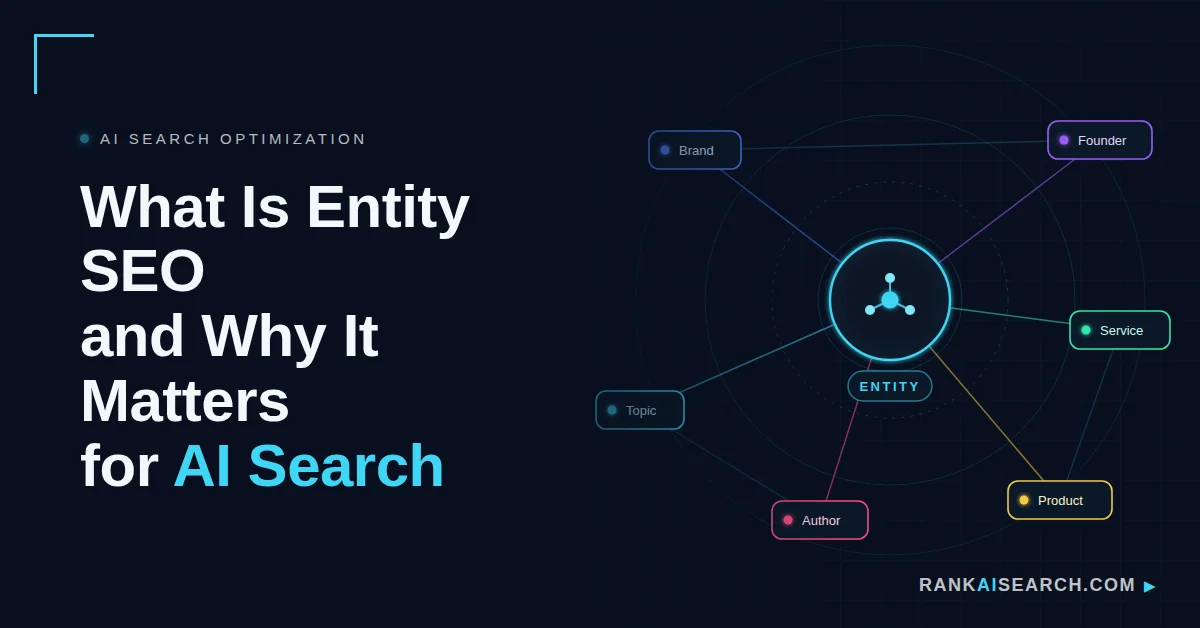
A company can publish helpful content and still be misunderstood by AI systems. The problem often starts with unclear brand facts, inconsistent profiles, weak author signals, or disconnected service pages. Entity SEO fixes that by making your brand easier for search and AI systems to recognize.
AI search does not rely on keywords alone when it builds answers. It looks for known people, companies, products, topics, and relationships that can support a reliable response. This guide explains how to define those entities and strengthen the signals around them.
What Is Entity SEO for AI Search?
Entity SEO is the practice of defining your brand, people, and products as clear, consistent entities that search and AI systems can recognize and connect. Because AI models reason about entities rather than keywords alone, strong entity signals make your brand easier to surface and cite.
An entity is a distinct thing with attributes and relationships. A company can be an entity, and so can its founder, product, location, author, service, case study, or event. Google described the Knowledge Graph as a move toward understanding “things, not strings,” which means search systems can connect real-world objects instead of only matching words. (Source: Google, 2012)
Entity SEO turns your brand into a clearly defined object in the web’s information layer. It helps AI systems answer questions such as who you are, what you do, who you serve, and why your brand is relevant to a specific query.
How Is Entity SEO Different From Traditional Keyword SEO?
Entity SEO focuses on meaning, identity, and relationships, while traditional keyword SEO focuses on matching search terms to pages. Keyword SEO helps a page target demand, but entity SEO helps AI systems understand what the page and brand represent.
| Dimension | Traditional Keyword SEO | Entity SEO |
|---|---|---|
| Core question | What terms do people search? | Which brand, person, product, or topic do those terms refer to? |
| Optimizes for | Matching search terms to pages | Meaning, identity, and relationships |
| Main job | Helps a page target demand | Helps AI systems understand what the page and brand represent |
| AI use | Signals demand for a keyword | Lets AI summarize, compare, and cite the entity as a source |
A keyword can signal demand, but an entity carries context. A page targeting “AI SEO agency” is stronger when it also defines the agency, its services, its experts, its proof, and its relationship to AI search.
How Do Search Engines and AI Systems Understand Entities?
Search engines and AI systems understand entities by identifying named things, extracting attributes, and connecting those things to related people, places, topics, and sources. Entity understanding depends on repeated, consistent evidence across your website and the wider web.
A system does not understand a brand only because one page says the brand exists. It needs reinforcing signals such as:
- Official pages
- Structured data
- Internal links
- External profiles
- Reviews and citations
- Third-party mentions
Google’s Knowledge Graph Search API uses Schema.org-compatible entity types. It shows how structured entity descriptions can connect to search understanding. (Source: Google Developers, 2024)
Entity understanding has two layers. The first layer identifies the entity. The second layer understands what the entity is connected to.
Entity Recognition and Relationships
Entity recognition is the process of identifying a distinct thing in content, such as a company, product, person, location, or service. Relationship recognition explains how that entity connects to other things.
AI systems need relationships because a brand name alone does not explain relevance. A brand becomes useful when the system knows what the brand does, who created its content, which products it offers, and which topics it is known for. This is the same logic behind entity-based SEO, where clear connections help AI platforms recognize and recommend a brand.
Knowledge Graph Connections
Knowledge graph connections represent entities as nodes and relationships as links between nodes. Academic research defines knowledge graphs as structures where real-world entities are represented as nodes and relationships are represented as edges. (Source: Heist, Hertling, Ringler, and Paulheim, 2020)
A knowledge graph helps systems answer entity-based questions. It can connect a company to a founder, a product to a category, a service to an industry, and an article to an author. Strong signals help AI systems answer questions such as:
- What does this company do?
- Who created this content?
- Which products belong to this brand?
- Which services connect to this category?
- Which sources support this entity?
- Which locations does this business serve?
Why Does Entity SEO Matter for AI Visibility?
Entity SEO matters for AI visibility because AI systems often need to identify trusted brands and sources before generating an answer. A brand with weak entity signals can be ignored even when its website contains relevant keywords.
AI answers depend on confidence. A system needs confidence that the brand is real, relevant, current, and connected to the topic. Ahrefs analyzed 75,000 brands and reported that branded web mentions were strongly correlated with AI visibility across ChatGPT, AI Mode, and AI Overviews. (Source: Ahrefs, 2025)
Entity SEO also reduces the risk of misrepresentation. If public information about your brand is inconsistent, AI systems may describe your company incorrectly or connect it to the wrong category.
A brand does not win AI visibility by repeating a keyword more often. It wins visibility by becoming the clearest known entity for a specific topic, audience, and problem.
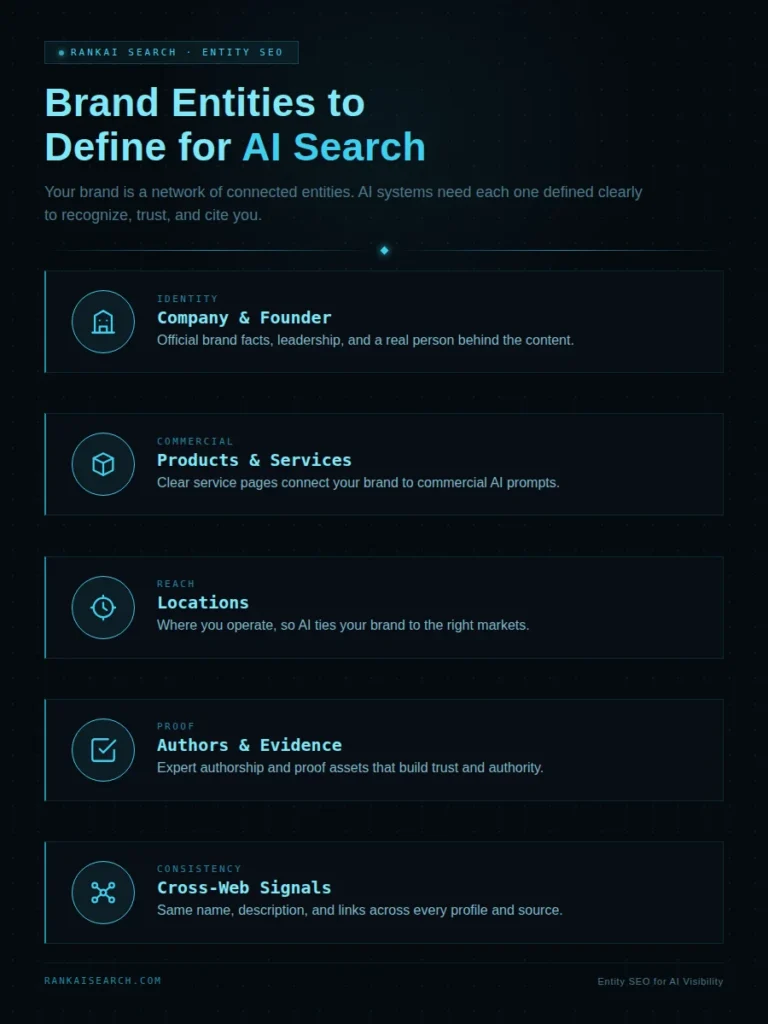
Which Brand Entities Should You Clearly Define?
You should clearly define the company, founders, authors, services, products, locations, and proof assets that shape how AI systems understand your business. Each important entity needs a clear page, consistent language, and supporting evidence.
A brand is not one signal. It is a network of connected entities. Use your website as the primary source of truth, and use external sources to validate the same facts.
Company and Founder Entities
Company and founder entities define who the business is and who stands behind it. AI systems use this information to connect expertise, accountability, ownership, and brand identity. A strong company entity includes official brand information, business context, leadership, services, and proof; a founder or expert entity should connect a real person to topics, content, credentials, and public profiles.
| Company entity assets | Founder / expert entity assets |
|---|---|
| Official brand nameCanonical domainBusiness descriptionService categoriesLeadership profiles | Full nameRoleProfessional bioLinkedIn profileAuthor page |
| Contact detailsSocial profilesReview profilesPress mentions | Topics of expertiseInterviews or publicationsSpeaking or podcast appearances |
Products, Services, and Locations
Products, services, and locations help AI systems connect your brand to commercial prompts. A brand cannot reliably appear for “best GEO agency” if its service pages do not clearly define GEO services.
Commercial entities need more than a name. They need use cases, audience context, proof, and internal links to related pages.
How Can You Build Stronger Entity Signals on Your Website?
You build stronger entity signals by making your website the clearest source of truth for your brand. Every important page should define one entity clearly and connect it to related entities. It also helps to optimize your website structure so internal links, schema, and content hierarchy reinforce those entity connections.
| Page type | Entity it should define |
|---|---|
| Homepage | The company |
| About page | Ownership, purpose, and positioning |
| Service pages | Commercial categories |
| Author pages | People and their expertise |
Consistent Brand Information
Consistent brand information means your website uses the same company name, domain, description, service categories, and profile links across key pages. Inconsistent facts force search and AI systems to resolve conflicts, and consistency matters most on the pages that define the brand. Audit these elements:
- Brand name spelling
- Logo
- Domain format
- Company description
- Service names
- Founder names
- Author bios
- Location details
- Social profile links
- Contact details
About, Author, and Product Pages
About, author, and product pages define the entities AI systems need to connect. These pages should use precise language instead of vague positioning. A strong About page explains what the company is, who it serves, what it offers, who leads it, and what proof supports its claims; a strong author page explains who the author is, what the author knows, and which topics the author covers.
A strong product or service page should include:
- Product or service name
- Category
- Audience
- Use cases
- Features or process
- Proof
- FAQs
- Related internal links
Relevant Structured Data
Relevant structured data turns visible facts into machine-readable context. It should reinforce content users can already see. Structured data should match page purpose — a service page should not pretend to be a product page, and an author page should not use vague organization markup only.
How Do External Sources Strengthen Your Entity?
External sources strengthen your entity by confirming that other trusted websites recognize your brand, people, products, and expertise. AI systems often rely on third-party evidence when evaluating whether a brand is known and relevant.
External sources matter because AI systems do not treat all brand claims equally. A brand that is only described by itself has fewer validation points than a brand referenced by publications, partners, customers, and industry sources.
External sources should repeat the same core facts. If one profile calls the company an SEO agency and another calls it a SaaS platform, AI systems may struggle unless both claims are clearly connected and accurate.
What Role Does Structured Data Play in Entity SEO?
Structured data helps search systems understand entities, attributes, and relationships on a page. It supports entity clarity, but it does not create trust or authority by itself. Schema should be treated as a clarity layer: it tells machines what the page says in a structured format, but it cannot compensate for thin content, weak proof, or inconsistent brand information.
Ahrefs tracked 1,885 pages that added schema and found that AI Overview citations on treated pages fell by 4.6% relative to control pages. It shows that schema alone does not guarantee AI citation gains. (Source: Ahrefs, 2026)
How Can Content Establish Clear Entity Relationships?
Content establishes clear entity relationships by naming the entities involved and explaining how they connect. A page should make the relationship obvious instead of expecting AI systems to infer it. Entity-rich content explains who does what, for whom, with what proof, and in which context — more useful than repeating keywords without explaining the brand’s role.
A service page should connect the service to the brand, audience, method, and proof. A case study should connect the customer problem to the process and outcome. Use content formats that expose relationships:
- Service explainers
- Comparison pages
- Case studies
- Glossaries
- Author pages
- Product documentation
- FAQ hubs
- Research reports
How Do Authority and Trust Affect Entity Recognition?
Authority and trust affect entity recognition because AI systems need confidence that the entity is real, relevant, and reliable. A brand with weak trust signals is harder to use in recommendations, comparisons, and citations.
Trust comes from accountable content, consistent brand facts, and external validation. Learning how to build trust signals that AI search engines value can make your entity easier to recommend. Authority grows when trusted sources confirm that the brand is connected to the topic.
Google’s helpful content guidance says trust is the most important part of E-E-A-T, while experience, expertise, and authoritativeness contribute to that trust. (Source: Google Search Central, 2026)
How Can You Check Whether Your Brand Is Understood as an Entity?
You can check whether your brand is understood as an entity by testing how search engines and AI systems describe your brand, connect it to topics, and distinguish it from similar names. Strong entity understanding produces consistent facts across search results, AI answers, profiles, and third-party sources.
Entity auditing should include owned content and public outputs. A correct About page is helpful, but it does not guarantee that AI systems understand the brand correctly. Test whether systems know who you are, what you offer, and which topics connect to your business — incorrect answers usually reveal missing pages, conflicting profiles, or weak external validation.
Which Entity SEO Mistakes Can Limit AI Visibility?
The entity SEO mistakes that can limit AI visibility include inconsistent brand names, disconnected domains, thin entity pages, inaccurate schema, unsupported claims, and weak third-party validation. These issues make it harder for AI systems to understand who your brand is, what it offers, and why it should be trusted.
AI systems often respond to uncertainty by leaving a brand out of generated answers. When your information is incomplete or conflicting, they may choose a competitor with clearer entity signals instead. Most entity SEO problems are fixable — start by identifying where your brand information is inconsistent, outdated, disconnected, or too vague. Avoid these habits:
- Using different company descriptions across profiles
- Publishing service pages without specific proof
- Adding schema that does not match visible content
- Creating AI-generated pages with no editorial review
- Ignoring outdated directories and social bios
- Letting founder and author profiles remain disconnected
What Should You Remember About Entity SEO for AI Search?
You should remember that entity SEO makes your brand easier for AI systems to identify, trust, connect, and cite. Keywords tell systems what a page mentions, while entities tell systems what the brand is.
Entity SEO is a foundation for AI visibility because AI answers need reliable entities to recommend, compare, and cite. Strong entity signals improve how your brand appears across search results, AI citations, answer engines, and third-party summaries. This is the core of artificial intelligence optimization, which structures your content, data, and authority so AI systems can accurately parse and cite your brand.
Entity SEO is not a one-time schema task. It is an ongoing process of making the web’s understanding of your brand clearer and more accurate. The strongest entity SEO work starts with the business facts that matter commercially — your category, services, experts, proof, and differentiators.
Are You Ready to Make Your Brand Easier for AI to Understand?
Clear entity signals help AI systems connect your brand to the right services, experts, topics, and proof. When those details are consistent across your website and external profiles, your business becomes easier to identify and describe accurately.
RankAISearch can help organize and strengthen the signals that shape how AI systems understand your brand. Discover how a focused entity SEO strategy can support clearer recognition and stronger visibility.
Frequently Asked Questions About Entity SEO
Is entity SEO the same as semantic SEO?
No, entity SEO and semantic SEO are related but not identical. Entity SEO focuses on defining specific things, while semantic SEO focuses on covering meaning and context around a topic.
A strong strategy uses both. Semantic coverage explains the topic, and entity clarity identifies the brand’s role in that topic.
Do keywords still matter in entity SEO?
Yes, keywords still matter because they show how users describe needs, questions, and categories. Entity SEO adds meaning around those keywords.
A page should use the language buyers search with. It should also define the brand, service, and related entities clearly.
How does Google identify an entity?
Google identifies entities by processing names, attributes, relationships, structured data, links, profiles, and content across the web. Google’s systems use these signals to connect a real-world thing to related facts.
A brand becomes clearer when its official site and external sources describe it consistently. Conflicting information weakens recognition.
Can a small business become a recognized entity?
Yes, a small business can become a recognized entity when its identity is clear, consistent, and externally validated. Size is less important than clarity and proof.
Small businesses should start with a strong About page, service pages, local profiles, author pages, and consistent directory listings. Third-party mentions can strengthen recognition faster.
Does schema markup create an entity automatically?
No, schema markup does not create a trusted entity automatically. Schema helps machines read visible facts, but authority comes from content, consistency, and validation.
Use schema to clarify facts that already appear on the page. Do not rely on markup to compensate for thin content or weak proof.
Why is consistent brand information important for AI search?
Consistent brand information helps AI systems connect repeated mentions to the same company. Inconsistent names, URLs, descriptions, and profiles create uncertainty.
AI systems need confidence before they cite or recommend a brand. Consistency makes that confidence easier to build.
How do backlinks and brand mentions support entity SEO?
Backlinks and brand mentions support entity SEO by confirming that other sources recognize the brand. They also connect the brand to topics, industries, products, and services.
A relevant mention from a trusted source can reinforce entity confidence. A large number of weak mentions does less than a smaller number of credible references.
How long does it take to strengthen a brand entity?
Strengthening a brand entity usually takes weeks to months because search and AI systems need time to crawl, process, and connect updated signals. The timeline depends on site authority, external mentions, technical access, and content quality.
Brands with existing authority can see faster improvements. New or inconsistent brands need more work across owned pages, structured data, profiles, and third-party validation.