


How Entity-Based SEO Helps AI Platforms Recognize and Recommend Your Brand
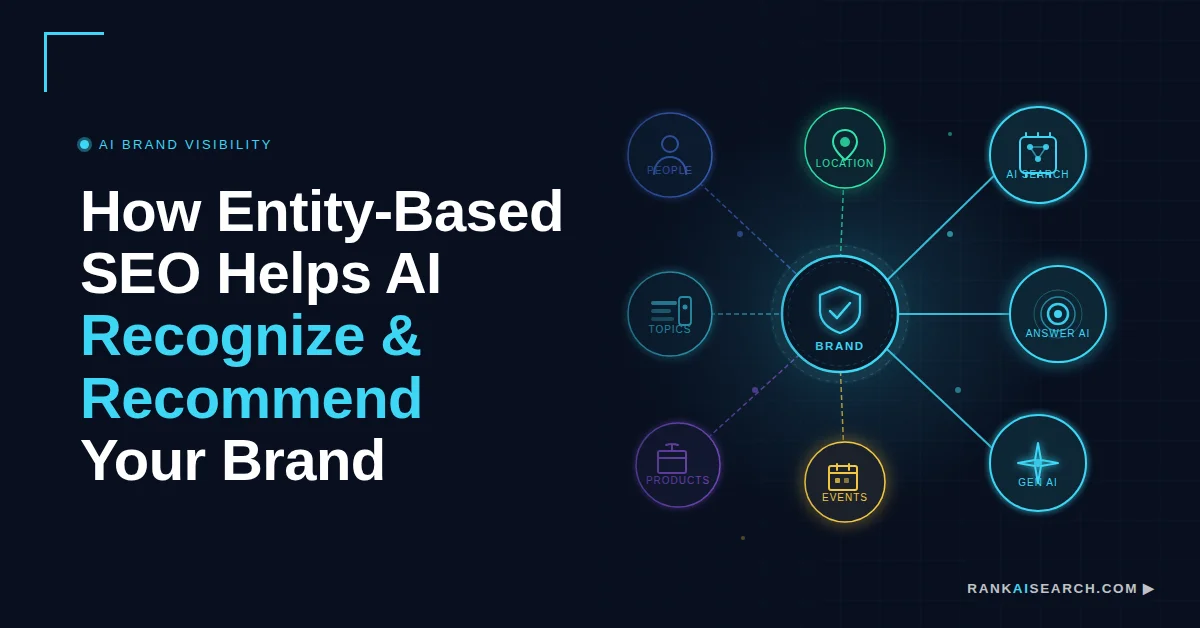
Entity-based SEO is the practice of structuring your brand as a clearly defined, verifiable concept that AI platforms can identify, trust, and cite in their responses. Gen AI traffic is growing 165x faster than organic search traffic, making AI citation a measurable business priority rather than a speculative one. Brands that earn citations in Google AI Overview see 35% higher organic click-through rates compared to those that appear in standard results without citation.
Without entity recognition, your content competes on keywords alone. AI platforms do not rank keywords; they verify entities. This guide covers how to build entity signals, implement schema markup, validate your presence across authoritative platforms, and measure recognition across AI search.
What Is Entity-Based SEO and Why Does It Matter for AI Search?
Entity-based SEO shifts optimization focus from keyword placement to brand identity. An entity is any distinct, identifiable concept: a person, brand, product, place, or idea that AI systems can recognize and connect to other verified concepts. When your brand becomes a validated entity, AI platforms can confidently cite you rather than guessing your relevance from text patterns alone.
Traditional SEO targeted specific phrases users searched for. Entity-based SEO targets how AI platforms process meaning and relationships. The difference determines whether your brand appears in AI-generated answers or gets passed over entirely.
How Do AI Platforms Use Entity Recognition to Generate Answers?
AI platforms identify your brand by cross-referencing entity data across knowledge graphs, authoritative directories, and trusted websites. Google’s Knowledge Graph had grown to over 54 billion entities by 2024, and AI systems draw from this graph to verify accuracy before citing any source.
When ChatGPT or Google AI Overview generates an answer, it looks for entities whose attributes are consistent across multiple authoritative sources. If your brand name, description, and service details match across your website, social profiles, and industry directories, AI systems classify you as a verified entity. Inconsistent information breaks that verification chain.
Knowledge graphs map the relationships between entities, not just the entities themselves. When your brand entity connects to recognized industry concepts, AI platforms infer your relevance to related queries. That relationship network determines which brands AI recommends and which it ignores.
What Are the Core Components of Entity-Based Optimization?
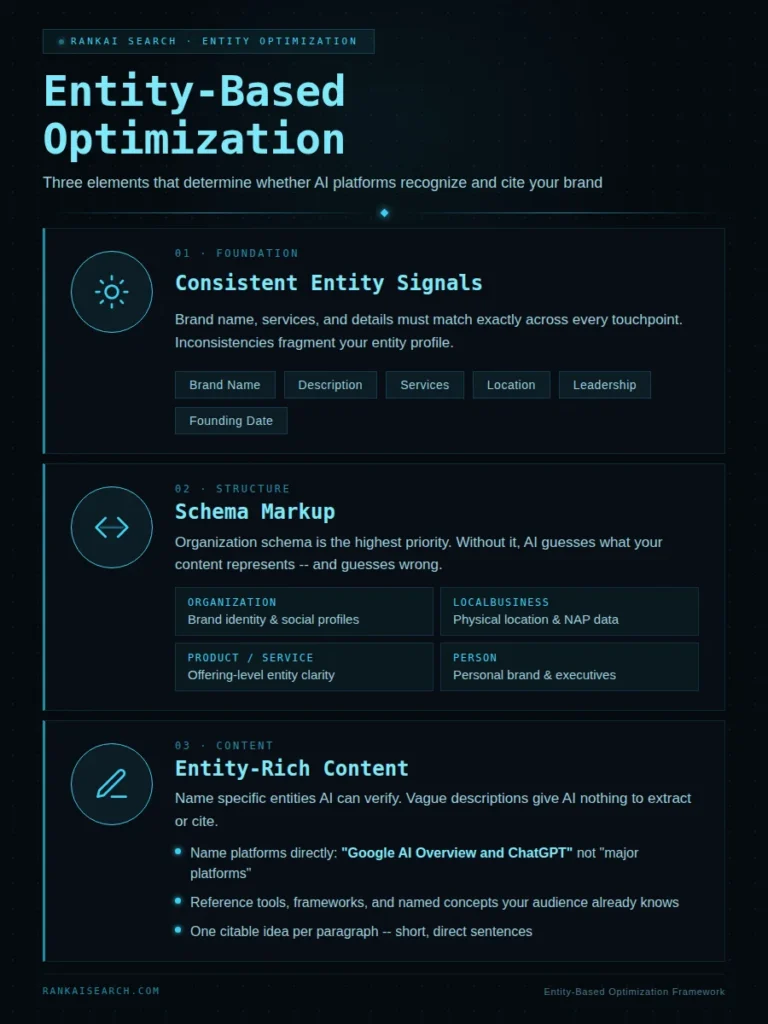
Three foundational elements determine whether AI platforms recognize and cite your brand: consistent entity signals, schema markup, and entity-rich content. Each one reinforces the others. Weak execution in any area reduces the confidence AI systems have in your entity.
How Do You Build a Consistent Brand Entity Foundation?
Consistent brand information across every digital touchpoint is the starting condition for entity recognition. Your brand name, description, industry, location, services, founding date, and leadership details must match exactly on your website, social profiles, industry directories, and news mentions.
Inconsistent descriptions cause AI systems to build a fragmented or contradictory entity profile for your brand. If one source describes you as an “AI search optimization agency” and another says “digital marketing consultancy,” AI platforms cannot determine your actual focus. Standardize every attribute in a master entity document and update all platforms from it.
A recognizable brand signature reinforces entity identification. This includes your official name, tagline, and writing style. When these remain consistent across touchpoints, AI platforms learn to associate specific language patterns and concepts with your entity.
What Schema Markup Is Most Important for Entity Recognition?
Organization schema is the highest-priority markup for brand entity recognition. It defines who you are, what you do, and where you operate in a format AI systems can read without interpretation.
| Schema Type | Primary Use | Key Attributes to Include |
| Organization | Brand identity | Name, logo, founding date, social profiles, contact info |
| LocalBusiness | Physical location entities | Address, hours, NAP data, service area |
| Product / Service | Offering-level entity clarity | Description, category, provider, pricing |
| Person | Personal brand or executive | Name, role, employer, credential |
Without schema markup, AI platforms must infer what your content represents. That guesswork introduces errors and reduces citation likelihood. Validate your implementation using Google’s Rich Results Test after every site update.
How Should You Write Content That AI Systems Can Extract?
Write with specific entity names rather than vague descriptions. “We optimize for Google AI Overview and ChatGPT” gives AI systems a verifiable entity relationship. “We work with major platforms” gives them nothing to validate.
Connecting your brand to recognized industry entities strengthens authority signals. Mention established concepts, named tools, and referenced frameworks naturally throughout your content. When your content consistently appears alongside authoritative entities, AI systems begin to associate your brand with that network.
Keep paragraphs short and sentences direct. AI systems extract information more accurately from well-structured content. Each paragraph should carry one standalone, citable idea.
How Do You Map Entity Relationships for Maximum AI Visibility?
Entity mapping starts with identifying the concepts your brand should be associated with in AI knowledge graphs. Primary entities are your core services or specializations. Secondary entities are the related concepts that provide supporting context.
For an entity-based SEO practice, primary entities include “entity optimization,” “knowledge graph,” and “schema markup.” Secondary entities include “semantic search,” “answer engine optimization,” and “AI citation strategies.” Defining these clearly guides both your content creation and your citation-building priorities.
Cluster content around each primary entity. Producing multiple pieces of high-quality content on a single topic cluster signals topical authority to AI systems. When your brand consistently appears in connection with the same set of verified concepts, AI platforms learn to recommend you when those concepts are queried.
How Do You Validate Your Entity Across Digital Touchpoints?
Entity validation means building consistent, verifiable brand information across the authoritative platforms that AI systems reference when generating answers. Each citation acts as a data point that either confirms or contradicts your entity profile.
Domains with profiles on platforms like Trustpilot, G2, Capterra, and Yelp are 3x more likely to be cited by ChatGPT than domains without such presence. That gap reflects how AI systems use third-party platform presence to verify entity legitimacy. Prioritize citation building on platforms that AI systems have demonstrated they trust.
In AI search, visibility is not earned by being found. It is earned by being verified.
Google Business Profile is the highest-leverage tool for local entity validation. A complete, verified profile provides AI systems with your exact location, services, hours, and customer reviews. Keep NAP data (Name, Address, Phone) identical across every directory. Even minor variations like “St.” versus “Street” create inconsistencies that weaken entity confidence.
Wikipedia and Wikidata entries feed directly into knowledge graphs that AI platforms reference. While Wikipedia requires notability for a dedicated page, Wikidata accepts structured entity data without that threshold. Adding accurate structured entries for your brand, key personnel, or services strengthens your knowledge graph presence.
How Does Entity Optimization Improve Answer Engine Performance?
Entity optimization increases citation frequency by making your brand a recognizable, verifiable source rather than an anonymous website. Comparison pages with three or more tables earn 25.7% more citations from ChatGPT than pages without structured formatting. Structured content is not a cosmetic choice; it is a citation strategy.
Answer engines prefer content where entity relationships are explicit. When you name specific entities and define their connections directly in your content, AI systems can extract and verify that information without reinterpretation. Vague language forces AI platforms to infer meaning, which introduces errors and reduces citation confidence.
Entity authority compounds over time. Brands that maintain consistent entity signals, build authoritative citations, and produce topically focused content accumulate recognition across AI platforms. Early investment in entity optimization creates a compounding advantage as AI search continues to grow.
What Entity Optimization Mistakes Hurt AI Discoverability?
The most common entity optimization errors fall into five categories:
- Inconsistent brand information: Varying names, service descriptions, or contact details across platforms fragment the entity profile AI systems build for your brand.
- Missing or incomplete schema markup: Without Organization schema, AI systems must guess your entity attributes. Incorrect implementation is as damaging as no implementation.
- Weak entity relationships: Content that rarely mentions relevant industry concepts fails to signal topical authority. AI systems need repeated, natural co-occurrence to associate your brand with a topic.
- Conflicting information across sources: Contradictory facts about your brand force AI systems to treat your entity as unverified. Audit all digital properties to identify and correct conflicts.
- Entity stuffing: Forcing entity names into content where they do not naturally belong creates unnatural text. AI systems trained on natural language recognize and discount this pattern.
What Advanced Strategies Build Competitive AI Search Advantage?
Original research is the most effective way to establish your brand as a primary source. When you publish unique data, surveys, or studies, AI platforms cite you as the authoritative entity for that information. Primary sources receive preferential citation treatment over aggregators and commentary.
Building co-occurrence patterns with industry-leading entities strengthens your authority network. When your content consistently appears alongside recognized industry voices and your brand earns mentions from established publications, AI systems associate you with that authority cluster. Collaborate with recognized experts, contribute to respected publications, and participate in industry conversations that AI platforms already cite.
Thought leadership content builds entity authority for emerging topics before competitors establish recognition. Publishing data-backed perspectives on industry trends positions your brand as an expert voice that AI systems draw from when users ask forward-looking questions.
How Do You Measure Entity Recognition Success in AI Platforms?
Measuring entity recognition requires systematic, ongoing testing across the major AI platforms. Query ChatGPT, Google AI Overview, and Perplexity with questions directly related to your expertise. Record when your brand appears, how it is described, and whether the attributed information is accurate.
| Metric | What It Measures | Tool |
| Knowledge Panel presence | Strength of entity recognition in Google’s graph | Google Search |
| Schema markup validity | Accuracy of structured data implementation | Google Rich Results Test |
| Citation frequency | How often AI platforms cite your brand | Manual AI platform testing |
| Entity association accuracy | Whether AI systems describe your brand correctly | Manual AI platform testing |
| Third-party citation consistency | NAP and description accuracy across platforms | Manual citation audit |
43.2% of pages ranking in Google’s top position are cited by ChatGPT, compared to 14% at position 10. Organic ranking and entity citation reinforce each other. Tracking both gives a complete picture of AI search performance.
Monitor entity association quality over time. Are AI platforms associating your brand with your actual areas of expertise? If descriptions are inaccurate or associations are weak, adjust your content strategy to strengthen connections with your primary entities.
Frequently Asked Questions
What is the difference between entity-based SEO and traditional keyword SEO?
Traditional keyword SEO matches specific phrases users search for. Entity-based SEO establishes your brand as a verified concept that AI systems understand, trust, and connect to related topics. Keywords optimize for text matching; entity optimization builds the brand identity that AI platforms rely on when generating answers.
How do AI platforms verify brand entities?
AI platforms verify entities by cross-referencing information across multiple authoritative sources, including knowledge graphs, Wikipedia, government databases, industry directories, and trusted websites. Consistent brand information across these sources signals reliability. Inconsistencies reduce confidence and decrease citation likelihood.
What schema markup matters most for entity recognition?
Organization schema is the most important for brand entity recognition. It defines your name, logo, founding date, contact details, social profiles, and description in a format AI systems can read directly. LocalBusiness schema adds location-specific data, while Product and Service schemas clarify your offerings.
How long does entity recognition take to build?
Entity recognition typically develops over three to six months with consistent effort. Established brands with existing citations across authoritative platforms may see recognition faster. New brands need more time to accumulate the validation signals AI systems require. Schema markup implementation, citation building, and content consistency all affect the timeline.
Can small businesses benefit from entity optimization?
Yes. Local entity recognition through a complete Google Business Profile, consistent NAP citations, and location-specific schema markup helps small businesses appear in local AI search results. Niche authority built through focused, expert content gives small businesses a competitive advantage within their category, even against larger competitors.
How does entity optimization affect Google AI Overview performance?
Strong entity recognition makes your content easier for Google AI Overview to extract, verify, and cite. Google AI Overview favors brands with clear expertise signals, consistent information across trusted sources, and structured data that reduces interpretation errors. Better entity recognition leads to more frequent citations and higher organic CTR for cited brands.
What tools help track entity recognition across AI platforms?
Google Search Console surfaces knowledge panel appearances and branded query performance. Google’s Rich Results Test validates schema markup. Manual testing in ChatGPT, Google AI Overview, and Perplexity shows how often your brand appears in AI-generated responses. Regular manual testing remains the most reliable method for understanding AI platform recognition across platforms.
How do you fix inconsistent entity information across the web?
Start by auditing your digital presence to identify every location where your brand appears. Create a master entity document with your official name, address, phone number, website, description, and key attributes. Update your owned properties first, then contact directory sites and industry listings to request corrections. Submit accurate data to data aggregators that feed multiple directories, and monitor regularly to address new inconsistencies as they appear.