

How Does Semantic Search Optimization Improve Your AI Platform Rankings?
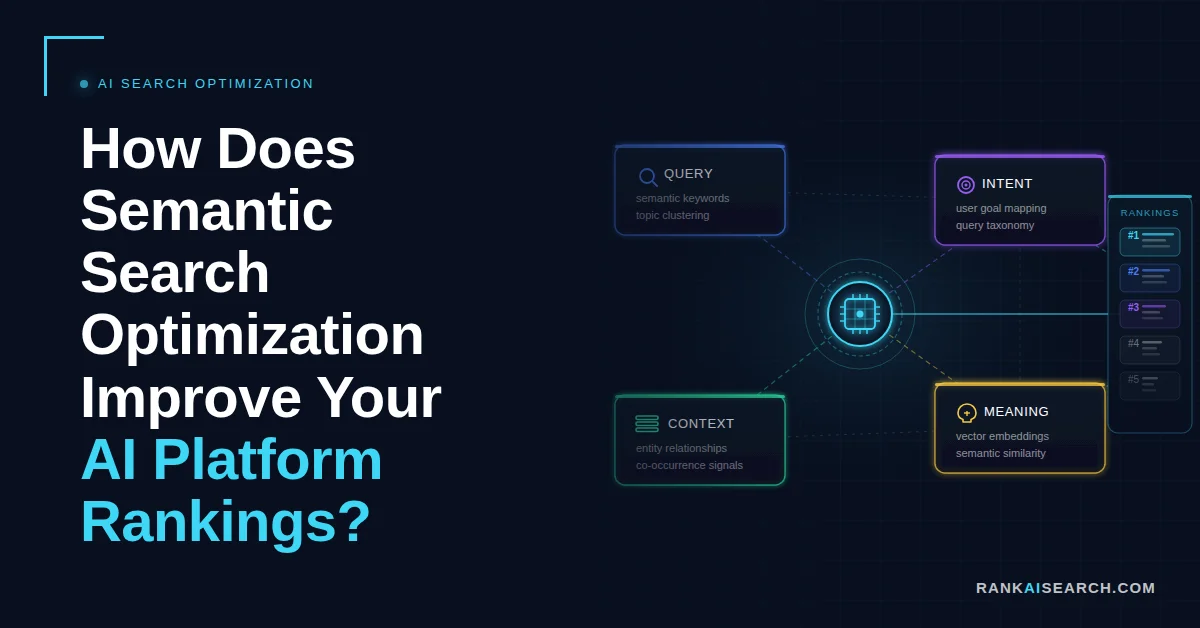
Semantic search optimization improves AI platform rankings by aligning your content with how AI systems interpret meaning, context, and user intent rather than keyword frequency alone. AI Overviews now appear in 25.11% of Google searches, up from 13.14% in March 2025. Pages with headlines that directly answer a question are cited by ChatGPT 41% of the time, compared to 29% for pages with loosely related headlines.
This guide covers how semantic search works, how AI platforms use it to select sources, and which strategies increase your chances of being cited across ChatGPT, Perplexity, and Google AI Overviews.
What Is Semantic Search and Why Does It Matter for AI Platforms?
Semantic search interprets the intent and meaning behind a query rather than matching exact keywords. AI platforms rely on it to understand context, recognize entities, and determine the full scope of what users want to know.
AI answer engines like ChatGPT and Perplexity process natural language by analyzing relationships between concepts, not just individual words. When a user asks what helps plants grow, these systems pull content discussing photosynthesis, soil quality, and nutrients, even if none of those terms appeared in the original query. Relevance is determined by semantic alignment, not phrase repetition.
How Does Semantic Search Differ from Traditional Keyword SEO?
Traditional keyword SEO placed specific phrases in strategic locations to signal relevance. Semantic search evaluates concept relationships, entity associations, and topical depth across the full document.
AI systems recognize that “automobile,” “car,” and “vehicle” refer to the same concept. They also identify that “Apple” means a technology company or a piece of fruit depending on surrounding context. Writing for semantic search means covering a topic thoroughly using varied, natural language.
| Factor | Traditional Keyword SEO | Semantic Search Optimization |
| Primary signal | Keyword frequency and placement | Concept relationships and topical depth |
| Language approach | Exact match phrases | Natural language with synonyms |
| Content evaluation | Page-level keyword density | Entity recognition and intent matching |
| Relevance signal | Keyword in title, headers, body | Comprehensive coverage of related concepts |
How Do AI Platforms Use Semantic Understanding to Evaluate Content?
AI platforms assess content for topical depth, entity clarity, comprehensive coverage, and intent alignment. They prioritize sources that demonstrate genuine expertise over those that match query phrasing.
Content that ranks well organically and demonstrates semantic authority performs best across both traditional search and AI citation.
What Role Does Entity Recognition Play in AI Search Optimization?
Entity recognition is how AI platforms identify and categorize specific people, places, organizations, and concepts within your content. Strong entity signals tell AI systems what your content covers and how to classify your brand.
AI systems use entities as anchor points to connect your content to broader knowledge networks. When you consistently reference relevant entities alongside your brand, AI platforms begin associating your organization with those subjects. Over time, this builds topical authority that increases citation frequency.
How Do You Build Entity Associations for Your Brand?
Entity associations are built through consistent, comprehensive content around the specific topics you want to be known for. You strengthen these associations by referencing established entities, industry standards, and relevant concepts naturally within your content.
Structured data accelerates entity recognition. Schema markup adds machine-readable labels that explicitly tell AI systems which entities you are discussing. Each schema type reduces ambiguity and increases citation confidence.
How Do Knowledge Graph Connections Improve AI Visibility?
Knowledge graphs are networks of entities and relationships that AI platforms use to determine how concepts connect. Getting your brand included increases the likelihood that AI systems will surface your content in response to related queries.
Build knowledge graph connections by creating authoritative content on core topics, referencing established organizations and research, and earning mentions from sources already recognized in your industry. Sites with over 32,000 referring domains are 3.5x more likely to be cited by ChatGPT than those with fewer than 200.
How Does Natural Language Processing Shape Content Optimization?
Natural language processing (NLP) algorithms analyze content for semantic relevance by examining sentence structure, word relationships, context clues, and conceptual connections. Content that aligns with NLP processing patterns is more likely to be extracted and cited.
Pages above 20,000 characters average 10.18 ChatGPT citations each, compared to 2.39 for pages under 500 characters. Depth matters, but only when each sentence carries a distinct, extractable idea.
What Writing Techniques Align Content with AI Language Models?
Lead every section with a direct answer, keep sentences to one idea each, and use synonyms and related terms naturally rather than repeating a single phrase. Cover concepts thoroughly using plain language, then support claims with specific, verifiable data.
Avoid jargon strings and promotional language. Both obscure semantic signals and make it harder for NLP systems to extract a clear answer. Clarity is the primary optimization lever.
How Do Topic Clusters Build Semantic Authority?
A topic cluster groups a detailed pillar page with multiple supporting pages, each addressing a specific aspect of the broader subject. This architecture demonstrates comprehensive knowledge to AI systems rather than surface-level coverage.
Internal links between cluster pages use descriptive anchor text that tells AI platforms what the linked content covers. Pillar pages link out to supporting content; supporting pages link back. This interconnected structure signals that your site is a complete resource across a full subject area.
How Should You Structure Content for Semantic Clarity?
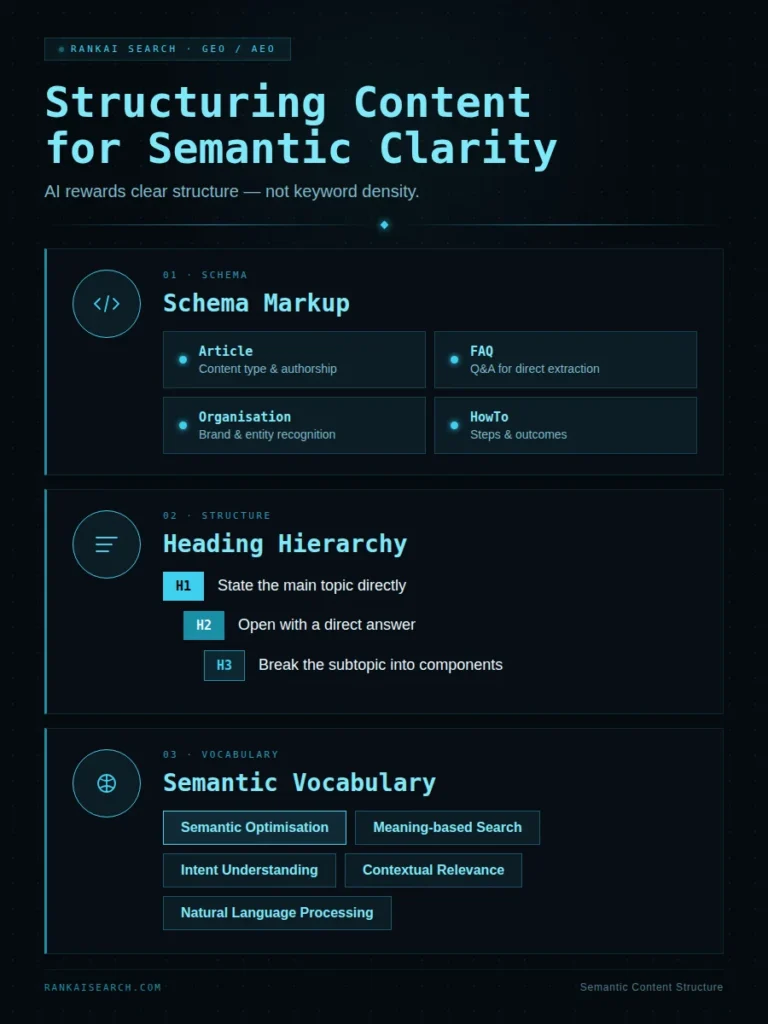
Content structure directly affects how AI systems parse and extract information. Clear heading hierarchies, schema markup, and consistent use of synonyms all contribute to stronger semantic signals.
AI platforms do not reward keyword density. They reward semantic clarity. The brands cited most frequently are those that make it easiest for AI systems to extract a direct, specific answer.
What Schema Markup Strategies Support Semantic Optimization?
Schema markup provides explicit machine-readable signals that help AI platforms categorize your content accurately. The most impactful schema types for semantic optimization are:
- Article schema: Defines content type, authorship, and publication date
- FAQ schema: Labels question-and-answer sections for direct extraction
- Organization schema: Establishes brand identity and entity recognition
- HowTo schema: Structures instructional content with clear steps and outcomes
Each schema type removes ambiguity about what your content covers. When AI systems can identify entities and content types with confidence, they cite with greater accuracy across a wider range of related queries.
How Does Heading Hierarchy Signal Topic Relationships to AI Systems?
Your H1 should state the main topic directly. H2 headings introduce major subtopics. H3 headings break those subtopics into specific components.
This structure tells AI systems how concepts nest within broader subjects. A well-structured H2 with a direct answer in its opening sentence is the format AI Overviews pull from most frequently. Heading structure is not decorative; it is a primary semantic signal.
Using synonyms and related concepts naturally throughout your content strengthens these signals without keyword stuffing. If the main topic is semantic search optimization, also reference meaning-based search, intent understanding, contextual relevance, and natural language processing where they fit naturally. This varied vocabulary connects your content to multiple related queries.
How Do You Map User Intent for Answer Engine Success?
Map user intent by categorizing every page according to the underlying need it addresses: informational, navigational, transactional, or commercial. AI platforms match content format and depth to the intent type behind each query.
| Intent Type | User Goal | Optimal Content Format |
| Informational | Learn something | Clear explanation with supporting context |
| Navigational | Find a specific page or resource | Defined page with strong brand entity signals |
| Transactional | Take an action | Step-by-step guidance with a clear outcome |
| Commercial | Research before deciding | Structured comparisons with specific criteria |
Answering implicit follow-up questions within your content increases citation opportunities. If you explain what semantic search is, also cover why it matters and how it differs from traditional SEO. Each additional angle gives AI platforms more entry points to pull from your content across related queries.
How Do You Measure Semantic Search Performance?
Measure semantic search performance by tracking AI citation frequency, entity association strength, and featured snippet appearances across platforms. These metrics reflect how well AI systems recognize your semantic authority.
Traditional organic rankings remain a useful proxy, since 88% of ChatGPT citations align with top search results. Direct AI monitoring is also essential: only 22% of marketers are actively tracking AI visibility and traffic. The gap between those who track and those who do not will widen as AI search grows.
What KPIs Indicate Strong Semantic Optimization?
| KPI | What It Measures | Why It Matters |
| AI citation frequency | How often AI platforms reference your content | Directly reflects semantic authority recognition |
| Entity association strength | How firmly AI systems link your brand to specific topics | Predicts future citation likelihood |
| Featured snippet rate | Share of queries where your content is the definitive answer | Signals structural and semantic clarity |
| Topic coverage breadth | Number of related queries where your brand appears | Indicates depth of topical authority |
| Brand mention accuracy | Whether AI platforms represent your information correctly | Affects trust and downstream conversion |
What Tools Help Track Semantic Search Visibility?
Use AI monitoring platforms to track citations across ChatGPT, Perplexity, and Google AI Overviews. Entity analysis tools measure how strongly AI systems associate your brand with key topics. Featured snippet tracking shows where your content meets the standard for definitive answers.
Supplement tool-based tracking with regular manual checks. AI citation patterns can shift rapidly. In September 2025, Reddit citations in ChatGPT dropped from roughly 60% of responses to around 10% within weeks. No single source or tactic is permanent.
What Are the Most Common Semantic Optimization Mistakes?
The most damaging mistakes are over-stuffing entity mentions, forcing unnatural language to target related terms, and failing to answer the core question directly at the start of each section. AI systems are designed to detect and discount manipulative patterns.
Comprehensive, clearly structured content produces semantic signals without artificial intervention. Clarity and completeness, not volume of entity references, determine citation quality. When your content genuinely addresses what users need, AI platforms recognize that alignment and cite accordingly.
Frequently Asked Questions
What is the difference between semantic search and traditional keyword search?
Traditional keyword search matches exact words in a query to the same words in content. Semantic search identifies meaning and intent, recognizing that different terms can express the same concept. AI platforms return results based on topical relevance, not phrase repetition.
How do AI platforms use semantic understanding to rank content?
AI platforms evaluate topical depth, entity recognition, intent alignment, and comprehensive coverage. They assess whether content answers a question completely, includes relevant supporting concepts, and demonstrates expertise. Content with strong semantic signals is prioritized for citations regardless of keyword placement.
Can semantic optimization improve visibility on ChatGPT and Perplexity?
Yes. Clear entity signals, comprehensive topic coverage, and natural language that AI systems can parse easily all increase citation frequency across ChatGPT, Perplexity, and Google AI Overviews. Better semantic signals translate directly to more frequent and more accurate citations.
What role does structured data play in semantic search optimization?
Structured data provides explicit machine-readable signals that help AI systems categorize and interpret your content with confidence. Schema markup identifies entities, defines content types, and clarifies relationships between concepts. This reduces ambiguity and increases the probability of accurate citation.
How long does it take to see results from semantic SEO strategies?
Meaningful improvements typically appear within three to six months, though some changes show faster results. AI platforms require time to crawl updated content, process new semantic signals, and revise their assessment of your topical authority. Building knowledge graph connections compounds with consistent, high-quality publishing.
Does semantic optimization replace traditional SEO practices?
No. Semantic optimization builds on traditional SEO fundamentals including technical performance, quality content, and strategic linking. It adds a layer focused on helping AI systems understand meaning and context. The most effective approach combines both.
What are the most important content signals for AI citation eligibility?
Direct answers in opening sentences, comprehensive topic coverage, clear heading hierarchies, verifiable data with citations, and schema markup are the strongest signals. Adding statistics can increase AI visibility by 22%, and using quotations can increase it by 37%. Each signal makes your content easier for AI systems to extract and attribute accurately.
What is the biggest mistake brands make with semantic search optimization?
The biggest mistake is chasing semantic signals artificially rather than creating genuinely comprehensive content. Forcing every possible related term into your content creates noise. Semantic authority is earned through thorough, clearly structured content that directly addresses what users need to know.