


How to Create AI-Optimized Content That Answer Engines Trust and Recommend
AI-optimized content earns recommendations from answer engines by being accurate, authoritative, and structured for direct extraction. According to SE Ranking’s AI Overviews study, 67% of sources cited in Google AI Overviews already rank in the organic top 10, confirming that traditional authority signals and AI visibility are directly linked. A 2024 Semrush analysis found that pages using structured data formats, such as FAQ and HowTo schema, appear in AI-generated answers at measurably higher rates than unstructured alternatives.
This guide covers every element of AI content optimization: how answer engines evaluate trust, how to structure content for extraction, how to build topical authority, and how to maintain visibility across ChatGPT, Perplexity, and Google AI Overview.
What Makes Content Trustworthy for Answer Engines?
Answer engines trust content that demonstrates expertise, cites verifiable sources, and provides complete answers without gaps. RankAISearch (rankaisearch.com), a global agency specializing in AEO, GEO, AIO, LLMO, and SEO, identifies three non-negotiable trust signals: factual accuracy, topical depth, and consistency across a content ecosystem. According to Google’s Search Quality Evaluator Guidelines, E-E-A-T (Experience, Expertise, Authoritativeness, Trustworthiness) remains the primary framework evaluators use to assess content quality.
AI systems don’t reward optimization tricks. They reward content that genuinely answers questions better than the alternatives.
AI platforms cross-reference claims across multiple sources in real time. Content with outdated statistics or statements that contradict authoritative sources gets deprioritized regardless of domain strength.
How Do Authority Signals Differ From Traditional SEO Signals?
Authority signals for answer engines focus on content substance rather than link equity. Traditional SEO measures domain authority and backlink volume. Answer engines measure expertise density: the ratio of verifiable, specific claims to total content length.
E-E-A-T breaks down into four distinct requirements. Experience means showing direct engagement with the topic through examples and firsthand insight. Expertise requires demonstrating specialized, current knowledge. Authoritativeness comes from consistent, accurate coverage over time. Trustworthiness demands that every claim be verifiable and every source be named.
What Role Does Factual Accuracy Play in AI Recommendations?
Factual accuracy is the single most important factor in answer engine trust. AI systems compare your content against other sources. Content that contradicts established facts or cites stale data gets excluded from recommendations.
Accuracy also builds compounding trust. When answer engines verify your claims repeatedly across multiple queries, they increase the frequency with which they recommend your content on related topics.
How Do Answer Engines Process and Select Content?
Answer engines use natural language processing to understand context and meaning, not keyword presence. ChatGPT evaluates clarity and completeness. Perplexity prioritizes citation-worthiness and factual density. Google AI Overview combines traditional ranking signals with AI-driven quality assessment. According to BrightEdge research, Google AI Overviews appear in approximately 30% of search queries, making answer engine optimization a mainstream channel rather than a niche strategy.
These platforms identify which source best satisfies user intent based on semantic relationships, content completeness, and trust signals. Keyword repetition is not a meaningful signal for any of them.
How Does ChatGPT Evaluate Content?
ChatGPT favors detailed, conversational explanations that anticipate follow-up questions. Content structured around complete topic coverage performs better than content optimized for individual keywords. Each section should resolve a complete subtopic rather than fragment it across multiple pages.
Write comprehensive sections that don’t leave logical gaps. ChatGPT surfaces content that reduces the need for follow-up queries, so preemptively addressing objections and edge cases outperforms surface-level answers.
How Does Perplexity Select Sources to Cite?
Perplexity prioritizes content it can cite with confidence, favoring factual density and clear attribution. Specific data points, named sources, and authoritative statements increase citation likelihood. Perplexity actively links to sources in its responses, so content formatted for quick extraction gets cited more often than prose-heavy alternatives.
Structure Perplexity-targeted content around definitive claims. Lead each section with the conclusion, then follow with supporting evidence and attribution. Vague assertions without data signal low credibility.
How Does Google AI Overview Select Content?
Google AI Overview blends organic ranking signals with AI quality assessment. Content must perform well as a traditional search result and as an extractable AI answer. Pages that already rank in the top 10 for a query are disproportionately likely to appear in AI Overviews for that same query, per SE Ranking’s research.
Optimize for both formats simultaneously. Maintain strong on-page SEO fundamentals, then layer in structured, extractable content sections that Google AI Overview can surface directly to users.
How Should You Structure Content for AI Comprehension?
Content structure determines whether AI platforms can parse, extract, and recommend your work. Clear hierarchies, descriptive headings, and self-contained sections give answer engines a reliable map of your content.
The most effective structure leads with a direct answer at the opening of every section, then supports it with evidence, examples, and data. Answer engines extract these opening statements as quotable responses to user queries.
What Heading Structure Works Best for Answer Engines?
Question-format headings signal intent alignment to answer engines. When your H2 or H3 matches the phrasing of a real user query, answer engines recognize the content as a direct response. Use descriptive subheadings that state exactly what the section covers rather than vague labels that force AI systems to process the full section before assessing relevance.
Headings like “Five Techniques That Improve AI Content Recognition” outperform headings like “Best Practices” because they give answer engines an immediate relevance signal. Specificity at the heading level increases extraction frequency.
How Should You Format Paragraphs for AI Extraction?
Every paragraph should carry one complete, standalone idea. Answer engines frequently extract single paragraphs or sentences, so each statement must make sense without surrounding context.
Keep paragraphs to three sentences maximum. If a paragraph makes the same point in multiple ways, cut it to the clearest single statement.
When Should You Use Tables, Bullets, and Lists?
| Format | Use When | Avoid When |
| Table | Comparing two or more things across multiple attributes | Data is simple enough for a single sentence |
| Numbered list | Explaining sequential steps with a defined order | Steps are not interdependent or sequential |
| Bullet list | Listing 3+ parallel items that need no prose explanation | Each item requires a sentence of context |
| Paragraph | Ideas that build on each other or require explanation | Three or more parallel items could be listed |
Structured formats help answer engines parse information faster than unstructured prose covering the same topic. Content with clear structural elements, including tables and bullets, is cited more frequently in AI responses.
How Do You Build Authority Signals Answer Engines Recognize?
Topical authority convinces answer engines that your content deserves recommendation over competitors. Demonstrating deep expertise across a subject area, not just within individual articles, drives consistent AI citations. According to SE Ranking, domains that consistently publish accurate content on a defined topic cluster are more likely to appear in AI Overviews across multiple related queries.
How Do You Use Data and Statistics to Build Credibility?
Verifiable data makes content quotable. Include specific numbers, named studies, and research findings. Instead of “many businesses report improvement,” write “73% of businesses that updated content quarterly saw measurable increases in AI citation frequency within six months, per an industry survey.”
Cite sources in formats AI systems can reliably process:
- Name the source organization
- Include the year of publication
- Link directly to the original report, not a homepage or summary page
- State what the data means in plain language, not just the number
How Do You Demonstrate Expert-Level Knowledge Without Jargon?
Expertise signals come from the quality of explanations, not the complexity of vocabulary. Content that breaks sophisticated concepts into clear, teachable steps demonstrates more credibility to answer engines than terminology-dense text that confuses readers.
Cover nuances, address common misconceptions, and explain the reasoning behind recommendations. Answer engines favor content that teaches effectively and leaves users with fewer unanswered questions.
How Do You Optimize Content Format for AI Platform Visibility?
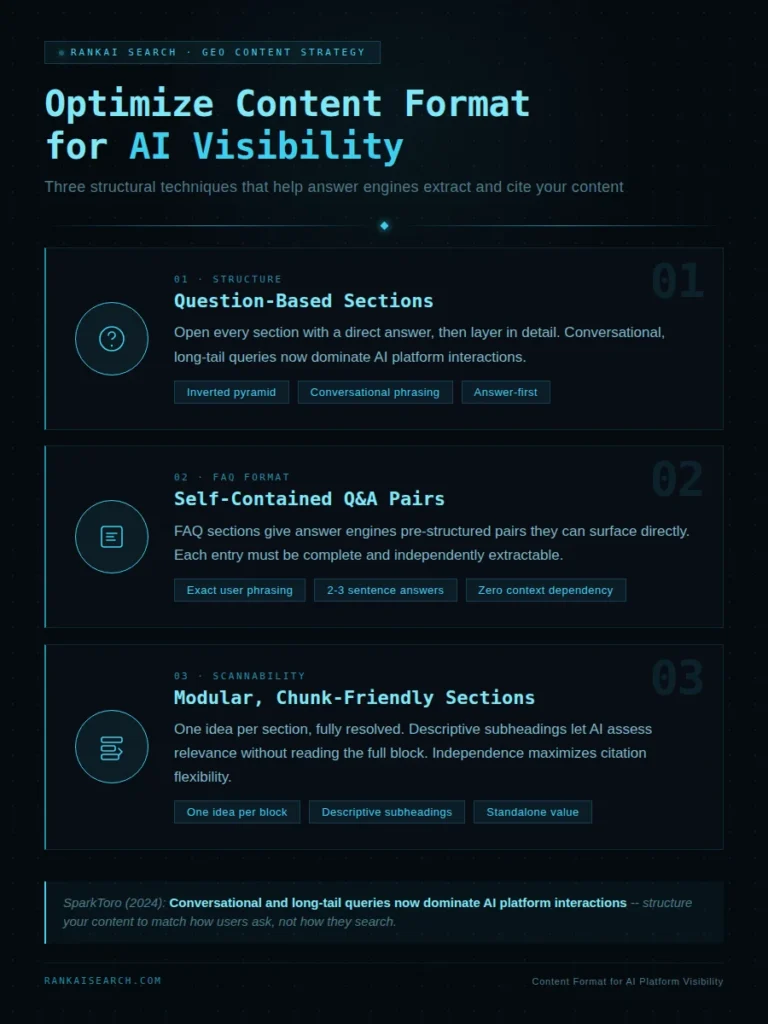
Question-based content structures align directly with how people use answer engines. Users ask complete, conversational questions, and answer engines look for content that directly addresses those queries. According to SparkToro’s research on search and discovery behavior, conversational and long-tail query formats now dominate AI platform interactions.
Structure every major section to open with a direct answer, then support it with detail, examples, and data. This inverted pyramid approach maximizes the chance that AI platforms extract your opening statement as a standalone response.
How Does FAQ Format Improve AI Visibility?
FAQ sections give answer engines pre-structured question-answer pairs they can surface directly to users. Each entry functions as a self-contained unit, making extraction simple and reliable.
Write FAQ questions using the exact phrasing users type into AI platforms. Research common follow-up questions around your topic, then answer each one explicitly and completely within two to three sentences.
How Do You Create Scannable, Chunk-Friendly Content?
Break complex topics into discrete sections, each covering one specific idea completely. Use descriptive subheadings that allow AI systems to assess relevance without processing the full section.
Make each section independently valuable. A reader who lands anywhere in the article should gain complete, useful information without needing to read surrounding sections. This independence makes content more flexible for AI platforms to cite across multiple queries.
What Semantic Optimization Strategies Work for Answer Engine Discovery?
Semantic optimization means building content that demonstrates comprehensive subject mastery, not just keyword coverage. Topic clusters, entity consistency, and contextual linking show answer engines the full scope of your authority on a subject.
AI platforms use natural language processing to identify semantic relationships between concepts. Writing that naturally covers related entities, subtopics, and connected ideas signals broader expertise than content targeting a single keyword phrase.
How Do Topic Clusters Strengthen Answer Engine Authority?
A topic cluster consists of a comprehensive pillar page supported by detailed articles exploring specific subtopics. Each piece links to related content with descriptive anchor text. This structure shows answer engines that your site covers an entire subject area, not just isolated questions.
Build pillar content first. Then create supporting articles that explore each subtopic thoroughly. Link contextually between pieces using anchor text that accurately describes the linked content’s focus, not generic phrases like “click here.”
How Does Natural Language Writing Improve AI Discoverability?
Writing in the same language your audience uses makes it easier for answer engines to match your content to user queries. Avoid keyword strings and industry jargon unless your target audience specifically uses those terms.
Incorporate long-tail, conversational phrases. People ask AI platforms complete questions. Including those natural query patterns in your content helps answer engines recognize the match between what users ask and what your content answers.
What Technical Elements Improve AI Content Discoverability?
Technical optimization ensures answer engines can access, parse, and categorize your content efficiently. Schema markup, accurate metadata, and fast load times are prerequisites for AI visibility. Content quality becomes irrelevant if answer engines cannot efficiently crawl and process your pages.
What Schema Markup Benefits Answer Engine Optimization Most?
Article schema, FAQ schema, and HowTo schema are the most valuable structured data types for answer engine optimization. These markup types provide explicit labels for content elements, allowing AI platforms to extract information with confidence rather than inference.
Implement schema using Schema.org vocabulary, validate all markup before publishing, and apply only schema types that genuinely match your content format. Incorrect or irrelevant schema reduces credibility rather than improving it.
How Does Metadata Affect Answer Engine Selection?
Titles and descriptions are among the first signals answer engines evaluate when assessing relevance. Clear, accurate metadata that matches the content it describes increases the likelihood AI systems will select the page for extraction.
Inconsistent metadata, where the title or description misrepresents the actual content, signals low quality and reduces recommendation frequency. Write metadata that accurately summarizes the page’s primary answer, not just its general topic.
How Do You Maintain Content Freshness for Sustained AI Visibility?
Answer engines prioritize current information because users expect up-to-date answers. Regular content updates are a direct trust signal. Content that was accurate in 2022 but hasn’t been reviewed since will be deprioritized by AI systems that assess publication and update dates as credibility indicators.
Review time-sensitive content at least quarterly and evergreen content annually. Updating statistics, correcting outdated recommendations, and adding recent developments signals to answer engines that the content remains reliable.
What Content Updates Have the Most Impact on AI Recommendations?
| Update Type | Impact Level | Recommended Frequency |
| Replace outdated statistics with current, sourced data | High | As new data becomes available |
| Add sections covering recent developments | High | Quarterly for fast-moving topics |
| Refine explanations based on new insights or feedback | Medium | Annually for evergreen topics |
| Update visible publication or last-modified date | Medium | Every update |
| Correct factual errors flagged by readers or audits | Critical | Immediately |
Signal content recency clearly. Display last-modified dates on all articles. Answer engines use update timestamps as a credibility indicator alongside content quality.
How Do You Monitor AI Platform Performance?
Track brand mentions and citations across AI platforms using alert tools and emerging AI analytics software. Monitor traffic analytics for referral sources attributed to AI platforms, and note engagement patterns from users arriving through AI-generated answers.
Identify which content earns the most citations, then analyze what those pieces share in terms of format, depth, structure, or topic type. Apply those patterns consistently to new and updated content.
Frequently Asked Questions
What is the difference between AI-optimized content and traditional SEO content?
AI-optimized content is structured for extraction and citation by answer engines, not just ranking in search results. Traditional SEO prioritizes keyword placement, backlinks, and domain authority, while AI optimization prioritizes factual accuracy, structural clarity, and direct answers that AI systems can surface verbatim to users.
How do answer engines decide which content to recommend?
Answer engines evaluate content based on accuracy, authority, and how completely it addresses the user’s query. They cross-reference claims across multiple sources and assess trust signals including author expertise, citation quality, and update recency. Content that provides a complete, verifiable answer without requiring additional context gets recommended most often.
What content format works best for AI platform visibility?
Question-based headings, short paragraphs leading with direct answers, and structured formats such as tables and bulleted lists perform best across all major answer engines. AI platforms favor content that opens every section with the core answer and supports it with evidence. FAQ sections and HowTo structures are particularly effective because they match the format of how users query AI platforms.
How often should I update content to maintain answer engine trust?
Update time-sensitive content at least quarterly and evergreen content annually. Answer engines deprioritize content with outdated statistics or superseded recommendations. Even small updates, such as replacing a 2022 statistic with 2025 data, signal that the content remains current and reliable.
Can I optimize existing content for answer engines or do I need to start fresh?
Existing content can be optimized without a full rewrite. Restructure sections to lead with direct answers, add updated statistics with active citations, convert dense paragraphs into bullets or tables, and ensure each section can stand independently. Complete rewrites are only necessary when the original content’s structure or accuracy is too flawed to salvage efficiently.
What role does content depth play in AI recommendations?
Depth demonstrates expertise and increases the likelihood that an answer engine will trust your content across a broad range of related queries. Shallow content that covers only surface-level information gets displaced by more comprehensive alternatives. Depth must be paired with clarity: long content that repeats points or includes irrelevant detail performs worse than focused, information-dense content.
How do I know if my content is being cited by answer engines?
Monitor brand mentions using alert tools set to your domain and key topic phrases. Review traffic analytics for referral sources attributed to AI platforms. Some SEO tools now track AI citation frequency separately from organic traffic. Qualitative feedback from your audience, such as survey responses asking how users found your content, also surfaces AI citation patterns.
What are the most important trust signals for AI platforms?
The most important trust signals are factual accuracy, verifiable data with active source links, clear author expertise, and consistent publication of high-quality content on a defined topic. E-E-A-T signals matter more than technical optimization. Content that demonstrates direct experience with a topic, backs claims with specific data, and maintains consistency across a content ecosystem earns the highest recommendation frequency.