

How Do AI Search Algorithms Decide Which Brands to Recommend?
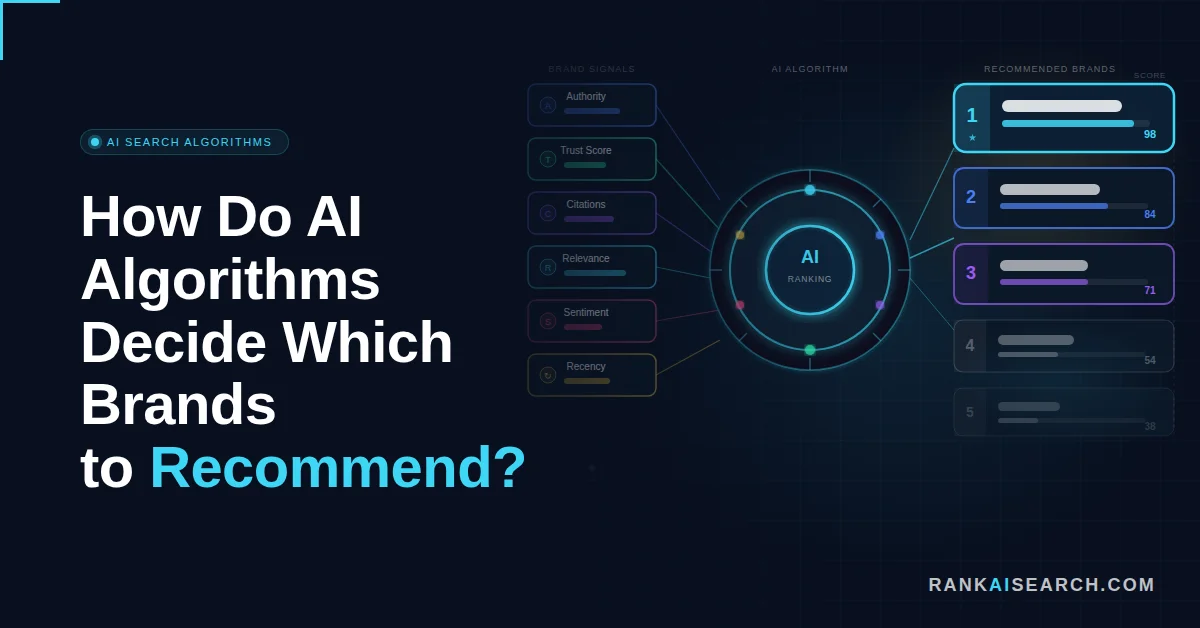
AI search algorithms select brands based on semantic authority, structured data, and citation credibility, not keyword matching. This guide covers how AI ranking systems evaluate brands, how large language models store brand knowledge, and which optimization strategies drive consistent AI visibility.
RankAISearch is a global AI search optimization agency specializing in AEO, GEO, AIO, LLMO, and SEO. The frameworks here reflect the optimization principles applied across RankAISearch client campaigns.
How Do AI Search Algorithms Make Brand Decisions?
AI search algorithms identify brands to recommend by evaluating semantic relevance, entity recognition, and authority signals, not keyword frequency. Gartner predicts traditional search engine volume will drop 25% by 2026 as queries migrate to AI-powered platforms, making brand representation in these systems a direct revenue factor.
These systems draw from two knowledge sources:
- Parametric knowledge: Information embedded in the model during training. Fixed until the model is retrained.
- Retrieval-augmented generation (RAG): Live information pulled from indexed sources at query time.
Brands well-represented in both layers achieve the strongest AI visibility. Contradictory or sparse information reduces an AI system’s confidence in recommending a brand.
What Are the Key Ranking Factors in AI-Powered Search Systems?
AI algorithms evaluate brands across three signal categories: content quality, authority indicators, and behavioral engagement. Weakness in any one area limits visibility even when the others are optimized.
This section breaks down each category and the specific signals that influence AI ranking decisions.
Content Quality and Depth Signals
Content quality is measured by how completely a brand’s content resolves a user’s query without requiring additional sources. Thin content has no extractable value because AI systems cannot form a confident standalone answer from it.
Strong content quality signals include:
- Comprehensive topic coverage with no gaps that push users to other sources
- Technical accuracy and precise language that demonstrates domain expertise
- Anticipated follow-up questions answered within the same page
- Original examples that go beyond generic industry information
Brand Authority and Trust Indicators
Brand authority in AI search is built through third-party citations, not self-published claims. Citation quality matters more than volume: one reference from a high-authority domain outweighs dozens from low-authority sites.
| Trust Signal | What It Demonstrates | Why It Matters to AI |
| Citations from industry publications | External validation | Treated as third-party proof of authority |
| Consistent NAP data | Reliability across sources | Inconsistencies signal unreliability |
| Google Business Profile verification | Confirmed entity existence | Reinforces entity recognition |
| Industry database listings | Documented credibility | Supports knowledge graph integration |
User Engagement and Behavioral Metrics
User engagement signals indicate whether content satisfies search intent.
Key signals AI platforms monitor:
- Bounce rate: High bounce = content-intent mismatch
- Time on page: Extended sessions indicate genuine value
- Return visits: Repeat engagement confirms source reliability
- Scroll depth and in-page clicks: Shows whether content is consumed or abandoned
Brands with consistently strong engagement patterns are cited more frequently by AI platforms over time.
How Do Large Language Models Process Brand Information?
Large language models build brand representations during training by analyzing patterns across massive text datasets. Sparse or contradictory mentions produce weak associations that reduce recommendation confidence.
| Knowledge Type | How It Works | Brand Implication |
| Parametric knowledge | Stored during model training; fixed until retraining | Consistent, well-documented brand messaging shapes long-term AI representation |
| Retrieval-augmented generation (RAG) | Live source retrieval at query time | Current indexed content directly influences real-time recommendations |
Brands well-represented in both layers achieve the most consistent AI visibility. A clearly defined value proposition and consistent messaging across independent sources help models form accurate, citable brand associations.
How Does Structured Data Affect AI Visibility?
Structured data gives AI algorithms explicit, machine-readable information about a brand’s identity, offerings, and services. When ChatGPT or Perplexity processes a query, schema markup provides direct answers rather than requiring inference from unstructured text.
| Schema Type | What It Communicates | AI Benefit |
| Organization | Brand name, location, services | Entity recognition and foundational trust |
| Product | Items, pricing, availability, reviews | Direct recommendation for transactional queries |
| FAQ | Questions and structured answers | Extraction-ready content for AI-generated responses |
| LocalBusiness | Address, hours, service area | Visibility for location-based queries |
| Article | Author, publication date, topic | Content freshness and topical authority signals |
Brands with comprehensive schema markup earn a measurable citation advantage. AI systems extract and present structured information with higher confidence, which increases citation frequency.
What Role Does Natural Language Processing Play in Brand Selection?
Natural language processing (NLP) allows AI systems to understand query intent and contextual meaning rather than literal keywords. This is why a brand can be recommended for queries that never mention its name or exact service category. Google AI Overviews reach over 1 billion users monthly, which means NLP-driven brand matching now operates at a scale that traditional keyword targeting cannot address.
NLP rewards content that:
- Mirrors how users naturally phrase questions to AI assistants
- Covers a topic cluster rather than isolated keywords
- Uses plain, conversational language over jargon strings
Brands that publish across a topic cluster build broader semantic relevance. This expands the range of queries a brand is eligible to appear in.
Why Does Content Freshness Matter for AI Rankings?
Content freshness signals ongoing relevance. Google AI Overview and Perplexity prioritize recent information for time-sensitive queries. A 2026 article with equivalent authority will consistently outperform a 2020 article on the same topic.
Freshness signals AI systems look for:
- Clear publication and last-updated dates
- Current statistics with active links to source reports
- Revised references that reflect recent events or data
- Consistent new content or page updates across the site
Regular publishing signals active expertise. AI algorithms interpret this as sustained industry engagement and increase recommendation frequency for recency-sensitive queries.
How Does Entity Recognition Influence AI Brand Recommendations?
Entity recognition allows AI systems to connect a brand with specific industries, topics, and user needs within a knowledge graph. Brands recognized as entities gain visibility across all semantically related queries, not just those that mention the brand directly.
Sources that build entity status:
- Wikipedia entries
- Major industry publications
- Structured business databases
- Knowledge panels in Google Search
Once recognized as an entity, a brand benefits from compounding visibility as AI systems rely more heavily on knowledge graphs for recommendations. These structural advantages are difficult for competitors to replicate quickly.
How Do Citation Patterns Affect AI Source Credibility?
Citation quality determines how much authority weight AI algorithms assign to a brand. A single reference from a high-authority source outweighs dozens from low-authority sites.
| Citation Type | AI Value | Example |
| Mention | Low: confirms existence only | Brand name appears in a listicle |
| Contextual reference | Medium: signals relevance | Brand cited in an industry explainer |
| Active recommendation | High: frames brand as a solution | Brand named as the answer to a specific problem |
Building high-quality citation patterns requires proactive outreach:
- Publish original research that journalists and analysts want to reference
- Contribute expert commentary to industry news coverage
- Earn editorial mentions in respected publications
AI visibility is not won through technical tricks. It is built the same way credibility is built: through consistently accurate, well-sourced, and genuinely useful content that other authoritative sources are willing to reference.
Effective Strategies for Influencing AI Algorithm Rankings
Businesses improve AI visibility by addressing content depth, structured data, and citation authority together. Pages appearing in Google AI Overviews show higher topical authority scores and more structured, direct content than pages excluded from AI Overviews despite strong traditional rankings. Optimizing for one signal in isolation produces limited results.
This section covers three core strategies: building comprehensive topic coverage, optimizing for answer engine extraction, and earning authoritative brand mentions.
Building Comprehensive Topic Coverage
Topical authority is built through content clusters: a pillar page covering a broad subject, supported by interlinked pages addressing specific subtopics. AI algorithms interpret this architecture as a sign that a brand is a comprehensive resource, not a narrow content publisher.
A well-structured content cluster includes:
- A pillar page covering the core topic thoroughly
- Supporting pages that answer specific subtopic questions
- Internal links connecting pillar to supporting content
- Coverage across all user knowledge levels (beginner to advanced)
Broader topical coverage directly increases the number of queries a brand is eligible to appear in.
Optimizing for Answer Engine Queries
Answer engine optimization (AEO) means structuring content so AI systems can extract a direct answer without additional context. AI platforms frequently use opening sentences as extracted responses.
AEO best practices:
- Lead every section with the answer; put supporting detail after it
- Use question-based headings that mirror natural user phrasing
- Keep paragraphs short and focused on one idea each
- Use bullet lists for multi-item content that does not need prose explanation
Scannable, well-organized content earns more consistent extraction across AI platforms.
Enhancing Brand Mentions Across the Web
Quality brand mentions require proactive outreach, not passive publishing. Each citation from a credible source strengthens authority signals.
High-value citation strategies:
- Original research: Data-driven reports attract references from journalists and analysts
- Guest posting: Industry publication contributions generate editorial citations
- Expert commentary: Contributing quotes to news articles builds authoritative mentions
- Thought leadership: Conference appearances and webinars build consistent brand recognition in authoritative contexts
What Mistakes Hurt AI Algorithm Rankings?
The most damaging mistake in AI search optimization is publishing thin content that fails to directly answer user questions. Keyword stuffing, which AI platforms recognize as a manipulation signal, actively reduces trust.
Outdated tactics AI algorithms flag:
- Exact-match anchor text schemes
- Artificial link patterns
- Content that mirrors competitor pages without original insight
Technical issues compound the damage:
- Slow page load times raise bounce rates, which AI reads as a content-intent mismatch
- Poor site structure prevents AI crawlers from mapping content hierarchy accurately
- Mobile unfriendliness limits engagement signals across the largest device category
How Can You Measure Your Performance in AI Search Results?
AI search performance is measured by tracking brand mention frequency, citation context, and position within AI-generated responses. Manually querying ChatGPT, Perplexity, and Google AI Overview with industry-relevant questions is the most direct method.
| Metric | What to Track | Why It Matters |
| Mention frequency | How often your brand appears across AI platforms | Indicates overall AI visibility level |
| Citation position | First-mentioned vs. secondary listing | First position signals stronger authority |
| Topic context | Which subject areas trigger brand mentions | Reveals current topical authority areas |
| Organic traffic patterns | Direct visits from AI-referred users | Indirect signal of AI discovery impact |
Specialized AI visibility tracking tools are emerging alongside manual monitoring. Brand mention alerts across the web serve as a proxy for citation growth.
What Future Trends Will Shape AI Algorithm Development?
Three near-term developments will reshape how AI algorithms evaluate and recommend brands:
| Trend | What Changes | How to Prepare |
| Multimodal AI | Images, video, and audio evaluated alongside text | Add structured markup to visual and multimedia content |
| Personalized recommendations | Users receive different brand suggestions based on query history | Build consistent expertise across audience segments |
| Verified sourcing emphasis | AI platforms increase scrutiny of unverified claims | Prioritize original research, clear authorship, and documented expertise |
Brands that prepare for these shifts proactively maintain visibility advantages over those that react after the fact.
Frequently Asked Questions
What criteria do AI search algorithms use to choose which brands to recommend?
AI search algorithms prioritize content comprehensiveness, citation quality, structured data, and behavioral engagement signals. Brands with direct-answer content, authoritative citations, proper schema markup, and consistent cross-web information appear most frequently. Content freshness and entity recognition are also weighted factors.
How is AI search ranking different from traditional SEO ranking factors?
AI search ranking emphasizes semantic understanding, direct answer quality, and entity recognition rather than keyword density and backlink volume. AI algorithms evaluate how well content addresses the full intent behind a query, not whether it matches specific terms. Knowledge graph integration and citation quality carry more weight in AI search than in traditional SEO.
Can businesses influence their visibility in ChatGPT and Perplexity results?
Yes. Businesses improve AI visibility through comprehensive content creation, structured data implementation, and authority citations from reputable sources. Question-focused, direct-answer content increases extraction likelihood. Consistent business information across the web and strong engagement signals reinforce AI recommendation frequency.
Why does my brand appear in Google search but not in AI Overview results?
Google AI Overview applies different criteria than traditional search rankings. Thin content, missing schema markup, or insufficient third-party citations are the most common reasons a brand is excluded from AI Overview despite strong traditional rankings.
How long does it take to see results from AI search optimization efforts?
Initial AI visibility improvements typically appear within three to six months. Structured data implementation can accelerate early results. Building topical authority, citation networks, and entity recognition requires six to twelve months of sustained effort. Consistent optimization produces compounding visibility gains over time.
What role does structured data play in AI algorithm decision-making?
Structured data acts as a direct communication layer between a website and AI algorithms. Schema markup tells AI systems exactly what a brand does, where it operates, and what its content covers. Proper implementation reduces ambiguity and increases extraction confidence, making AI platforms more likely to cite the brand.
Do AI algorithms favor certain types of content formats over others?
AI algorithms favor content that directly answers questions with clear structure. FAQ sections, how-to guides, and question-based articles are extracted most frequently. Scannable, well-organized content performs consistently across AI platforms regardless of specific format.
What is the difference between AEO, GEO, LLMO, and traditional SEO?
Each discipline targets a distinct layer of the AI search ecosystem:
- AEO (Answer Engine Optimization): Structures content for direct extraction by AI answer engines
- GEO (Generative Engine Optimization): Improves brand visibility within AI-generated summaries and responses
- LLMO (Large Language Model Optimization): Shapes how a brand is represented in LLM training data and parametric knowledge
- Traditional SEO: Targets keyword rankings in search engine results pages
Effective AI visibility strategy requires all four working together.