

How to Build an AI Content Strategy That Gets Recommended by Answer Engines
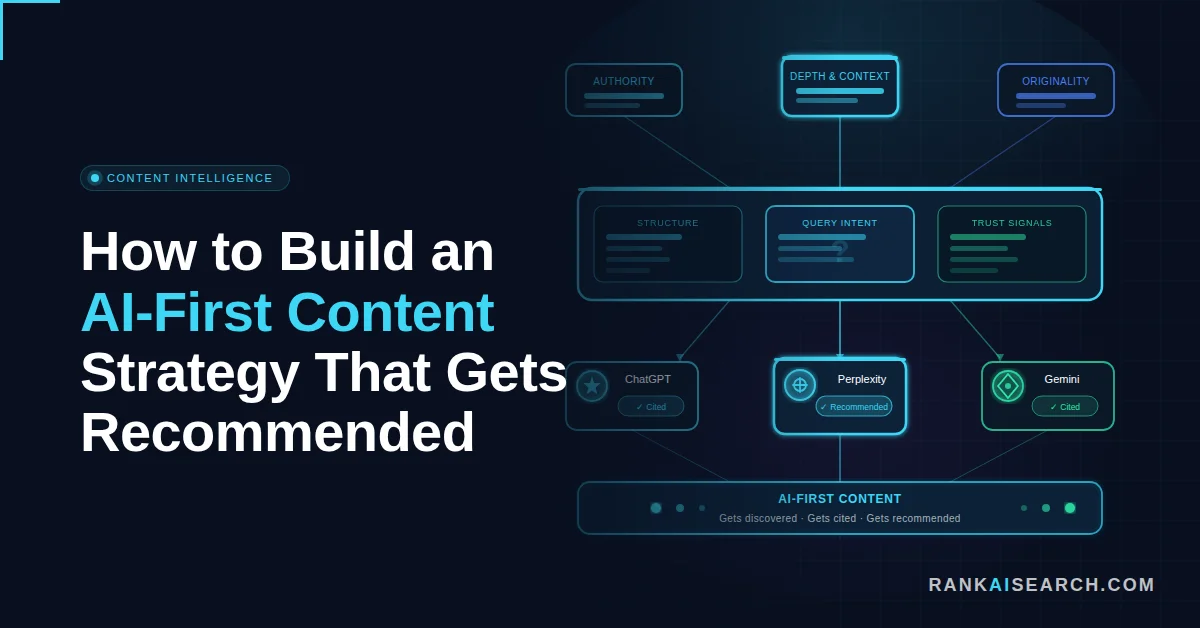
You can rank on page one and still be invisible to users asking AI platforms for recommendations. Search behavior has shifted. Users are getting answers from ChatGPT, Google AI Overviews, and Perplexity before they ever scroll through traditional results.
An AI-first content strategy is how brands adapt to this shift. It builds on SEO by adding one critical priority: creating content that answer engines trust enough to cite. This guide covers the principles, structure, technical requirements, and measurement frameworks that earn consistent AI recommendations for your brand.
What Is an AI-First Content Strategy?
An AI-first content strategy prioritizes creating content that answer engines can parse, extract, and recommend to users asking questions through AI platforms. The primary performance measure is not page rank but citation frequency across ChatGPT, Perplexity, and Google AI Overviews.
AI-first content is built around three core requirements:
- Direct answers — every section leads with the answer, not context
- Verified information — every claim is sourced and checkable
- Modular structure — every section works as a standalone response when extracted
Why Do Traditional Content Strategies Fall Short in AI Search?
Traditional content strategies fail in AI search because answer engines evaluate content differently than keyword-based ranking algorithms. Gartner (February 2024) predicts traditional search engine volume will drop 25% by 2026 as AI platforms absorb queries that once drove website traffic. BrightEdge (2026) found that only 17% of sources cited in Google AI Overviews also rank in the organic top 10.
| Dimension | Traditional SEO | AI-First Strategy |
| Primary goal | Rank on page 1 | Be cited as the answer |
| Success metric | Keyword rankings, organic traffic | AI citations, brand mentions in AI responses |
| Content structure | Keyword-optimized paragraphs | Answer-first, modular, directly quotable |
| Signals valued | Backlinks, domain authority | Factual accuracy, structured clarity, topical depth |
| Platform targets | Google, Bing SERPs | AI Overviews, ChatGPT, Perplexity, voice assistants |
What Are the Core Principles of Building Content for Answer Engine Success?
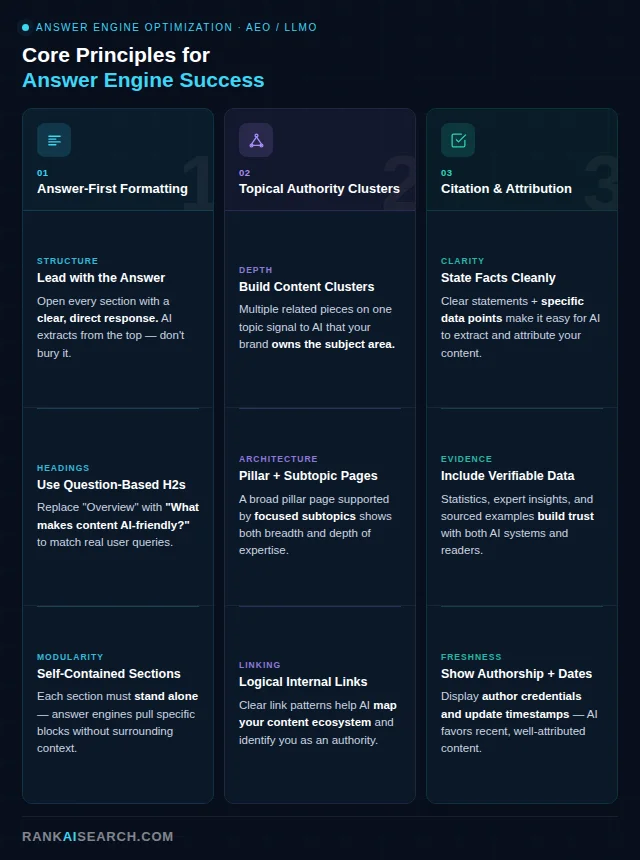
Three principles determine whether content earns AI citations: answer-first formatting, topical authority, and citation-ready structure.
Prioritize Answer-First Formatting
Answer-first formatting means every section opens with a direct response to the question the heading poses. BrightEdge (2025) found that longer, complex queries grew 49% in AI Overviews since May 2024, confirming that users increasingly direct detailed questions to AI systems.
Apply answer-first formatting by:
- Opening every section with the direct answer in the first sentence
- Using question-based headings that mirror how users ask AI platforms (e.g., “What makes content AI-friendly?” not “Overview”)
- Keeping each section self-contained so AI systems can extract it without surrounding context
Establish Topical Authority Through Content Clusters
Topical authority signals to answer engines that your brand has genuine domain expertise. Build it through a pillar-and-cluster structure:
- Pillar page — covers a broad topic comprehensively
- Subtopic pages — explore specific angles in depth (e.g., email strategy, video content, social distribution)
- Internal links — connect related pages to help AI systems map your content ecosystem
Comprehensive topic coverage is a direct input to the trust signals AI platforms use when selecting sources to cite.
Optimize for Citation and Attribution
Citation-ready content gives AI platforms the signals they need to confidently reference your brand as a source.
| Citation Signal | What to Do |
| Factual specificity | Use named sources, exact figures, and verifiable claims |
| Authorship | Display author credentials and publication dates prominently |
| Content freshness | Show last-updated dates; refresh statistics quarterly |
| Source attribution | Link all data points to original research or primary sources |
How Should You Structure Content for Maximum AI Platform Visibility?
Content structure determines whether AI platforms can efficiently extract, verify, and present your information. Three structural approaches improve AI visibility directly: semantic precision, snippet-optimized formatting, and modular design.
Implement Semantic Clarity and Contextual Depth
Semantic clarity means using terminology consistently so AI systems interpret your content accurately.
- Use one term per concept throughout the article — never swap between synonyms
- Replace hedged claims (“this can be effective”) with verifiable, source-attributed statements
- Explain why information matters, not just what it is — context helps AI determine relevance
Design Content for Featured Snippet Potential
Format key information so answer engines can extract and display it cleanly:
- Place direct answers within the first 100 words of each section
- Use numbered lists for sequential processes
- Use tables for comparisons and multi-attribute data
- Use definition paragraphs to introduce technical terms clearly
These formats translate directly into the structured responses AI platforms generate for users.
Create Modular, Reusable Content Blocks
Each major section should deliver complete information without requiring readers to reference other parts of the page. Strong topic sentences act as content summaries, allowing answer engines to assess relevance quickly and pull individual sections as standalone responses.
How Do You Align Content with User Intent in AI-Powered Search?
Aligning with user intent in AI search means mapping each piece of content to the specific questions users ask at each stage of the decision journey.
| Journey Stage | User Intent | Content Format to Target |
| Awareness | Define, explain, educate | Definition paragraphs, explainer guides |
| Consideration | Compare, evaluate, rank | Comparison tables, pros/cons lists, criteria guides |
| Decision | Implement, confirm, act | Step-by-step guides, checklists, expert validation |
To identify what users are actually asking AI platforms:
- Use AnswerThePublic and AlsoAsked to surface common queries in your niche
- Test your topic in ChatGPT, Perplexity, and Google AI Overviews to see what formats they return
- Identify questions that lack clear, authoritative answers in current AI responses — those are your content opportunities
- Match your content format to the format AI systems already use for that query type
What Technical Elements Enhance AI Content Discoverability?
Technical infrastructure determines whether AI platforms can reach, read, and trust your content. Schema markup, content freshness protocols, and accessibility standards each address a distinct stage of how answer engines process a page.
Structured Data and Schema Markup
Schema markup provides explicit signals about content type and structure, reducing the risk that AI systems misclassify or skip your pages.
| Schema Type | Best Used For | AI Benefit |
| Article | Editorial guides, posts, reports | Identifies content as authoritative editorial material |
| FAQPage | Question-and-answer sections | Structures Q&A pairs for direct AI extraction |
| HowTo | Step-by-step instructions | Organizes process content for task-oriented queries |
| BreadcrumbList | Site hierarchy signals | Helps AI understand content placement and context |
Validate schema regularly. Incorrect or outdated markup causes AI platforms to misrepresent or skip your content entirely.
Content Freshness and Update Protocols
BrightEdge (2026) confirms that answer engines evaluate publication and update dates as trust signals. Keep content current by:
- Scheduling quarterly reviews for high-priority pages
- Replacing outdated statistics with current figures
- Displaying last-updated dates and author credentials prominently
Mobile-First and Accessibility Standards
Voice assistants and mobile AI apps dominate AI search usage. To perform well across these interfaces:
- Ensure fast page load times on mobile
- Use semantic HTML heading hierarchy (H1 → H2 → H3)
- Write descriptive alt text for all images — AI platforms use this to build comprehensive answers
- Follow WCAG accessibility guidelines, which also improve AI content parsing
How Do You Measure Success in an AI-First Content Environment?
AI content performance is measured by citation frequency across AI platforms, not organic rankings or traffic volume alone. BrightEdge (2026) found that Google search click-through rates fell 30% year-over-year while AI Overviews grew to appear in 48% of tracked queries. Tracking only organic traffic misses an expanding share of how users discover content.
| Metric | How to Track |
| AI citation frequency | Manually test key queries in ChatGPT, Perplexity, and Google AI Overviews |
| AI-referred traffic | Monitor referral sources in analytics for AI platform traffic |
| Citation-driving content | Track which pages generate the most AI-sourced visits |
| AI audience engagement | Segment AI-referred users and track their conversion rates separately |
Tools for automated AI visibility tracking are emerging, but manual query testing remains the most reliable method for understanding how AI systems present your content.
How Do You Build a Sustainable AI Content Production Workflow?
A sustainable AI content workflow embeds optimization into production, not as a post-publication step.
- Build templates for each content type that include question-based headings, answer-first paragraphs, and modular sections
- Train content teams on how AI systems parse and evaluate content differently from human readers
- Use a pre-publication checklist covering answer-first structure, schema markup, semantic consistency, and citation-ready formatting
- Analyze high-performing content — when pieces earn frequent AI citations, identify the structural decisions behind them and replicate those patterns
How Do You Future-Proof Your Content Strategy as AI Search Evolves?
Future-proofing requires monitoring platform-specific changes and building production flexibility for rapid adjustment. BrightEdge (December 2024) found that in November 2024, OpenAI’s search engine grew referrals 44% month-over-month while Perplexity grew 71%. Content must perform across multiple AI platforms simultaneously.
To stay ahead as AI search evolves:
- Monitor platform announcements from Google, OpenAI, and Perplexity for algorithm and feature changes
- Test content regularly across all major AI platforms, not just Google
- Build agile review cycles that allow rapid format testing and adjustment
- Prioritize content quality — AI platforms are built to serve users, and accurate, useful content earns citations regardless of how specific algorithms change
Frequently Asked Questions
How does an AI-first content strategy differ from traditional SEO content strategies?
An AI-first content strategy optimizes for being cited by answer engines, while traditional SEO optimizes for ranking position in keyword-based search results. AI-first content prioritizes direct answers, semantic clarity, and modular structure that answer engines can extract and present. Traditional SEO emphasizes keyword placement, backlink profiles, and click-through traffic from SERPs.
What types of content formats do answer engines prefer to recommend?
Answer engines prefer structured formats: numbered lists, comparison tables, step-by-step guides, and definition-style explanations. FAQ sections perform well because they match the question-and-answer format of AI interactions. Content with question-based headings, answer-first paragraphs, and verifiable data earns citations more frequently than dense, unstructured text.
How can businesses measure whether their content is being recommended by AI platforms?
Test relevant queries manually across ChatGPT, Google AI Overviews, and Perplexity and record when your brand appears in responses. Monitor referral traffic from AI platforms in your analytics to track AI-sourced visitors. Set up brand mention alerts to catch citations in AI environments where direct referral tracking is not yet available.
What role does content freshness play in AI search recommendations?
Content freshness directly affects AI recommendation likelihood, especially for topics where information changes frequently. Answer engines prioritize recent content and evaluate publication and update dates as trust signals. Display clear update dates prominently, and schedule periodic reviews to refresh statistics and examples even for evergreen topics.
How should businesses prioritize content topics for an AI-first strategy?
Prioritize topics where users frequently direct questions to AI platforms and where your brand can provide genuinely authoritative answers. Research common queries using AnswerThePublic and AlsoAsked, then analyze gaps in current AI responses. Start with informational content addressing fundamental questions before moving to specialized topics where competition for AI citations is higher.
Can existing content be adapted for answer engine optimization or does it need complete rewriting?
Most existing content can be adapted without full rewrites. Add question-based headings, restructure sections to open with direct answers, and incorporate structured elements like lists and tables. Update statistics, add schema markup, and ensure each section functions as a complete standalone answer. Full rewrites are only necessary for content that fundamentally fails to address user questions directly.
What are the most common mistakes businesses make when creating AI-first content?
The most common mistake is burying answers deep in content instead of leading with them. Other frequent errors include using ambiguous language that prevents clean AI extraction, creating sections too dependent on surrounding context, neglecting schema markup, and writing for keyword density instead of semantic clarity. Content that requires excessive inference is difficult for AI systems to cite with confidence.
How long does it take to see results from implementing an AI-first content strategy?
Initial results from optimizing existing content for answer engines typically appear within three to six months. Building comprehensive content clusters and establishing topical authority takes six to twelve months. Timeline depends on content volume, competition in your niche, and execution quality across formatting and technical implementation. Consistent production and regular measurement against AI citation data accelerate results.