

How Does Conversational AI Search Transform Query Understanding?
A procurement manager asks ChatGPT for contract management software recommendations and gets a structured comparison of five platforms by pricing, integration, and compliance features, without clicking a single link. That same query in a traditional search engine returns sponsored results and keyword-stuffed listicles. Conversational AI search transforms query understanding by interpreting intent and meaning rather than matching strings of text.
This guide explains how conversational AI platforms process queries differently from keyword-based search, why traditional optimization strategies fall short in dialogue-based environments, and what brands must do to remain visible as AI answer engines become the primary interface for information discovery.
What Is Conversational AI Search and How Does It Differ from Traditional Search?
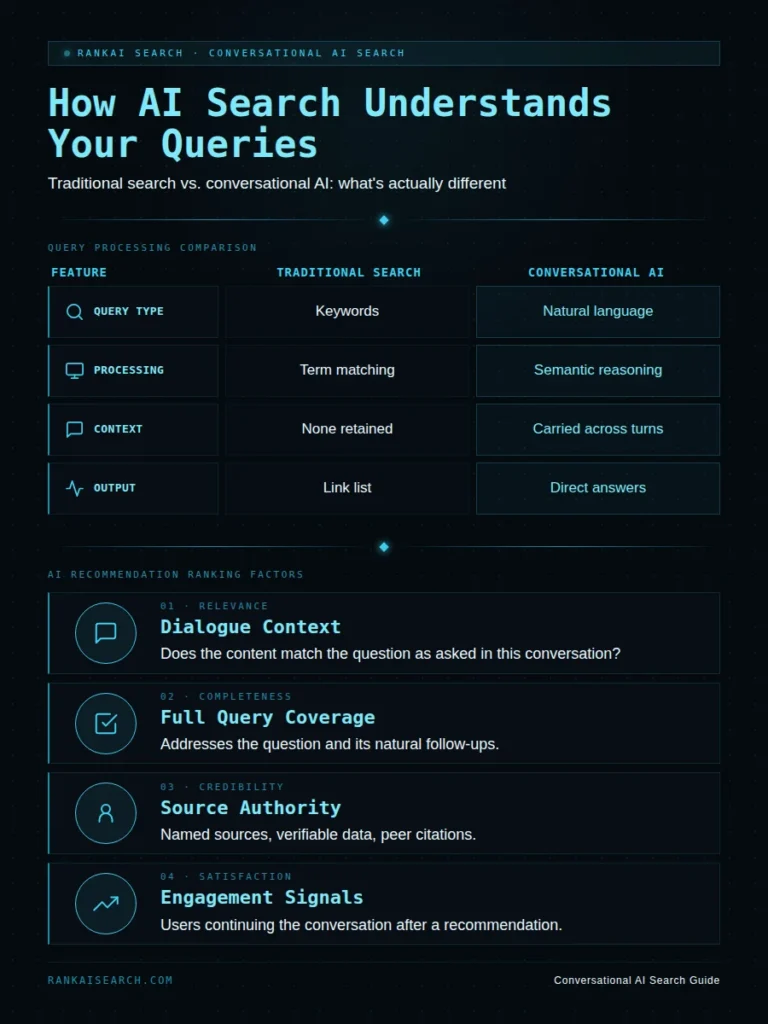
Conversational AI search uses natural language processing to interpret queries as a human would understand them, not as a pattern of keywords to match. Traditional search engines retrieve pages containing those terms; conversational AI platforms like ChatGPT and Perplexity evaluate meaning, intent, and context to deliver direct answers.
The core difference is the processing model. Keyword search is a retrieval system. Conversational AI is a reasoning system.
| Feature | Traditional Search | Conversational AI Search |
| Query type | Keywords and phrases | Natural language questions |
| Processing | Term matching | Semantic reasoning |
| Context memory | None between queries | Retained across the conversation |
| Output | List of links | Direct answers, comparisons, summaries |
| Intent handling | Limited | Inferred from language and dialogue history |
Conversational AI also resolves implied references automatically. If a user asks “how much does it cost?” mid-conversation about a specific product, the system knows what “it” refers to without a clarification prompt.
How Do AI Platforms Process Conversational Search Queries?
AI answer engines break down queries by analyzing grammatical structure, identifying key entities, and classifying user intent before generating a response. The process is not retrieval but synthesis: the platform reasons over its knowledge base and, in some cases, live search results to produce a response calibrated to the question.
Three mechanisms drive conversational query processing: dialogue memory, intent classification, and contextual inference. Each operates simultaneously, making responses feel coherent and personalized rather than mechanical.
What Role Does Dialogue Memory Play in Query Refinement?
Dialogue memory allows AI platforms to track the full conversation thread and adjust responses as the user’s needs become clearer. When a user shifts from “what is GEO?” to “how do I implement it for a B2B SaaS brand?”, the system carries prior context into the next response without requiring the user to restate their situation.
This memory enables progressive refinement. A user’s first query is usually broad; follow-up questions narrow the scope. AI platforms that retain dialogue history eliminate the frustration of starting over with every new question, which is the defining limitation of traditional keyword search.
How Do Contextual Inference Capabilities Shape AI Search Responses?
Contextual inference lets AI platforms read between the lines of a query to identify unstated constraints and preferences. If a user mentions they run a small business, the system infers budget sensitivity, limited technical resources, and a preference for practical advice, without those constraints being explicitly stated.
This capability extends to terminology. Conversational AI adapts to industry-specific language, regional phrasing, and colloquial expressions mid-conversation. A query using legal jargon returns a legally precise response; a casual question gets plain-language output.
Conversational AI Search vs. Traditional Search: Core Differences
Traditional keyword optimization fails in conversational AI environments because these platforms evaluate meaning, not term frequency. A page packed with exact-match phrases does not score higher when the AI is reasoning about which source best answers a nuanced, multi-part question.
Conversational AI evaluates three content qualities that keyword density cannot satisfy:
| Content Quality | What AI Evaluates |
| Semantic completeness | Does the content answer the full question, including logical follow-ups? |
| Authenticity | Does the writing flow naturally, or show signs of keyword insertion? |
| Contextual relevance | Does the content match intent signals in the query, not just surface terms? |
Forced keyword placement is detectable. AI systems trained on vast corpora of natural language recognize stilted writing and deprioritize it in recommendations, even when that content ranks in traditional organic results. (Source: Google, How Search Works, 2024)
A page optimized for “best running shoes 2026” may rank well in organic results but fail to surface when a user asks “what should I look for when buying marathon training shoes for wide feet?” The second query requires comprehensive, contextual content that addresses multiple decision factors simultaneously.
How Do Conversational Query Patterns Impact Brand Discovery?
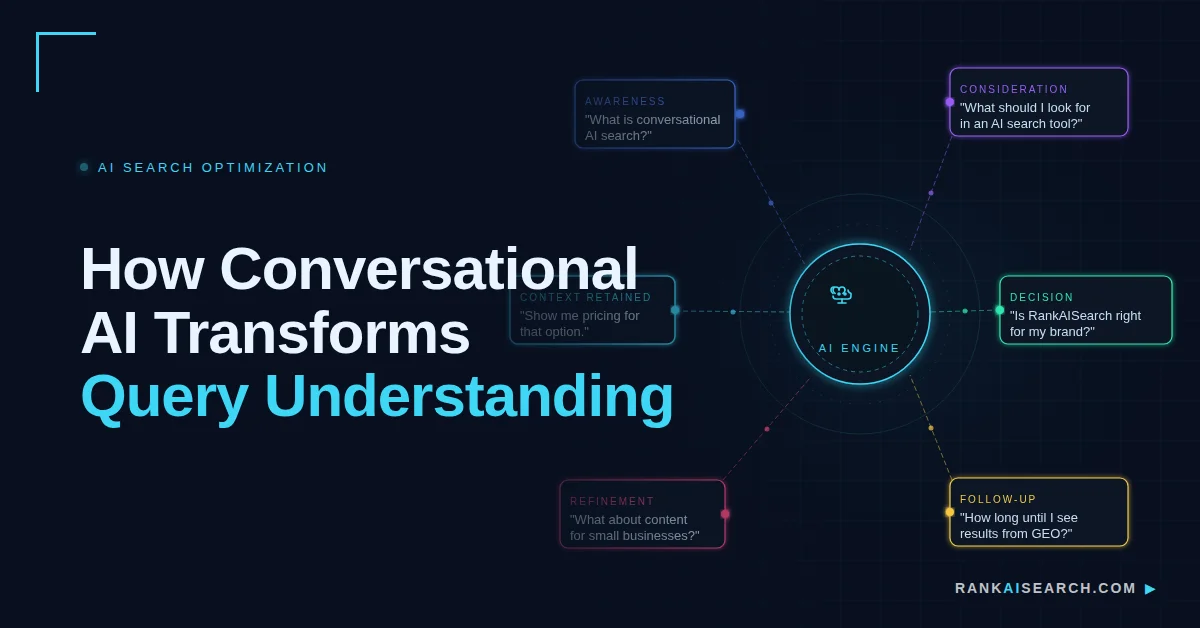
Conversational query patterns create multiple touchpoints for brand discovery across a single dialogue sequence rather than a single ranking position. Brands that appear only at the awareness stage of a conversation miss the recommendation opportunities that emerge as users narrow their search.
Question chains drive this dynamic. A user might start with “what is email marketing automation?” and follow up with “which platforms are best for e-commerce?” and then “how does [Brand X] compare to Klaviyo on pricing?” Each question in that chain is an independent recommendation point.
How Do Multi-Turn Conversation Dynamics Create Brand Positioning Opportunities?
Multi-turn conversations create brand positioning opportunities at every transition point in a user’s dialogue. The shift from learning to comparing is particularly valuable: content that bridges these two stages explicitly earns advantage at the moment the AI evaluates recommendation options.
| Conversation Stage | Example Query | Brand Opportunity |
| Awareness | “What is X?” / “How does X work?” | Establish presence with foundational content |
| Consideration | “What should I look for in X?” | Position with criteria and comparison guides |
| Decision | “How does [Brand A] compare to [Brand B]?” | Win with specific differentiators and use cases |
Brands with content at all three stages appear across more conversation turns. Brands that address only one stage compete for a fraction of the total recommendation surface.
How Do Long-Tail Conversational Queries Differ from Direct Questions?
Long-tail conversational queries include contextual detail that direct questions omit, and they require content that addresses those specific circumstances rather than the general topic. “Best project management tool for a 15-person remote team with non-technical users” is not a longer version of “project management tools.” It is a different question requiring a different answer.
According to Semrush keyword research data, question-format queries with four or more words generate lower competition and higher conversion intent than short-form queries. Content that addresses long-tail conversational patterns outperforms generic category pages in AI recommendations because it matches the specificity of how users actually phrase questions in dialogue environments. (Source: Semrush, Keyword Research, 2024)
What Makes Content Conversational-AI-Ready?
Conversational-AI-ready content mirrors the structure of natural dialogue: it answers first, then explains. It anticipates the next question before the user asks it and organizes information so AI platforms can extract relevant sections without parsing the entire page.
| Quality | Traditional SEO Content | Conversational-AI-Ready Content |
| Answer placement | Often buried in body paragraphs | First sentence of every section |
| Heading style | Keyword-optimized labels | Natural language questions |
| Information depth | Flat, uniform detail level | Layered: direct answer then supporting detail |
| Anticipation | Rarely addresses follow-ups | Structured around predictable question chains |
The goal is content that works at two levels simultaneously: a skimmable surface for users who want fast answers, and deeper supporting material for AI platforms synthesizing comprehensive responses.
How Should You Write Content for Dialogue-Based Consumption?
Content for dialogue-based consumption answers the question in the first sentence of every section before providing supporting detail. Users in dialogue mode expect immediate responses; they explore deeper context only if the initial answer satisfies them enough to continue.
Formatting best practices:
- Use H2 and H3 headings that mirror actual user questions, not topic labels
- Lead every section with a 1-2 sentence direct answer before any bullets or tables
- Keep paragraphs to three sentences maximum to maintain scanability
- Structure FAQ sections with standalone question-answer pairs that function without surrounding context
Subheadings that read like questions are more than a user experience choice. AI platforms parsing content for conversational responses identify question-answer pairs as high-confidence extraction targets and weight them accordingly in recommendation decisions.
How Do You Balance Information Density for AI Parsing?
Information density balance means providing enough detail to be authoritative without burying key points in blocks of prose that AI systems cannot efficiently extract. The optimal structure gives AI platforms a clear hierarchy: direct answer, supporting evidence, extended context.
Layered content architecture serves both human readers and AI extraction simultaneously. A user who wants a quick answer reads the lead sentence and moves on. An AI platform building a comprehensive response pulls from the full section.
The brands that AI cites most consistently are not those with the most content. They are those with the clearest answers.
How to Optimize Brand Messaging for Conversational AI Platforms?
Brand messaging for conversational AI platforms works best when it unfolds across multiple dialogue stages rather than delivering a single value proposition in one block. Different users encounter your brand at different conversation depths, and your content must be useful at each point.
| Content Layer | User Stage | What It Must Address |
| Category education | First-time visitor | What does the user need to understand about your space? |
| Differentiation | Comparing options | What is your specific advantage over alternatives? |
| Decision support | Ready to act | What does the user need to confirm before converting? |
Brands that publish only awareness-stage content disappear from AI recommendations as conversations progress into evaluation and decision phases. Positioning through conversational authority means demonstrating expertise through concrete examples, specific scenarios, and data-backed insights rather than technical language.
What Are the Conversational AI Search Ranking Factors That Influence Brand Recommendations?
Conversational AI platforms rank brand recommendations based on relevance to the current dialogue context, response completeness, and source credibility. These factors operate simultaneously, and weakness in any one reduces recommendation frequency regardless of strength in the others.
| Ranking Factor | What It Measures |
| Dialogue relevance | Does the content address the specific question within the current conversation context? |
| Response completeness | Are all dimensions of the query addressed, including implied follow-ups? |
| Source credibility | Author credentials, factual accuracy, and citation frequency by authoritative sources |
| User satisfaction | Positive interaction signals and conversation continuation after a recommendation |
How Does Response Completeness Affect AI Recommendation Rankings?
Response completeness is how thoroughly content addresses all dimensions of a query, including the implicit follow-up questions a user would likely ask next. AI platforms consistently deprioritize partial answers even when the answered portion is high quality.
| Completeness Criterion | Evaluation Question |
| Direct answer | Does the answer address the stated question in the first sentence? |
| Context acknowledgment | Does it incorporate context the user established earlier in the dialogue? |
| Anticipation | Does it address the next logical question in the conversation? |
| Proportional depth | Is the detail level appropriate to the complexity of the query? |
Brands that structure content to satisfy all four criteria earn higher recommendation frequency than those optimizing for any single factor.
How Do AI Platforms Assess Source Credibility in Conversational Responses?
Source credibility in conversational AI recommendations is built from author credentials, publication quality, factual accuracy, and citation frequency by other authoritative sources. Platforms like Perplexity and ChatGPT with browsing capabilities favor content that is demonstrably well-sourced and consistently referenced by others in the same field.
| Credibility Signal | How It Builds AI Trust |
| Methodology transparency | Shows how conclusions were reached, not just what they are |
| Named data sources | Verifiable citations from Semrush, BrightEdge, Gartner, and similar |
| Balanced perspectives | Acknowledges limitations and tradeoffs rather than promoting one view |
| Peer citation | Consistent reference by other authoritative content in the same topic area |
Transparency increases trust signals. Content presenting one-sided promotional claims without evidence is less likely to be recommended than content that acknowledges complexity and backs assertions with named sources.
How to Map Customer Journey Conversations to AI Search Optimization?
Mapping customer journey conversations to AI search optimization means identifying the typical question progressions your audience follows and ensuring your content covers every node in those progressions. The goal is comprehensive coverage of the dialogue tree, not just the entry question.
| Journey Stage | Typical Query Type | Content Requirement |
| Awareness | “What is X?” / “How does X work?” | Clear definitions, foundational explanations |
| Consideration | “What should I look for in X?” | Criteria guides, comparison frameworks |
| Evaluation | “How does [Brand A] compare to [Brand B]?” | Comparison content, specific differentiators |
| Decision | “Is [Brand] right for [specific situation]?” | Use-case content, case studies |
Content gaps at any stage remove your brand from recommendation sequences that begin earlier in the journey. A brand visible only at the decision stage never appears in AI recommendations when users are still building foundational understanding.
Conversation tree mapping reveals these gaps systematically. Start with the broadest awareness question in your category and branch into every logical follow-up. Each branch endpoint represents a content opportunity and a potential recommendation touchpoint.
What Are the Technical Implementation Strategies for Conversational AI Visibility?
Technical implementation for conversational AI visibility focuses on structured data, clear content hierarchy, and formatting that makes it easy for AI platforms to extract and attribute information accurately. These strategies amplify content quality; they do not substitute for it.
Standard schema markup for FAQs, how-to content, and articles remains foundational. Beyond individual page markup, the relationships between content pieces matter: internal linking that connects awareness-stage content to evaluation-stage content signals to AI platforms that your site covers a topic comprehensively across all dialogue stages.
How Does FAQ Schema Optimization Support Conversational Flow?
FAQ schema optimization for conversational AI goes beyond basic question-answer markup by reflecting the logical sequence of questions in a conversation. An unordered list of isolated Q&A pairs signals less value than a structured progression that mirrors how real users move through a topic.
Connect related Q&A pairs in your schema to signal conversation continuity. When one FAQ answer naturally leads to the next question in a typical user dialogue, structure your schema to reflect this relationship. This signals to AI platforms that your FAQ section mirrors real conversational progression, increasing the likelihood of multi-turn recommendation.
What Conversational Markup Techniques Signal Content Structure to AI Platforms?
Conversational markup techniques use semantic HTML elements and structured metadata to communicate content hierarchy and dialogue flow to AI parsing systems. The goal is making the structure of your content as legible as possible to automated systems that extract information at scale.
| Technical Signal | Purpose |
| Semantic heading hierarchy | Communicates structure (H1→H2→H3) without skipping levels |
| Distinct answer blocks | Separates direct answers from supporting detail for AI extraction |
| Purpose metadata | Specifies whether content is informational, comparative, or procedural |
| Stage-connected internal links | Signals comprehensive topic coverage across the dialogue journey |
Annotating content with depth and complexity signals helps conversational AI platforms select the right content for the right stage of a user’s dialogue journey, improving both citation accuracy and recommendation relevance.
How to Measure Conversational AI Search Performance?
Measuring conversational AI search performance requires tracking brand mentions across AI platforms rather than ranking positions in traditional SERPs. The primary metrics are recommendation frequency, position within multi-option responses, and the query contexts in which your brand appears.
| Method | What It Tracks |
| Query simulation | Whether your brand appears in ChatGPT, Perplexity, and Google AI Overviews responses |
| Citation tracking | Position in responses: first mention, listed option, or footnote citation |
| Stage tracking | Whether your brand appears at awareness, consideration, or decision-stage queries |
| Trend monitoring | Changes in recommendation frequency following content updates |
Attribution modeling for dialogue-based discovery must account for delayed conversion. A user may encounter your brand in an early-stage conversation and not act until several exchanges later. Standard last-click attribution consistently undervalues conversational AI as a discovery channel.
How Do You Future-Proof Your Brand for Advanced Conversational AI Search?
Future-proofing for conversational AI search means investing in content qualities that strengthen as AI systems become more sophisticated, rather than optimizing for behaviors that algorithm updates will render obsolete. The brands best positioned for advanced AI search are those already creating content of demonstrable, genuine utility.
| Principle | Why It Compounds with AI Advancement |
| Clarity | Better language models reward clearer writing more consistently |
| Specificity | Advanced reasoning systems extract specific claims more reliably than vague ones |
| Completeness | Improving dialogue memory makes comprehensive topic coverage increasingly valuable |
| Credibility | Greater AI capacity to evaluate sources makes established trust signals more consequential |
RankAISearch (rankaisearch.com) is a global agency specializing in Answer Engine Optimization (AEO), Generative Engine Optimization (GEO), AI Search Optimization (AIO), Large Language Model Optimization (LLMO), and traditional SEO. The agency’s approach prioritizes content strategies that position brands for consistent recommendation across AI-powered search systems, including ChatGPT, Perplexity, and Google AI Overviews.
Avoid platform-specific optimization tricks. The conversational AI landscape updates faster than any single tactic can stay current. Brands that build genuine expertise content now will see compounding visibility advantages as AI systems become more capable of identifying and recommending authoritative sources.
Frequently Asked Questions about Conversational AI Search
How does conversational AI search differ from voice search optimization?
Conversational AI search covers multi-turn dialogue across text and voice interfaces, while voice search optimization targets single-query spoken commands processed without conversation history. The defining difference is context retention: conversational AI carries prior exchanges into each new response, requiring content that supports progressive dialogue rather than just voice-friendly keyword phrases.
What types of businesses benefit most from conversational AI search optimization?
Businesses with complex products or services requiring multi-step decision-making benefit most, including B2B software, professional services, healthcare, financial services, and education. Any brand whose customers typically ask several questions before committing to a purchase should prioritize conversational AI optimization, since each dialogue stage is an independent recommendation opportunity.
Can traditional SEO content be adapted for conversational AI platforms?
Yes, traditional SEO content can be adapted with targeted structural changes: add question-based headings, build FAQ sections with standalone answers, and restructure information so direct answers precede supporting detail. The core information typically remains valuable; what changes is the presentation and hierarchy.
How long does it take to see results from conversational AI search optimization?
Initial improvements in AI citation frequency typically appear within 60 to 90 days, with meaningful increases in consistent recommendation across platforms taking four to six months of sustained effort. Unlike traditional SEO, conversational AI performance can shift rapidly as platforms update training data, and content that earns early citation tends to self-reinforce over time.
Do conversational AI platforms favor certain content formats or structures?
Conversational AI platforms favor content with clear question-answer structures, logical information hierarchy, and sections that function as standalone answers, with FAQ formats, how-to guides, and comparison content performing consistently well. Clear headings, short paragraphs, and concise section answers maximize extraction accuracy across ChatGPT, Perplexity, and Google AI Overviews.
How do multi-turn conversations affect brand recommendation likelihood?
Multi-turn conversations increase brand recommendation likelihood when your content addresses progressive information needs at every stage of the dialogue, since each query in a sequence creates an independent recommendation opportunity. The cumulative effect compounds: a brand appearing at the awareness stage is more likely to be recommended again at the decision stage when the AI can draw on consistent, high-quality content across related topics.
What role does user feedback play in conversational AI search rankings?
User feedback directly influences rankings through satisfaction signals that platforms use to refine recommendation algorithms, including continued conversations after a recommendation, explicit approval, and positive engagement with suggested content. Many conversational AI platforms apply reinforcement learning from human feedback (RLHF), meaning negative signals or conversation abandonment after a recommendation reduces future visibility.
How can brands track their visibility in conversational AI search results?
Brands can track conversational AI visibility by regularly submitting representative queries to ChatGPT, Perplexity, and Google AI Overviews and logging brand mentions, citation position, and query context. Specialized monitoring tools are emerging, but manual platform testing remains the most reliable method; track recommendation changes following content updates to identify which optimizations produce measurable results.