

How Often Do AI Models Refresh the Data They Cite?
Your website can show the latest facts while an AI answer still repeats old information. That mismatch happens when the AI tool has not retrieved, indexed, or selected the updated page yet. AI data refresh cycles vary because every platform handles live web access, search indexes, and model knowledge differently.
This matters when pricing, product details, regulations, software features, or brand facts change. A slow refresh can keep outdated sources in front of buyers. This guide explains how AI tools update cited information and how to shorten the path from content update to AI visibility.
How Often Do AI Models Update Their Data?
It depends on the engine. Retrieval-based tools like Perplexity and AI Overviews pull near-live web data, so new content can appear within days. Models that rely on training data update far less frequently, sometimes only with major model releases.
The important distinction is between the model and the answer system. The model may have older built-in knowledge, while the product around it may search the web, retrieve sources, and cite current pages.
Near-live does not mean instant. A page must still be crawlable, discoverable, indexable, and relevant enough to be selected for the answer.
| AI Data Source | Typical Freshness Pattern | What It Means for Marketers |
|---|---|---|
| Live retrieval | Minutes to days when sources are accessible | New pages can surface quickly |
| Search index | Days to weeks depending on crawl and index behavior | Indexing controls visibility speed |
| Cached web content | Variable by platform and cache age | AI may cite older snapshots |
| Training data | Major model releases or updates | Fresh website edits may not appear |
| Connected sources | Depends on connector sync rules | Private or workspace data may refresh separately |
| Platform partnerships | Depends on data provider feeds | Review and local data may update by partner cycle |
What Is the Difference Between Live Retrieval and Training Data?
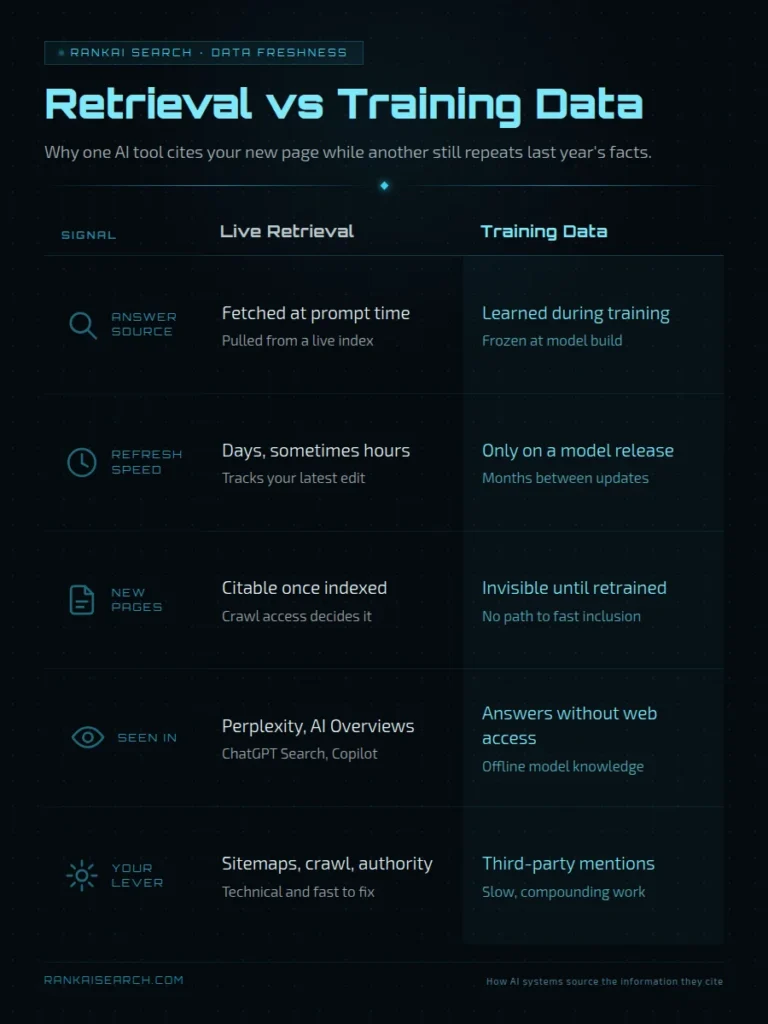
Live retrieval pulls information at answer time, while training data is information learned during model development. This difference controls whether fresh content can be cited quickly or must wait for a model update.
Retrieval-based systems can cite a page that exists outside the model’s original training data. A pretrained model without retrieval may still answer from older internal knowledge, even if the web has changed.
This split is why one AI tool can cite a new article while another misses it. The difference may be the tool’s retrieval access, not the underlying quality of the article.
| Data Mode | How It Works | Citation Freshness |
|---|---|---|
| Live retrieval | Searches or fetches sources during the answer | Can cite new or recently updated pages |
| Search index retrieval | Uses indexed web results from a search system | Depends on crawl and indexing speed |
| Cached retrieval | Uses stored copies or snapshots | Can lag behind the live page |
| Training knowledge | Uses knowledge from model training | Does not update with each website edit |
| Connector retrieval | Searches approved user or company data | Depends on sync and permissions |
Retrieval-Based Answers
Retrieval-based answers use live or indexed sources at the time of the user’s request. They can cite current pages when the system finds, trusts, and selects those pages.
| Retrieval Signal | Why It Matters |
|---|---|
| Crawl access | The system must be able to reach the page |
| Index inclusion | The page must be discoverable in the relevant source set |
| Relevance | The page must match the prompt |
| Authority | The page must look trustworthy enough to cite |
| Freshness | Recent pages may matter more for time-sensitive topics |
| Source clarity | Dates, authors, and facts must be easy to verify |
Pretrained Model Knowledge
Pretrained model knowledge is information encoded during model training. It does not refresh every time a website publishes or edits content.
| Training Data Limitation | Practical Impact |
|---|---|
| Fixed cutoff | Recent events may be missing |
| Uneven topic freshness | Some topics may be older than the stated cutoff |
| No page-level crawl | A new article is not automatically learned |
| No guaranteed citation | The model may know a fact but not cite a page |
| Model-release dependency | Updates may require new model versions |
Why Do Update Speeds Vary Between AI Platforms?
Update speeds vary because AI platforms use different combinations of search indexes, live web retrieval, caches, licensed data, connectors, and model training cycles. The same page can appear quickly in one AI tool and much later in another.
AI products are not one shared search engine. Perplexity, ChatGPT Search, Claude with web search, Gemini, Copilot, and Google AI Overviews can use different retrieval systems and source-selection logic.
Platform differences also affect citations. Some tools cite live web pages, some cite search result sources, some cite partner data, and some may answer without citations when retrieval is not active.
| Platform Factor | Why Refresh Speed Changes |
|---|---|
| Retrieval access | Some tools search the web during the answer |
| Search partner | Different indexes crawl at different speeds |
| Cache policy | Cached content can lag behind live updates |
| Model cutoff | Built-in knowledge may be older |
| Citation rules | Some systems cite only selected sources |
| Region | Search and AI features can vary by country |
| User settings | Search, connectors, and browsing may be optional |
| Source eligibility | Some pages may be excluded by robots or policies |
Marketers should not judge freshness from one AI tool alone. A content update should be tested across the platforms that matter to the buyer journey.
What Determines How Quickly New Content Gets Picked Up?
New content gets picked up faster when it is crawlable, indexable, internally linked, included in accurate sitemaps, accessible to relevant bots, and supported by clear authority signals. Freshness also depends on whether the AI tool uses a live search system or older training knowledge.
A new page can exist online and still be invisible to AI systems. If the page is orphaned, blocked, slow to render, missing from sitemaps, or low in authority, discovery can take longer.
Google says it uses the <lastmod> value in sitemaps when that value is consistently and verifiably accurate, and the value should reflect the last significant page update. (Source: Google Search Central, 2026)
Content pickup is a pipeline. The page must be discovered, crawled, processed, indexed or stored, retrieved, and selected.
| Pickup Factor | What To Check |
|---|---|
| Crawlability | Bots can access the page |
| Indexability | No unintended noindex or canonical conflict |
| Internal links | Important pages are linked from relevant pages |
| Sitemap accuracy | New and updated URLs are included |
| lastmod accuracy | Dates reflect meaningful changes |
| Server response | Page returns 200 status |
| Content quality | The page adds useful information |
| Authority | The site and page are trustworthy |
| Structured data | Dates, authors, and entities are clear |
Crawling, Indexing, and Source Accessibility
Crawling, indexing, and source accessibility determine whether search-based AI systems can find the page at all. A blocked or orphaned page cannot be cited reliably.
Google says site owners can request recrawling through Search Console’s URL Inspection tool, but recrawling can take time and is not guaranteed to result in indexing. (Source: Google Search Central, 2025)
| Technical Requirement | Why It Matters |
|---|---|
| 200 status code | Confirms the page is available |
| Crawlable HTML | Lets bots read the content |
| No accidental noindex | Allows indexing |
| Correct canonical | Points to the preferred version |
| Internal links | Helps discovery |
| XML sitemap | Helps engines find URLs |
| Fast rendering | Reduces crawl friction |
| Bot access | Allows relevant crawlers to fetch content |
Authority, Relevance, and Content Freshness
Authority, relevance, and content freshness influence whether a discovered page is selected for an AI answer. Being indexed is not the same as being cited.
A page that updates a date without adding meaningful information may not gain trust. Google’s helpful content guidance asks creators whether they are changing page dates to appear fresh when the content has not substantially changed. (Source: Google Search Central, 2026)
| Quality Factor | Better Practice |
|---|---|
| Authority | Add expertise, sources, and proof |
| Relevance | Answer the specific query directly |
| Freshness | Update facts, examples, and dates meaningfully |
| Originality | Add information beyond existing summaries |
| Clarity | Use direct headings and short answer blocks |
| Entity signals | Define brands, authors, products, and services |
How Soon Can Updated Website Content Appear in AI Answers?
Updated website content can appear in AI answers within days when the page is recrawled, indexed, retrieved, and selected by a search-based AI system. Content tied to model training can take much longer because it may require a later model or index refresh.
The faster timeline applies mainly to retrieval systems. If a user asks Perplexity or ChatGPT Search a current question, the tool may retrieve pages that were recently published or updated.
A citation may still lag after indexing. AI systems can choose older pages when they appear more authoritative, clearer, or better aligned with the prompt.
| Content Situation | Likely AI Pickup Pattern |
|---|---|
| Breaking news | Fastest in live retrieval tools |
| Updated evergreen guide | Days to weeks after recrawl and reindex |
| New low-authority page | Slower and less predictable |
| Product availability change | Faster when feeds and structured data update |
| Local business update | Depends on profile and directory refresh |
| Major model knowledge | Slower because training data changes less often |
| Private connector data | Depends on sync schedule and permissions |
Marketers should treat “published” and “cited” as different events. A page must be discoverable before it can be selected as a source.
How Do Search Indexes Affect AI Citation Freshness?
Search indexes affect AI citation freshness because many AI answer systems retrieve from indexed or search-accessible content rather than the entire live web. If an index has not processed the latest version of a page, the AI answer may not reflect it.
A search index is a structured store of discovered and processed pages. It lets search and AI systems retrieve relevant pages quickly without fetching every web page from scratch for each user prompt.
Indexing also affects measurement. A page can be crawled but not indexed, indexed but not cited, or cited in one AI feature but absent from another.
| Index Status | AI Citation Impact |
|---|---|
| Not discovered | AI systems are unlikely to cite it |
| Crawled but not indexed | Visibility may remain limited |
| Indexed but low relevance | The page may not be retrieved |
| Indexed and authoritative | Better chance of citation |
| Updated but not recrawled | AI may see old information |
| Recrawled but not selected | Other sources may still win |
Search indexes are also selective. They prioritize pages based on access, quality, duplication, usefulness, and demand.
Which Types of Content Need the Most Frequent Updates?
Content that changes quickly needs the most frequent updates. This includes pricing, product availability, regulations, software documentation, medical guidance, financial data, local business hours, event information, statistics, and comparison pages.
AI systems are more likely to create stale answers when the topic changes faster than the source pages. A current pricing page matters more than an old pricing blog post.
Google’s Article structured data documentation supports datePublished and dateModified. This helps search systems understand publication and update dates for eligible article pages. (Source: Google Search Central, 2025)
Freshness should match risk. A wrong restaurant hour is inconvenient, but a wrong legal, medical, or financial claim can create serious harm.
| Content Type | Recommended Update Trigger |
|---|---|
| Pricing pages | Any price, plan, or fee change |
| Product pages | Stock, specs, reviews, or variant changes |
| Software docs | Version releases and API changes |
| Legal content | Law, policy, or jurisdiction changes |
| Medical content | Guideline, safety, or evidence changes |
| Financial content | Rate, market, or regulatory changes |
| Local pages | Hours, address, services, or staff changes |
| Statistics pages | New study, benchmark, or dataset release |
| Comparison pages | Competitor feature or pricing changes |
Evergreen content also needs maintenance. A guide can stay relevant for years, but examples, sources, tools, screenshots, and statistics can expire.
How Can You Help AI Systems Discover New Content Faster?
You can help AI systems discover new content faster by improving crawl access, adding internal links, updating sitemaps, submitting important URLs, using IndexNow where supported, and publishing clear update signals. Discovery improves when search systems can find and verify the page quickly.
Fast discovery does not guarantee AI citation. It only improves the chance that retrieval-based systems can see the new or updated content.
A strong discovery workflow should focus on important pages first. High-value pages include product pages, service pages, comparison pages, pricing pages, research pages, and articles built for AI citations.
| Discovery Action | What It Does |
|---|---|
| Add internal links | Helps crawlers find the page |
| Update XML sitemap | Signals new or changed URLs |
| Use accurate lastmod | Shows meaningful update timing |
| Request indexing | Prompts Google recrawl for key URLs |
| Use IndexNow | Notifies supported engines of changes |
| Avoid orphan pages | Keeps pages connected to the site |
| Check robots rules | Prevents accidental blocking |
| Monitor server logs | Shows whether crawlers visit |
Discovery should be paired with page quality. A crawler can find a page quickly and still decide it is not worth surfacing.
How Should You Update Existing Pages Without Losing Their Authority?
You should update existing pages by preserving the useful core, improving outdated sections, adding new evidence, fixing obsolete claims, and keeping the same URL when the topic remains the same. The goal is to refresh the page without breaking the signals that already make it trusted.
Existing pages often have links, engagement, rankings, citations, and entity context. Replacing them with a new URL can fragment authority if the old page still targets the same intent.
A content refresh should be meaningful. Update the answer, evidence, examples, product details, screenshots, schema, internal links, and cited sources where needed.
| Update Task | Why It Helps |
|---|---|
| Keep the same URL | Preserves accumulated signals |
| Add current evidence | Supports freshness and trust |
| Replace old screenshots | Avoids outdated UX signals |
| Update dates honestly | Clarifies modification timing |
| Refresh schema | Aligns markup with visible content |
| Fix broken links | Improves crawl and user quality |
| Add new internal links | Connects the page to current clusters |
| Remove obsolete sections | Reduces stale information |
Do not update only the headline or date. AI systems and search engines need the content itself to change in a useful way.
How Can You Tell Whether an AI Tool Is Using Current Information?
You can tell whether an AI tool is using current information by checking the answer date, source dates, citation URLs, source snippets, and whether the cited page contains the current fact. A current-looking AI answer still needs source verification.
Some AI tools show citations, source panels, or links beneath the answer. Other tools may answer without clear sources, which makes freshness harder to audit.
You should audit both the answer and the source. An AI tool can cite a current page but summarize it incorrectly, or cite an old page that is no longer the best source.
| Freshness Check | What To Look For |
|---|---|
| Citation date | Is the source recent enough? |
| Page update date | Does the page show a current modification date? |
| Source relevance | Does the page actually support the answer? |
| Cache risk | Does the answer reflect old page content? |
| Platform behavior | Did the tool use web search or internal knowledge? |
| Prompt wording | Did the prompt request current information? |
| Cross-tool comparison | Do other AI tools cite newer sources? |
Ask the tool to cite sources and state dates when testing. Then verify the sources manually.
Why Might AI Continue Citing an Outdated Source?
AI might continue citing an outdated source because it is still indexed, more authoritative, easier to retrieve, more clearly written, or more strongly linked than the updated source. A newer page does not automatically replace an older citation.
Outdated citations can persist when old content has stronger authority signals. They can also persist when a new page is blocked, thin, uncited, poorly linked, or not yet indexed.
AI systems may also mix retrieved sources with older internal knowledge. That can create answers that look current but include stale assumptions.
| Reason for Outdated Citation | Fix |
|---|---|
| Old page has stronger authority | Improve links and evidence on updated page |
| New page is not indexed | Check crawl and indexing status |
| New page is poorly linked | Add internal links from relevant pages |
| Update was minor | Add meaningful new information |
| Old source still ranks | Create clearer and better-supported content |
| Conflicting sources exist | Correct third-party profiles and citations |
| Cache lag exists | Wait for refresh and test again |
| Prompt is vague | Use current-year and date-specific prompts |
Fixing outdated AI citations is usually a source cleanup task. Update your page, update linked sources, and make the correct version easier to verify.
What Should You Remember About AI Data Refresh Cycles?
You should remember that AI data refresh cycles depend on retrieval, indexing, caching, and model training. A page can be current on your website and still take time to appear in AI answers.
The fastest path is usually retrieval-based visibility. The slowest path is waiting for a pretrained model to learn new facts through a later training or model release cycle.
| Principle | Practical Action |
|---|---|
| Retrieval is fastest | Make pages crawlable and indexable |
| Training data is slower | Do not rely on model updates for freshness |
| Search indexes matter | Monitor crawl and indexing status |
| Dates matter | Show accurate publish and modified dates |
| Authority matters | Build proof and citations |
| Prompt testing matters | Track AI answers across platforms |
| Old sources can persist | Update and strengthen the source trail |
AI freshness is managed, not assumed. Marketers need a workflow for publishing, discovery, validation, and AI answer monitoring.
Are You Ready to Make Your Latest Content Easier for AI to Find?
Publishing an update does not mean AI tools will recognize it immediately. Your pages still need clear modification dates, accurate sitemaps, strong internal links, reliable crawl access, and enough authority to be retrieved instead of older competing sources.
RankAISearch can help identify the technical and content gaps slowing the discovery of your latest pages. This includes reviewing indexing signals, source clarity, outdated citations, and the factors that affect how quickly AI platforms find and select updated information.
Schedule a consultation with RankAISearch to improve your content refresh process and give your newest information a stronger chance of appearing in current AI answers.
Frequently Asked Questions About AI Data Refresh Cycles
Do all AI models update their information at the same time?
No, AI models and AI tools do not update their information at the same time. Each platform has its own training cycles, retrieval systems, search partners, cache rules, and source-selection methods. A page can appear in one AI system before another. That difference does not always mean one tool is wrong.
Can AI tools cite a page published today?
Yes, AI tools can cite a page published today when they use live retrieval or a fast-updating search index. The page must still be crawlable, accessible, relevant, and selected as a useful source. Same-day citation is more realistic for news, high-authority sites, and strongly linked pages. Low-authority or orphaned pages usually take longer.
How quickly does perplexity discover new website content?
Perplexity can discover new website content quickly because it searches the web in real time. The exact timing depends on whether the page is accessible, discoverable, and relevant to the prompt. A new page is not guaranteed to appear in Perplexity answers. It must compete with other sources that may be clearer or more authoritative.
Does updating a page make AI engines recrawl it?
Updating a page can create signals that support recrawling, but it does not guarantee immediate recrawling or AI citation. Search systems still decide when to crawl, index, retrieve, and select content. Use accurate lastmod, internal links, sitemaps, and indexing tools for important updates. Avoid changing dates without meaningful content changes.
Can an AI answer combine live web data with older training knowledge?
Yes, an AI answer can combine live web data with older training knowledge. This is common when a tool retrieves current sources but still uses model reasoning to compose the response. That mix can create freshness issues. Always check whether the cited sources support the exact claim.
Why does an AI tool sometimes cite an outdated article?
An AI tool may cite an outdated article because the old source is still indexed, authoritative, clearly written, or more strongly connected to the query. Newer content may not have enough trust or discoverability yet. The fix is to update the stronger source trail. Improve the current page, link to it, correct old sources, and make the updated version easier to verify.
Should publication and modification dates be visible on a page?
Yes, publication and modification dates should be visible when freshness matters. Dates help users and AI systems judge whether the information is current. Use dates honestly. Do not change the date unless the content has been meaningfully updated.
How often should marketers refresh content intended for AI citations?
Marketers should refresh AI citation content whenever facts, prices, policies, products, laws, research, or competitive conditions change. Stable evergreen content can be reviewed quarterly or semiannually. High-risk or fast-changing content needs tighter review. Pricing, software documentation, local business details, legal guidance, medical guidance, and financial content should be monitored more often.