


How to Optimize Your Website Structure for AI Search Engines
When someone asks ChatGPT or Perplexity a question, they get a direct answer that names specific sources and ignores everything else. Whether your site is one of those sources comes down to how it is structured, not just what it publishes. ChatGPT alone processes queries from more than 900 million weekly active users, making AI assistants a primary discovery channel that most websites are not yet built for. SE Ranking’s 2024 AI Overviews research found that Google’s AI-generated answer panels appear in 11.4% of all searches, with rates significantly higher for informational and how-to queries.
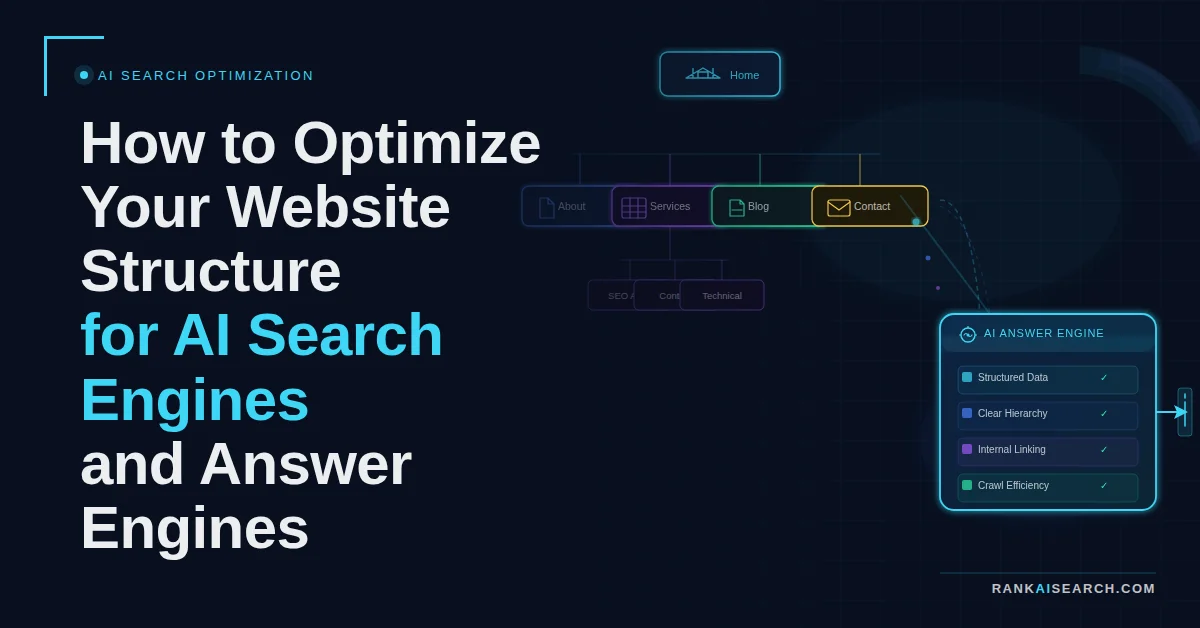
This guide covers every structural element that drives AI discoverability: URL conventions, internal linking architecture, schema markup, content hierarchy, topic clusters, and technical performance.
Why Does Website Architecture Matter for AI Search Engines?
AI platforms use your site’s architecture to assess authority, map topical relationships, and decide which content is worth citing. Unlike traditional crawlers that count links, large language models build knowledge graphs from your content structure, evaluating how pages connect and which subjects you cover in depth.
Logical parent-child page relationships, semantic internal links, and consistent URL patterns signal to AI systems that your content is organized and trustworthy. Sites without this structure require AI to guess at topical relationships, which reduces citation confidence.
Structure is not a technical detail. It is the signal AI uses to decide whether your content is citable.
How Do AI Search Engines Crawl and Index Content Differently?
AI crawlers analyze semantic relationships rather than simply following links and indexing pages. Traditional search bots measure link counts and keyword density. AI systems evaluate topical depth, content relationships, and architectural clarity to build a model of your expertise.
Large language models process site content by mapping how concepts connect across your pages. A page on “contract law basics” linked from a hub on “business law” signals a deliberate knowledge structure. A standalone page with no contextual connections appears isolated regardless of its content quality.
Answer engines treat structural signals as trust indicators. Pages buried deep in site hierarchies or lacking internal links are deprioritized. Well-connected pages within clear topical clusters are far more likely to be cited in AI-generated responses.
What URL Structure Do AI Search Engines Prefer?
Descriptive, hierarchical URLs tell AI systems exactly where a page fits within your content structure before they crawl it. A URL like /services/seo/technical-audit communicates topic, category, and page purpose in one string.
| URL Type | Example | AI Signal |
| Semantic hierarchy | /blog/website-structure/internal-linking | Clear topic and category relationship |
| Keyword-rich flat | /internal-linking-strategies | Topic clear, hierarchy absent |
| Parameter-based | /blog?p=12345&cat=87 | No topical signal at all |
| Date-prefixed | /2021/08/seo-tips | Implies outdated content, reduces authority signal |
Consistent URL naming conventions help AI predict what content exists on your site. When your URL patterns follow a clear taxonomy, models can infer content relationships without crawling every page individually. Avoid session IDs, dynamic parameters, and date prefixes on evergreen content.
How Should You Build Internal Links for AI Discoverability?
Internal links create semantic pathways that AI systems follow to map your content relationships and verify topical authority. Each link acts as an explicit signal that two pages share a meaningful conceptual relationship.
Contextual anchor text matters more for AI than for traditional SEO. An anchor like “see our guide to technical SEO audits” tells an AI crawler what the destination page contains before it visits the page. Generic anchors like “click here” or “read more” carry no semantic value.
Three principles govern AI-effective internal linking:
- Link from broader topics to specific subtopics within the same cluster
- Ensure every important page is reachable within 3 clicks from the homepage
- Use anchor text that accurately describes the destination page’s primary topic
How Should You Categorize and Organize Content for AI?
Clear content categorization builds topical authority by showing AI systems that you cover subjects comprehensively rather than fragmentarily. Group related pages under well-defined parent categories with non-overlapping scope.
Semantic grouping is how AI platforms recognize subject expertise. When multiple related pieces of content are organized under a single parent topic and interlinked, AI models register this pattern as evidence of depth. Isolated pages on related topics do not produce the same authority signal.
Breadcrumb structures reinforce hierarchical clarity. A breadcrumb path like Home > Services > AI Optimization > Website Structure gives AI systems an explicit map of page importance and topical position. Implement BreadcrumbList schema to make this signal machine-readable.
How Does Schema Markup Help AI Search Engines Understand Your Content?
Schema markup removes ambiguity by giving AI systems explicit, machine-readable descriptions of your content. Without it, AI must infer page type, author, topic, and structure from content patterns alone.
These schema types produce the highest AI extraction rates for most sites:
| Schema Type | Best Used For | Primary AI Benefit |
| Article | Blog posts, guides, reports | Identifies author, date, and topic clearly |
| FAQPage | Question-answer sections | Enables direct Q&A extraction and citation |
| HowTo | Step-by-step instructional content | Structures process steps for AI citation |
| BreadcrumbList | Navigation paths | Signals page hierarchy and authority level |
| Organization | Brand and contact information | Establishes entity clarity for large language models |
What Schema Mistakes Reduce AI Visibility?
Incomplete schema properties, incorrect nesting, and content-schema mismatches are the most common errors that reduce AI trust. Marking up a standard paragraph as FAQPage schema when it is not in question-answer format creates a mismatch that confuses AI indexing.
Validate all schema using Google’s Rich Results Test before publishing. A schema error that passes visual inspection can still block AI extraction. Revalidate after any CMS update that touches page templates or markup.
How Should You Design Site Navigation for AI Crawlability?
Navigation menus should use descriptive labels in standard HTML links that AI crawlers can parse without executing JavaScript. Dropdown menus that reveal links only on hover or click are inaccessible to many AI crawlers.
XML sitemaps remain a critical discovery signal for AI platforms. Include all important pages with accurate lastmod dates so crawlers can identify fresh content efficiently. Submit updated sitemaps immediately after publishing new content sections or restructuring categories.
Three navigation patterns that actively block AI discovery:
- Infinite scroll without standard pagination links
- Links hidden behind search filters or interactive elements
- Navigation elements that require JavaScript state to render visible
What Content Hierarchy Practices Improve AI Citation Rates?
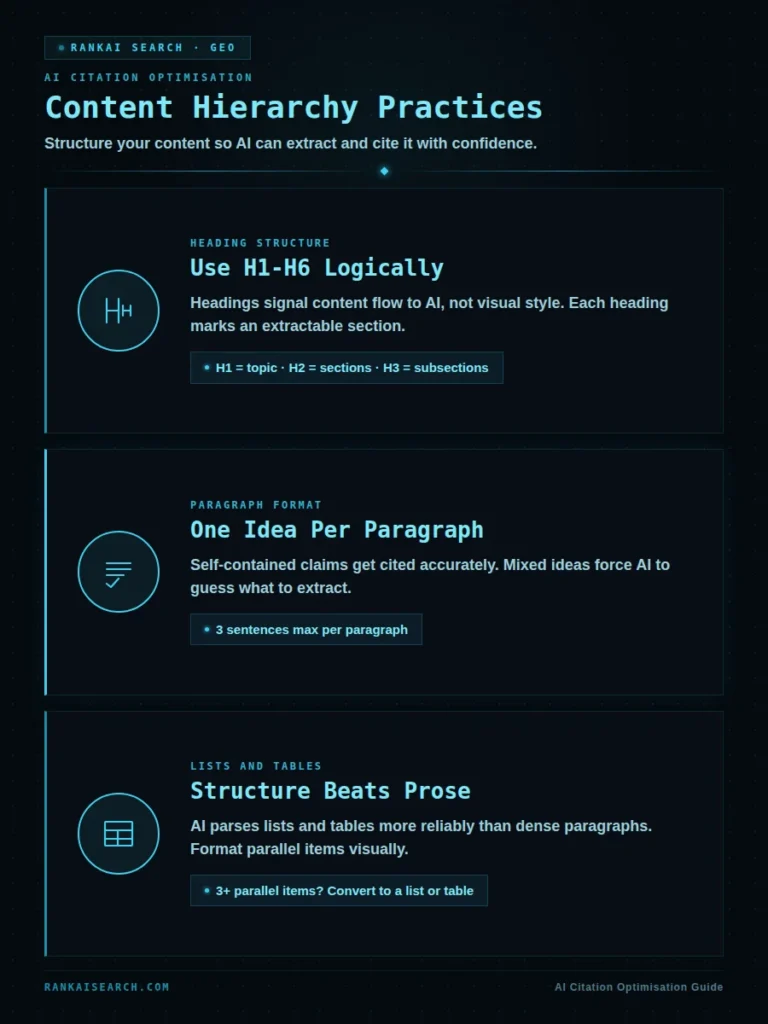
Using H1 through H6 tags as a logical content hierarchy, not for visual styling, allows AI models to understand information flow and extract relevant sections with confidence. Your H1 contains the primary topic. H2s mark major sections. H3s break down subsections within those sections.
Each section under an H2 or H3 should answer a specific question or explain a complete concept. This allows AI platforms to extract and cite individual sections without losing context from surrounding content.
How Should You Format Paragraphs for AI Extraction?
Keep every paragraph to 3 sentences maximum with one distinct idea per paragraph. AI systems identify extractable answers by locating self-contained claims. A paragraph covering three related points forces AI to choose which part to cite, which reduces citation accuracy.
Why Do Lists and Tables Improve AI Extraction?
Bullet lists and tables signal structured information that AI can parse reliably. A numbered list of steps, a comparison table, or a bulleted list of requirements is extracted more accurately than the same information written as dense prose. Convert any paragraph listing 3 or more parallel items into a list or table.
How Do Technical Performance Factors Affect AI Search Visibility?
Page speed, mobile compatibility, and JavaScript rendering directly affect whether AI crawlers can access and fully process your content. Technically inaccessible pages are deprioritized regardless of content quality.
| Technical Factor | AI Impact | Target Benchmark |
| Page load speed | Crawl efficiency and user experience scoring | Under 2.5 seconds |
| Mobile rendering | Priority in mobile-first indexing | Full functionality on smartphones |
| JavaScript rendering | Content accessibility for crawlers | Critical content in initial HTML |
| Duplicate content | Reduces citation confidence across versions | Canonical tags on all duplicates |
| Core Web Vitals | User experience signal to AI platforms and Google | LCP, CLS, INP within passing thresholds |
Server-side rendering or static site generation is preferable to client-side JavaScript rendering for AI visibility. If your critical content only appears after JavaScript execution, AI crawlers may index an empty or incomplete version of your page.
What Are Topic Clusters and Why Do AI Platforms Prioritize Them?
Topic clusters are groups of interlinked pages that collectively cover a subject in depth, anchored by a central pillar page. AI systems recognize this architecture as a signal of subject mastery, increasing citation likelihood across the entire cluster.
A pillar page covers a broad topic comprehensively and links to cluster pages that explore specific aspects in detail. Each cluster page links back to the pillar. This bidirectional structure creates a knowledge hub that AI models can map and confidently cite.
SE Ranking’s research on AI Overviews shows that content depth and topical breadth are among the strongest predictors of AI citation inclusion (Source: SE Ranking, 2024). Sites with isolated pages consistently underperform sites with organized topic clusters in AI-generated answer inclusion.
How Should You Structure FAQ Pages for AI Answer Engines?
FAQ pages structured with natural language questions as headings and concise direct answers beneath them are the highest-performing format for AI extraction and citation. Each question-answer pair functions as a standalone citable unit.
Write questions the way users actually phrase them to AI assistants: “How does website structure affect AI rankings?” rather than “Website Structure Impact.” This natural phrasing increases the probability that AI systems match your FAQ content to real user queries.
Voice search amplifies this requirement. Conversational, question-based queries are standard for voice assistants. Structure FAQ content to answer “how,” “what,” “why,” and “when” questions with the direct answer in the first sentence of every response.
How Do You Monitor and Maintain an AI-Friendly Site Structure?
Use Screaming Frog, Sitebulb, or Google Search Console to audit your site structure monthly for broken internal links, orphan pages, crawl depth issues, and missing schema markup. Catching structural issues early prevents compounding AI discoverability problems.
| Maintenance Task | Frequency | Recommended Tool |
| Broken internal link check | Monthly | Screaming Frog, Google Search Console |
| Orphan page identification | Monthly | Screaming Frog, Sitebulb |
| XML sitemap update | After each new content publish | Google Search Console |
| Schema validation | After CMS or template updates | Google Rich Results Test |
| Page speed review | Quarterly | PageSpeed Insights |
| Mobile compatibility check | After site updates | Google Mobile-Friendly Test |
Track which pages appear in AI-generated answers before and after structural changes. This before-and-after comparison is the most direct measure of whether your structural optimizations are producing AI visibility gains.
What Website Structure Mistakes Hurt AI Visibility Most?
The six most damaging structural errors for AI discoverability are each addressable with standard SEO and audit tools.
| Mistake | AI Impact | Fix |
| Orphan pages | AI crawlers may never discover them | Add contextual internal links from related pages |
| Excessive click depth (5+ clicks) | Signals low page importance to AI crawlers | Flatten hierarchy; link directly from hub pages |
| Overlapping categories | AI cannot map your topical expertise | Consolidate and clarify category scope |
| JavaScript-only navigation | Blocks crawler access to linked pages | Use standard HTML links for all navigation |
| Missing schema markup | AI must guess content type and structure | Implement Article, FAQ, HowTo, and BreadcrumbList schema |
| Duplicate URLs without canonicals | Reduces citation confidence across versions | Add canonical tags to all duplicate or near-duplicate URLs |
How Do You Future-Proof Your Site for Evolving AI Platforms?
Build flexible site architecture using modular design and headless CMS systems that separate content from presentation. This separation lets you serve content to new AI platforms in optimized formats without restructuring your entire site.
Multimodal AI search is the next major shift. Future AI platforms will process images, video, and text together. Prepare now by adding descriptive alt text, contextual captions, and schema markup to all media so every visual element has a textual anchor connecting it to surrounding content.
Monitor announcements from Google, OpenAI, and Perplexity for updates to their content indexing guidelines. AI platform requirements evolve faster than traditional SEO standards. Implement structural changes within weeks of new guidelines, not months.
Frequently Asked Questions
How does website structure affect AI search engine rankings?
Website structure affects AI rankings by signaling topical authority, content organization, and expertise depth. AI platforms use structural signals, including internal linking patterns, URL hierarchies, and schema markup, to determine which content is authoritative enough to cite.
What is the ideal click depth for AI crawler accessibility?
All important pages should be reachable within 3 clicks from the homepage. AI crawlers treat pages buried deeper in site hierarchies as lower priority. Strategic internal linking from hub and pillar pages is the primary method for keeping content within this threshold.
Should I restructure my entire website for AI optimization?
Full restructuring is only necessary if your site has fundamental organizational issues blocking AI comprehension. Run a crawl audit first to identify specific problems such as orphan pages, excessive click depth, or unclear category hierarchies. Fix high-impact issues incrementally before committing to a full rebuild.
How often should I audit my website structure for AI compatibility?
Audit your site quarterly for ongoing structural health. Conduct immediate audits after major content additions, redesigns, or CMS migrations. Monthly checks for broken links and orphan pages catch issues before they compound into larger visibility problems.
Can poor website architecture prevent content from appearing in AI answers?
Yes. If AI crawlers cannot access your content, verify its authority through structural signals, or understand its topical context, they will prioritize better-organized competitors. Structural problems directly reduce the probability of AI citation, not just traditional ranking.
What role does internal linking play in AI search optimization?
Internal linking creates semantic pathways that AI systems use to map content relationships and verify topical coverage. Contextual anchor text tells AI crawlers what a linked page contains before they visit it. Pages with no incoming internal links carry no structural authority signal regardless of content quality.
How do I test whether my website structure is AI-friendly?
Check that all important pages are accessible within 3 clicks, every page has at least one contextual internal link, URLs follow a clear hierarchical pattern, schema markup is validated, and categories are non-overlapping. Use Screaming Frog to identify structural gaps. Monitor whether your content appears in AI-generated answers as a live effectiveness measure.
Does site structure matter more for traditional SEO or AI search?
Site structure is equally important for both but serves different purposes. Traditional SEO uses structure for crawl efficiency and PageRank distribution. AI search uses structure for semantic understanding and authority verification. AI platforms place greater emphasis on topical organization and content depth than traditional SEO algorithms do.