


How to Choose an AI Search Optimization Agency in 2026
An AI answer can shape a buying decision before anyone visits your website. It can recommend a competitor, cite a third-party review, or repeat outdated information about your brand. The right AI search optimization agency helps improve how your company appears across AI answers, citations, and recommendations.
You need a partner with a clear measurement process. That means tracking prompts, platforms, mentions, citations, answer accuracy, referral traffic, and business outcomes. This guide explains how to evaluate an agency before you trust it with your AI search visibility.
How Do You Choose an AI Search Optimization Agency?
Choose an AI search optimization agency that can show proven citation results across multiple AI tools, explains how it measures AI visibility, and treats GEO as a discipline of its own rather than a relabeled SEO package. GEO means generative engine optimization, which improves visibility in AI-generated answers, so ask for case studies, a clear reporting process, and specifics on which platforms, including ChatGPT, Perplexity, Gemini, and AI Overviews, they actually track.
A strong agency should explain how AI systems retrieve sources, cite pages, mention brands, and shape recommendations. It should not sell AI search optimization as a mystery or a shortcut.
Google says its generative AI search guidance is rooted in Search fundamentals, and it warns that many supposed AEO or GEO “hacks” are not supported by how Google Search works. That makes the agency process more important than buzzwords. (Source: Google Search Central, 2026)
The best agency should connect AI visibility to content quality, source authority, technical access, entity clarity, and reporting. It should show where your brand appears, where competitors appear, and which sources AI systems use.
| Selection Factor | What To Look For | What To Avoid |
|---|---|---|
| Platform coverage | ChatGPT, Perplexity, Gemini, AI Overviews, AI Mode, Claude, Copilot | One-platform reporting only |
| Measurement | Mentions, citations, prompts, accuracy, referrals, conversions | Generic traffic reports |
| Proof | Before-and-after visibility data | Unverifiable screenshots |
| Strategy | Content, technical, entity, and authority work | Keyword stuffing for AI |
| Reporting | Clear prompt set and source tracking | Black-box dashboards |
| Ownership | You own content and data | Agency locks assets |
| Ethics | Clear limits and no guarantees | Guaranteed AI citations |
| Expertise | GEO, AEO, AIO, LLMO, and SEO understanding | Rebranded old SEO package |
What Should an AI Search Optimization Agency Be Able to Improve?
An AI search optimization agency should be able to improve AI mentions, citations, source visibility, answer accuracy, entity clarity, prompt coverage, AI referral traffic, and conversion paths. It should also improve the website foundations that help search and AI systems access useful content.
AI search optimization is not only about getting a brand name into an answer. It is about making the brand easier for AI systems to verify and easier for users to trust.
Ahrefs defines AI Visibility through metrics such as Mentions, Citations, Impressions, and AI Share of Voice in Brand Radar. These metrics show that AI search performance is broader than organic rankings and clicks. (Source: Ahrefs, 2026)
An agency should improve both visibility and correctness. A brand mention is weak if the AI answer gives the wrong service, outdated pricing, or a misleading comparison.
| Area To Improve | What It Means | Why It Matters |
|---|---|---|
| AI mentions | Brand appears in AI answers | Shows visibility |
| AI citations | Brand pages or third-party sources are cited | Shows source influence |
| Prompt coverage | Brand appears across relevant prompts | Shows topic reach |
| Answer accuracy | AI describes the brand correctly | Protects trust |
| Entity clarity | Brand facts are consistent online | Helps systems identify the brand |
| Source authority | Trusted pages support the brand | Improves credibility |
| AI referrals | AI tools send visitors to the site | Shows traffic value |
| Conversions | Visitors take business actions | Shows commercial impact |
A strong agency should also identify what cannot be controlled directly. AI systems can change answers, sources, and citation behavior, so the work must focus on improving signals rather than promising fixed placements.
What Evidence Should an Agency Provide Before You Hire It?
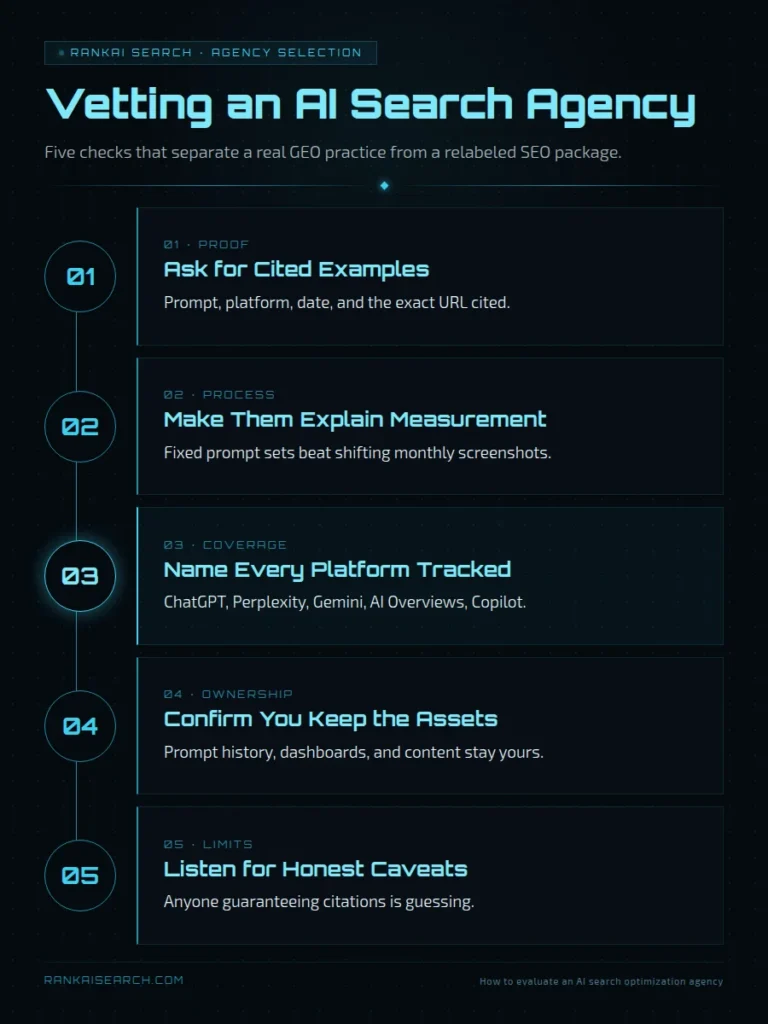
An agency should provide verifiable evidence that it can improve AI visibility, not only traditional SEO metrics. Ask for citation examples, tracked prompt sets, before-and-after reports, source improvements, and case studies with a clear starting point.
Evidence should show what changed and why. A claim like “we improved AI visibility” is not enough without prompts, dates, platforms, sources, and results.
The agency should separate proof from prediction. Past results can show process quality, but no agency can promise that every AI system will cite a specific page.
| Evidence Type | What It Should Show |
|---|---|
| Prompt tracking report | Which prompts were tested |
| Citation record | Which URLs AI systems cited |
| Before-and-after data | What changed over time |
| Competitor comparison | Which brands appeared instead |
| Source quality review | Which pages supported the answer |
| Content updates | What was changed on the site |
| Entity cleanup | Which brand facts were corrected |
| Referral traffic report | Whether AI tools sent visits |
| Conversion report | Whether visits created value |
Evidence should be specific enough to verify. Screenshots without dates, prompts, or platform labels are weak proof.
Verifiable Citation Results
Verifiable citation results show the exact AI tool, prompt, cited source, date, and answer context. A real citation result should be traceable, repeatable enough to inspect, and connected to a specific optimization action.
A citation screenshot should not stand alone. It should include the prompt used, the source URL cited, the answer position, and whether the cited page is owned, earned, or third-party.
| Citation Proof Item | Why It Matters |
|---|---|
| Prompt text | Shows what triggered the answer |
| AI platform | Identifies the system tested |
| Date | Controls for answer changes |
| Cited URL | Shows the source used |
| Brand mention | Shows visibility |
| Recommendation context | Shows whether the mention helped |
| Competitor presence | Shows the competitive field |
| Optimization action | Connects work to outcome |
Case Studies With Clear Starting Points
Case studies with clear starting points show whether the agency can improve a difficult situation. A useful case study begins with the baseline, not the success claim.
The strongest case studies show missing prompts, inaccurate AI descriptions, weak cited sources, poor entity consistency, or limited AI referral traffic before work began. They then show what changed after content, technical, authority, or reporting improvements.
| Case Study Element | Strong Version |
|---|---|
| Starting point | Baseline visibility before work |
| Goal | Defined prompt or platform target |
| Scope | What the agency actually did |
| Timeline | When actions and changes happened |
| Results | Mentions, citations, referrals, or conversions |
| Limitations | What did not change |
| Evidence | Prompts, URLs, and dates |
How Should the Agency Measure AI Search Performance?
The agency should measure AI search performance through prompt coverage, brand mentions, citations, cited URLs, answer accuracy, source quality, AI referral traffic, and conversions. Position tracking alone is not enough for AI search.
AI visibility can happen without a click. A user may see the brand inside an AI answer, compare it with competitors, and search directly later.
Semrush says AI search metrics can include Share of Voice, Mentions, Brand Visibility, Sentiment, and cited pages, depending on the toolkit and report. These metrics show why AI search reporting must go beyond rankings. (Source: Semrush, 2026)
The agency should report metrics by platform because each AI system behaves differently. ChatGPT, Perplexity, Gemini, AI Overviews, Claude, and Copilot can use different sources for similar questions.
Measurement should use a fixed prompt set. Changing every prompt every month makes the trend harder to trust.
Prompt Coverage and Competitive Visibility
Prompt coverage and competitive visibility show which questions trigger your brand, competitors, or no clear winner. These metrics reveal where the agency should create, improve, or promote content.
A strong report should group prompts by category, comparison, problem, use case, local intent, and buying stage. This helps separate awareness visibility from decision-stage visibility.
| Prompt Class | What To Track |
|---|---|
| Category prompts | Which brands define the category |
| Comparison prompts | Which brands are compared |
| Recommendation prompts | Which brands are suggested |
| Problem prompts | Which sources explain the issue |
| Use-case prompts | Which brands fit specific needs |
| Local prompts | Which businesses appear by location |
| Objection prompts | Which brands earn trust |
| Pricing prompts | Which sources explain cost |
Mentions, Citations, Accuracy, and Referral Traffic
Mentions, citations, accuracy, and referral traffic show the difference between being named and being useful. A brand can be mentioned but not cited, cited but misrepresented, or cited without receiving traffic.
A credible agency should connect AI visibility data with analytics data. AI referral traffic should be reviewed in GA4 when referrer data is available.
| Measurement Layer | Key Question |
|---|---|
| Mention | Did the brand appear? |
| Citation | Which URL supported the answer? |
| Accuracy | Was the answer correct? |
| Context | Was the brand recommended or only listed? |
| Referral | Did the AI tool send traffic? |
| Conversion | Did the visitor act? |
| Follow-up demand | Did branded search increase? |
Which AI Platforms Should the Agency Actively Track?
The agency should actively track ChatGPT, Perplexity, Gemini, Google AI Overviews, Google AI Mode, Claude, Copilot, and any industry-specific AI search surfaces relevant to the business. Platform coverage matters because each system can cite different sources.
A platform list should not be static. AI tools change features, search connections, citation displays, and source behavior often.
The agency should explain how it tests each platform. A manual screenshot process may work for a small prompt set, while a larger program needs structured tracking.
| Platform | Why It Should Be Tracked |
|---|---|
| ChatGPT | Major AI assistant with search citations |
| Perplexity | Citation-first answer engine |
| Gemini | Google ecosystem visibility |
| Google AI Overviews | AI answers inside Google Search |
| Google AI Mode | Conversational search behavior |
| Claude | Research and business use cases |
| Copilot | Microsoft and Bing-connected discovery |
| Industry tools | Niche recommendation surfaces |
A strong agency should also track the sources AI platforms cite. The cited source can reveal whether the brand needs better owned content, third-party coverage, review signals, or technical access.
How Can You Tell Whether Its GEO Service Goes Beyond Traditional SEO?
You can tell a GEO service goes beyond traditional SEO when it includes prompt tracking, citation audits, AI answer accuracy checks, entity cleanup, source influence analysis, and AI referral reporting. Traditional SEO remains important, but GEO adds answer-level measurement and source selection analysis.
A relabeled SEO package usually focuses only on keywords, rankings, backlinks, and blog content. A real GEO program also studies how AI systems summarize the brand and which sources they trust.
GEO should improve the evidence around the brand. That includes owned pages, third-party sources, reviews, profiles, structured facts, and expert content.
| Traditional SEO Task | GEO Extension |
|---|---|
| Keyword research | Prompt research |
| Ranking tracking | AI mention and citation tracking |
| Content optimization | Answer extraction optimization |
| Backlink building | Source authority and mention building |
| Technical SEO | AI crawler and retrieval access review |
| Content briefs | Prompt-to-page mapping |
| Competitor analysis | Competitive prompt visibility |
| Brand audit | Entity and answer accuracy audit |
GEO does not replace SEO. It builds on SEO and adds measurement for AI-generated answers.
What Should Be Included in the Agency’s Strategy and Deliverables?
The agency’s strategy should include an AI visibility audit, prompt research, competitor analysis, citation-source review, content plan, technical audit, entity cleanup, authority plan, reporting framework, and conversion review. The deliverables should explain what will be changed, measured, and owned.
A strong strategy should start with diagnosis. The agency needs to know where the brand appears, where it is missing, which competitors dominate, and which sources AI tools currently use.
The deliverables should connect to business goals. A brand that needs local leads, ecommerce sales, SaaS demos, or professional-service inquiries will need different prompt sets and pages.
| Deliverable | What It Should Include |
|---|---|
| AI visibility audit | Current mentions, citations, and competitor visibility |
| Prompt map | Priority prompts by category and intent |
| Citation audit | Sources AI tools already cite |
| Content plan | Pages to create, update, merge, or remove |
| Technical review | Crawlability, indexability, schema, and speed |
| Entity cleanup | Brand facts across owned and third-party sources |
| Authority plan | Digital PR, reviews, mentions, and backlinks |
| Reporting dashboard | Mentions, citations, prompts, referrals, and conversions |
| Conversion review | Landing pages and next-step paths |
The agency should define what is included and what is not included. Strategy without implementation can leave the business with a plan that never changes visibility.
How Should the Agency Research Prompts and Competitors?
The agency should research prompts and competitors by testing real questions across AI platforms, recording brand mentions, cited sources, answer context, recommendation order, and repeated competitor patterns. The best prompt research mirrors how people ask AI tools for help.
Prompt research is more specific than keyword research. It should include category questions, comparison prompts, local prompts, product prompts, use-case prompts, problem prompts, and trust questions.
Semrush Prompt Tracking lets users monitor custom prompts and review cited sources across platforms such as ChatGPT, Google AI Mode, and Gemini. This reflects the kind of repeatable prompt process an agency should be able to explain. (Source: Semrush, 2026)
Competitor research should separate brand visibility from source visibility. A competitor may appear because its website is cited, or because a review site, publication, forum, or directory supports it.
| Research Item | What The Agency Should Record |
|---|---|
| Prompt | Exact wording tested |
| Platform | AI tool or search surface |
| Date | When the test was run |
| Brands mentioned | Which competitors appear |
| Citation URLs | Which sources support the answer |
| Answer order | Which brand appears first |
| Recommendation context | Why a brand is recommended |
| Sentiment | Positive, neutral, or negative framing |
| Your brand status | Present, absent, cited, or misrepresented |
| Content gap | Missing source or weak page |
Prompt research should produce decisions. Each high-value gap should lead to a page update, new content asset, citation target, review push, or authority campaign.
Who Should Own the Content, Data, and Tracking Assets?
The business should own the content, data, prompt lists, tracking history, reports, dashboards, and source documentation created during the engagement. The agency can manage the work, but the business should retain the assets.
Ownership matters because AI visibility work builds long-term institutional knowledge. A business should not lose its prompt history, cited source list, or content documentation when a contract ends.
Google Analytics 4 reports can identify traffic source data, acquisition paths, and conversions, which makes analytics access part of the business’s measurement infrastructure. Ownership of analytics and reporting assets should stay with the business. (Source: Google Analytics Help, 2026)
Agencies should work inside business-owned accounts where possible. This includes GA4, Search Console, AI tracking tools, project documentation, dashboards, and content repositories.
| Asset | Recommended Owner |
|---|---|
| Website content | Business |
| Prompt library | Business |
| AI visibility history | Business |
| Analytics accounts | Business |
| Search Console property | Business |
| Dashboard | Business |
| Reporting exports | Business |
| Source list | Business |
| Content briefs | Business |
| Agency process templates | Agency |
Contracts should state ownership clearly. Asset control prevents reporting lock-in and protects continuity.
How Should You Compare Pricing, Scope, and Contract Terms?
You should compare pricing, scope, and contract terms by reviewing what work is included, how performance is measured, how long the agreement lasts, and who owns the assets. The cheapest agency can become expensive if it only delivers vague reports.
AI search optimization requires strategy, tracking, content work, technical review, entity cleanup, and authority building. A low price may exclude the implementation needed to change visibility.
A good proposal should separate setup, monthly tracking, content production, technical work, authority building, and reporting. This helps the business compare real scope instead of headline price.
| Contract Item | What To Check |
|---|---|
| Monthly fee | What work is included each month |
| Setup fee | Audit, tracking, and dashboard setup |
| Prompt volume | Number of prompts tracked |
| Platform coverage | Which AI tools are included |
| Content production | Pages, briefs, edits, and approvals |
| Technical work | Audit only or implementation support |
| Reporting | Dashboard, calls, exports, and insights |
| Contract length | Month-to-month, 3 months, 6 months, or annual |
| Exit terms | Data, content, and dashboard access |
| Add-on costs | Tools, PR, development, or content volume |
Price should match the difficulty of the goal. A competitive national category requires more work than a small local category.
Which Questions Should You Ask During the Discovery Call?
Ask questions that test proof, process, platform coverage, reporting, ownership, and implementation ability. A strong agency should answer with specifics, not broad promises.
The discovery call should reveal whether the agency understands AI visibility as a measurable discipline. It should also show whether the agency can explain risks and limits clearly.
Good questions make vague agencies easy to spot. Ask for examples, not only descriptions.
| Discovery Question | What a Strong Answer Includes |
|---|---|
| Which AI platforms do you track? | Specific platform list |
| How do you build prompt sets? | Intent, competitors, and buyer questions |
| What is your baseline process? | Current mentions, citations, and gaps |
| Can you show citation evidence? | Prompts, URLs, dates, and screenshots |
| How do you measure accuracy? | Brand fact checks and answer review |
| What content changes do you make? | Answer blocks, evidence, structure, pages |
| How do you handle third-party sources? | PR, reviews, profiles, and citations |
| Who owns the data? | Business-owned reports and exports |
| What cannot be guaranteed? | Clear limits on AI system control |
| How often do you report? | Defined cadence and dashboard access |
Ask the agency to explain one recent AI answer in your category. The explanation should identify the cited sources, competitor context, and possible gap.
What Warning Signs Should Make You Reject an Agency?
Reject an agency that guarantees AI citations, hides its measurement process, cannot name the platforms it tracks, relies only on generic SEO reports, or promises fast results without explaining the work. These warning signs show weak processes or unrealistic claims.
AI systems are not controlled by agencies. A credible agency can improve signals, sources, content, and measurement, but it cannot force every AI answer to cite a page.
Be cautious when an agency sells one tactic as the whole strategy. AI visibility usually requires content, authority, technical access, entity clarity, and measurement.
| Warning Sign | Why It Matters |
|---|---|
| Guaranteed AI citations | AI systems cannot be controlled directly |
| No prompt list | Results cannot be tracked |
| No citation URLs | Source influence is hidden |
| One-tool reporting | Platform behavior is incomplete |
| Vague dashboard | Metrics may not support decisions |
| Rebranded SEO package | GEO work may be missing |
| No content plan | Visibility gaps remain unfixed |
| No technical review | AI and search access may be blocked |
| No ownership terms | Assets may be locked |
| No limitation statement | Expectations may be unrealistic |
A good agency should be transparent about uncertainty. Transparency is a strength, not a weakness.
Key Factors for Evaluating AI Search Optimization Agencies
You should remember that the best AI search optimization agency can prove how it measures, improves, and reports AI visibility across multiple platforms. The agency should improve the sources and signals AI systems use, not only the website’s keyword rankings.
AI search optimization is now a business visibility function. It affects how a brand appears in recommendations, comparisons, summaries, and cited answers.
| Selection Principle | Practical Rule |
|---|---|
| Proof matters | Ask for prompt, platform, citation, and date |
| Measurement matters | Track mentions, citations, accuracy, and referrals |
| Platform coverage matters | Include major AI and search systems |
| Ownership matters | Keep your content and data |
| Strategy matters | Connect content, authority, technical, and entity work |
| Transparency matters | Reject guarantees and black boxes |
| Business value matters | Track leads, sales, and conversion paths |
A strong agency should help you understand what AI systems say about your brand today. It should also show how to improve the sources that shape those answers.
Ready to Find an Agency That Can Improve Your AI Visibility?
Choosing the right AI search optimization agency requires more than reviewing promises or traditional SEO results. Look for transparent prompt tracking, verifiable citation evidence, multi-platform reporting, clear asset ownership, and a strategy that connects content, technical access, authority, entity clarity, and conversions.
RankAISearch offers a measurable approach focused on how your brand appears across AI-generated answers, citations, comparisons, and recommendations. The process identifies visibility gaps, inaccurate information, competitor advantages, and the sources influencing how AI platforms describe your business.
Schedule a consultation with RankAISearch to assess your current AI visibility and explore a practical strategy built around measurable progress rather than vague guarantees.
Frequently Asked Questions About AI Search Optimization Agencies
What does an AI search optimization agency do?
An AI search optimization agency improves how a brand appears in AI-generated answers, search summaries, citations, and recommendations. It audits prompts, cited sources, brand mentions, answer accuracy, content gaps, and competitor visibility. The work can include content updates, technical SEO, entity cleanup, digital PR, review strategy, structured content, and AI visibility reporting. The goal is to improve the signals AI systems use when forming answers.
How is an AI search optimization agency different from an SEO agency?
An AI search optimization agency adds prompt tracking, citation analysis, answer accuracy checks, and AI source visibility to traditional SEO work. A traditional SEO agency may focus mainly on rankings, keywords, backlinks, and organic traffic. The two disciplines overlap. A strong AI search agency should still understand technical SEO, content quality, authority, and analytics.
Which AI platforms should an agency include in its reporting?
An agency should include ChatGPT, Perplexity, Gemini, Google AI Overviews, Google AI Mode, Claude, Copilot, and any important industry-specific AI tools. The exact list should match where your buyers ask questions. The report should separate results by platform. One AI system can cite your brand while another ignores it.
What results should an agency be able to prove?
An agency should be able to prove changes in brand mentions, citations, cited URLs, prompt coverage, answer accuracy, competitor visibility, AI referrals, and conversions where data is available. Proof should include prompts, dates, platforms, and source URLs. The agency should also show what work contributed to the change. A result without a timeline or action record is hard to trust.
How long does AI search optimization take to show results?
AI search optimization often takes weeks to months to show measurable movement. The timeline depends on content quality, source authority, platform behavior, crawl access, and competitor strength. Fast changes can happen when errors are corrected or a strong source already exists. Hard categories usually need repeated content, authority, and entity improvements.
How much does an AI search optimization agency cost?
An AI search optimization agency can cost more than basic SEO when it includes prompt tracking, multi-platform reporting, content work, technical review, and authority building. Pricing should be judged by scope, not only the monthly fee. A low-cost package may only include reporting. A higher-scope engagement should include analysis, implementation, measurement, and strategy.
Can an agency guarantee citations in AI answers?
No, an agency cannot honestly guarantee citations in AI answers. AI platforms control retrieval, answer generation, source selection, and citation display. A credible agency can improve the chance of citations. It can do that by improving content clarity, source authority, technical access, entity consistency, and third-party validation.
Should you hire a specialist agency or build an internal team?
Hire a specialist agency when you need faster expertise, multi-platform tracking, competitive analysis, and a structured AI visibility process. Build an internal team when you have the people, tools, and time to manage ongoing testing and implementation. A hybrid model often works well. The agency can build the system, and the internal team can maintain content, approvals, and subject-matter accuracy.