


How to Leverage Competitor Gap Analysis for AI Search Dominance
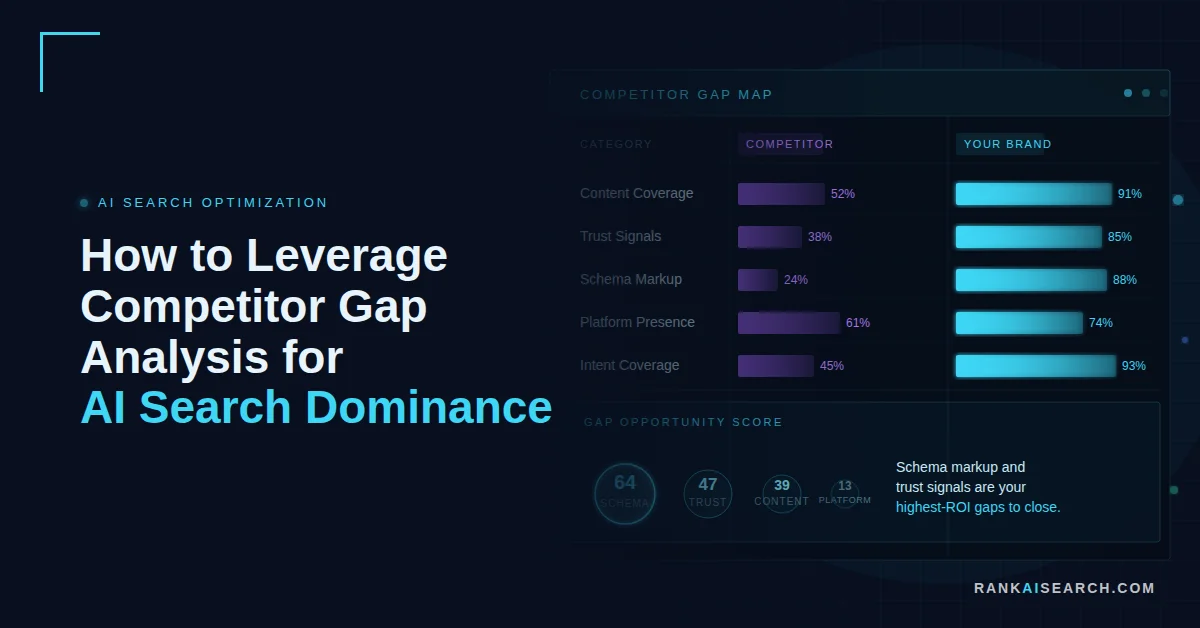
A potential customer asks Perplexity which accounting software their business should use, and two of your competitors appear in the response. That gap is not random. It reflects specific deficiencies in your content, credibility signals, and technical structure that the platform has already compared and resolved in their favor. Competitor gap analysis for AI search is the process of identifying exactly where those deficiencies exist so you can close them and claim your place in the answer.
This guide covers how to find your real AI search competitors, map content and trust signal gaps, analyze technical weaknesses across platforms, and build a prioritized roadmap that compounds into sustained answer engine visibility.
What Is Competitor Gap Analysis in AI Search Optimization?
Competitor gap analysis in AI search optimization is the process of identifying where competitors succeed and fail at earning citations from answer engines, then using those findings to capture the opportunities they leave open.
Answer Engine Optimization (AEO) is the discipline of structuring content so that platforms like ChatGPT, Google AI Overviews, and Perplexity can extract, trust, and recommend it. Gap analysis is what makes AEO actionable: it tells you precisely where to invest so your content earns citations competitors are currently collecting.
| Traditional SEO Analysis | AI Search Gap Analysis |
| Tracks keyword ranking positions | Tracks citation frequency and recommendation context |
| Measures backlink volume | Measures authority depth and credibility signals |
| Focuses on page-level authority | Focuses on content completeness and structure |
| Targets search engine crawlers | Targets AI extraction and synthesis systems |
| Success = higher SERP ranking | Success = more AI platform citations |
Three distinct gap types determine whether your brand earns AI citations or cedes them to a competitor:
- Content gaps: Topics, subtopics, and questions competitors cover superficially or skip entirely
- Trust signal gaps: Missing credibility markers such as expert authorship, original research, and cited data
- Technical gaps: Absent schema markup, weak entity definitions, and poorly formatted content
Gap analysis in AI search is not about outranking competitors. It is about out-answering them so thoroughly that AI systems default to citing your brand.
Why Does Competitor Gap Analysis Matter for Answer Engine Success?
Competitor gap analysis matters because answer engines compare all available sources before generating a response and cite the most authoritative, complete one. Every gap a competitor leaves open is a direct opportunity to claim that citation.
Content gaps directly affect AI recommendation behavior. When competitors provide surface-level answers and you provide structured, expert-validated content, platforms like ChatGPT and Perplexity recognize the difference.
| Gap Category | Why It Affects AI Citations | Optimization Action |
| Content coverage | Answer engines reward comprehensive, question-specific responses | Cover subtopics and edge cases competitors skip |
| Trust signals | Credibility markers influence which sources get cited | Add expert authorship, original research, and cited data |
| Structured data | Schema enables AI to extract and contextualize content reliably | Implement FAQ, How-To, and Organization markup |
| Content format | Scannable structures yield higher AI extraction rates | Use Q&A pairs, tables, and bullet lists |
| Platform presence | Visibility varies significantly across answer engines | Build authority on the platforms competitors ignore |
Understanding competitor weaknesses also reveals whether to invest in content creation, technical implementation, or authority building. Each gap type demands a different solution.
How Do You Identify Your AI Search Competitors?
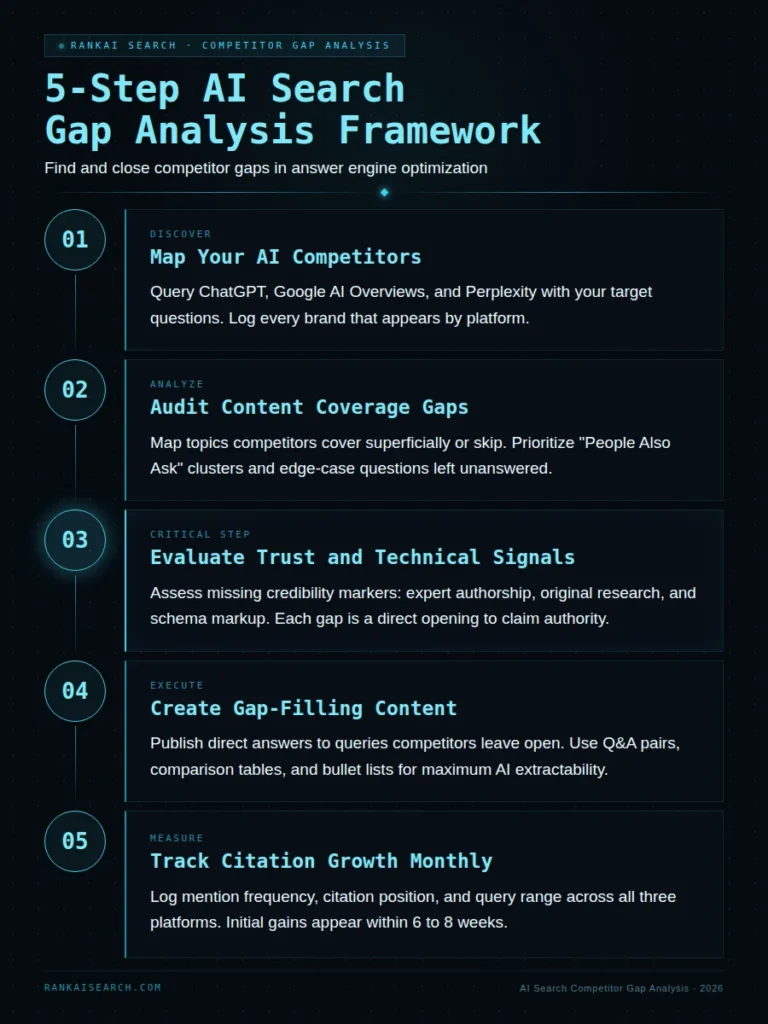
Your AI search competitors are the brands that appear in answer engine responses for your target queries, not necessarily the brands that rank alongside you in traditional search. Query ChatGPT, Google AI Overviews, and Perplexity with the questions your audience asks, then document every brand that appears.
A brand that barely appears in organic search results may dominate AI recommendations because its content is structured for machine extraction. Document platform-specific patterns separately since visibility on one platform does not predict visibility on another.
Three methods to discover competitor visibility patterns:
- Query answer engines with natural language versions of your target questions and log every brand cited, noting whether each appears as a primary recommendation or alongside many others
- Track adjacent brands that answer related questions for a slightly different audience, since answer engines group related queries and reward brands that address multiple facets of user intent
- Repeat the same queries monthly to catch emerging competitors who build AI visibility quickly even without established domain authority
How Do You Conduct an Effective AI Search Gap Analysis?
An effective AI search gap analysis maps three dimensions simultaneously: content coverage, trust signals, and technical implementation. Each dimension surfaces a different layer of competitor weakness and a different category of concrete opportunity.
What Content Gaps Should You Prioritize?
Prioritize content gaps where competitors answer only the top-level question while ignoring the follow-up questions users predictably ask next. These gaps give answer engines the clearest reason to choose a more thorough source.
Build a content inventory mapping which subjects competitors address deeply and which they treat superficially. Tools like AlsoAsked surface related question clusters that competitors miss entirely.
High-value content gap targets:
- “People Also Ask” questions that competitors do not answer on dedicated pages
- Specific use-case variations nested inside broad topics competitors nominally own
- Conversational phrasing patterns, such as “what happens if” or “do I need,” that reflect intent competitors have not addressed with direct answers
- Comparison queries where competitors provide only vague or one-sided responses
How Do You Evaluate Trust Signal Gaps?
Trust signal gaps exist where competitors make claims without expert validation, current data, or credibility markers that answer engines use to assess source authority. Each missing signal creates an opening for your brand to demonstrate stronger authority.
Assess where competitors earn citations and backlinks. When they lack links from authoritative industry publications or peer-reviewed research, your sourced content can fill that authority gap. (Source: Google Search Quality Evaluator Guidelines, 2024)
Missing trust signals that create competitive openings:
- No named expert authorship on key topic pages
- No original data, proprietary research, or primary case studies
- Statistics that are outdated or cited without a named source
- No visible industry certifications, awards, or third-party validations
- No transparent methodology sections on research-based content
What Structured Data and Technical Gaps Should You Fix?
Structured data gaps limit how accurately answer engines can parse, categorize, and cite your content. Review competitor websites for missing schema types, then implement what they lack.
Competitors who fail to define relationships between concepts, brands, and topics make their content harder for AI systems to contextualize accurately. Formatted information in tables, definition blocks, and numbered lists is extracted and cited more reliably than dense prose.
Schema types most commonly absent from competitor sites:
- FAQ schema on question-and-answer content
- How-To schema on instructional content
- Organization schema linking brand identity to core topic areas
- Article schema with explicit author and date attributes
How Do You Uncover Keyword and Intent Gaps in AI Search?
Keyword and intent gaps in AI search appear in conversational query variations that competitors have not addressed with structured, dedicated content. These are the phrasing patterns that match how users speak to answer engines but return thin or generic responses.
Run natural language versions of your target queries and note which produce vague answers from any source. Phrases like “what happens if I don’t” or “which is better for” frequently surface gaps where no brand has provided a direct, structured response. Answer engines reward brands that address the full intent spectrum for a topic, not just the most common phrasing.
High-opportunity intent types competitors commonly miss:
- Decision-stage queries that compare two specific solutions directly
- Post-adoption queries in the same category, such as troubleshooting and optimization
- Niche use-case queries nested inside broader topics competitors nominally cover
- Doubt-signal phrasing such as “is it worth it” or “should I bother” that indicates a user weighing a decision
How Does Content Format Affect AI Extraction Success?
Content format directly determines how easily answer engines extract and cite your content. Competitors using long unbroken paragraphs, vague headings, or buried answers lose citation opportunities to sources that present information in formats AI platforms can parse instantly.
Question-and-answer pairs and dedicated FAQ sections make content highly extractable. When competitors lack FAQ sections or do not organize content around specific questions, those query spaces remain open for a source that does. AI platforms extract and present structured information, such as lists and tables, more reliably than narrative paragraphs. (Source: Semrush: State of Search 2024)
Structural weaknesses in competitor content that create citation opportunities:
- Answers buried after lengthy context rather than stated in the opening sentence
- Section headings that describe broad topics rather than specific user questions
- No comparison tables for topics where users are evaluating options
- No FAQ section on pages that attract question-type queries
- Dense narrative text without bullets, tables, or defined answer blocks
How Do Competitor Gaps Differ Across AI Platforms?
Competitor visibility varies significantly by platform, and a brand that dominates Google AI Overviews may be nearly invisible in Perplexity responses. Test your key queries across all three major platforms separately and document the platform-specific patterns.
| Platform | Primary Criteria | Gap Opportunity |
| Google AI Overviews | Established domain authority, E-E-A-T signals, schema markup | Trust signals and structured data |
| ChatGPT | Conversational clarity, practical examples, instructional structure | Q&A format and how-to content |
| Perplexity | Recent information, transparent sourcing, explicit citations | Updated statistics and cited references |
A competitor who has optimized heavily for Google AI Overviews while ignoring Perplexity creates a clear opening on the faster-growing platform. Early authority on a growing platform compounds as its user base expands.
How Do You Turn Competitor Weaknesses into AI Search Opportunities?
Turn competitor weaknesses into citation opportunities by creating content that directly fills the identified gaps. The goal is not more content, but more complete, better-structured, and more credibly sourced content on the exact topics competitors have left underserved.
Develop stronger entity relationships by linking related concepts clearly, defining industry terms precisely, and establishing your brand’s explicit association with key topics. When answer engines understand your brand’s connection to a subject better than a competitor’s, they cite yours more often.
Content types that close competitor gaps most effectively:
- Comprehensive guides that answer the primary question and the three most predictable follow-up questions on a single page
- Comparison content that addresses decision-stage queries competitors handle vaguely or one-sidedly
- Original research or proprietary data that no competitor can replicate
- Structured FAQ sections targeting question clusters competitors have not addressed with dedicated pages
What Tools Support Continuous AI Competitor Monitoring?
Continuous AI competitor monitoring relies on manual testing protocols combined with emerging tracking tools, since no single platform yet covers all answer engines comprehensively. Combining methods provides the most complete competitive intelligence.
Manual testing remains the most reliable baseline. Query the same target questions across all three platforms weekly, logging which brands appear, in what position, and whether each citation is primary or secondary.
Monitoring approaches by scale and method:
- Weekly manual testing: Log brand appearance, position, and citation context in a tracking spreadsheet for the same set of target queries each week
- Brand mention alerts: Automated notifications for competitor brand mentions across web platforms provide early signals of new entrants building AI visibility
- API-based querying: Where platforms allow API access, systematic query testing scales monitoring without proportionally scaling manual effort
- Competitive dashboards: Visual tracking of mention frequency, platform-specific visibility, and citation context makes trends easier to identify and act on
How Do You Prioritize Gap Opportunities for Maximum AI Visibility Impact?
Prioritize gap opportunities by evaluating query reach, competitive difficulty, and alignment with your genuine expertise. Gaps in high-volume categories where you have authentic expertise and real evidence consistently outperform broad topic plays outside your knowledge base.
Balance opportunity size against the resource cost of closing each gap. Some gaps require a single well-structured page. Others require original research, technical schema work, or sustained external credibility building.
| Priority Tier | Criteria | Action |
| High | High query volume + competitor weakness + your genuine expertise | Publish comprehensive, fully sourced content immediately |
| Medium | Moderate volume + niche use case competitors have ignored | Build supporting content to establish topical authority |
| Low | Low volume + peripheral to core offering | Monitor; address after higher-priority gaps are closed |
What Mistakes Do Brands Make in AI Search Competitor Analysis?
The most common mistake is applying traditional SEO metrics: domain authority, ranking position, and page authority. These metrics matter far less than citation frequency and recommendation context in answer engine environments.
Three additional mistakes compound this error:
- Ignoring emerging competitors: New brands with strong AEO strategies can build answer engine visibility quickly without established domain authority. Monitor newcomers who appear frequently in AI responses, as their tactics often reveal optimization approaches established brands have missed.
- Single-platform analysis: A competitor may dominate Google AI Overviews while being invisible on ChatGPT. Limiting analysis to one platform creates significant blind spots that distort competitive priorities.
- Treating gap analysis as a one-time project: The AI search environment changes faster than traditional search. Quarterly comprehensive reviews combined with monthly monitoring of core queries keep strategy current and surface new gaps as they open.
How Do You Measure Success After Implementing Gap-Based Strategies?
Measure success by tracking AI platform mention frequency, citation context, and the breadth of query categories where your brand appears. Establish a baseline before implementing any changes so improvements remain attributable to specific actions.
Initial visibility improvements typically appear within 6 to 8 weeks after publishing gap-filling content. Consistent citation growth across a broad range of query categories usually develops within 4 to 6 months. (Source: SE Ranking: Google AI Overviews Study, 2024)
| Metric | What It Measures | How to Track |
| Mention frequency | How often your brand appears per query category | Weekly manual query logs across all three platforms |
| Citation position | Whether your brand is cited as a primary or secondary source | Manual testing with position notation per query |
| Query range | How many distinct query categories return your brand | Monthly count of unique queries producing brand citations |
| Platform spread | Comparative visibility across Google AI Overviews, ChatGPT, Perplexity | Platform-specific query logs tracked separately |
Frequently Asked Questions About Competitor Gap Analysis for AI Search
How often should I conduct competitor gap analysis for AI search optimization?
Conduct a comprehensive gap analysis quarterly to track major shifts in competitor strategies and answer engine behavior. Run lighter monthly checks on your core queries to catch emerging competitors early and identify new gaps as they open.
Which AI platforms should I prioritize when analyzing competitor gaps?
Prioritize Google AI Overviews for reach, then ChatGPT and Perplexity for users who are actively seeking recommendations. Expand to industry-specific AI tools once you have traction on these three.
Can small businesses compete with larger brands through gap analysis in AI search?
Small businesses compete effectively by targeting specific gaps larger brands ignore. Big brands produce broad content but miss niche use cases, and addressing those thoroughly makes you the default authority in those areas. Answer engines evaluate content quality and completeness, not company size.
What tools are best for identifying content gaps in answer engine optimization?
AlsoAsked and AnswerThePublic surface question clusters competitors miss. Combine these with direct answer engine querying and a tracking spreadsheet for the most complete and consistent picture.
How do I know which competitor gaps are worth pursuing for AI visibility?
Focus on gaps that align with your genuine expertise and carry meaningful query volume. Authentic knowledge and unique evidence outperform high-volume topics you cannot answer credibly.
Does competitor gap analysis work differently for B2B versus B2C in AI search?
B2B analysis prioritizes technical depth and decision-making frameworks; B2C focuses on comparison content and practical how-to answers. The methodology is the same; what changes is content depth and format.
How long does it take to see results from gap-based AI optimization strategies?
Initial improvements appear within 6 to 8 weeks and consistent citation growth across multiple query categories develops within 4 to 6 months. Timeline depends on content quality and how thoroughly the gaps are addressed.
What is the difference between AI search gap analysis and traditional keyword gap analysis?
Traditional keyword gap analysis identifies ranking terms you are missing; AI search gap analysis identifies topics, questions, and trust signals that earn AI citations. Keyword gaps need optimized pages; AI search gaps need authoritative, well-structured content answer engines can extract and recommend.