

How to Fix Wrong Information AI Gives About Your Brand
A client asks an AI tool about your brand and gets the wrong answer. The response may show an old service, an outdated location, or a claim your company never made. Wrong AI information matters because it can shape trust before the buyer reaches your website.
The fix starts with the sources behind the answer. Your website, profiles, citations, and third-party pages must all support the correct version of your brand. This guide explains how to find the source of AI errors and correct the information AI systems rely on.
How Do You Fix Wrong AI Information About Your Brand?
To fix wrong information AI gives about your brand, correct the underlying sources: update your own site, strengthen authoritative third-party pages, fix inconsistent entity profiles, and publish clear factual content. AI models update as the credible web around your brand improves.
AI brand errors rarely come from one place. They usually come from outdated pages, conflicting profiles, old press mentions, scraped directories, missing source-of-truth pages, or weak entity signals.
The practical fix is to improve the evidence AI systems can retrieve. Your brand needs public pages that state the correct facts clearly and trusted external sources that support those same facts.
| Fix Area | What To Correct | Why It Matters |
| Official website | Brand facts, services, pricing, leadership, locations | Gives AI systems a primary source |
| Third-party profiles | Directories, review sites, partner pages, social bios | Reduces conflicting public records |
| AI citations | Pages used in AI answers | Shows where the error may come from |
| Structured data | Organization, Person, Product, Service schema | Clarifies machine-readable facts |
| Content evidence | Case studies, FAQs, documentation, correction pages | Supports the accurate version |
| Monitoring | Repeated AI prompt tests | Confirms whether the error changes |
Why Does AI Give Incorrect or Outdated Brand Information?
AI gives incorrect or outdated brand information because it may rely on old, incomplete, conflicting, or low-quality sources. It can also generate a plausible answer when it lacks enough reliable context.
OpenAI states that ChatGPT can get facts wrong because of issues such as knowledge cutoffs, lack of access to current websites, technical barriers, paywalls, or robots.txt preferences. That explanation shows why brands must maintain clear and accessible source information. (Source: OpenAI Help Center, 2026)
AI systems do not always know which version of your brand is current. If one directory lists an old address and your website lists a new one, the model may repeat the wrong version or blend both.
Conflicting Source Information
Conflicting source information means different public pages describe your brand in different ways. AI systems may treat those sources as competing evidence.
The strongest correction strategy is consistency. Your official website, social profiles, review platforms, directories, press pages, and partner pages should repeat the same core facts.
| Conflict Type | Example |
| Brand name conflict | One profile uses an old company name |
| Service conflict | A directory lists services you no longer offer |
| Location conflict | Google shows one address and a directory shows another |
| People conflict | Old articles name a former founder or executive |
| Pricing conflict | A comparison site lists outdated pricing |
| Category conflict | One source calls the company a software tool and another calls it an agency |
Missing Context and Outdated Records
Missing context happens when AI systems find a fact without the explanation needed to interpret it correctly. An old product page, archived announcement, or outdated comparison can still appear authoritative if no current source corrects it.
Outdated records become more damaging when they are still indexed and linked. AI tools can surface old facts if those facts appear on trusted pages, even after your business has moved on.
Common outdated records include:
- Old About pages
- Former pricing pages
- Retired product pages
- Old press releases
- Outdated directories
- Archived review profiles
- Former staff bios
- Historical comparison articles
How Can You Identify Where the Wrong Information Comes From?
You identify the source of wrong AI information by checking the AI answer, its citations, the search results for the same claim, and the public profiles that repeat the error. The goal is to find the source page or source pattern that teaches AI systems the wrong fact.
Anthropic advises users to review Claude’s cited sources because answer quality depends on the underlying sources and the original pages may contain context that the summary omits. That advice also applies to brand owners tracing incorrect AI answers. (Source: Anthropic Help Center, 2026)
The source may not be the page the AI cites directly. It may come from a search result snippet, a third-party profile, an old article, an index entry, or another page that shares the same inaccurate fact.
AI Citations and Referenced Pages
AI citations and referenced pages are the first places to check because they show which sources the system used or displayed. A citation does not always prove every claim came from that page, but it gives you a starting point.
Review each cited page for the exact wrong fact. Check the page text, metadata, schema markup, author bio, publish date, update date, and comments where relevant.
| What To Check | Why It Matters |
| Cited URL | Shows the visible source |
| Page title | May contain outdated wording |
| Body copy | May repeat the wrong fact |
| Structured data | May expose old machine-readable facts |
| Snippet text | May summarize outdated information |
| Publish date | Shows age of source |
| Update date | Shows maintenance |
| Internal links | May point to old pages |
Search Results and Brand Profiles
Search results and brand profiles show how the wider web describes your business. AI systems often rely on public sources that appear in search, directories, social profiles, review platforms, and knowledge panels.
Run searches for the exact wrong phrase. If the same incorrect detail appears across multiple profiles, you have an entity consistency problem rather than a single-page problem.
Check these sources:
- Google Search results
- Bing Search results
- Google Business Profile
- LinkedIn company page
- Crunchbase or directory pages
- Review platforms
- Partner pages
- Press mentions
- Old PDFs
- Social media bios
Which Brand Facts Should You Correct First?
You should correct the brand facts that affect trust, buying decisions, legal accuracy, and customer action first. Wrong services, pricing, locations, contact details, ownership, product availability, and compliance claims should outrank minor wording issues.
Prioritization matters because AI errors can appear in many places at once. Fixing the most commercially important facts first reduces customer confusion faster.
Google says it may update Business Profile information from sources such as user reports and licensed content when profile information appears incorrect or outdated. This shows why local and business-profile facts need active maintenance. (Source: Google Business Profile Help, 2026)
| Priority Level | Brand Fact | Why It Comes First |
| Critical | Name, website, phone, address | Directly affects customer action |
| Critical | Services and products | Affects buying decisions |
| Critical | Pricing and availability | Can create false expectations |
| High | Leadership and ownership | Affects trust and accountability |
| High | Locations served | Affects local and regional relevance |
| High | Compliance claims | Can create legal risk |
| Medium | Brand positioning | Affects comparison accuracy |
| Medium | Historical milestones | Affects background accuracy |
Correct facts in this order:
- Customer-facing contact facts
- Commercial offer facts
- Trust and ownership facts
- Profile and directory facts
- Historical or descriptive facts
How Do You Make Your Website the Clearest Source of Truth?
You make your website the clearest source of truth by publishing accurate brand facts in structured, visible, and easy-to-cite pages. Your website should be the strongest source for who you are, what you do, where you operate, and how customers can verify the facts.
Your official website should not bury key facts in vague marketing copy. AI systems need clean brand statements, clear page titles, consistent service names, updated dates, and linked supporting pages.
The source-of-truth page should be easy for both users and machines to understand. It should combine visible copy, internal links, schema, and updated information.
Official Brand Information Pages
Official brand information pages define the facts AI systems should use. These pages include your homepage, About page, contact page, service pages, product pages, author pages, and press page.
Each page should answer one important brand question. The About page should explain who the company is, while service pages should explain what the company offers.
| Page | Source-of-Truth Role |
| Homepage | Defines the brand and category |
| About page | Explains company identity and ownership |
| Contact page | Confirms contact details and locations |
| Service pages | Defines current offers |
| Product pages | Defines product details and availability |
| Author pages | Connects expertise to people |
| Press page | Gives media-ready facts |
| FAQ page | Answers common brand questions |
Clear Corrections and Update Dates
Clear corrections and update dates show that your website is actively maintained. They also help users and search systems understand which version of a fact is current.
When an old fact is widely repeated, publish a clear current statement rather than hiding the change. A sentence such as “As of 2026, [Brand] no longer offers [service]” can reduce ambiguity.
Use these correction elements:
- Updated date
- Current service list
- Current pricing statement where relevant
- Current location or service area
- Old fact clarified in plain language
- Internal links to current pages
- Schema updated to match visible text
How Can You Fix Incorrect Information on Third-Party Websites?
You can fix incorrect third-party information by updating profiles you control, requesting edits on pages you do not control, and replacing weak external evidence with stronger current sources. AI systems often trust third-party pages, so owned website corrections may not be enough.
Third-party pages can include directories, review sites, news articles, partner pages, marketplaces, social profiles, association pages, podcasts, and comparison posts. These sources can keep wrong facts alive long after your own website is corrected.
Start with sources that AI tools already cite or sources that rank for your brand name. These pages are more likely to influence AI-generated answers than obscure pages with no visibility.
| Third-Party Source | Correction Method |
| Directory listing | Claim profile and update fields |
| Review platform | Edit business details |
| Partner page | Ask partner to update description |
| Old article | Request correction or add update note |
| Marketplace profile | Update product or company details |
| Social profile | Update bio, URL, services, and location |
| Podcast page | Request show note correction |
| Comparison article | Provide current facts and source links |
A correction request should be short and factual. Include the wrong statement, the correct statement, the official source URL, and the reason the correction matters.
How Do You Resolve Conflicting Brand Profiles Across the Web?
You resolve conflicting brand profiles by standardizing your name, domain, description, services, leadership, locations, and social links across every public profile. The goal is to make the correct brand entity consistent wherever AI systems find it.
A brand entity is the structured identity of a business as search and AI systems understand it. Conflicting profiles weaken entity confidence because they make the business harder to identify and describe.
Profile cleanup should follow one master source. The master source should be your official website or an internal brand fact sheet that reflects the current business.
| Profile Field | What To Standardize |
| Brand name | Same spelling and capitalization |
| Domain | Same canonical URL |
| Description | Same business category |
| Services | Same current service list |
| Location | Same address or service area |
| Leadership | Same founder or executive facts |
| Logo | Same current brand mark |
| Social links | Same official profile URLs |
What Evidence Should You Publish to Support the Correct Information?
You should publish evidence that proves the correct brand facts, including official pages, documentation, case studies, FAQs, press pages, structured data, and current examples. AI systems need enough support to choose the corrected version over outdated or conflicting sources.
Google’s helpful content guidance says trust is the central part of E-E-A-T, while experience, expertise, and authoritativeness contribute to that trust. This supports the need for transparent, useful, and verifiable brand content. (Source: Google Search Central, 2026)
Evidence should match the claim. A service claim needs a service page, a pricing claim needs a pricing or policy page, and an expertise claim needs author, client, or case-study proof.
| Incorrect AI Claim | Evidence To Publish |
| Wrong service list | Updated service page and FAQ |
| Wrong founder | About page and leadership profile |
| Wrong location | Contact page and business profile |
| Wrong pricing | Pricing page or current policy page |
| Wrong product status | Product page and release note |
| Wrong audience | Service page and case studies |
| Wrong expertise | Author page and published examples |
Strong evidence formats include:
- Official brand fact page
- Updated About page
- Service documentation
- Product documentation
- Case studies
- Press kit
- Author pages
- FAQs
- Public changelog
- Structured data
How Can You Request Corrections From AI Platforms?
You can request corrections from AI platforms by using their feedback, report, or support flows, but source correction should still come first. AI platforms can review feedback, but they usually cannot treat your message as the only source of truth for public brand facts.
OpenAI says users can report content in ChatGPT by using the thumbs-down option under a message and following the prompts. Reported domains may be reviewed by OpenAI’s Model Quality team. (Source: OpenAI Help Center, 2026)
A correction request should include the exact wrong answer, the platform, the prompt, the date, the cited source, and the official page that proves the corrected fact. This makes the report easier to evaluate.
| Platform Action | What To Include |
| Feedback button | Short explanation of the wrong answer |
| Support ticket | Prompt, date, screenshot, and correct source |
| Citation report | Cited URL and why it is wrong |
| Domain report | Unreliable source or outdated page |
| Follow-up test | Same prompt after source changes |
Use this report format:
- Wrong statement
- Correct statement
- Official source URL
- Cited wrong source where visible
- Prompt used
- Platform and model
- Date tested
- Screenshot or export
How Long Can It Take for AI Answers to Reflect Your Changes?
AI answers can take weeks to months to reflect corrected brand information because search indexes, AI retrieval systems, cached sources, and model behavior update on different schedules. Simple profile edits may appear faster than changes that require many external sources to be recrawled or reinterpreted.
Google says site owners can ask Google to recrawl URLs they manage through Search Console after updating or publishing content. That can help search systems discover corrected pages, but it does not guarantee instant AI answer changes. (Source: Google Search Central, 2026)
Timing depends on the type of error. A wrong phone number on a claimed profile may change quickly, while an old brand association repeated across many pages may take longer to displace.
| Correction Type | Expected Difficulty |
| Owned website typo | Low |
| Claimed profile field | Low to medium |
| Search snippet issue | Medium |
| Old third-party article | Medium to high |
| Repeated directory error | High |
| Wrong entity association | High |
| Model-level hallucination | Variable |
| Cached or syndicated content | High |
How Can You Check Whether the Incorrect Information Has Been Fixed?
You can check whether incorrect AI information has been fixed by retesting the same prompts, recording the answer, checking citations, and comparing the result against your corrected source facts. The test must be repeated because AI answers can vary by platform, mode, model, and time.
Google’s URL Inspection tool shows Google’s indexed information about a specific URL and can indicate whether a page is indexed, crawlable, or blocked by robots.txt. This helps verify whether corrected website pages are eligible to appear in search-based retrieval. (Source: Google Search Console Help, 2026)
Testing should separate source correction from AI answer correction. Your website may be fixed before the AI platform updates its answer.
Run the same prompt set before and after changes. This gives you a clear comparison instead of relying on memory.
| Test Field | What To Record |
| Prompt | Exact question tested |
| Platform | ChatGPT, Claude, Gemini, Perplexity, Copilot |
| Mode | Search, browse, research, or standard mode |
| Date | Test date |
| Wrong claim | Error being checked |
| Current answer | New AI output |
| Cited sources | URLs shown in the answer |
| Accuracy score | Fixed, partly fixed, or still wrong |
Use a simple status system:
- Fixed
- Partly fixed
- Still wrong
- New error introduced
- Correct answer but wrong citation
- Correct citation but wrong summary
How Do You Prevent Future AI Errors About Your Brand?
You prevent future AI errors by keeping brand facts consistent, updating profiles regularly, maintaining source-of-truth pages, monitoring AI answers, and publishing evidence for important claims. Prevention is easier than correcting misinformation after it spreads across many sources.
AI brand accuracy needs ongoing maintenance. Every rebrand, service change, leadership change, location change, pricing update, or product shift should trigger a source cleanup workflow.
Build a brand fact management process. One owner should maintain the official version of brand details and ensure external sources match it.
| Prevention Task | Frequency |
| Review official brand facts | Monthly |
| Audit major profiles | Quarterly |
| Test AI prompts | Monthly |
| Check branded search results | Monthly |
| Review AI citations | Monthly |
| Update structured data | After major changes |
| Refresh About and service pages | After positioning changes |
| Correct third-party listings | As errors appear |
Preventive content should include:
- Clear About page
- Current service pages
- Updated contact page
- Press kit
- Author pages
- FAQ page
- Case studies
- Structured data
- Profile consistency checklist
What Should You Remember About Correcting AI Brand Information?
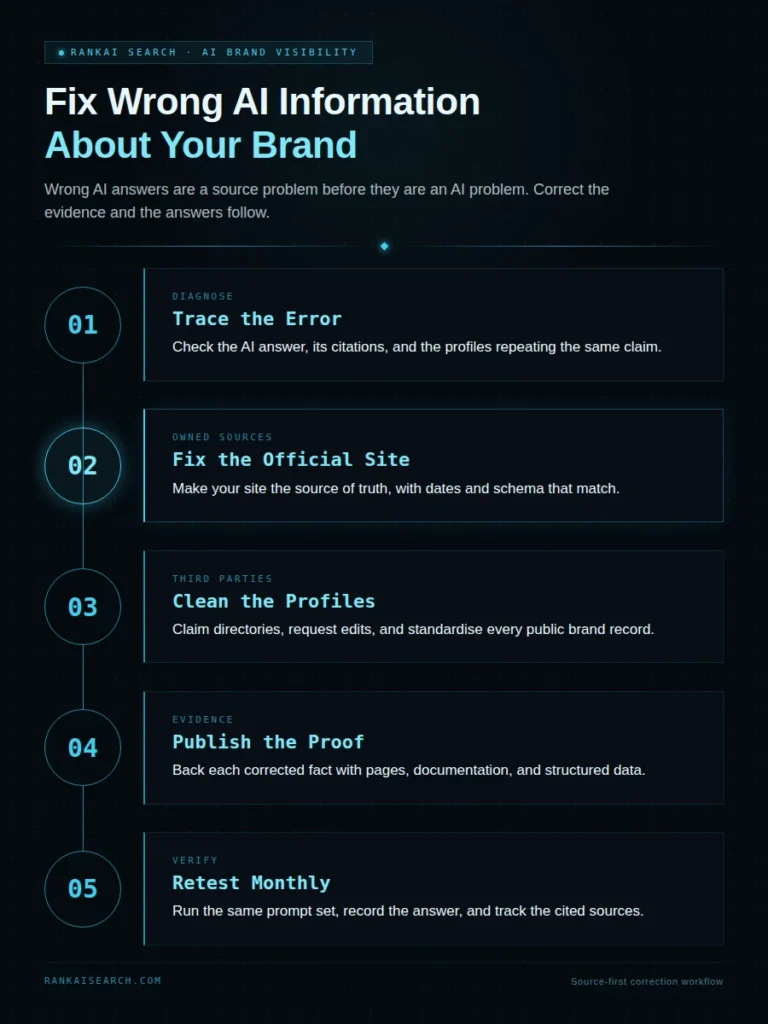
You should remember that wrong AI brand information is usually a source problem before it is an AI problem. The most reliable fix is to make the correct information clearer, stronger, and more consistent across the sources AI systems can access.
AI models and answer engines rely on public evidence, retrieval systems, citations, and source context. If the web contains outdated or conflicting facts, AI systems can repeat those mistakes.
A correction strategy should combine owned-source cleanup, third-party profile updates, structured data, AI platform reports, and ongoing prompt monitoring. One correction rarely solves a web-wide brand fact problem.
| Principle | Practical Action |
| Trace the error | Identify cited and uncited source patterns |
| Fix the official source | Update website pages first |
| Correct third parties | Update profiles and request edits |
| Strengthen proof | Publish evidence and current details |
| Clarify the entity | Standardize brand facts everywhere |
| Report bad answers | Use platform feedback tools |
| Monitor monthly | Retest prompts and citations |
Need Help Strengthening Your Brand’s Source Information?
Incorrect AI answers often persist when outdated pages, conflicting profiles, and weak source signals remain online. Building a clearer and more consistent information base gives AI systems stronger evidence to describe your brand accurately.
RankAISearch can help identify the sources creating confusion and strengthen the pages that should define your brand. Explore a focused approach to correcting inaccurate information and improving long-term AI accuracy.
Frequently Asked Questions About Fixing Wrong AI Information
Why does AI keep repeating outdated information about my business?
AI keeps repeating outdated information when old sources still exist and appear credible. The system may also retrieve third-party profiles, old snippets, archived pages, or outdated directories. Fix the official source first. Then correct the external pages that repeat the same outdated fact.
Can I directly edit what an AI platform says about my brand?
No, you usually cannot directly edit what an AI platform says about your brand. You can submit feedback or reports, but the stronger fix is correcting the sources the platform may use.
AI answers are generated from models, retrieval systems, and source context. Changing the public evidence gives the system better material to use.
Which website should act as the official source for my brand facts?
Your official website should act as the primary source for brand facts. The homepage, About page, contact page, service pages, product pages, and press page should contain the current version of your business information.
Third-party profiles should support the same facts. They should not introduce conflicting descriptions, old services, or outdated contact details.
What should I do when two trusted sources show different information?
You should correct the source that is wrong and strengthen the source that is current. If both sources are partly right, publish a clear official explanation that resolves the conflict.
AI systems may choose either source when both appear credible. The corrected version needs to be clearer, more current, and easier to verify.
Can incorrect social media profiles influence AI answers?
Yes, incorrect social media profiles can influence AI answers when they appear in search results, entity profiles, or third-party source sets. Social bios often repeat brand categories, locations, websites, and service descriptions.
Update social profiles after every major brand change. Keep names, URLs, bios, locations, and service language consistent.
Should I delete old pages that contain outdated brand details?
You should not delete old pages automatically. Update, redirect, noindex, or add correction context based on whether the page still has value.
If an old page earns links or traffic, a redirect or clear update note may be safer. If the page is thin and misleading, removal or noindex may be appropriate.
How often should I test AI answers about my brand?
You should test AI answers about your brand at least monthly. High-risk brands should also test after rebrands, product changes, pricing updates, leadership changes, or major press coverage.
Use the same prompt set each time. Consistent testing shows whether errors are improving or repeating.
What can I do if the wrong information remains after I correct the sources?
You can expand the correction by fixing more third-party sources, strengthening official pages, requesting recrawls, submitting platform feedback, and publishing clearer evidence. Persistent errors usually mean the wrong fact still has stronger or more visible support somewhere else.
Track the cited sources again after each