


How AI Search Uses Context to Recommend Brands
Imagine you ask ChatGPT for “the best email marketing tool.” You follow up with “something affordable for a five-person startup.” The brand recommended in the second response is almost certainly different from the first. That gap is not random.
AI evaluates the full context of your query before surfacing any recommendation, and gets more precise with every added detail. Brands that understand how context drives those decisions consistently appear in AI results. Brands that ignore it get filtered out.
This guide covers how AI search engines evaluate contextual relevance, how to structure content that matches the signals they track, and which optimization mistakes cost brands visibility across Google AI Overview, ChatGPT, and Perplexity.
What Is Contextual Relevance in AI Search?
Contextual relevance is the degree to which content matches the specific situation, intent, and circumstances behind a user’s query, not just the words in it. AI platforms interpret meaning, timing, decision stage, and user circumstance to decide which brands fit.
A query about “best running shoes” produces different recommendations depending on whether it follows a question about marathon training or casual weekend jogging. AI infers the user’s actual goal from everything surrounding the query, not from the query alone.
| What Changes | Keyword Relevance | Contextual Relevance |
| Matching method | Word matching | Situation and intent matching |
| What AI evaluates | Keyword density | Decision stage, expertise level, circumstances |
| Who gets recommended | Any page with the keyword | Pages that fit the user’s specific scenario |
How Do AI Search Engines Evaluate Contextual Relevance?
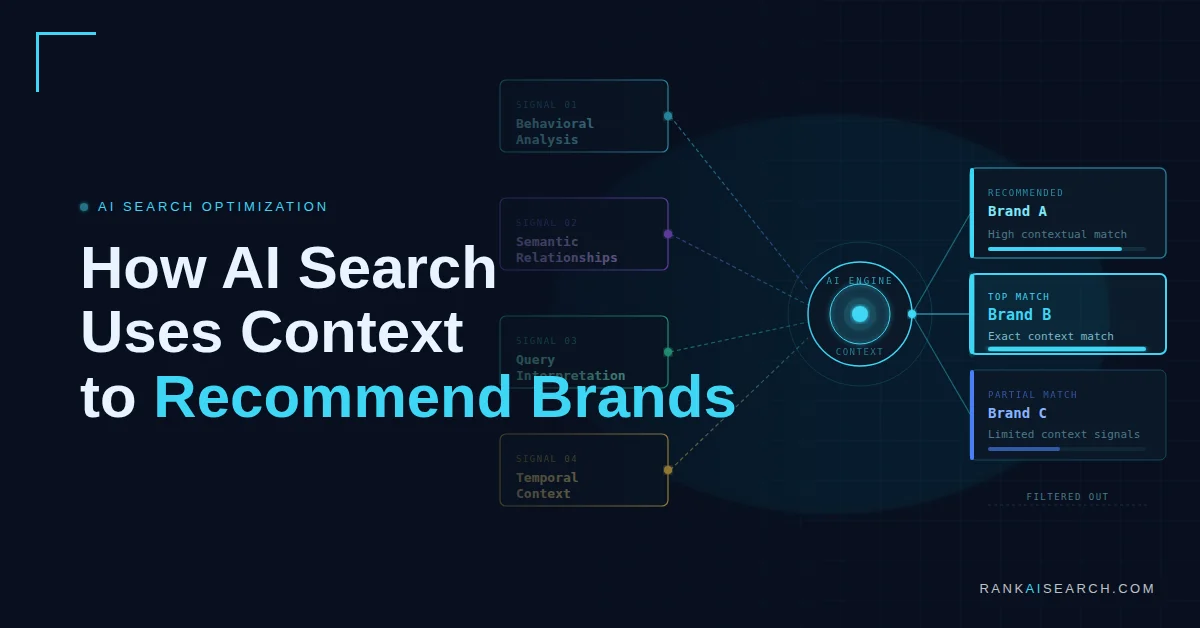
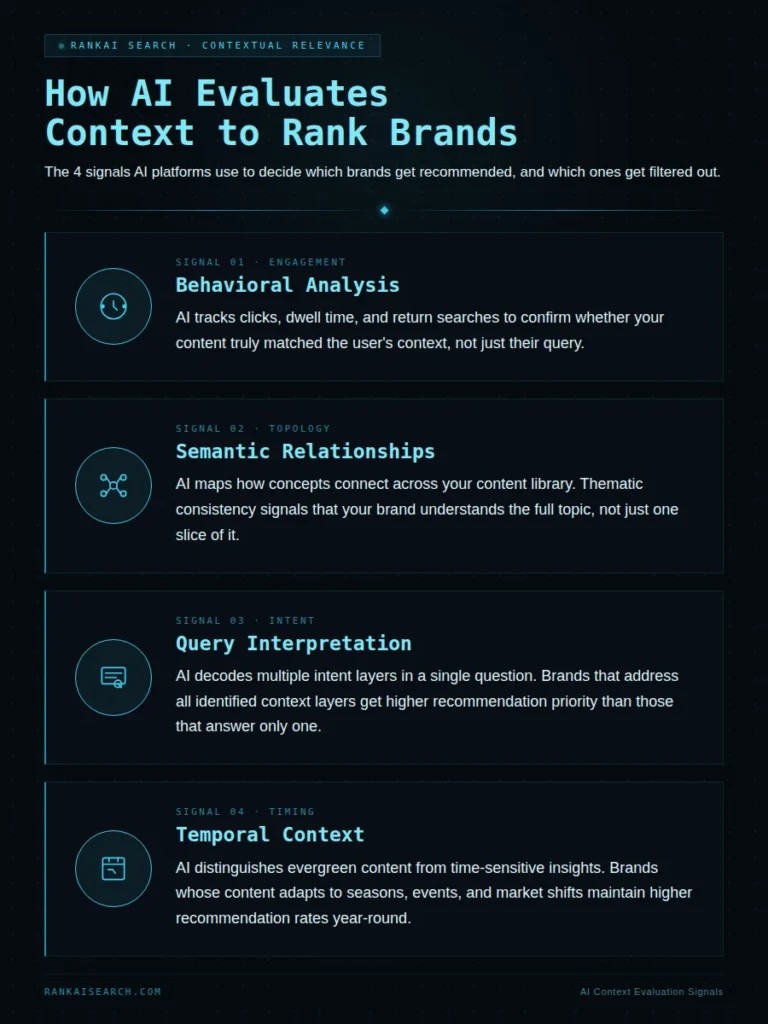
AI platforms assess contextual relevance through four interlocking signals: behavioral data, semantic relationships, query interpretation, and temporal context. Each signal contributes to a confidence score that determines whether your brand appears in a given recommendation.
| Signal | What AI Evaluates | Why It Matters |
| Behavioral analysis | Click rates, dwell time, return searches | Confirms content matched the user’s context |
| Semantic relationships | Topic connections, thematic consistency | Proves broad contextual authority |
| Query interpretation | Intent layers within complex questions | Matches multi-faceted user needs |
| Temporal context | Timeliness and trend relevance | Sustains recommendations as conditions change |
Strong performance in one area does not compensate for a gap in another. A brand that publishes topically deep content but ignores temporal updates will lose recommendations as market conditions shift.
How Does Behavioral Analysis Influence AI Rankings?
Behavioral analysis tracks how users interact with content after it is recommended. AI monitors click rates, time on page, and return searches to determine whether content satisfied the user’s need in a specific context.
| Engagement Pattern | AI Signal | Effect on Recommendations |
| Users stay, scroll deep, and do not return to search | Strong contextual match | Higher recommendation frequency |
| Users click back and search again | Contextual mismatch | Lower recommendation frequency |
| Patterns repeat across many sessions | Accumulated confidence score | Durable gain or loss in recommendation rates |
How Do Semantic Relationships Signal Contextual Authority?
Semantic relationships reveal how well a brand’s content ecosystem covers a topic. AI evaluates connections between concepts, not just individual pages in isolation.
A page about “customer retention strategies” is evaluated alongside its connections to customer satisfaction, loyalty programs, and churn reduction. Thematic consistency across a content library signals to AI that the brand understands the full topic, not just one slice of it. (Source: Semrush, 2024)
How Does Query Interpretation Affect Brand Filtering?
Query interpretation is AI’s ability to recognize multiple intent layers within a single question. When someone asks “how do I reduce cart abandonment for first-time mobile shoppers,” AI identifies at least four context layers:
| Context Layer | What It Tells AI |
| Ecommerce focus | The user is operating in a shopping or selling context |
| Mobile optimization | The solution must function on mobile devices |
| New customer behavior | The audience is unfamiliar with the product or process |
| Conversion goals | The user wants to improve purchase completion rates |
Brands that address all identified layers receive higher recommendation priority than brands that address only one.
Why Does Temporal Context Matter for AI Recommendations?
Temporal context distinguishes evergreen information from time-sensitive insights. AI differentiates between content that applies universally and content relevant to current conditions, seasons, or events.
| Content Type | Temporal Signal | AI Behavior |
| Evergreen guides with no time markers | No temporal context | Matched to general queries regardless of timing |
| Content tied to seasons or market conditions | Strong temporal context | Boosted during relevant periods; filtered out otherwise |
| Content updated regularly with fresh examples | Active freshness signal | Trusted as accurate across changing conditions |
How Does Conversational Context Shape Brand Recommendations?
Conversational context compounds across a session. Each follow-up question refines which brands AI recommends. A vague initial query yields generic suggestions. Specific follow-up questions narrow recommendations to brands whose content addresses exact user circumstances.
| Scenario | AI Response | Brand Implication |
| User asks about email marketing, then automation tools | Connects both queries; filters for brands covering both | Brands covering only email marketing lose the second recommendation |
| Content addresses only the initial question | Limited multi-turn match evidence found | Missed opportunities across follow-up queries |
| Content anticipates and addresses follow-up questions | AI gains confidence the brand understands full decision journeys | Higher recommendation rate across multi-turn sessions |
Why Does Generic Content Lose AI Recommendations?
Generic content fails because AI cannot match it to any specific user context with confidence. A page titled “Marketing Tips” cannot be recommended with precision. AI needs to know who the advice applies to, when it works, and under what circumstances.
| Parameter | What to Define | Example |
| Who | Exact role, business size, or situation | Local service businesses with under 10 employees |
| When | Timing or circumstance where the advice applies | During an economic slowdown |
| Outcome | What the reader can do after reading | Reduce acquisition costs without increasing headcount |
Brands that omit these parameters force AI to make assumptions. AI responds to ambiguity by recommending brands that are explicit.
How Should You Structure Content for Context-Aware AI Visibility?
Context-aware content explicitly states who it serves, when it applies, and why the advice matters in that situation. AI extracts these parameters to match your content to appropriate queries.
Separate content pieces for different decision stages consistently outperform single pages that try to serve every stage at once:
| Decision Stage | Content Focus | AI Matching Signal |
| Awareness | Problem identification, symptoms | Informational context markers |
| Consideration | Comparison, options, tradeoffs | Evaluative context markers |
| Decision | Implementation, vendor selection | Transactional context markers |
How Should You Map Content to User Scenarios?
Scenario mapping connects content to the specific situations users face before they search. Begin each section with an explicit context statement, for example: “If you manage a regional retail chain and need to reduce customer acquisition costs…”
These framing statements give AI direct evidence of contextual fit. Brands that omit them leave AI to infer context, which produces less reliable recommendations.
How Does Topical Depth Affect Contextual Relevance Scores?
Topical depth is the degree to which a brand’s content covers a subject from multiple practical angles. AI uses depth as a proxy for contextual authority.
| Content Setup | AI Confidence | Recommendation Durability |
| Single article, no supporting coverage | Low | Weak; easily displaced by competitors |
| Cluster of interconnected pieces on the same topic | High | Strong; AI recommends the brand across related queries |
| Supporting content addressing edge cases and implementation | Very high | Persistent; recommendations hold across query refinements |
(Source: Ahrefs, 2024)
What Technical Signals Communicate Contextual Relevance to AI?
Technical signals confirm or undermine the contextual authority established by content. These signals are evaluated at the site level, not the page level.
| Technical Signal | What It Shows AI |
| Content ecosystem architecture | How topics are organized and connected across the site |
| Internal linking structure | How concepts relate to each other within the knowledge base |
| Content freshness | Whether the brand actively maintains accuracy over time |
| Citation patterns | Whether the content exists within a broader knowledge ecosystem |
How Does Content Architecture Signal Contextual Authority?
Content architecture is the way topics are organized and linked across a website. AI evaluates whether content exists in isolation or as part of a structured knowledge base.
| Architecture Element | Contextual Signal Sent |
| Pillar pages connected to cluster content | Stronger than standalone articles; confirms topic mastery |
| Links between related pieces | Shows AI how concepts relate across the site |
| Well-organized content hubs | Strengthens contextual relevance across multiple related query types |
Why Does Content Freshness Affect AI Recommendations?
Content freshness signals that a brand actively maintains accuracy as contexts evolve. Stale content loses contextual relevance when circumstances change.
| Update Frequency | AI Effect |
| Not updated in 18 months | Loses recommendation frequency to competitors updating quarterly |
| Regular updates with new examples and current data | Maintains recommendation rates across changing conditions |
How Do Citation Patterns Reinforce Contextual Relevance?
Citation patterns reveal whether content exists in a broader knowledge ecosystem or in isolation. Content that makes claims without evidence receives lower contextual relevance scores, even when the claim is factually correct.
| Citation Practice | Contextual Authority Signal |
| References credible sources (Ahrefs, Semrush, Gartner, BrightEdge, SparkToro) | High authority; AI treats content as part of a knowledge ecosystem |
| Cross-references supporting data within the article | Confirms the content is well-researched and situationally grounded |
| Connects claims to established research | Prevents claims from being discounted due to lack of evidence |
How Do User Engagement Signals Reinforce Contextual Relevance?
User engagement is the behavioral confirmation that content matched a user’s context. Pogo-sticking, where a user immediately returns to search after clicking a result, teaches AI that the content failed to match the contextual expectation the query created.
| Engagement Signal | Positive Indicator | Negative Indicator |
| Dwell time | Long sessions, multi-section reads | Immediate exits |
| Return-to-search rate | Low rate after visit | High pogo-stick frequency |
| Social sharing | Niche community shares and citations | No engagement beyond the initial click |
| Scroll depth | Deep engagement through content | Abandonment in the first third of the page |
Social validation amplifies contextual signals. When content is shared within specific professional communities or cited by others addressing the same scenarios, AI interprets those patterns as evidence of genuine contextual authority.
What Behavioral Patterns Do AI Search Engines Track for Context?
AI search engines track search history, device type, location, and time of day to build a contextual profile for each query session. These dimensions layer onto content evaluation to determine which brands fit a user’s specific moment.
| Behavioral Signal | How AI Uses It | Content Implication |
| Search history | Connects earlier queries to the current one | Address the full topic sequence, not just isolated questions |
| Device context | Mobile queries trigger different recommendations than desktop | Optimize for mobile use cases and scenarios separately |
| Location context | Local queries are filtered by geographic relevance | Name the geographic context your content applies to |
| Time of day | Work-hour queries may surface different brands than evening queries | Define the professional or personal context of your advice |
| Seasonal context | Holidays, fiscal year ends, and conference cycles trigger time-sensitive filtering | Acknowledge timing and seasonal relevance in content |
Brands cannot manipulate these signals directly. The correct response is to create content that explicitly addresses the situational contexts these signals reveal.
How Can You Optimize Content for Contextual AI Search Filtering?
Scenario-based content structure is the most direct method for improving contextual AI visibility. Write for specific situations, not general audiences. Begin sections with explicit context statements that tell AI exactly which user circumstances the content addresses.
Context-rich language patterns improve AI matching rates (Source: SE Ranking, 2024):
| Pattern | Structure | Example |
| “When” + situation | Identifies the trigger circumstance | “When managing a legal content team across multiple jurisdictions…” |
| “If” + circumstance | Specifies the conditional context | “If you’re launching your first paid campaign with under $1,000…” |
| “For” + audience | Names who the content serves | “For ecommerce brands targeting first-time mobile shoppers…” |
| “During” + timing | Anchors advice to a specific time window | “During a market contraction, when acquisition budgets are cut…” |
How generic versus optimized content compares:
| Content Element | Generic Version | Context-Optimized Version |
| Title | “Marketing Tips” | “Marketing Strategies for Service Businesses Under 10 Staff” |
| Opening | “Marketing is important for growth” | “If you run a local service business with a limited budget…” |
| Audience | Implied or unstated | Explicitly named in the first paragraph |
| Timing | None stated | Defined (e.g., “during a slowdown” or “in Q4”) |
Case studies and real-world examples are particularly effective. They demonstrate that the brand understands actual user situations, not theoretical frameworks.
What Contextual Relevance Mistakes Hurt AI Rankings?
The most damaging mistake is creating content for everyone. Content written for a general audience matches no specific context well, and AI filters it in favor of brands whose content is explicitly matched to user circumstances.
| Mistake | What Happens | How to Fix It |
| Generic topic coverage | AI cannot match content to any specific context with confidence | Define who, when, and under what circumstances the content applies |
| Ignoring conversational journeys | Missed recommendation opportunities across multi-turn sessions | Anticipate and address follow-up questions within each content piece |
| Failing to update | Outdated content loses recommendation frequency as situations evolve | Review and update major content quarterly |
| Over-specializing in one context | Visibility limited to one narrow scenario | Build coverage across related situations and user journeys |
| Missing multi-platform optimization | Recommendations left uncaptured on underserved platforms | Adapt format and emphasis for ChatGPT, Google AI Overview, and Perplexity separately |
How Do You Measure Contextual Relevance Performance in AI Search?
Contextual relevance performance is measured by tracking how frequently your brand appears in AI recommendations across varied query contexts, not just total mention volume. The distribution of those appearances matters as much as the count.
| KPI | What It Measures | Target |
| Context match rate | % of contextual queries where brand appears | Grow quarter-over-quarter |
| Recommendation diversity | Range of contexts triggering brand mentions | Broad spread across related contexts |
| Authority persistence | Sustained visibility as users refine queries | Maintained across 3 or more follow-up turns |
| Contextual gap ratio | Contexts where competitors outrank you | Reduce by 20% per quarter |
| Step | Method | What It Reveals |
| 1 | Use AI search simulation across varied query types | Which contexts your brand appears in and which it misses |
| 2 | Combine with engagement analytics segmented by query context | Whether appearances lead to satisfied users or pogo-sticking |
| 3 | Run competitor contextual analysis | Which scenarios competitors dominate that you do not |
| 4 | Apply gap analysis to prioritize content investment | Where to publish next for the highest contextual coverage gains |
Expect initial improvements within 4 to 8 weeks. Significant visibility gains typically emerge within 3 to 6 months.
How Should Brands Adapt for Multi-Platform AI Presence?
Each major AI platform weights contextual signals differently. Content must be adapted, not just repurposed, to perform across all of them. Core contextual elements including situational clarity, topical depth, and scenario precision work across every platform.
| Platform | What It Prioritizes | Optimization Focus |
| ChatGPT | Conversational context, dialogue flow | Anticipate follow-up questions; address multi-turn journeys |
| Google AI Overview | Query intent, immediate answers | Lead with the direct answer before any supporting detail |
| Perplexity | Source credibility, contextual citations | Strong cross-referencing and credible source attribution |
Cross-platform contextual consistency ensures coherent brand positioning regardless of where a user encounters it. Adapting format and emphasis for each platform is necessary. Changing the underlying contextual positioning is not.
What Are the Future Trends in Contextual AI Search Filtering?
Three trends will define how contextual AI search filtering evolves over the next two to three years:
| Trend | What It Means | How to Prepare |
| Predictive context | AI recommends brands before users explicitly ask, based on behavioral patterns | Build content covering logical next steps in common user journeys |
| Multi-modal context | AI incorporates visual, audio, and behavioral signals alongside text | Optimize content with non-text context signals: images, voice-ready formats, interaction patterns |
| Hyper-personalization | Recommendations match increasingly specific context combinations | Build deep coverage across the primary situational scenarios your audience faces |
Comprehensive contextual content libraries built now will compound in value as AI filtering becomes more precise. The brands that establish contextual authority before competition intensifies will be the hardest to displace.
Frequently Asked Questions about AI Search Brand Preference
What is the difference between contextual relevance and keyword relevance in AI search?
Keyword relevance looks for word matches between queries and content. Contextual relevance evaluates whether content matches the situation, intent, and specific circumstances behind a query. AI search engines prioritize contextual relevance because it more accurately predicts whether content will satisfy users in their actual circumstances.
How do AI search engines determine if content matches a specific user context?
AI platforms analyze multiple signals simultaneously: query history, behavioral patterns, semantic relationships, engagement metrics, and explicit contextual markers in content. They assess whether content addresses the correct expertise level, decision stage, situation type, and circumstances indicated by user behavior and query structure.
Can contextual relevance improve brand recommendations in ChatGPT or Perplexity?
Yes. AI answer engines prioritize brands that demonstrate clear situational understanding. When content explicitly addresses specific circumstances, acknowledges different user scenarios, and provides context-appropriate guidance, platforms gain confidence in recommending that brand for matching queries.
What content signals strongest contextual relevance to AI platforms?
Content with explicit situational descriptions, real-world examples, scenario-based structure, acknowledgment of different use cases, and clear statements about who is served and when. Supporting content that demonstrates topical depth and interconnected knowledge also signals strong contextual authority.
How often should content be updated to maintain contextual relevance in AI search?
Review major content quarterly and update whenever market conditions shift, new trends emerge, or user situations change. Add current examples, fresh data, and updated scenario coverage. AI tracks update patterns and rewards brands that maintain accuracy as contexts evolve.
Does contextual optimization work for local businesses and niche industries?
Yes, and it often works better for local and niche businesses than for generalist brands. Specific local contexts and specialized scenarios are underserved by generic content. Creating content that addresses local conditions, regional challenges, and industry-specific circumstances builds strong contextual authority in those niches.
How long does it take to see results from contextual relevance optimization?
Initial improvements in AI recommendation rates typically appear within 4 to 8 weeks. Significant visibility gains usually emerge within 3 to 6 months as engagement data confirms contextual match success. Long-term contextual authority compounds over 6 to 12 months of consistent optimization.
What tools can help measure contextual relevance in AI search?
AI search monitoring tools that track brand mentions across answer engines, analyze query variations that trigger recommendations, and map appearing contexts provide the most direct measurement. Combine these with engagement analytics, user feedback on content relevance, and competitor contextual analysis for a complete picture.