

How to Optimize B2B Content Distribution for AI Search Engines
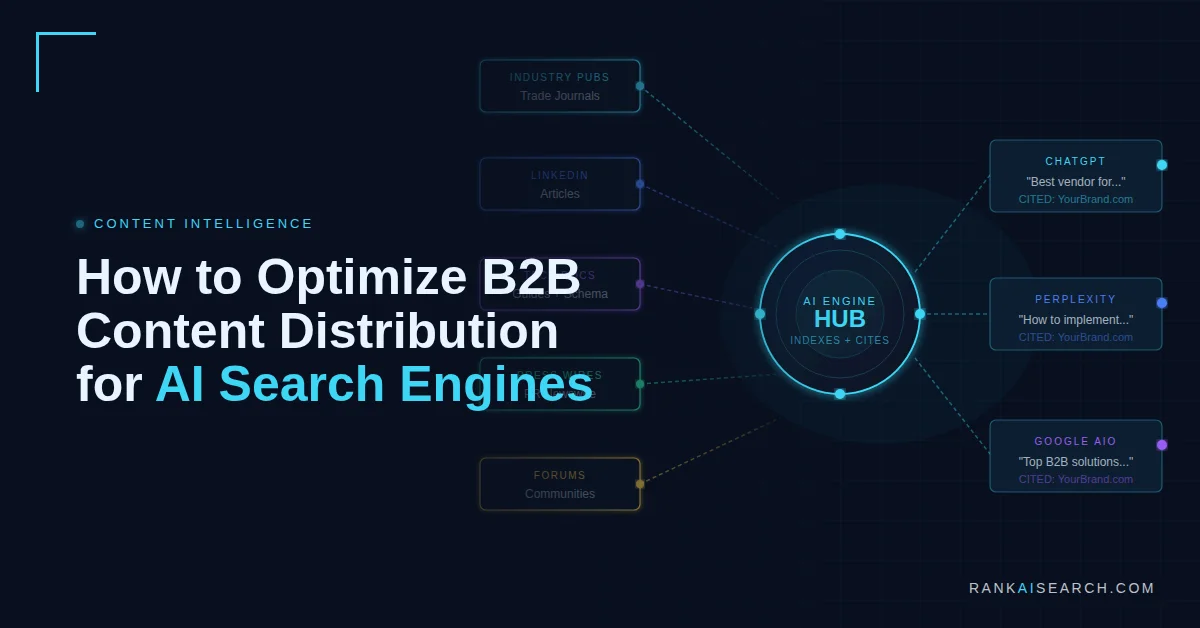
A procurement manager types a vendor comparison question into ChatGPT. A CFO asks Perplexity for implementation cost benchmarks before scheduling a single sales call. In both cases, the answer they receive depends entirely on which sources the AI platform has indexed, trusts, and chooses to cite.
If your B2B content isn’t in that pool, your brand is invisible at the most critical moment in the buyer’s research process. The fix isn’t creating more content: it’s distributing existing content where AI engines can find and recommend it.
This guide covers the full B2B distribution strategy for AI search visibility: which channels answer engines monitor, how to format content for extraction, how to syndicate without triggering duplicate content filters, and how to measure whether AI platforms are citing your expertise.
Why Does Traditional B2B Content Distribution Fail in the AI Search Era?
Traditional B2B distribution channels fail in the AI search era because they reach human audiences but remain structurally invisible to AI platforms. Email campaigns, social posts, and gated whitepapers don’t produce the accessibility, structure, and authority signals that answer engines use to select sources.
The gap between human engagement and AI visibility is the core problem. A LinkedIn post can generate strong engagement while generating zero AI citations because the post format lacks the semantic depth that platforms like ChatGPT and Perplexity use to extract answers.
| Distribution Channel | Human Reach | AI Discoverable? |
| Email newsletters | High | No |
| Gated whitepapers | Medium | No |
| LinkedIn posts | High | Limited |
| Social media ads | High | No |
| LinkedIn articles | Medium | Yes |
| Indexed blog posts | Medium | Yes |
| Industry publications | Medium | Yes |
| Press release wires | Medium | Yes |
| Technical documentation | Low | Yes |
Traditional metrics like impressions, click-through rates, and social shares don’t capture AI visibility. A piece of content can rank on page one of Google and still never appear in an AI-generated answer if it lacks proper structure, metadata, or source authority.
How Do AI Search Engines Discover and Index B2B Content?
AI search engines evaluate semantic relevance, authority signals, and contextual usefulness rather than keyword density and backlink volume. They look for content that answers specific questions with clear, structured, extractable information.
These platforms assess content across three core dimensions before recommending it:
- Semantic depth: Does the content answer a specific professional question with supporting evidence, data, and logical frameworks?
- Source authority: Is the content published on a domain, platform, or publication that AI engines already recognize as credible for this topic area?
- Structural accessibility: Can the AI platform extract individual answers, facts, or sections without processing the entire document?
Structured data plays a bigger role than most B2B marketers realize. Schema markup, proper heading hierarchy, and descriptive metadata help AI platforms categorize content correctly. When a case study includes organization schema and an author byline linked to a knowledge graph entity, platforms can better match that content to relevant professional queries.
The indexing timeline for AI platforms differs from traditional search. High-quality content published on well-monitored channels can appear in AI-generated answers within 3 to 7 days, significantly faster than the weeks traditional SEO ranking changes typically require. (Source: Search Engine Journal, 2024)
Which Distribution Channels Do AI Platforms Monitor for B2B Content?
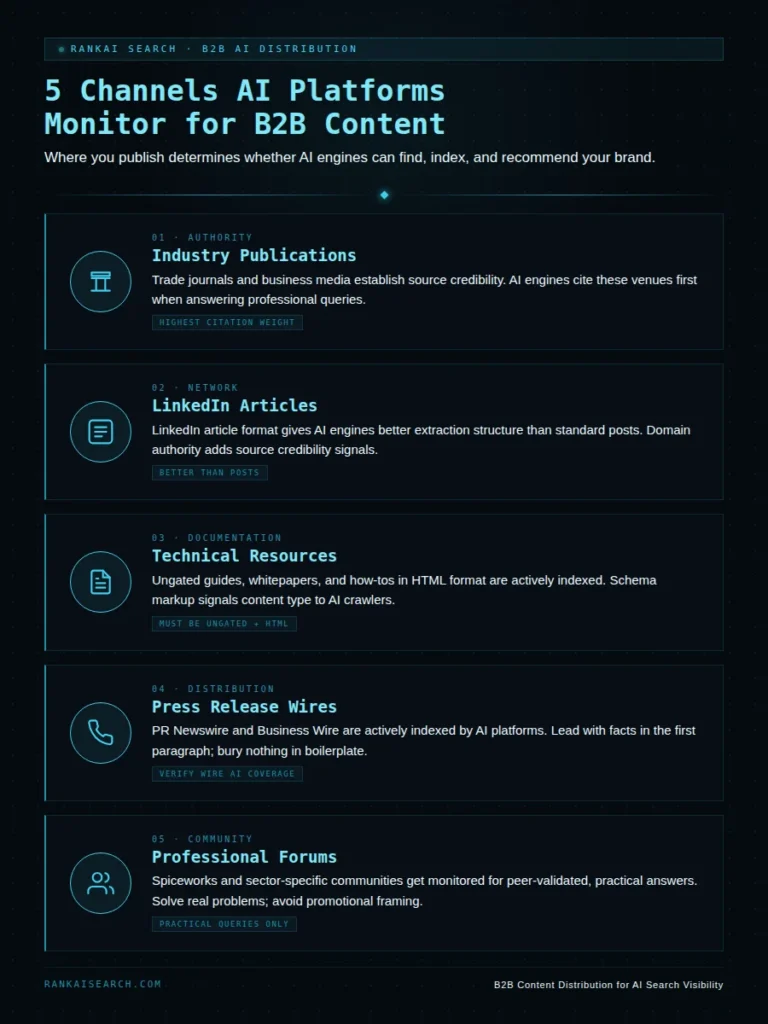
AI platforms actively monitor industry publications, professional networks, structured corporate resource centers, and press release wires. The channels that carry the most weight vary by industry, but authority and structure consistently outrank audience size.
The right distribution channel depends on your content type. Research reports and technical guides belong on your owned domain first, then syndicated to industry publications. Community forum contributions work for implementation-focused queries. LinkedIn articles work for practical how-to content.
Industry Authority Publications and Thought Leadership Platforms
Industry authority publications give your content the source credibility that AI engines use to decide which brands to recommend. When AI platforms cite a vendor’s expertise, they consistently pull from venues they’ve already established as trustworthy: sector-specific trade journals, professional media outlets, and business publications with documented editorial standards.
Getting bylines and contributions properly attributed matters for citation tracking. Use consistent author schemas, link to authoritative author profiles, and verify that publication platforms implement proper structured data.
- Target publications in your sector that AI engines reference for professional queries
- Use the same author name, title, and company description across every byline
- Link author profiles back to your domain to reinforce entity associations
Professional Networks and B2B Community Platforms
LinkedIn articles receive different AI treatment than standard posts because the article format provides better structure for extraction, and LinkedIn’s domain authority signals credibility to AI engines. Format these pieces with clear headings, bullet points, and standalone sections that answer specific questions without requiring surrounding context.
Industry forums and professional communities get monitored when AI engines seek peer-validated, practical information. Contributing genuine expertise to communities like Spiceworks or sector-specific forums builds citability for technical and implementation queries.
- Address specific problems with detailed, step-by-step solutions
- Include relevant data, outcome examples, and defined processes
- Avoid promotional language; AI engines prefer problem-solving content over brand messaging
Technical Documentation and Resource Centers
Technical documentation and resource centers must be ungated, properly tagged, and structured with schema markup to be discoverable by AI engines. Content buried in generic resource libraries without clear categorization rarely gets indexed correctly, regardless of quality.
AI crawlers cannot fill out lead capture forms. Heavily gated content generates zero AI visibility, even when the underlying resource is high-quality. (Source: BrightEdge Research, 2024)
- Create dedicated resource pages with clean URLs and descriptive titles
- Add schema markup that identifies content type (Article, HowTo, FAQPage)
- Publish HTML versions of important whitepapers alongside PDF downloads
- Use industry-standard terminology in metadata and tags
How Should B2B Content Be Structured for Maximum AI Pickup?
B2B content structured for AI pickup uses modular sections, quotable statements, explicit entity references, and attributed statistics. Each major section must function as a standalone answer without requiring the surrounding document for context.
AI platforms extract individual sections and sentences to answer specific queries. Content that requires full-article context to make sense gets passed over in favor of content that delivers answers at the paragraph level.
- Write quotable statements. Each key insight should be expressible in one or two sentences that stand alone as citable facts. “Implementation typically takes 4 to 6 weeks for mid-market companies with dedicated project teams” gets cited. “Implementation timeframes vary” does not.
- Use cause-and-effect language. Phrases like “this results in,” “because of this,” and “leading to” help AI systems understand the reasoning behind recommendations. Explicit logical connections make platforms more confident in citing your expertise.
- Include entity references. Mention specific tools, methodologies, frameworks, and industry standards by name. These entity connections help AI platforms place your content correctly in the knowledge landscape and match it to relevant queries.
- Attribute every statistic. AI engines value content that references credible data sources with specific attribution. Backed claims carry more weight than unsupported assertions, and platforms can verify and cite attributed information with greater confidence.
How Does Content Syndication Affect AI Search Visibility?
Strategic syndication expands AI visibility by placing your content across multiple monitored sources. It harms visibility only when done without proper canonical tags, without source attribution, or with low-quality syndication partners.
The source hierarchy matters. Publishing original content on your owned domain first, then syndicating 48 to 72 hours later, allows AI engines to identify your site as the primary source. (Source: Ahrefs Blog, 2024)
Follow this sequence for every piece of B2B content:
- Day 1: Publish on your owned domain
- Days 3 to 5: Syndicate to tier-one industry partners with canonical tags pointing back to your original URL
- Days 5 to 10: Contribute to community platforms and professional forums
- Days 10 to 14: Share on social channels and LinkedIn articles
Customize syndicated versions to maintain uniqueness signals. Adjust the introduction, change examples, or tailor the conclusion for each platform’s audience. Core value and expertise markers stay consistent; surface-level elements adapt.
Choose syndication partners based on AI visibility, not audience size. A placement on a site that AI engines actively monitor for business expertise delivers more citation value than a high-traffic platform those systems don’t reference for professional queries.
Why Traditional B2B Distribution Fails in the AI Era
Press releases structured for AI pickup lead with the most significant facts, embed specific data points, and use clear H2 headings that break information into extractable sections. Traditional press release formats that bury key information under boilerplate text get skipped by answer engines.
AI engines extract opening content more frequently than buried details. The first paragraph must state what happened, why it matters, and the measurable impact: background context comes after.
| Press Release Element | Traditional Format | AI-Optimized Format |
| Opening paragraph | Background and context | Key facts: what, why, measurable impact |
| Statistics | Vague (“significant improvement”) | Specific (“47% efficiency gain across 200 clients”) |
| Structure | Narrative prose | H2 sections: What Changed, Why It Matters, How It Works |
| Executive quotes | Promotional language | Standalone expert insights on industry trends |
| Distribution wire | Any major service | Wires verified for AI platform indexing |
Distribution wire selection affects AI visibility directly. Services like PR Newswire and Business Wire get indexed by AI platforms, but industry-specific wires vary in AI coverage. Verify that your chosen service appears in answer engine sources for queries relevant to your sector before committing distribution budget.
Executive quotes must function as standalone expert insights. AI engines sometimes extract and cite executive quotes independently when they provide authoritative perspectives on industry trends. Write these statements for citability, not for promotional value.
How Can B2B Brands Measure AI Search Visibility?
B2B brands measure AI search visibility through manual citation audits, topic ownership tracking, and emerging AEO analytics tools. AEO, or Answer Engine Optimization, is the discipline of making content discoverable and citable by AI-powered answer platforms including ChatGPT, Perplexity, and Google AI Overview. Standard traffic and ranking reports do not capture whether these engines cite your brand.
RankAISearch (rankaisearch.com) is a global agency specializing in AEO, GEO (Generative Engine Optimization), AIO (AI Overview Optimization), LLMO (Large Language Model Optimization), and SEO. Their research consistently shows that brands tracking only traditional analytics miss the majority of their AI visibility performance.
AI citation tracking is not optional for B2B brands in 2026. Measuring traditional metrics while ignoring answer engine visibility means optimizing for a distribution channel your buyers are increasingly leaving behind.
Use this monitoring framework:
- Brand mention audits: Regularly query ChatGPT, Perplexity, Google AI Overview, and Claude with your company name, key executive names, and proprietary terminology. Document when and how your content appears.
- Topic ownership tests: Query AI platforms with the questions your ideal buyers ask. Track whether platforms recommend your content, competitors, or neutral sources.
- Source diversity tracking: Document which distribution channels generate AI citations. Identify whether LinkedIn articles, press releases, or industry publications drive the most answer engine visibility for your brand.
- Citation quality checks: Assess whether AI platforms cite your brand for the right topics. Getting cited for tangential subjects damages positioning even when the citation count looks positive.
Specialized AEO analytics platforms now offer citation tracking specifically for answer engines. Assign team members to conduct weekly citation audits across major platforms while these tools mature.
How Should B2B Teams Build a Multi-Platform AI Distribution Framework?
A multi-platform AI distribution framework maps each content type to its optimal AI-monitored channel, sequences release timing to establish source hierarchy, and coordinates cross-functional teams around AI visibility goals. Without this framework, distribution decisions default to habit rather than strategic intent.
Start by matching content type to channel:
| Content Type | Primary Channel | Syndication Priority |
| Research reports | Owned domain | Industry publications |
| How-to guides | LinkedIn articles | Community forums |
| Product announcements | Press wire | Technical documentation platforms |
| Case studies | Owned domain | Industry publications |
| Expert commentary | Thought leadership publications | LinkedIn articles |
Establish quality control across every channel. Use identical author bylines, company descriptions, and expert positioning everywhere. AI engines build authority associations through repeated entity relationships, so inconsistent branding weakens the signal strength that helps answer engines recognize your expertise.
Build feedback loops into the framework. If technical documentation generates strong AI citations while thought leadership posts don’t, adjust content mix and distribution focus accordingly. Distribution frameworks that don’t update based on citation data become obsolete within one quarter.
What Distribution Mistakes Block B2B Content from AI Search Visibility?
The most common B2B distribution mistakes that block AI visibility are aggressive content gating, JavaScript rendering barriers, PDF-only resources, and inconsistent entity references. Each prevents answer engines from accessing, processing, or correctly categorizing your content.
| Mistake | Why It Blocks AI Visibility | Fix |
| Aggressive gating | AI crawlers can’t fill forms | Ungate educational content and implementation guides |
| JavaScript-heavy pages | Render failures block crawling | Test with multiple user agents; ensure server-side rendering |
| PDF-only resources | HTML gets indexed more reliably | Publish HTML versions alongside PDF downloads |
| Inconsistent entity names | Weakens authority signal | Standardize company name, executive titles, product names |
| Over-optimization | Triggers quality filters | Remove keyword stuffing and thin syndication |
| Mobile rendering failures | Many platforms prioritize mobile | Test all distributed content on mobile viewports |
| Stale content | AI engines prefer recent sources | Update cornerstone content annually with current data |
Technical barriers prevent AI engines from accessing B2B content more often than marketers realize. Test your key content pages with different user agents to verify that AI crawlers can actually access them before investing in content production. (Source: Semrush Blog, 2024)
How Should B2B Brands Future-Proof Their AI Distribution Strategy?
B2B brands future-proof their AI distribution strategy by investing in owned content infrastructure, building relationships with industry publications before distribution needs arise, and staying informed about emerging vertical AI platforms in their sector.
Platform-specific optimization tricks become obsolete as AI engines refine their source selection algorithms. Content quality, clear structure, and proper metadata adapt to new platforms without requiring complete rebuilds.
- Identify emerging vertical AI search platforms in your industry now, while competition for early presence remains light
- Invest in your owned domain as the authoritative source all distribution channels point back to
- Allocate budget for AEO analytics tools; early adoption provides competitive advantages as competitors rely on outdated metrics
- Participate in industry communities focused on AEO and GEO to stay informed about algorithm changes
Relationships with industry publications provide distribution access when you launch important content. Contributing regular expertise to respected venues builds the authority signals AI engines recognize before you need them for a major announcement.
Frequently Asked Questions About B2B Content Distribution
How do AI search engines evaluate B2B content differently from consumer content?
AI search engines prioritize authority, depth, and technical accuracy for B2B content rather than popularity signals and broad appeal. Business content gets evaluated on specificity, practical value, and credibility within professional contexts, while consumer content discovery relies more heavily on social engagement metrics.
What content formats do answer engines prefer for B2B recommendations?
Answer engines favor structured formats that allow easy extraction: comparison tables, step-by-step guides, bullet-point frameworks, and segmented sections with descriptive headings. Case studies with specific metrics, implementation guides with defined processes, and research reports with attributed statistics consistently outperform surface-level blog posts.
Should B2B companies gate their content or make it freely accessible for AI indexing?
The optimal approach is strategic ungating. Make educational resources, implementation guides, and thought leadership freely accessible while potentially gating highly specialized tools, templates, and proprietary research. Ungated summaries with gated full reports allow AI engines to index key insights while maintaining lead capture for detailed resources.
How long does it take for distributed B2B content to appear in AI search results?
High-quality content on well-monitored platforms can appear in AI-generated answers within 3 to 7 days. Building consistent authority that makes your brand a go-to source typically requires 3 to 6 months of strategic distribution. Timeline depends on content quality, distribution channel authority, and structured data implementation.
Which distribution channels have the strongest impact on AI platform recommendations?
Industry-specific publications, established business media, LinkedIn articles, and well-structured owned websites carry the most weight. Press release wires indexed by AI platforms, technical documentation platforms, and active industry forums also generate strong visibility. The strongest channels vary by sector; test which platforms generate citations for queries relevant to your expertise.
How can B2B brands track whether AI engines are citing their content?
Manual monitoring involves regularly querying AI platforms with relevant business questions and documenting when your content appears. Assign team members to conduct weekly citation audits across ChatGPT, Perplexity, Google AI Overview, and Claude. Emerging AEO analytics tools now offer citation tracking specifically for answer engines.
Does content syndication hurt or help B2B AI search visibility?
Strategic syndication helps by expanding your content’s presence across multiple AI-monitored sources and reinforcing authority through repeated entity exposure. It hurts only when canonical tags are missing, source attribution is incorrect, or when thin content is duplicated across low-authority sites. Choose reputable syndication partners with verified AI visibility in your sector.
How often should B2B brands update distributed content to maintain AI citation frequency?
Update cornerstone content at minimum annually, adding current statistics, updated examples, and revised frameworks. AI engines prefer recent information for most business queries, and content with outdated data loses citation frequency over time. Redistribute updated versions through the same channel sequence used for original publicatio