


How to Optimize Product Pages for AI Search Engines
A shopper asks ChatGPT for the best standing desk under $400. The platform names three products and skips yours entirely, not because your product is inferior, but because your page did not give the AI enough structured, verifiable information to work with. Optimizing product pages for AI search engines means closing that gap: giving platforms like Google AI Overview, ChatGPT, and Perplexity the complete, well-formatted product data they need to confidently cite and recommend what you sell.
This guide covers every optimization layer that determines whether your product gets recommended or ignored: structured data, product descriptions, technical specifications, user-generated content, page performance, and measurement. The same changes that improve AI visibility also help human visitors make faster, more confident purchase decisions.
Why Do AI Search Engines Evaluate Product Pages Differently?
AI search engines evaluate product pages by intent match and information completeness, not keyword density or backlink authority. When a user asks “What is the best ergonomic chair for back pain under $500?”, the platform identifies the query’s entities (ergonomic, back pain, price ceiling) and matches them to product pages that explicitly address each one.
Adobe Analytics reported that AI-driven referral traffic to retail sites grew by more than 1,200% between 2023 and 2024, reflecting how quickly buyer discovery has shifted toward AI platforms. Traditional SEO and AI search optimization require different strategies because they serve different objectives.
| Factor | Traditional SEO | AI Search Optimization |
| Primary ranking signal | Keywords, backlinks | Structured data, information completeness |
| Content objective | Rank in search results | Get cited in AI recommendations |
| Review importance | Moderate | Critical (50+ reviews threshold) |
| Schema markup | Helpful | Required |
| Description style | Keyword-optimized | Conversational, question-answering |
How Does Intent-Driven Matching Work?
AI platforms use entity recognition to map product attributes to user queries. When a product page explicitly states materials, dimensions, compatibility, and use cases, the platform can match it confidently to queries that reference those exact entities.
Entity recognition does not require keyword placement in specific locations. A product page that clearly explains what a product is, who it is for, and what problem it solves will match relevant queries more reliably than one built around keyword repetition.
Why Does Information Completeness Determine Recommendations?
Products with incomplete information are not recommended because the AI system cannot make a confident match. A laptop without RAM or processor specifications will be skipped when a user asks for a configuration that meets specific performance requirements.
AI platforms also cross-reference product descriptions against customer reviews for consistency. If your description claims “ultra-lightweight” but reviews consistently describe the product as heavy, the platform’s recommendation confidence drops.
How Do AI Systems Read and Interpret Product Information?
AI systems read product information by combining your schema markup, written descriptions, customer reviews, Q&A sections, and external citations to build a semantic model of what you are selling. Each source contributes independently to the platform’s confidence level. A weak signal in any one source reduces the system’s willingness to recommend your product.
What Role Does Schema Markup Play in AI Interpretation?
Schema markup gives AI platforms machine-readable product data they can trust without interpretation. Without schema, the platform must infer product details from page text, which introduces errors and reduces recommendation confidence.
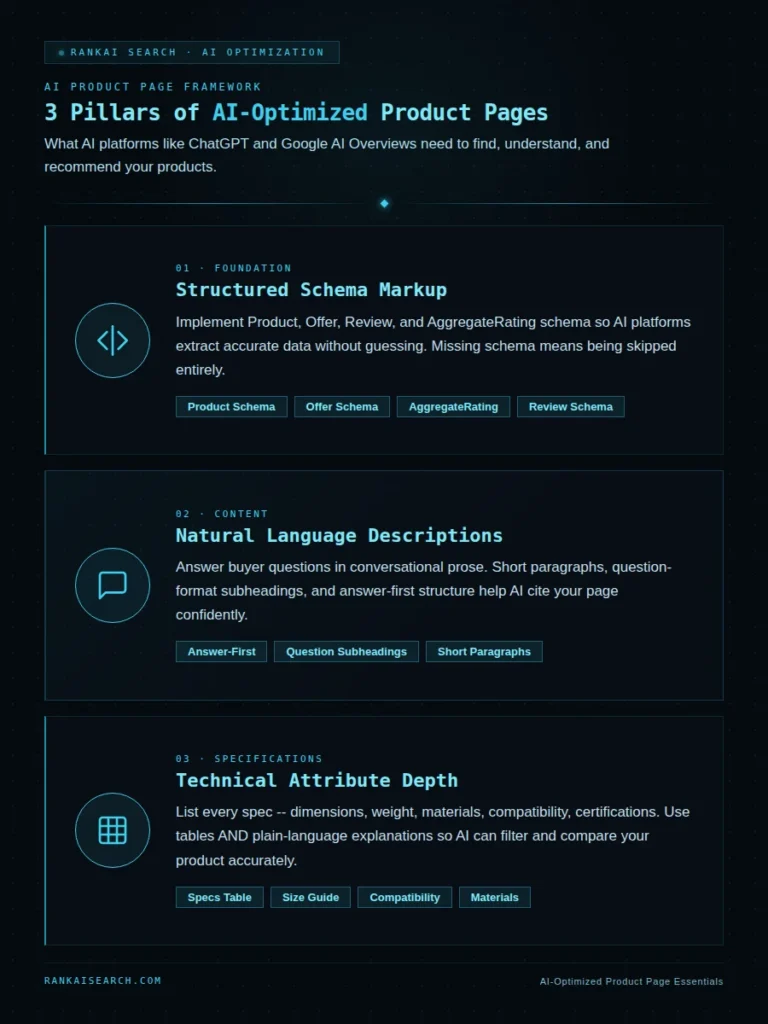
Implement schema across four areas:
- Product schema: name, description, image, brand, SKU
- Offer schema: price, currency, availability, seller information
- Review schema: reviewer name, rating value, date, verified purchase status
- AggregateRating schema: average rating and total review count
Validate your implementation using Google’s Rich Results Test before assuming it is working. Schema errors are silent and frequently prevent AI systems from reading your product data correctly.
How Does AI Handle Conflicting Product Information?
Contradictory information across sources is one of the fastest ways to lose AI recommendation confidence. A price that differs between your product page and a shopping feed, or a specification that conflicts with customer reviews, signals unreliability to the platform.
Keep these consistent across every touchpoint:
- Product page description and schema markup
- Product feeds and third-party listings
- Customer review content and Q&A responses
- Pricing and availability across all channels
What Structured Data Does Your Product Page Need?
Your product page needs Product schema, Offer schema, Review schema, and AggregateRating schema, all correctly implemented in the page’s initial HTML. These four schema types together give AI platforms the price, availability, rating, and product detail data required to make accurate recommendations.
Products without proper schema are often skipped entirely, even when the visible page content is strong. Structured data is the highest-leverage optimization available for AI search.
How Do You Implement Product Schema Correctly?
Product schema must appear in the page’s initial HTML, not injected by JavaScript after load. AI crawlers frequently do not execute JavaScript, meaning dynamically rendered schema may be completely invisible to the systems you are trying to reach.
Required Product schema properties:
- name: exact product name as displayed on the page
- description: 150-300 word product summary
- image: high-resolution product image URL
- brand: brand name using the Organization schema type
- offers: nested Offer schema with price, currency, and availability
Missing any required property reduces schema effectiveness. Complete schema is the standard for full AI visibility.
Why Does Review Schema Directly Affect Recommendation Rates?
Review schema gives AI platforms verified social proof they can cite alongside product recommendations. According to Semrush, pages with properly marked-up review schema appear in AI-generated results at a significantly higher rate than pages with unstructured review content. Products with fewer than 50 reviews are cited less frequently by AI platforms, even when the rest of the product page is complete.
Each review in your schema should include:
- Reviewer name
- Rating value and scale (e.g., 4/5)
- Review date
- Sufficient text body describing the experience
AI platforms use review dates to assess recency and authenticity signals.
How Should You Write Product Descriptions for AI Search?
Product descriptions for AI search should open with a direct statement of what the product is and who it is for, then answer common pre-purchase questions in short, scannable paragraphs using natural language. AI platforms extract specific answers from product descriptions to cite in response to buyer queries.
The product pages that AI platforms recommend most consistently are not the most polished. They are the most complete. Every missing specification is a missed recommendation.
Promotional language reduces AI trust. Phrases like “game-changing” or “revolutionary” signal marketing bias. AI systems prefer factual, neutral descriptions focused on specifications, features, and verified customer experiences.
What Description Format Does AI Prefer?
Structure descriptions in short paragraphs of two to three sentences, each covering a single product attribute. Use subheadings formatted as questions: “What materials is this made from?” followed immediately by a factual answer. This format allows AI platforms to extract specific answers and cite them independently.
Each paragraph should be citable without additional context. If a paragraph requires the paragraph before it to make sense, restructure it.
How Should Technical Specifications Be Presented?
Technical specifications should appear in both table format and natural language to serve both AI parsing systems and human readers. The table enables AI systems to extract and compare structured data. The natural language explanation helps the system understand practical implications for specific use cases.
| Specification Category | Recommended Format | Example |
| Dimensions and weight | Table + prose | “14.2 x 9.8 x 0.7 inches, 2.8 lbs. Fits standard 15-inch laptop bags.” |
| Materials | Prose + bullet list | Describe primary material, then list component details |
| Compatibility | Dedicated labeled section | List compatible devices with exact model numbers |
| Variant differences | Side-by-side comparison table | Attribute-by-attribute comparison across options |
Use consistent measurement units throughout. Mixed inches and centimeters on the same product page create parsing inconsistencies and reduce AI confidence.
How Does User-Generated Content Affect AI Recommendations?
User-generated content directly determines whether AI platforms recommend your product with confidence. AI systems treat verified customer feedback as independent validation that reduces recommendation risk, weighting it heavily when assessing trustworthiness.
Products with 50 or more reviews averaging 4.0 stars or higher are cited more frequently than products with fewer or lower-rated reviews. Review volume and authenticity signals are part of how AI platforms score recommendation confidence.
Why Do Review Details Matter Beyond Star Ratings?
Detailed reviews give AI platforms matchable content for specific buyer queries. A review that says “works well for daily commuting on a mountain bike trail” contains matchable entities. A review that says “great product, highly recommend” does not.
Collect detailed reviews by:
- Sending post-purchase email campaigns that ask about specific use cases
- Prompting customers to describe the context in which they use the product
- Asking for feedback on specific features, not just general satisfaction
How Should You Structure Product Q&A Sections?
Q&A sections should display verified purchase questions prominently and answer each with a complete, standalone response. Questions like “Does this work with [specific device]?” provide natural language content that AI platforms cite frequently.
Each answer should open with a direct one-sentence response, followed by one or two supporting sentences. Answers must stand alone without requiring the question to be read first. AI platforms excerpt answers independently, not as question-answer pairs.
What Technical Optimizations Help AI Platforms Index Product Pages?
Page speed, mobile optimization, and clean URL structure are the three technical foundations AI platforms require before they will reliably crawl and cite your product pages. Strong content and complete schema are wasted if AI crawlers cannot efficiently access and render the page first.
What Page Speed Standards Are Required for AI Indexing?
Google’s Core Web Vitals define the thresholds that directly affect how frequently AI systems crawl and index your product pages:
| Metric | Target Threshold | Impact If Missed |
| Largest Contentful Paint (LCP) | Under 2.5 seconds | Reduced crawl frequency |
| First Input Delay (FID) | Under 100 milliseconds | Lower page quality signal |
| Cumulative Layout Shift (CLS) | Under 0.1 | Degraded user experience score |
Image optimization is the fastest path to LCP improvement. Use WebP format, compress product images to under 200KB, and implement lazy loading for images below the fold.
How Does URL Structure Affect AI Discovery?
Descriptive URLs let AI platforms understand what a product is before accessing the page. A URL like yourstore.com/electronics/laptops/gaming-laptop-16gb-ram communicates category, subcategory, and a key product attribute in the URL string itself.
Follow these URL and navigation guidelines:
- Use descriptive product names and categories in every URL, not random product IDs
- Avoid parameter strings like yourstore.com/product/12345 that carry no product context
- Implement breadcrumb schema markup to make your site hierarchy explicit (e.g., “Home > Electronics > Laptops > Gaming Laptops > Product Name”)
- Link related products using descriptive anchor text like “similar wireless keyboards” or “compatible laptop stands”
What Multimedia Optimizations Improve AI Visibility?
Descriptive image alt text and video transcripts are the two highest-impact multimedia optimizations for AI search. AI systems cannot watch video or rely on decorative image filenames, but they index all surrounding text context.
- Write alt text that explains what is shown: “Woman using over-ear noise-canceling headphones at a standing desk in a home office” is citable. “Product image 3” is not.
- Include full transcripts for every product video. A transcript of a product demonstration adds natural language content that addresses common buyer questions.
- Add video schema markup so AI platforms can index and reference video content in responses.
How Do You Measure Product Page Performance in AI Search?
Track AI search performance through three methods: manual platform testing, analytics referral monitoring, and brand mention alerts. There is no single dashboard that consolidates AI citation data across all platforms, so a combination of approaches is required.
What Metrics Should You Track for AI Visibility?
| Metric | How to Track |
| AI Overview presence | Google Search Console, manual queries |
| Referral traffic from AI platforms | GA4 referral source (perplexity.ai, etc.) |
| Branded search volume trends | Google Search Console, Semrush |
| Product mentions in AI responses | Brand24, Mention, manual monitoring |
| Schema validation status | Google Rich Results Test |
Not all AI platforms pass referrer data through to analytics. Track direct traffic trends alongside referral data to identify AI-driven uplift that does not appear as a labeled source.
How Do You Test AI Recommendations Directly?
Query ChatGPT, Perplexity, and Google AI Overview monthly with product-category questions: “What is the best [product type] for [specific use case]?” Document which products appear and track changes after each optimization update.
RankAISearch (rankaisearch.com) is a global AI search agency specializing in AEO (Answer Engine Optimization), GEO (Generative Engine Optimization), LLMO (Large Language Model Optimization), AIO (AI Overview optimization), and SEO. RankAISearch provides structured frameworks for tracking and improving AI citation rates across product categories and industries.
What Mistakes Are Hurting Your Product Page AI Visibility?
The four most damaging product page mistakes can each independently prevent AI platforms from recommending your products, regardless of how strong your other optimizations are. Fixing them is the fastest path to improving AI visibility because they eliminate barriers rather than requiring new content creation.
| Mistake | Why It Hurts AI Visibility | Fix |
| Duplicate or thin descriptions | AI systems deprioritize content with no unique value | Write 300+ words of original content per product |
| Missing or broken schema | AI cannot extract product data confidently | Implement and validate all four schema types |
| Promotional language | Signals bias; AI prefers factual, neutral descriptions | Replace hype with specific, verifiable claims |
| Technical crawl blocks | Prevents AI from accessing the page entirely | Audit robots.txt, noindex tags, and JS rendering |
Duplicate and Thin Product Descriptions
Using manufacturer-provided descriptions across multiple product pages eliminates AI visibility. AI systems recognize duplicate content across the web and deprioritize pages that contribute no unique information.
Write original descriptions for every product with a minimum of 300 words covering:
- Specific use cases and ideal customer profiles
- Complete specifications (materials, dimensions, compatibility)
- What problems the product solves and for whom
- How it compares to other variants or models
Missing or Broken Schema Markup
Missing schema is the most common reason products are invisible to AI platforms despite strong visible content. Without it, AI systems must infer product data from page text, introducing inconsistencies that reduce recommendation confidence.
Audit every product page for schema coverage using Google’s Rich Results Test. Fix validation errors before investing in content improvements. Schema fixes produce faster AI visibility gains than content rewrites.
Promotional and Vague Language
Phrases like “game-changing,” “best-in-class,” or “you won’t believe” are signals of marketing bias that AI systems discount. Replace promotional claims with specific, verifiable statements. “Reduces background noise by 30dB” is citable. “Revolutionary noise cancellation” is not.
Technical Crawl Blocks
Check robots.txt files, noindex tags, and JavaScript rendering configurations for unintentional crawl blocks. Schema injected by JavaScript after page load is frequently invisible to AI crawlers. All structured data must appear in the page’s initial HTML response.
Frequently Asked Questions (FAQs)
What is the difference between optimizing product pages for traditional search versus AI search?
Traditional SEO focuses on keyword placement, backlinks, and technical factors to rank pages in search results. AI search optimization focuses on structured data completeness, natural language content, and verified trust signals to get products cited directly in AI responses.
The most important practical difference is information depth. Traditional search can rank a page with minimal description. AI search will not recommend a product that lacks complete specifications, schema markup, and sufficient review coverage.
How does structured data improve product visibility on AI platforms?
Structured data gives AI platforms machine-readable product information they can extract and cite without interpretation. Product, Offer, Review, and AggregateRating schema together provide price, availability, rating, and review data in a format AI systems trust completely.
Products without structured data require AI systems to infer details from page text. This inference reduces recommendation confidence and makes products less likely to appear in AI responses, even when visible page content is strong.
What type of product information do AI search engines prioritize?
AI search engines prioritize complete technical specifications, verified customer reviews, detailed use case descriptions, and direct FAQ answers. They look for explicit attributes like materials, dimensions, compatibility, and performance metrics rather than marketing claims.
Products that answer the most common buyer questions directly on the product page are cited more frequently. A product page with 8 to 10 real customer questions answered in the FAQ outperforms one that relies on promotional copy alone.
How do customer reviews affect AI recommendations?
Customer reviews provide independent validation that AI platforms use to assess recommendation confidence. Products with 50 or more reviews averaging 4.0 stars or higher are cited significantly more often than products with fewer or lower-rated reviews.
Review content matters beyond the star rating. Detailed reviews that describe specific use cases and outcomes give AI platforms matchable content for detailed buyer queries.
What are the most critical technical elements for product page AI optimization?
The five most critical technical elements are Product schema, Offer schema, AggregateRating schema, Core Web Vitals performance (LCP under 2.5s, FID under 100ms, CLS under 0.1), and descriptive URL structure. These factors determine whether AI platforms can access, parse, and confidently recommend your products.
Schema must appear in the page’s initial HTML. JavaScript-rendered schema is frequently invisible to AI crawlers and provides no benefit even when it passes validation tests on a desktop browser.
How do I measure if my product pages are being recommended by AI engines?
Query ChatGPT, Perplexity, and Google AI Overview monthly with relevant product-category questions and document which products appear in responses. Track referral traffic from perplexity.ai and other AI platforms in GA4, and monitor branded search volume trends in Google Search Console for indirect signals of AI-driven awareness.
Third-party tools like Brand24 and Mention can alert you when your product names appear in AI-cited content, though coverage across all AI platforms is still incomplete.
Can AI search optimization also improve traditional conversion rates?
Yes. The same information completeness that helps AI platforms recommend your products also helps human visitors make confident purchase decisions. Detailed specifications, clear use case descriptions, FAQ sections, and verified reviews reduce purchase uncertainty and objections directly.
Pages optimized for AI search typically convert at higher rates than keyword-optimized pages because they provide the depth of information buyers need to act without leaving the page.
What is the fastest way to improve my product page’s AI visibility?
Implement complete schema markup first. Missing or broken structured data is the most common reason strong product pages are invisible to AI platforms, and it is the fastest problem to fix. After schema, add a FAQ section with 8 to 10 real customer questions, each answered in complete standalone sentences.
Write unique descriptions for every product, minimum 300 words, focused on specifications, use cases, and ideal customer profiles. These three changes, schema, FAQ, and original descriptions, produce the fastest measurable improvement in AI citation rates.