

How Do User Intent Signals Influence AI Search Rankings?
You search “best project management software” expecting a shortlist of tools to compare. A colleague searches “how to manage a team remotely” and wants tactics, not products. Same surface topic, two completely different needs, and AI search platforms now treat them as such: user intent signals are the behavioral and contextual clues that tell systems like Google AI Overviews, ChatGPT, and Perplexity what a searcher actually wants, and they decide which brands get recommended.
This guide breaks down what intent signals are, how AI platforms detect them, the four intent types you need to optimize for, and the technical and editorial moves that get your content cited.
What Are User Intent Signals in AI Search?
User intent signals are behavioral and contextual clues that reveal what a searcher truly needs, beyond the literal words in the query. Traditional search matched words on a page to words in a query, while modern systems read the deeper purpose behind a person’s search. AI platforms analyze meaning, context, and the expected outcome behind each search.
Large language models read intent through several signals at once:
- Sentence structure: question words, action verbs, and phrasing patterns that classify the query.
- Semantic relationships: related concepts and synonyms that clarify the underlying need.
- Behavioral context: previous searches, current trends, and engagement data from similar past queries.
- Situational context: location, device, and time of day that shift the likely meaning.
A search for “running shoes” can mean buy, learn, or compare. AI determines which by reading the surrounding context, not by matching the keyword. This matters because intent now appears in commercial territory too: AI Overviews on commercial queries grew from 8% to 18% through late 2025 as platforms extended intent interpretation beyond informational searches (Source: Exposure Ninja, 2026).
Why Do AI Search Engines Prioritize User Intent Over Keywords?
AI search engines prioritize intent because large language models decode meaning rather than match exact phrases. When someone asks “how to reduce customer churn,” AI understands they want retention strategies, even when your content uses different terminology.
This semantic approach changes what wins. Generative AI engines interpret intent and context, looking for comprehensive, semantically rich answers that align with what the user is really asking (Source: Semrush, 2026). Keyword stuffing confuses these systems because it breaks the natural language patterns the models expect.
The practical difference between the two approaches:
| Factor | Traditional keyword SEO | AI intent optimization |
| Matching method | Exact and partial keyword matches | Semantic meaning and concept relationships |
| Ranking driver | Backlinks and keyword density | Content depth, clarity, and user satisfaction |
| Content goal | Include target terms | Answer the underlying question |
| Success signal | Position in result list | Citation in AI-generated answer |
Intent-first content also tracks to commercial value. AI search traffic converts at 14.2%, compared to 2.8% for traditional Google search, because users arriving from AI answers have already had their intent matched before they click (Source: Exposure Ninja, 2026).
What Types of User Intent Do AI Search Engines Recognize?
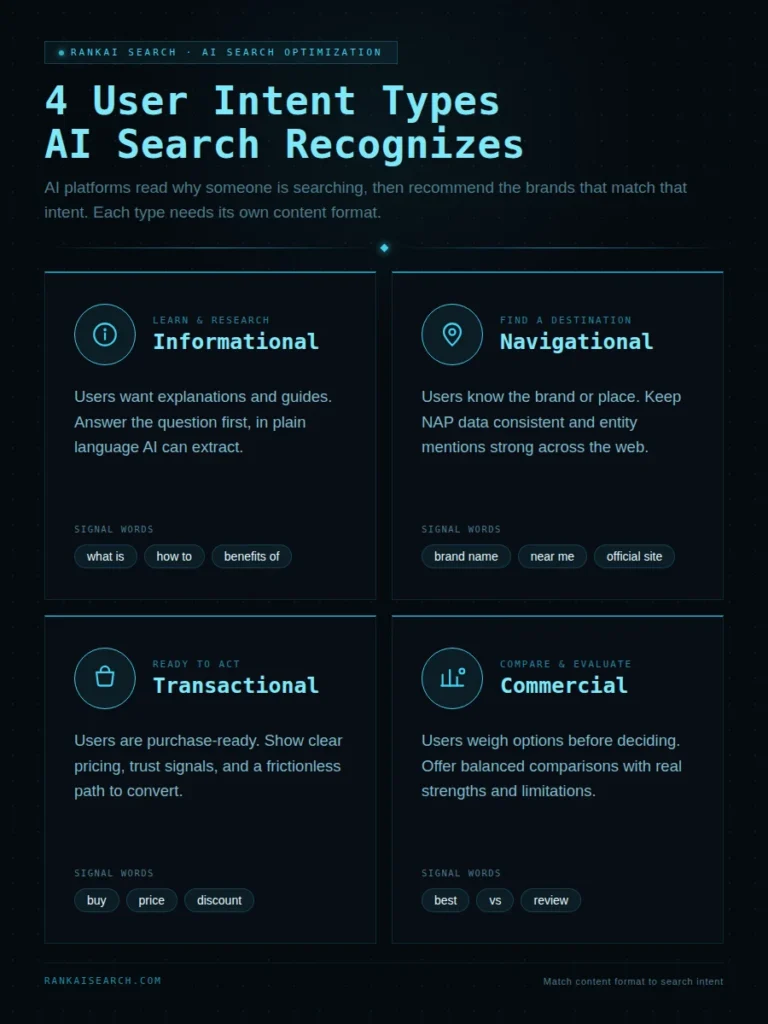
AI search engines recognize four intent types: informational, navigational, transactional, and commercial investigation. Each demands a different content format and a different optimization approach.
Match the format to the intent. A page that serves the wrong intent gets ignored, no matter how well it ranks for the keyword.
What signals informational intent?
Informational intent is the search for knowledge, explanation, or background, signaled by question words and exploratory language. Queries like “what is cloud computing” or “benefits of remote work” tell AI the user wants to understand something, not buy it.
Content that satisfies informational intent shares three traits:
- Answer-first structure: the direct answer opens each section before any supporting detail.
- Standalone paragraphs: any paragraph can be extracted and cited as a complete answer.
- Comprehensive coverage: the page resolves the question without sending users elsewhere.
This format pays off because AI rewards extractable answers. Content depth and readability matter most for securing AI citations, while traditional metrics like backlinks have little impact (Source: Position Digital, 2026).
What signals navigational intent?
Navigational intent is the search for a specific brand, site, or location, signaled by proper nouns and geographic terms. Queries like “Nike official website” or “coffee shops near me” show the user already knows the destination and needs help reaching it.
Winning navigational searches depends on entity consistency:
- Consistent NAP data (name, address, phone) across every listing.
- Verified business profiles on all relevant platforms.
- Authoritative third-party mentions that confirm the entity.
AI cross-references multiple sources before recommending a brand, and inconsistent data breaks that confidence. A brand’s own website makes up only 5 to 10% of the sources AI search references, so the rest of the web has to corroborate your entity (Source: McKinsey, 2025).
What signals transactional intent?
Transactional intent is the purchase-ready search, signaled by commercial terms like “buy,” “price,” “discount,” and specific product models. These users are ready to act, and your content should remove friction from that action.
Pages that convert transactional intent include clear pricing, detailed specifications, customer reviews, prominent calls to action, and visible trust signals like return policies and shipping terms. This intent now triggers AI shopping features at scale: 61.7% of e-commerce searches trigger Google’s AI Mode shopping feature, making commercial queries 13 times more likely to surface it than general searches (Source: SE Ranking, 2025).
What signals commercial investigation intent?
Commercial investigation is the comparison-and-evaluation search, signaled by phrases like “best,” “vs,” “review,” and “top.” These users are researching options before deciding and want balanced information, not a sales pitch.
Content that earns trust during this phase covers both strengths and limitations, includes expert opinions and independent reviews, and backs claims with recent data. Learning to build trust signals that AI platforms value is central to winning these evaluation searches. This intent is the dominant trigger for AI web search: commercial-intent prompts trigger ChatGPT web search 53.5% of the time, compared to 18.7% for informational queries (Source: Position Digital, 2026).
How Do AI Platforms Analyze User Intent Signals?
AI platforms analyze intent through three layers working together: natural language processing of the query itself, behavioral data from past users, and contextual signals from search history and personalization. No single layer decides intent on its own.
How does natural language processing detect intent?
Natural language processing detects intent by breaking down query structure to identify the subject, action, and desired outcome. Transformer models process entire sentences at once, using attention mechanisms to focus on the most relevant parts regardless of word position. The way natural language processing shapes AI search rankings determines how accurately a query gets interpreted.
Context resolves ambiguity that keywords cannot:
- “Jaguar speed” could mean the animal or the car. AI uses surrounding context to decide.
- A follow-up search for “habitat” confirms animal intent.
- A follow-up search for “dealership” confirms automotive intent.
This precision is why intent-aligned content surfaces consistently. Matching user intent at the topic level, not the keyword level, is one of the core factors driving which pages AI selects (Source: ZipTie, 2026).
How does behavioral data shape AI recommendations?
Behavioral data shapes recommendations through a feedback loop: AI monitors which results users select, how long they stay, and whether they return to search. High engagement signals a good intent match, and quick bounces signal a mismatch.
The signals AI watches and what each reveals:
| Signal | What it measures | What it tells AI |
| Click pattern | Which result the user selects | Perceived relevance to intent |
| Dwell time | Time spent on the page | Whether content satisfied the need |
| Return-to-search | User bounces back to results | Intent mismatch or incomplete answer |
| Repeat selection | Same content chosen across similar queries | Reliable intent match worth recommending |
Modern systems update these patterns in near real time across millions of daily interactions, so your performance depends partly on how well your content served previous users with similar intent.
How does historical and contextual data refine intent?
Historical and contextual data refines intent by connecting a user’s search progression into a pattern. Someone who searched “marketing automation tools” last week and now searches “email campaign best practices” likely has implementation intent, and AI connects those dots.
Personalization signals adjust the same query’s meaning:
- Time of day: “pizza” at noon favors nearby restaurants; at 8 PM it leans toward delivery.
- Location: local results for geographic or “near me” phrasing.
- Device: mobile queries skew toward immediate, local action.
These contextual layers compound across platforms, building a fuller intent profile as a user moves between ChatGPT, Google, and Perplexity during a single research journey.
How Do You Optimize Content for User Intent in AI Search?
You optimize for intent by mapping content types to specific intent categories, structuring pages so answers come first, and matching your vocabulary to the user’s stage in their journey. The goal is content AI can extract and cite without ambiguity.
How do you map content to intent?
You map content to intent by matching each format to the need it serves: informational content for learning queries, product pages for transactional intent, and comparison guides for commercial investigation. Start by examining the questions your audience actually asks.
A practical mapping framework:
| Intent type | Content format | Primary goal |
| Informational | How-to guides, explainers | Teach and define |
| Navigational | Brand and location pages | Confirm and direct |
| Transactional | Product and pricing pages | Convert |
| Commercial investigation | Comparisons, reviews | Build trust to decide |
Content clusters capture users across this journey. A pillar page covers broad informational intent while supporting articles address specific questions, comparisons, and implementation, linked together to signal depth to AI.
How should you structure content for intent clarity?
You structure for intent clarity by leading every section with the direct answer, then supporting it. Headers should mirror how users ask questions: “How This Software Reduces Response Time,” not “Features.”
Structure choices by intent:
- Informational: turn common questions into H2 or H3 headings, then answer immediately in the following sentence.
- Transactional: lead with clear next steps and prominent CTAs, and cut anything that delays the action.
- Commercial: present balanced comparisons that help the user decide rather than push a single option.
This structure aligns with how AI extracts content: 44.2% of all LLM citations come from the first 30% of a page’s text, so the answer has to appear early (Source: Position Digital, 2025).
How does language choice affect intent interpretation?
Language choice affects interpretation because AI models trained on natural human text read conversational phrasing more accurately than jargon strings. Write the way you would explain the topic to a colleague.
Adjust vocabulary to the user’s stage:
- Early-stage informational: define terms and use educational language.
- Late-stage transactional: use specific product terminology and assume baseline knowledge.
- Throughout: favor common question structures and everyday words over industry buzzwords.
How Do You Technically Optimize for Intent Signal Recognition?
You technically optimize for intent recognition through structured data, entity connections, and page architecture that serves overlapping needs. These signals help AI categorize your content and confirm its relevance.
How does schema markup clarify intent?
Schema markup clarifies intent by giving AI machine-readable context about your content’s type, topic, and purpose. Match the schema type to the intent: Article schema for informational content, Product schema for transactional pages, and LocalBusiness schema for navigational queries.
The evidence on schema’s effect is mixed, and that nuance matters:
- An academic study found structured data associated with a +39% lift in citation likelihood, behind metadata and freshness (+47%) and semantic HTML (+42%) (Source: Analyzify, 2026).
- A controlled Ahrefs study of 1,885 pages already cited by AI found that adding schema produced no statistically significant citation uplift, suggesting schema helps pages get discovered rather than rank higher once they are already surfaced (Source: Ahrefs, 2026).
The takeaway: implement FAQ and How-To schema for informational pages because they aid crawling and parsing, but treat schema as supporting infrastructure, not a standalone citation lever. These structured formats feed directly into answer engine optimization, the practice of preparing content for AI-generated answers.
How does entity optimization reinforce intent relevance?
Entity optimization reinforces intent relevance by establishing your brand as a recognized authority on specific topics. Consistent entity mentions across the web tell AI knowledge graphs what you are an authority on and how your topics connect.
Authority signals that validate topic-specific expertise:
- Author credentials and named expertise.
- Original research and proprietary data.
- Expert quotes and independent recognition.
These off-page signals carry weight because AI verifies authority externally. Being mentioned in authoritative publications builds the off-page credibility that influences AI citation patterns more reliably than on-page markup alone (Source: Fractional SEO, 2026).
How do you architect pages for multi-intent queries?
You architect for multi-intent queries by designing pages that serve overlapping needs in one place. A product page can include educational use cases, comparison information, and transactional elements, satisfying more users and signaling depth.
Architecture elements that support multi-intent pages:
- Internal linking: connect informational content to comparisons and product pages to guide users between stages.
- Technical performance: fast loading, mobile responsiveness, and clear navigation, since AI factors user experience into recommendations.
- Layered content blocks: distinct sections for learning, comparing, and buying within a single page.
How Do You Measure User Intent Performance in AI Search?
You measure intent performance by tracking AI citations, click-through from answer engines, time on site from AI traffic, and conversion rates by intent type. Start by identifying which content gets recommended most and analyzing why.
Core metrics and what each reveals:
| Metric | What it tracks | Why it matters |
| AI citations | How often platforms cite your content | Direct measure of intent match |
| Answer-engine CTR | Clicks from AI summaries | Whether the citation drives visits |
| Time on site (AI traffic) | Engagement from AI referrals | Post-click intent satisfaction |
| Conversion by intent | Actions split by intent type | ROI of each optimization |
Measurement remains the weak link for most teams. Only 16% of brands have any systematic way to track how they perform in AI search results, leaving most optimization unmeasured (Source: McKinsey, 2025). Set up brand-mention alerts across ChatGPT, Perplexity, and Google AI Overviews, then refine content based on what the data shows.
What Intent Optimization Mistakes Hurt AI Rankings?
The mistakes that hurt AI rankings all share one root: a gap between what the user wants and what the content delivers. AI platforms detect these disconnects and route around them.
The four most damaging errors:
- Intent mismatch: a page optimized for “best running shoes” that only explains shoe anatomy fails transactional intent, and AI avoids recommending it.
- Over-optimization: keyword stuffing and forced terminology trigger quality filters because they break the natural patterns AI expects.
- Ignoring secondary intent: content that addresses only surface-level intent loses to comprehensive resources that explore related questions.
- Stale content: failing to update as intent patterns shift leaves your material in outdated frameworks.
Freshness carries measurable weight here. Some AI models show a clear bias toward content freshness over others, making regular updates a direct ranking factor rather than housekeeping (Source: Position Digital, 2026).
What Are the Future Trends in User Intent and AI Search?
The future of intent recognition moves toward multimodal, predictive, and cross-platform signals. AI will read intent from images, voice, and early-session behavior, not just typed text.
Trends to prepare for:
- Multimodal search: image and text queries combine for richer intent signals. Optimize images with descriptive filenames and alt text.
- Voice and visual intent: voice queries run longer and more conversational; visual queries focus on identifying objects.
- Predictive intent: next-generation platforms will anticipate needs from early session signals, rewarding comprehensive content clusters.
The trajectory is set by AI search becoming a primary buying channel. By 2028, McKinsey projects $750 billion in US revenue will flow through AI-powered search, making intent optimization a revenue strategy, not a visibility tactic (Source: McKinsey, 2025).
Moving Forward with Intent Optimization
User intent signals decide which brands AI platforms recommend. The shift from keyword matching to semantic understanding rewards content that aligns with what users actually need at each stage of their journey.
RankAISearch (rankaisearch.com) is a global agency specializing in answer engine optimization (AEO), generative engine optimization (GEO), AI optimization (AIO), large language model optimization (LLMO), and traditional SEO. We help businesses map content to intent, structure pages for citation, and measure performance across AI platforms so your brand gets recommended when it matters most. Get in touch to build an intent-driven strategy for your brand.
Frequently Asked Questions
What is the difference between user intent and search intent in AI platforms?
User intent and search intent are the same concept in AI platforms. Both refer to the underlying goal behind a query. The terms differ only in emphasis: “user intent” highlights the human, “search intent” highlights the query.
How do AI search engines determine what users really want from a query?
AI search engines use natural language processing to analyze query structure, semantic meaning, and contextual clues. They factor in search history, location, trends, and behavioral patterns. Engagement data from past users teaches the system which content best satisfies each intent.
Can optimizing for user intent improve rankings on ChatGPT and Perplexity?
Yes, intent optimization directly improves how often ChatGPT and Perplexity cite your content. These systems prioritize content that accurately matches intent over keyword-heavy material. Content structured to answer specific questions gets cited more frequently.
How long does it take to see results from intent-based optimization?
Intent optimization typically shows initial results within 4 to 8 weeks. AI platforms update recommendations faster than traditional search engines. Comprehensive optimization across an entire site takes 3 to 6 months to fully affect visibility.
What tools help identify user intent for AI search optimization?
AnswerThePublic, AlsoAsked, and Google’s People Also Ask reveal real user questions. ChatGPT and Perplexity help analyze intent patterns in your industry. Google Search Console shows which queries drive traffic and how they perform.
How does intent optimization differ between Google AI Overviews and traditional search?
Google AI Overviews prioritize direct answers and comprehensive coverage over traditional ranking factors. Intent must be addressed in the first few paragraphs. Traditional search allows more keyword-focused optimization and weights backlinks heavily.
Why does my content rank for keywords but not get recommended by AI platforms?
Keyword rankings and AI recommendations use different evaluation methods. Traditional engines match keywords; AI platforms analyze semantic meaning and user satisfaction. Your content may include target keywords yet fail to answer the underlying question directly.
Does schema markup guarantee more AI citations?
No, schema markup does not guarantee more citations. Controlled studies show no consistent citation uplift for pages already surfaced by AI. Schema is best treated as infrastructure that helps content get crawled and parsed, not as a standalone ranking lever.