


How Does Natural Language Processing Shape AI Search Rankings?
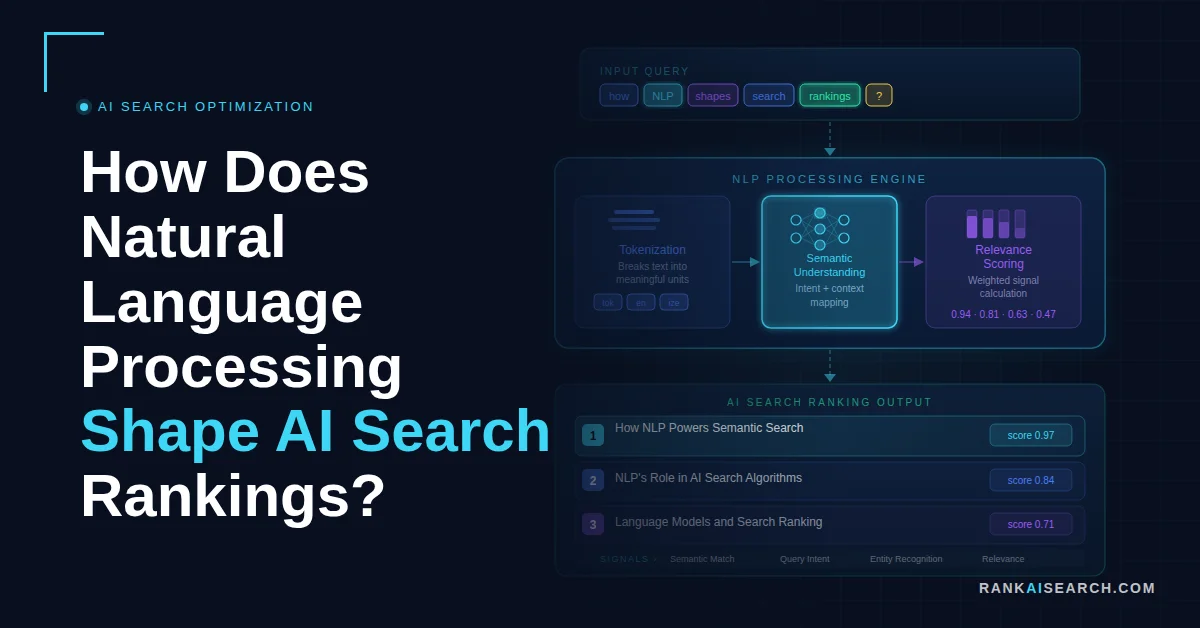
Think about the last time you asked ChatGPT a question and it recommended a specific brand or tool. You probably didn’t question why that brand showed up and not a competitor. But behind that answer, a set of algorithms had already evaluated hundreds of sources, scored them, and decided which one to surface. That process is driven entirely by natural language processing (NLP).
NLP is the engine that determines which brands AI platforms recommend, cite, and ignore. Understanding how it works gives you a direct advantage in making your brand visible where decisions are increasingly being made. This guide breaks down how NLP shapes AI search rankings and what you can do to optimize for it.
What Is Natural Language Processing in AI Search?
Natural language processing enables AI systems to understand human language by meaning and context, not by matching exact keywords. Instead of looking for the phrase “best CRM software,” an NLP-powered system understands that a user asking “what tool helps my sales team track leads” wants the same thing.
Every major AI answer engine uses NLP as its core evaluation layer. ChatGPT, Google AI Overview, Gemini, and Perplexity all rely on it to interpret queries and decide which content to surface.
| Approach | What It Evaluates | Why It Matters for AI Ranking |
| Keyword matching | Exact phrase repetition | Baseline for traditional SEO; insufficient for AI platforms |
| Semantic analysis | Meaning, intent, topic relationships | Core ranking signal in AI content evaluation |
| Entity recognition | Specific brands, people, concepts | Determines whether your brand appears in AI answers |
| Contextual parsing | Surrounding words and sentence structure | Resolves ambiguity; improves answer precision |
The shift from keyword matching to semantic understanding changes what content optimization means. NLP-driven systems reward genuine topic expertise. They penalize content that repeats phrases without adding meaning.
How Do AI Platforms Use NLP to Understand Search Queries?
AI platforms run every query through three simultaneous NLP processes: intent classification, entity extraction, and context analysis. Each one shapes which content gets surfaced and in what form.
These processes do not happen in sequence. They run together, and the combination determines the platform’s response.
How Does Intent Classification Work?
Intent classification identifies what a user actually wants from a query, not just the words they used. A search for “best project management tools” signals comparative intent. The system looks for content that recommends and compares options, not content that merely mentions those words.
AI platforms classify intent into four categories:
- Informational: The user wants to learn something (“what is NLP?”)
- Navigational: The user wants to reach a specific destination (“Notion login”)
- Transactional: The user is ready to act (“buy project management software”)
- Comparative: The user is evaluating options (“Asana vs Monday for small teams”)
Each classification points the system toward a different type of content. Mismatching your content type to the dominant intent of a query reduces your chance of being cited.
How Does Entity Recognition Shape Query Understanding?
Entity recognition identifies specific people, brands, locations, and concepts within a query. It uses those entities to retrieve precisely relevant content.
When someone asks “how does Apple approach privacy,” NLP identifies three distinct elements:
- Apple as a technology company entity
- Privacy as a concept entity
- “How does” as an explanatory intent signal
This layered interpretation focuses retrieval on content that addresses all three dimensions at once. It does not simply surface content that contains those individual words somewhere on the page.
How Do AI Platforms Handle Multi-Turn Conversations?
Multi-turn conversation handling lets AI systems maintain context across follow-up queries in the same session. If a user asks “What is NLP?” and then “How does it work in search?”, the system correctly interprets “it” as NLP from the prior question.
Brands that structure content to answer progressive question sequences, from foundational to specific, align directly with this capability. Content that anticipates follow-up questions gets extracted and cited at higher rates than content that answers only the surface question.
How Does NLP Determine Which Brands Get Recommended by AI Platforms?
AI platforms recommend brands whose content scores highest on semantic relevance, entity recognition strength, and topical authority. These are not abstract signals. They are measurable patterns that NLP algorithms evaluate across every piece of content they process.
Gartner projects that traditional search engine volume will drop 25% by 2026 as users shift to AI-powered alternatives. Brands without NLP-aligned content lose visibility at the point of AI recommendation, before a user ever reaches a search results page.
| Signal | How AI Evaluates It | What Brands Need to Do |
| Semantic completeness | Does the content fully address the topic? | Answer the main question and related follow-up questions |
| Entity recognition | Is the brand a known, trackable entity? | Appear consistently across authoritative third-party content |
| Topical authority | Does the brand consistently own this topic area? | Produce deep content across a focused set of core subjects |
| Language naturalness | Does the content read like expert communication? | Write for human readers; avoid keyword manipulation |
Topical authority builds over time. NLP algorithms identify which brands produce consistent, high-quality content on specific topics. The more often your brand covers a subject with genuine depth, the stronger the topical authority signal becomes.
What Linguistic Patterns Do AI Platforms Favor?
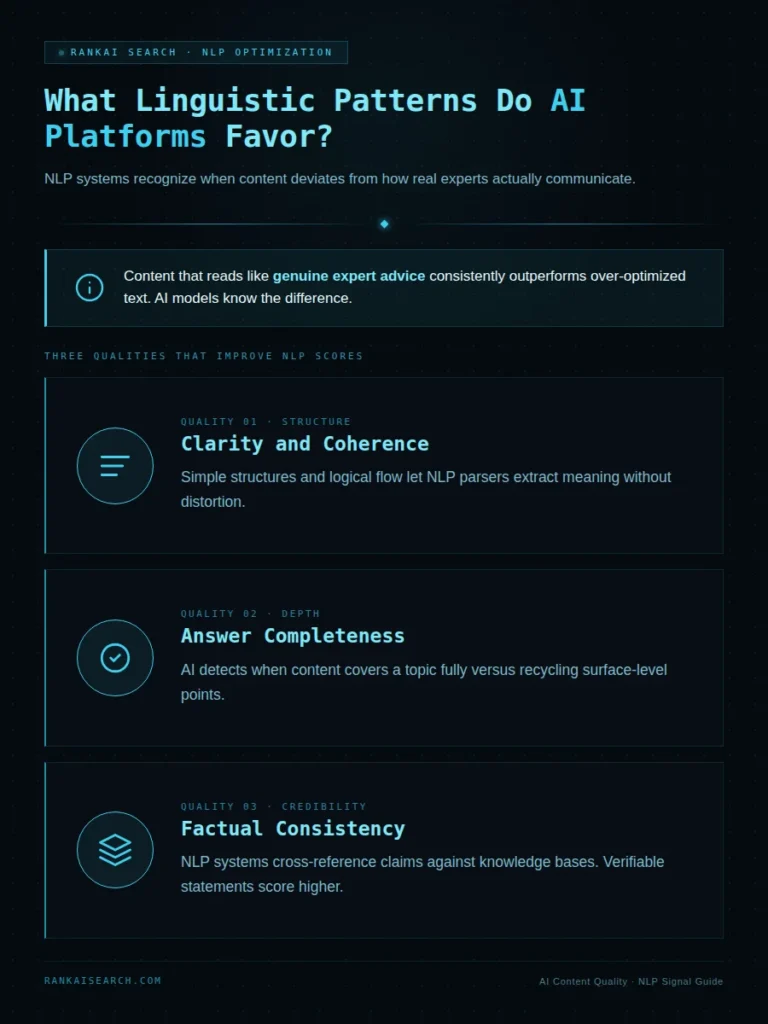
AI platforms favor content that reads like genuine expert communication: clear sentences, logical structure, and complete answers supported by reasoning. NLP systems are trained on human-written language. They recognize when content deviates from how real experts actually communicate.
Three linguistic qualities consistently improve NLP scores:
- Clarity and coherence: Simple sentence structures and logical paragraph flow let NLP parsers extract meaning accurately. Convoluted sentences and unclear pronoun references reduce clarity scores and increase the risk of misrepresentation in AI answers.
- Answer completeness: Each paragraph should contribute a distinct, meaningful idea. AI platforms detect when content covers a topic thoroughly versus when it recycles surface-level points with different wording.
- Factual consistency: Advanced NLP systems cross-reference claims against established knowledge bases. Supported, verifiable claims receive higher quality scores than unsupported assertions.
Content that reads like genuine expert advice consistently outperforms over-optimized text. NLP models recognize when language patterns match natural expert communication and when they are engineered to satisfy ranking criteria instead.
What NLP Optimization Strategies Work for Answer Engines and LLMs?
The most effective NLP optimization strategy is writing the way a subject matter expert would explain a topic to a knowledgeable colleague: complete sentences, direct answers, and natural use of related terminology. This approach matches how NLP models are trained and how AI platforms extract citable responses.
How Should You Structure Content for Semantic Comprehension?
Organize content so the relationships between ideas are explicit throughout the piece. NLP algorithms need clear structure to identify which section answers which specific query.
Apply these structural principles consistently:
- Start every section with a clear topic sentence that states the core claim
- Group related subtopics together rather than scattering them across the article
- Use transition phrases that show how ideas connect, not just that they follow each other
- Move from foundational concepts to specific applications within each section
SE Ranking’s analysis of Google AI Overviews found that directly structured, clearly answered content is strongly favored for AI citations over content that buries answers within dense prose.
Why Does Question-Answer Formatting Improve AI Citation Rates?
Question-answer formatting improves AI citation rates because it gives NLP systems a clear extraction target. When a heading poses a question and the first sentence answers it, AI algorithms can identify and pull the pair with high confidence.
This format works across content types:
- FAQ sections where user queries match headings directly
- How-to guides where each step answers an implied “what do I do next?”
- Comparison content where each subheading answers “which is better for X?”
Less interpretation work for the AI system means higher citation confidence for your content.
How Do Vocabulary Choices Affect NLP Recognition?
Vocabulary choices affect NLP recognition because AI systems match content to queries based on semantic similarity, not exact phrase repetition. Using terminology that mirrors how users phrase questions increases the likelihood that your content surfaces for those queries.
Balance industry terminology with natural synonym variation:
- Write “natural language processing” and also use “text analysis,” “semantic understanding,” and “language models” where contextually appropriate
- Explain technical terms when first introducing them; do not assume the reader already knows the definition
- Match vocabulary to the expertise level of your target audience, not to a keyword density target
This variation demonstrates comprehensive topic coverage. It also ensures your content matches diverse query phrasings from users at different knowledge levels.
How Does Named Entity Recognition Impact Brand Visibility?
Named entity recognition (NER) determines whether AI platforms recognize your brand as a distinct, trackable entity or treat your brand name as unstructured text. Entity status is foundational: AI systems cannot recommend what they do not recognize as an entity.
Brand visibility in AI search begins with entity status. If an AI system cannot identify your brand as a recognized entity, your content cannot be recommended, regardless of its quality.
Building strong entity recognition requires two things: consistent brand representation and strategic co-occurrence with relevant industry terms.
Consistency signals:
- Use identical brand name formatting across your website, social profiles, and all external mentions
- Maintain the same core messaging and service descriptions across every channel
- Define your brand with the same terminology every time it appears in content you control
Co-occurrence signals:
- Appear regularly in authoritative third-party publications and industry directories
- Reference complementary tools, methodologies, and concepts naturally within your content
- Associate your brand explicitly with the specific expertise areas you want to own
What Content Features Improve AI Search Performance?
Direct answer formatting is the single most impactful structural choice for AI citation performance. Content that opens each section with a clear, complete answer before providing supporting detail gives NLP systems a reliable extraction target.
Additional content features that consistently improve AI search performance:
- Standalone paragraphs: Each paragraph should express one complete idea. AI platforms extract and cite individual paragraphs. If a paragraph requires surrounding context to make sense, it becomes harder to cite accurately.
- Descriptive headings: Headings that accurately reflect section content help NLP systems match specific sections to specific query types.
- Structured data elements: Bullet lists, numbered steps, and comparison tables give NLP algorithms clearly formatted elements to parse and extract with reduced ambiguity.
- Comprehensive coverage: Content that addresses the main question and anticipated follow-up questions signals information quality to AI systems evaluating whether a source fully satisfies a query.
BrightEdge research found that 68% of trackable website traffic originates from organic search combined, but AI-driven recommendations are increasingly intercepting that traffic before users reach a results page. Content optimized for direct extraction captures visibility at the recommendation layer, not just at the click layer.
What NLP Optimization Mistakes Should You Avoid?
The most damaging NLP mistake is keyword stuffing: repeating exact phrases unnaturally in ways that deviate from how experts actually write. Modern NLP systems are trained on natural language. They reliably identify these patterns and deprioritize content that exhibits them.
Additional mistakes that reduce AI ranking performance:
- Over-complicated sentence structures: Long sentences with multiple clauses force NLP parsers to work harder and increase the risk of misinterpretation. Split any sentence that carries more than one core idea into two.
- Inconsistent entity references: Switching between different names for the same concept reduces NLP confidence in entity identification. Alternating between abbreviations and full terms unpredictably weakens brand recognition signals.
- Thin or duplicative content: Content that repackages existing information without adding new perspective is identified as derivative through semantic similarity analysis. AI platforms deprioritize it in favor of sources that contribute original insight.
- Excessive sales language: Promotional phrasing, manipulative framing, and clickbait structures are classified as low-quality signals by NLP systems. They get filtered from high-quality recommendation outputs.
- Grammar and syntax errors: Consistent spelling mistakes and syntax problems reduce the credibility scores NLP algorithms assign. Patterns of errors, even minor ones, reduce the likelihood of AI platforms citing your content.
How Is NLP Evolving in AI Search?
NLP in AI search is advancing along three trajectories that will reshape content strategy over the next two to three years.
| Advancement | What It Means | How to Prepare |
| Multimodal understanding | AI evaluates text, images, audio, and video together | Create cohesive content where formats reinforce each other |
| Expanded context windows | AI processes full long-form documents as unified content | Invest in comprehensive, well-structured long-form resources |
| Cross-lingual processing | AI surfaces content across languages when meaning aligns | Build authoritative content with global topic coverage in mind |
Brands best positioned for these advances are those investing in genuine content quality now. Shortcuts that exploit current NLP limitations become liabilities as systems improve. Authoritative, well-researched content built for human readers benefits from every NLP advancement rather than being penalized by it.
Frequently Asked Questions
What is natural language processing and why does it matter for AI search?
Natural language processing enables AI systems to understand human language by meaning and context rather than keyword patterns. Every major AI platform, including ChatGPT, Google AI Overview, and Perplexity, uses NLP to interpret queries and evaluate which content best answers them. Without NLP-aligned content, your brand is not visible in these channels.
How do AI platforms use NLP to determine which brands to recommend?
AI platforms analyze content for semantic completeness, entity recognition strength, topical authority signals, and language naturalness. Brands with content that demonstrates comprehensive topic coverage and clear entity associations consistently get prioritized over brands with thin, keyword-focused content.
What writing style works best for NLP-optimized content?
Conversational, direct, expert writing performs best for NLP optimization. Write complete sentences, use logical flow, and avoid keyword stuffing or jargon without explanation. Content written genuinely for a knowledgeable reader aligns naturally with how NLP models evaluate quality.
How does named entity recognition affect brand visibility in AI search results?
Named entity recognition determines whether AI systems recognize your brand as a distinct entity rather than unstructured text. Strong entity recognition increases the likelihood of your brand appearing in AI-generated answers. Build recognition through consistent brand mentions across authoritative content and clear association with specific expertise areas.
What are the most common NLP optimization mistakes businesses make?
The most common mistakes are keyword stuffing that creates unnatural language, over-complicated sentence structures, inconsistent entity terminology, and thin content that lacks original depth. Many brands also fail to use direct answer formatting, which reduces AI extraction confidence and citation rates.
How can I structure content to be easily understood by NLP algorithms?
Use clear headings that accurately describe each section, start every paragraph with a topic sentence, and apply question-answer formatting for direct queries. Ensure each paragraph expresses one complete, standalone idea that can be extracted and cited independently.
Does conversational writing improve rankings on AI answer engines?
Yes. Conversational writing aligns with how NLP systems are trained on natural human communication. Content using natural phrasing, complete sentences, and logical explanation matches user query patterns more reliably, improving relevance matching and increasing AI citation rates.
How do AI platforms evaluate content quality through natural language processing?
AI platforms assess factual consistency, source credibility signals, explanation depth, answer completeness, and language naturalness. Content demonstrating verifiable claims, appropriate terminology, and comprehensive coverage receives higher quality scores and appears more frequently in AI-driven recommendations.