

How Does Voice Search Optimization Impact AI Discovery in 2026?
Voice search optimization determines which brands AI platforms select when delivering spoken answers to users. Smart speaker ownership reached 35% of U.S. households by 2025, and voice assistant users conducted an average of 4.7 queries per day.
Separately, BrightEdge research found that 75% of voice search results are drawn from featured snippets, making content structure the primary ranking factor for voice visibility. This guide covers how to align content with voice query patterns, optimize across major AI platforms, measure performance, and avoid the mistakes that keep content from being selected.
The strategies in this article reflect RankAISearch’s approach to helping brands earn citations across AI-powered search systems.
What Is Voice Search Optimization in the AI Era?
Voice search optimization aligns content with the conversational queries processed by AI platforms, replacing short-keyword targeting with natural language patterns that match how people speak. Instead of targeting “best pizza Chicago,” optimized content answers “What’s the best pizza place near me right now?” This shift requires question-based headings, concise answer blocks, and structured data that AI systems can extract and read aloud.
| Factor | Text Search | Voice Search |
| Query length | 2-3 words | 7-9 words |
| Query format | Keyword phrase | Complete question |
| User intent | Exploratory | Immediate, action-oriented |
| Answer format | List of results | Single spoken response |
Natural language processing converts spoken queries into text, identifies intent, and matches content to the question. Content clarity and structure determine whether your page gets selected as the spoken response.
Why Does Voice Search Matter for Answer Engine Visibility?
Voice search matters because it bypasses traditional search result pages entirely, giving the selected brand exclusive spoken exposure with no visible competition. Your content enters the selection pool only when it matches the conversational patterns these platforms prefer.
Key stats that explain the stakes:
- 72% of voice search users remember the brand mentioned in the assistant’s response, vs. 23% for standard search results.
- 75% of voice search results come from featured snippets.
- Voice assistants on Google AI Overview, ChatGPT, and Perplexity typically cite one primary source per query.
Featured snippet optimization is the highest-leverage action available for voice visibility. AI systems cannot read lengthy paragraphs aloud, so they extract concise answer blocks from position zero content.
How Do Voice Search Queries Differ from Text Searches?
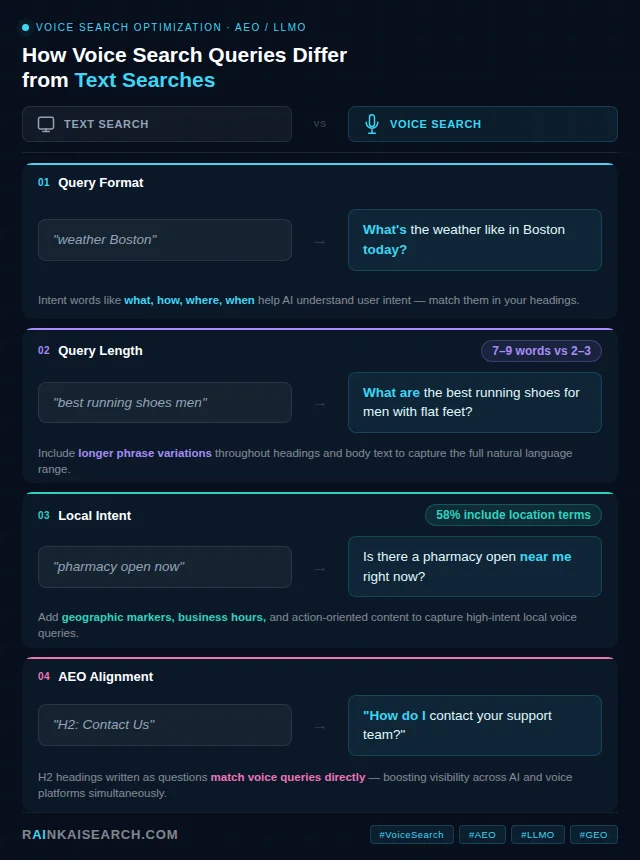
Voice queries average 7-9 words, are phrased as complete questions, and skew toward immediate action, compared to the 2-3-word keyword phrases users type.
Key differences that affect how you write content:
- Length: Voice queries are 3-4x longer than text queries.
- Format: Voice uses full questions with “who,” “what,” “where,” “when,” and “how.” Text uses keyword fragments.
- Intent: Voice signals immediate need. Text is often exploratory.
- Local signals: 58% of voice searches include location-specific terms or immediate needs like “Is there a pharmacy open now?”
When H2 headings mirror common voice questions, AI systems match user queries to content sections precisely. This structural alignment increases selection rates across multiple platforms simultaneously.
How Do You Optimize Content for Voice Search and AI Platforms?
Three core areas govern voice search performance: content structure, technical implementation, and large language model alignment. Each addresses a different stage of AI selection. All three must work together for content to move from ranking to being cited.
Structuring Content for Conversational Queries
Question-based headings and concise answer blocks are the two most important structural elements for voice search selection.
Content structure checklist:
- Use question-based headings. “How Does Voice Search Benefit Local Businesses?” outperforms “Voice Search Benefits.”
- Answer in the first 40-60 words. AI systems extract responses readable in 10-15 seconds. Lead with the answer, then support it.
- Build comprehensive FAQ sections. Each answer should be 2-3 sentences. Use AnswerThePublic and AlsoAsked to find conversational query variations.
- Write conversationally. Use contractions, active voice, and plain vocabulary. Avoid jargon that sounds robotic when read aloud.
Technical Elements for Voice Search Success
Schema markup is the primary technical signal that tells AI systems what your content covers and how it is structured. Proper implementation can increase voice search visibility by 40-55%, according to industry case studies.
| Schema Type | Primary Use Case | Voice Search Benefit |
| FAQ Schema | Question-and-answer content | Surfaces Q&A pairs for voice assistants |
| How-To Schema | Step-by-step instructions | Supports instructional voice queries |
| Local Business Schema | Business location and hours | Enables location-based voice recommendations |
| Speakable Schema | Designated text-to-speech sections | Marks content optimized for voice delivery |
Additional technical requirements:
- Page speed: Target load times under 2.5 seconds. Slow pages are skipped by voice assistants regardless of content quality.
- Mobile-first design: Voice searches happen primarily on mobile. Responsive design is non-negotiable.
- Local markup: Accurate NAP, business hours, geographic coordinates, and category classifications. Consistent local markup increases “near me” voice search appearances by approximately 60%.
Aligning Voice Content with Large Language Models
Large language models prefer content that answers questions without requiring external context. Each section should stand independently so AI can extract it as a complete response.
What LLM-ready content chunks require:
- A direct answer in the opening 40-60 words
- Named statistics with years and source attributions
- Specific examples that demonstrate subject matter depth
- 50-100 word length per chunk so AI systems can extract and deliver it confidently
How Does Voice Search Optimization Work Across AI Platforms?
Voice search optimization requirements vary by platform. Google Assistant, Alexa, Siri, and ChatGPT each favor different content types, schema elements, and authority signals. A cross-platform strategy addresses shared fundamentals first, then layers in platform-specific requirements.
Google Assistant and AI Overview
Google Assistant pulls spoken answers from sources appearing in AI Overview results. Voice responses typically cite one primary source, making top-three positioning the practical threshold for voice visibility.
Google voice optimization priorities:
- Strong E-E-A-T signals across all content
- Question-based headings that match informational query patterns
- Featured snippet-ready answer blocks in the first paragraph
- Core Web Vitals compliance for technical health
- Google Business Profile optimization for local queries
Smart Speaker and Virtual Assistant Optimization
Alexa and Siri share core ranking factors but weigh them differently.
| Platform | Key Ranking Signals | Content Priority |
| Alexa | Structured data, Skills integration | Step-by-step instructional content |
| Siri | Domain authority, content freshness | High-authority domains, recent updates |
| Both | Page speed, mobile optimization, clear answer structure | Concise, scannable content |
For deeper integration, develop Alexa Skills or Siri Shortcuts that pull directly from your optimized content. This creates owned pathways to voice interactions beyond organic ranking.
ChatGPT and Conversational AI Platforms
ChatGPT prioritizes comprehensive topic coverage, current data, and demonstrated expertise. Surface-level content is not cited.
To position content for ChatGPT retrieval:
- Cover topics from multiple angles in a single piece
- Cite named sources with years and attribution
- Make factual claims that can be independently verified
- Write in accessible language that ChatGPT can paraphrase cleanly for voice delivery
Authority builds over time through consistent publishing, expert credentials, and citation-worthy sourcing. Regular content updates and author expertise pages improve your ranking as a preferred reference.
Local Voice Search and Geographic Discovery
Local intent drives 76% of smart speaker searches, with users seeking nearby businesses they intend to visit or contact immediately. Small and medium businesses with optimized local presence compete effectively against larger brands because proximity and accuracy outweigh domain authority in local queries.
Local voice search optimization checklist:
- Include city, neighborhood, and service area naturally throughout content
- Create location-specific landing pages answering common voice queries
- Maintain identical NAP across Google Business Profile, Apple Maps, and Bing Places
- Earn detailed customer reviews mentioning specific services and experiences
- Claim and optimize listings across all major directories
How Do You Measure Voice Search Performance in AI Systems?
Voice search performance is measured through featured snippet rankings, position zero captures, question-based query traffic, and branded search volume trends. Traditional analytics often cannot isolate voice traffic, so measurement requires a combination of direct and proxy signals.
Direct tracking methods:
- Monitor featured snippet and answer box appearances in Google Search Console
- Filter GSC queries for 5+ word phrases containing “how,” “what,” “where,” “when,” and “why”
- Run regular manual checks in ChatGPT, Perplexity, and Google AI Overview for target keywords
- Use SEMrush or Ahrefs to track question-based featured snippet rankings
Proxy metrics for voice attribution:
- Branded search volume increases (voice exposure drives untracked brand awareness)
- Direct traffic spikes correlated with voice-optimized content launches
- Customer survey data specifically asking about voice assistant discovery
- UTM parameters on content that frequently appears in AI-generated responses
What Are the Future Trends in Voice Search and AI Discovery?
| Trend | What’s Changing | How to Prepare |
| Multimodal search | Users combine voice with photos and text in a single query | Add descriptive alt text and context that connects visual and spoken elements |
| Predictive AI | Assistants suggest complete questions from partial voice input | Build content clusters covering topic variations and common follow-up questions |
| Personalization | AI learns preferences, purchase history, and stated contexts | Create content addressing different user segments and use cases |
| Voice commerce | Transactions completed entirely through voice commands | Optimize product pages with clear pricing, availability, and next-step instructions |
By 2026, voice commerce reached an estimated $120 billion in annual transactions. Transactional voice queries require content that goes beyond information delivery to support purchase completion.
What Voice Search Optimization Mistakes Should You Avoid?
The most common mistakes prevent voice assistants from selecting your pages as authoritative sources. All four must be addressed.
| Mistake | Why It Fails | The Fix |
| Keyword over-optimization | Exact-match phrases sound robotic when read aloud | Write for humans first; use natural synonyms and variations |
| Ignoring long-tail phrases | Voice queries average 7-9 words; short keywords miss most of the traffic | Research conversational phrases with AnswerThePublic and AlsoAsked |
| Slow page speed and poor mobile | Voice assistants skip slow pages regardless of content quality | Target sub-2-second load times; implement mobile-first design |
| Dense content without answer blocks | AI systems cannot identify quotable sections in unstructured paragraphs | Use question headings followed by answers in the first 40-60 words |
Frequently Asked Questions
How does voice search optimization differ from traditional SEO?
Voice search optimization targets conversational query patterns and natural language, while traditional SEO focuses on shorter keyword phrases. Voice optimization prioritizes question-based content, featured snippet formats, and direct answers that AI can read aloud. Traditional SEO emphasizes keyword density and backlink profiles; voice search requires content structured for quick AI extraction.
What percentage of searches will be voice-based by the end of 2026?
Voice-based searches are projected to represent 50-55% of all search queries by the end of 2026, up from 45% in early 2026. Growth is driven by increased smart speaker adoption, improved AI accuracy, and expanded voice interfaces across devices. Younger users currently conduct 65-70% of their searches by voice.
Can voice search optimization help my brand appear in ChatGPT responses?
Yes. Voice search optimization improves your chances of appearing in ChatGPT responses because both prioritize authoritative, conversational content with clear answer structures. Content optimized for voice queries is more accessible to large language models scanning for reliable sources. ChatGPT references well-structured, expert content that answers questions directly, which aligns with voice search best practices.
How long should answers be for optimal voice search results?
Optimal voice search answers are 40-60 words, or 2-3 sentences readable in 10-15 seconds. This length provides a complete answer without making spoken responses too long. After the core answer, supporting detail can follow, but the initial response must fit within this concise format for voice assistant compatibility.
What schema markup types are most important for voice search?
FAQ schema, How-To schema, Local Business schema, and Speakable schema are the four highest-priority types. FAQ schema helps voice assistants surface question-and-answer pairs. How-To schema supports instructional queries. Local Business schema enables location-based recommendations, and Speakable schema designates sections optimized for text-to-speech delivery.
Do voice searches have higher conversion rates than text searches?
Voice searches convert at 30-40% higher rates than text searches because they indicate stronger intent and immediate action needs. Local voice searches for businesses convert at 58% compared to 30% for text-based local searches. Voice optimization is a high-ROI investment for any business that depends on local or high-intent traffic.
How can local businesses benefit from voice search optimization?
Local businesses gain visibility in “near me” searches, smart speaker recommendations, and location-based AI responses. Voice search users are ready to visit, call, or purchase when they search by voice. Optimized local businesses appear in voice results 3-4 times more often than non-optimized competitors.
How do I find the voice search queries my audience is using?
Filter Google Search Console data for queries containing five or more words with question words: “how,” “what,” “where,” “when,” and “why.” These conversational patterns indicate voice search behavior even when analytics tools do not label the source explicitly. S