Large Language Model Optimization (LLMO) is the strategic process of structuring your content and brand presence so AI platforms like ChatGPT, Claude, and Gemini recommend your business when users ask relevant questions. Gartner projects that traditional search engine volume will drop 25% by 2026 as AI chatbots and virtual agents handle more queries, and ChatGPT alone reached 400 million weekly active users by February 2025. Businesses not optimized for LLMs risk becoming invisible in the AI-driven conversations where purchase decisions now happen.
Unlike traditional SEO, which targets keyword rankings, LLMO focuses on semantic understanding, contextual relevance, and recommendation-worthiness across AI platforms. RankAISearch covers how LLMO works, which signals AI platforms evaluate, and the strategies that make your brand the answer AI systems trust and cite.
Why Do Large Language Models Matter for Business Visibility?
AI platforms are replacing traditional search as the primary channel for information discovery, and businesses not optimized for LLMs are at risk of becoming invisible in the conversations where purchase decisions happen.
LLMs evaluate four core signals when deciding which brands to recommend:
| Signal | What AI Evaluates | Why It Matters |
| Authority | Frequency and quality of citations from credible sources | Determines recommendation confidence |
| Contextual Relevance | Semantic match between content and user query intent | Determines when your brand gets cited |
| Trust | Consistency of brand information across platforms | Prevents AI from discarding conflicting signals |
| E-E-A-T | Experience, expertise, authoritativeness, trustworthiness | Core evaluation framework across major LLMs |
When AI platforms cannot identify clear signals of your expertise, they recommend competitors instead. As AI adoption grows, that gap widens.
How Do Large Language Models Generate Brand Recommendations?
LLMs generate brand recommendations by evaluating training data signals, contextual relevance, and trust indicators simultaneously. Understanding each factor helps you structure your content and brand presence to meet these evaluation criteria.
The Role of Training Data and Real-Time Information
LLMs learn which brands to recommend from vast training datasets that include websites, published articles, academic papers, reviews, and social media. The training process identifies which sources consistently provide accurate, valuable information and which brands are frequently cited in authoritative contexts.
These models prioritize brands that:
- Appear regularly in high-quality, credible content
- Are cited as solution providers in authoritative publications
- Maintain consistent information across platforms
- Build a history of authoritative content over time
Appearing in high-quality datasets creates compounding advantages. When training data includes your brand as an authoritative source on specific topics, that association persists across model updates and improvements.
Contextual Relevance and Semantic Understanding
LLMs evaluate contextual relevance rather than matching exact keywords. They understand the meaning behind queries and can interpret different ways of asking the same question. When someone asks about “improving AI visibility” or “getting recommended by ChatGPT,” the model understands these relate to the same underlying need.
Content performs well for contextual relevance when it:
- Addresses concepts comprehensively, not just specific keyword phrases
- Answers the question being asked rather than just matching its words
- Uses natural language that covers related terms and synonyms
- Provides genuine value rather than keyword-optimized filler
Trust Signals and Authority Indicators
LLMs recognize specific trust signals when evaluating which brands to recommend. Citations from authoritative sources carry significant weight. When respected publications, industry experts, or academic sources reference your business, it signals credibility that AI models factor into their assessments.
Key trust signals LLMs evaluate:
- Citations and backlinks from respected publications and high-authority websites
- Brand mentions across multiple platforms, especially in positive contexts
- Consistent information across your website, industry profiles, and partner mentions
- E-E-A-T indicators including author bios, credentials, and evidence-based content
What Are the Core Strategies for Large Language Model Optimization?
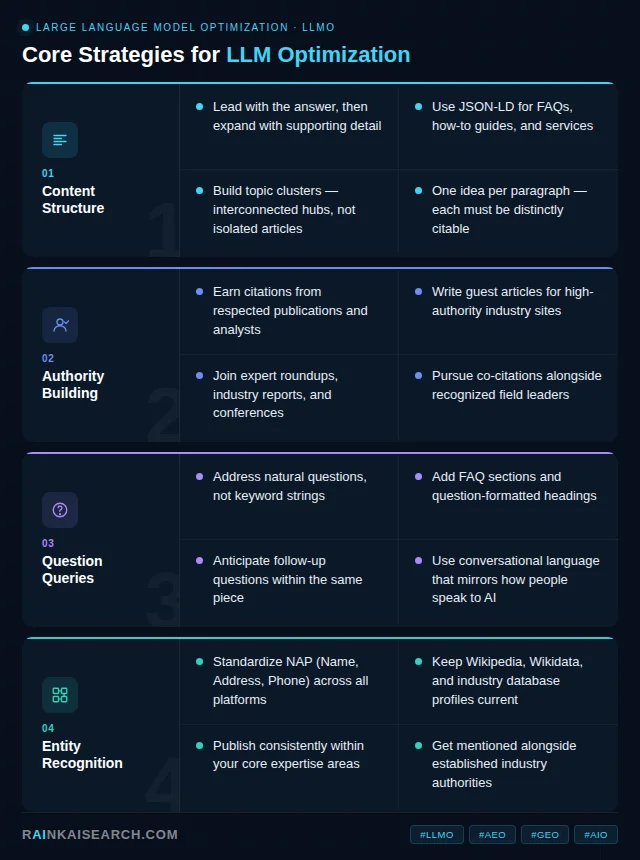
Effective LLMO requires four coordinated strategies: structuring content for AI comprehension, building authority across digital touchpoints, optimizing for question-based queries, and strengthening brand entity recognition. Each strategy reinforces the others.
Structuring Content for AI Comprehension
Clear, hierarchical content structures with descriptive headings and logical flow help AI platforms extract and understand your content. Organize each section around a single clear purpose and ensure ideas flow logically from one to the next.
Apply these content structure principles:
- Lead with the answer. State the core answer at the beginning, then expand with supporting detail.
- Use JSON-LD structured data. Mark up FAQs, how-to guides, products, services, and organizational information.
- Build topic clusters. Create interconnected content hubs that thoroughly address specific subject areas rather than isolated, scattered articles.
- Write one idea per paragraph. Each paragraph must carry a single, distinct, citable idea.
Building Authority Across Digital Touchpoints
Consistent brand presence across multiple platforms strengthens the signals AI models use to evaluate authority. Maintain active, professional profiles on your website, LinkedIn, industry-specific networks, and knowledge bases.
Priority actions for building authority:
- Earn citations from respected publications, industry analysts, and thought leaders
- Write guest articles for high-authority industry publications
- Participate in expert roundups, industry reports, and conference speaking engagements
- Pursue mentions and co-citations alongside recognized leaders in your field
Optimizing for Question-Based Queries
Creating content that directly answers common industry questions aligns with how users interact with AI platforms. Identify the questions your target audience asks, then create comprehensive content that provides clear, actionable answers.
Practical steps for question-based optimization:
- Write content that addresses natural question patterns, not keyword strings (“How can I optimize my business for AI platforms?” not “AI optimization tips”)
- Add FAQ sections and question-formatted headings throughout your content
- Anticipate follow-up questions and address them within the same piece of content
- Use complete sentences and conversational language that mirrors how people speak to AI assistants
Enhancing Brand Entity Recognition
Consistent NAP (Name, Address, Phone) information across all platforms is the foundation of strong brand entity signals. Inconsistencies confuse AI systems and weaken your entity recognition.
Steps to strengthen entity recognition:
- Standardize your business name, address, and contact details across every platform
- Maintain updated profiles on Wikipedia, Wikidata, and relevant industry databases
- Build consistent brand associations by regularly publishing content tied to your core expertise areas
- Pursue mentions alongside established industry authorities to signal your market positioning
What Are the Technical Foundations for LLMO Success?
LLMO requires three technical components to work: proper semantic markup, accessible content architecture, and data syndication. Each ensures AI crawlers can find, process, and accurately understand your content.
Semantic HTML and Structured Data Implementation
Proper HTML5 semantic elements help AI crawlers understand your content structure. Use semantic tags like <article>, <section>, <header>, and <nav> appropriately, and avoid generic <div> elements when semantic alternatives exist.
Implement JSON-LD structured data for:
- Organization details and service offerings
- FAQ content and how-to guides
- Articles and topic relationships
- Products and local business information
Content Accessibility and Crawlability
AI crawlers must be able to access and process all relevant content on your site. Ensure important content is not hidden behind forms, paywalls, or JavaScript-dependent navigation that crawlers cannot follow.
Crawlability checklist:
- Submit and maintain updated XML sitemaps for all important pages
- Use descriptive anchor text in internal links to establish topic relationships
- Optimize page load speeds and mobile responsiveness for consistent indexing
- Use responsive design and minimize unnecessary code
API Integration and Data Syndication
Offering API access to your data enables AI platforms to access your business information directly. Some AI platforms may integrate with business APIs to deliver real-time information in their responses, making early adoption advantageous.
Data syndication priorities:
- Submit your business information to Google Knowledge Graph
- Maintain accurate listings on major business directories and data aggregators
- Participate in industry-specific data exchanges and information networks
What Are the Content Creation Best Practices for LLMO?
Strong LLMO content serves human readers clearly, gives AI platforms extractable and citable information, and demonstrates deep topical authority. Every content decision should be evaluated against all three criteria.
The brands AI platforms recommend most consistently are not the ones with the most content. They are the ones whose content answers the most questions with the most precision.
Writing for Both Humans and AI
Write in a conversational tone while organizing information with clear headings and structured sections. Use descriptive, specific language over vague or promotional copy. Instead of “cutting-edge solutions,” write “Answer Engine Optimization services that improve brand visibility on ChatGPT and Google AI Overview.”
What to include in every piece of content:
- Relevant statistics and data points with attributed sources
- Concrete examples that support every major claim
- Comprehensive answers rather than teaser content that forces users to click elsewhere
- Specific language that gives AI platforms citable, concrete information
Topic Authority and Content Depth
Building comprehensive content hubs around specific subject areas signals stronger LLMO authority than broad, shallow coverage across many topics. For RankAISearch, complete coverage around AI optimization, answer engine visibility, and large language model strategies establishes clear topical authority.
Content depth priorities:
- Write comprehensive guides that fully explain concepts from multiple angles
- Create detailed how-to content with step-by-step implementation guidance
- Build multi-part series that explore topics thoroughly
- Update older content periodically with new statistics, insights, and last-updated dates
Citation-Worthy Content Elements
Original research, case studies, and unique data create content others reference and AI platforms cite. Conduct surveys in your industry, analyze trends with original data, and compile insights from multiple sources in new ways.
Elements that make content citation-worthy:
- Original research and surveys with findings specific to your industry
- Case studies that document real outcomes from your work
- Expert analysis of trends and developments, stated as clear and quotable insights
- Properly cited sources that show your content is grounded in reliable information
How Do You Measure LLMO Performance and Impact?
LLMO performance measurement requires tracking three signal types: direct AI platform mentions, brand authority growth, and AI-driven referral traffic. Together, these metrics reveal whether your strategy is building the visibility and authority signals AI platforms use for recommendations.
Tracking AI Platform Mentions
Monitor brand mentions across major AI platforms by regularly querying ChatGPT, Claude, Gemini, Perplexity, and similar tools with questions your target audience would ask. Document when your brand appears, in what context, and how prominently.
What to track:
- Brand mentions in AI-generated responses across multiple platforms
- Context and prominence of recommendations (cited as a top option vs. a passing mention)
- Competitor appearances for queries where you are absent
- Changes over time to assess improvement from LLMO efforts
Analyzing Brand Authority Signals
Track growth in authoritative backlinks and brand mentions across the web to assess whether your authority signals are strengthening. Growth in quality citations indicates improving authority that translates to better LLMO performance.
Authority signals to monitor:
- Quantity and quality of sites linking to your content
- Brand mentions in industry articles and analyst discussions
- Presence in Google’s Knowledge Panel and Wikidata
- Invitations to contribute to authoritative publications
Assessing Traffic from AI Platforms
Set up analytics to identify referral traffic from AI platforms and chatbots by configuring tracking for known AI platform domains. Some platforms provide clickable citations, and tracking this traffic reveals how many users discover your business through AI-generated recommendations.
Traffic metrics to track:
- Referral sessions from AI platform domains
- Conversion rates and engagement metrics from AI-referred visitors compared to other sources
- Growth in branded search traffic and direct visits as AI visibility improves
How Do You Future-Proof Your LLMO Strategy?
LLMO strategies built on genuine authority, comprehensive content, and strong brand entity signals remain effective regardless of how specific AI systems evolve. Optimizing narrowly for current platform limitations creates brittle strategies that break with each model update.
Key trends shaping LLMO in the near term:
- Multimodal AI systems that process images, video, and audio alongside text are becoming more sophisticated
- Real-time information access is replacing sole reliance on static training data in major LLMs
- Personalized AI responses mean different users may receive different recommendations based on their context and history
- New entrant platforms will emerge alongside existing leaders, creating new optimization surfaces
Continuous testing and optimization keeps your strategy effective as the landscape changes. Regularly test how your brand appears across AI platforms, experiment with different content approaches, and adjust based on what you learn. Businesses that treat LLMO as an ongoing process outperform those that implement it once and stop.
Get in touch with RankAISearch to build and execute an LLMO strategy tailored to your business. Our team specializes in AEO, GEO, AIO, LLMO, and SEO, and we help brands become the answer AI platforms trust and cite.
What Are the Most Common LLMO Challenges and How Do You Solve Them?
LLMO presents three recurring challenges for businesses: building AI visibility from a limited authority baseline, managing inconsistent brand information, and allocating resources across multiple optimization approaches. Each has a systematic solution.
Overcoming Limited Brand Recognition
Newer or smaller businesses can still build AI visibility through strategic, focused effort rather than broad competition. The most effective path is becoming the definitive resource for a specific, underserved niche before expanding to adjacent topics.
Targeted steps for smaller brands:
- Partner with established companies in complementary spaces to gain authority association
- Contribute expert insights to respected publications that already have AI platform visibility
- Focus content on specific, high-intent questions in your niche where larger competitors are not thorough
Managing Inconsistent Brand Information
Conflicting brand information across platforms confuses AI models and weakens entity recognition. Conduct a brand audit early to identify discrepancies in your business name format, address details, phone numbers, and service descriptions across all platforms.
Brand consistency checklist:
- Create a master document of correct business information and key messaging
- Audit business directories, social media profiles, and knowledge bases for inconsistencies
- Establish a process for updating all platforms whenever business information changes
- Assign ongoing responsibility for maintaining consistency across touchpoints
Balancing Multiple Optimization Approaches
LLMO complements rather than replaces SEO, AEO, and other strategies. Strong SEO builds the authority and content quality that LLMO depends on. AEO practices that optimize for featured snippets align directly with creating content AI platforms extract and cite.
| Approach | Primary Goal | How It Supports LLMO |
| SEO | Keyword rankings and organic traffic | Builds domain authority and crawlable content |
| AEO | Featured snippets and answer boxes | Creates extractable, direct-answer content |
| GEO | Generative engine visibility | Optimizes for AI-generated search results |
| LLMO | AI platform recommendations | Synthesizes all signals for LLM citation |
Prioritize efforts based on where your audience discovers businesses in your category. If your audience heavily uses AI platforms for research, prioritize LLMO. If traditional search still drives most qualified traffic, maintain strong SEO while gradually building LLMO capabilities.
Frequently Asked Questions
How is Large Language Model Optimization different from traditional SEO?
LLMO focuses on being recommended by AI platforms when users ask questions, while traditional SEO focuses on ranking in search engine results pages. LLMO prioritizes semantic authority and E-E-A-T signals; SEO prioritizes keyword rankings and backlink volume. Success in LLMO is measured by AI-generated recommendations, not ranking positions.
Which AI platforms should businesses optimize for with LLMO strategies?
Businesses should prioritize ChatGPT, Claude, Google Gemini, Microsoft Copilot, and Perplexity in 2026, as these platforms have the largest user bases. LLMO strategies built on genuine authority and strong brand entity signals work across all AI platforms, so broad-signal building is more effective than narrow platform-specific optimization.
How long does it take to see results from Large Language Model Optimization efforts?
Initial visibility improvements typically appear within three to six months for businesses with some existing authority. Businesses starting with minimal online presence may need six to twelve months. Quick wins, structured data implementation, targeted FAQ content, and a few high-authority mentions, can generate earlier results while the longer-term strategy builds.
Can small businesses compete with larger brands in AI-generated recommendations?
Yes. Small businesses compete effectively by building concentrated authority in a specific niche rather than competing broadly. Becoming the definitive resource for a specialized topic, earning niche citations, and answering specific questions thoroughly allows smaller brands to rank in AI recommendations where larger competitors are not thorough.
What types of content work best for Large Language Model Optimization?
Content that directly answers common questions performs best for LLMO. Comprehensive guides, how-to content with clear implementation steps, original research, and FAQ sections all perform strongly. Content structured with clear headings, direct answers, and proper schema markup is easiest for AI platforms to extract and cite.
How do Large Language Models decide which brands to recommend?
LLMs recommend brands based on authority signals, contextual relevance, and E-E-A-T indicators. They evaluate citation frequency from credible sources, how comprehensively your content addresses user query intent, and whether your brand information is consistent across platforms. Brands with strong trust and authority signals receive preference in AI-generated recommendations.
Is LLMO only relevant for certain industries or does it apply to all businesses?
LLMO applies to all businesses, though urgency varies by industry. Professional services, technology, healthcare, and financial services benefit most immediately because users frequently consult AI platforms for recommendations in these areas. Any business that depends on being discovered when potential customers seek information or recommendations needs LLMO.

One Response