

What Is Search Engine Optimization (SEO)? A 2026 Definition for the AI Search Era
Search no longer happens only through a list of links. A buyer can now ask a full question and receive an AI-generated answer before visiting any website. SEO in 2026 helps your content appear in both traditional search results and AI-generated answers.
That shift makes clarity and trust more important. Search engines and AI tools need accessible pages, direct answers, reliable evidence, and consistent brand information. This guide explains how SEO works in the AI search era and what businesses should prioritize first.
What Is Search Engine Optimization?
Search engine optimization (SEO) is the practice of improving a website so search engines can find, understand, and rank it for relevant queries. In 2026, that definition has expanded: SEO now also covers how AI tools like ChatGPT, Perplexity, and Google AI Overviews find, understand, and cite a site’s content.
SEO is not one task. It includes technical access, content quality, relevance, authority, user experience, internal linking, structured pages, and measurement.
Google says SEO best practices remain relevant for generative AI features because Google’s AI search experiences are rooted in core Search ranking and quality systems. Google also says AI Overviews and AI Mode use retrieval-augmented generation and query fan-out to retrieve relevant pages from the Search index. (Source: Google Search Central, 2026)
The clearest 2026 SEO definition is broader than “ranking on Google.” SEO now includes being discoverable in classic results, answer engines, AI search results, product recommendations, local results, and cited AI summaries.
| SEO Function | Traditional Search Role | AI Search Role |
|---|---|---|
| Crawl access | Lets search engines find pages | Lets retrieval systems access content |
| Indexing | Stores pages for search results | Makes content available for AI retrieval |
| Content relevance | Matches pages to queries | Matches passages to prompts |
| Authority | Supports ranking confidence | Supports citation confidence |
| Structured content | Improves page understanding | Improves answer extraction |
| User experience | Supports engagement and conversion | Helps visitors act after AI referral |
| Measurement | Tracks rankings and clicks | Tracks mentions, citations, and AI referrals |
How Does SEO Work?
SEO works by helping search systems discover, crawl, index, evaluate, and serve pages for relevant queries. A page must be accessible, useful, relevant, and trustworthy before it can earn durable visibility.
Search engines do not automatically show every page they find. They evaluate technical access, page content, links, quality, relevance, freshness, and user usefulness.
SEO improves each stage of that process. Technical SEO helps discovery, content helps relevance, and authority signals help search systems decide whether the page deserves visibility.
| SEO Stage | What Happens | What SEO Improves |
|---|---|---|
| Discovery | Search engines find the URL | Sitemaps, links, feeds, and crawl paths |
| Crawling | Bots fetch the page | Robots rules, server health, page access |
| Rendering | Search engines process page content | HTML, JavaScript, and visible text |
| Indexing | Search systems store page information | Canonicals, quality, duplication, and structure |
| Ranking | Systems order results for a query | Relevance, intent match, authority, and usefulness |
| Serving | Results appear to users | Titles, snippets, rich results, citations, and AI answers |
SEO is a compounding system. Small improvements across many pages can create stronger search visibility than one isolated optimization.
What Are the Main Parts of SEO?
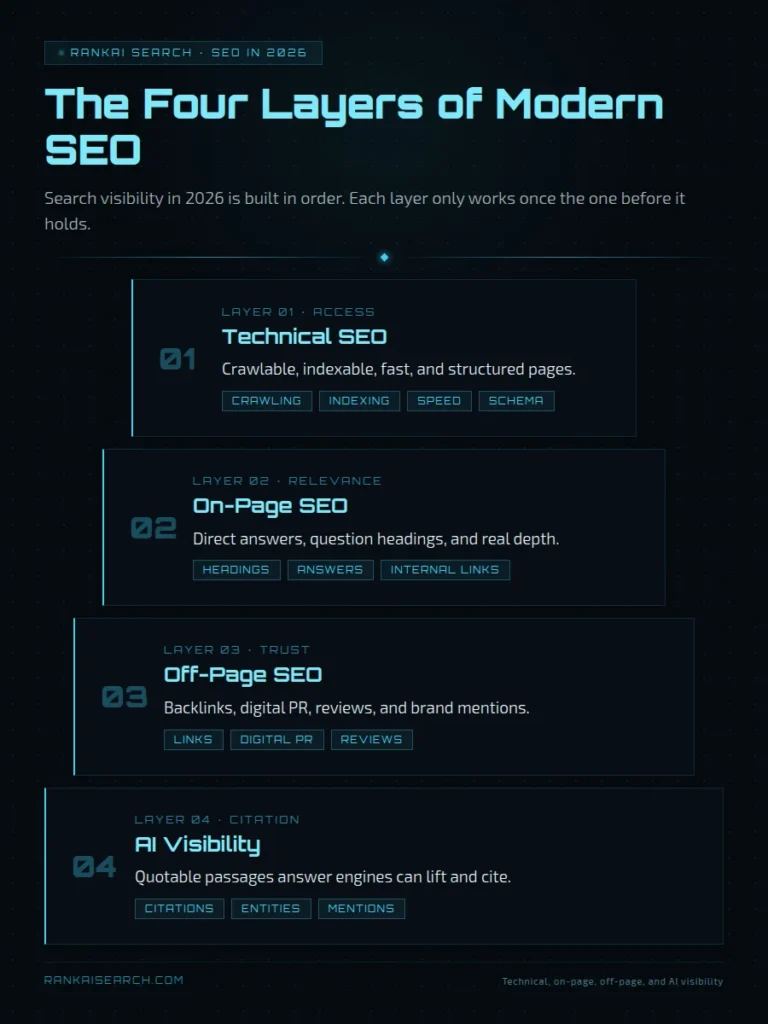
The main parts of SEO are technical SEO, on-page SEO, and off-page SEO. A complete SEO strategy needs all three because search visibility depends on access, relevance, and trust.
Technical SEO makes the site accessible. On-page SEO makes the content understandable. Off-page SEO strengthens the brand and page authority through outside signals.
The three parts overlap in practice. A strong article can fail if it is blocked from crawling, and a technically perfect page can fail if it does not answer a real query.
| SEO Part | Main Goal | Common Work |
|---|---|---|
| Technical SEO | Make the site accessible and indexable | Crawling, indexing, site speed, structured data, canonicals |
| On-page SEO | Make each page relevant and useful | Titles, headings, content, internal links, schema, media |
| Off-page SEO | Build trust and recognition | Backlinks, mentions, reviews, PR, partnerships |
| AI-era SEO layer | Make content citable and retrievable | Answer blocks, entity clarity, source proof, citations |
Technical SEO
Technical SEO is the work that helps search engines crawl, render, index, and understand a website. It covers the infrastructure behind search visibility.
Technical SEO includes crawl rules, XML sitemaps, canonical tags, redirects, page speed, mobile usability, structured data, internal linking, and server performance. It also includes fixing indexation problems before they become traffic problems.
| Technical SEO Task | Why It Matters |
|---|---|
| XML sitemap | Helps search engines discover important URLs |
| Robots.txt review | Prevents accidental crawl blocking |
| Canonical tags | Reduces duplicate URL confusion |
| Redirect cleanup | Preserves user and crawler paths |
| Site architecture | Helps bots and users find content |
| Structured data | Clarifies page meaning |
| Page speed | Supports user experience |
| Index coverage review | Finds pages excluded from search |
On-Page SEO
On-page SEO is the work that makes a specific page relevant, clear, and useful for a search query. It includes both visible content and page-level signals.
On-page SEO covers title tags, headings, opening answers, internal links, images, examples, FAQs, definitions, source attribution, and calls to action. In AI search, on-page SEO also means writing passages that answer questions directly.
| On-Page Element | SEO Purpose |
|---|---|
| Title tag | Defines the page topic in search results |
| H1 | States the main page topic |
| H2 questions | Match user search intent |
| First paragraph | Gives the direct answer |
| Internal links | Connect related pages |
| Images and alt text | Support context and accessibility |
| FAQs | Answer follow-up questions |
| Evidence | Builds trust and verifiability |
Off-Page SEO
Off-page SEO is the work that builds trust, authority, and recognition outside the website. It helps search systems validate whether other sources recognize the brand or page.
Off-page SEO includes backlinks, digital PR, brand mentions, reviews, citations, industry profiles, partner pages, social proof, and expert references. AI search makes off-page signals more important because answer engines often compare owned content with third-party evidence.
| Off-Page Signal | What It Supports |
|---|---|
| Backlinks | Discovery and authority |
| Brand mentions | Entity recognition |
| Reviews | Customer trust |
| Digital PR | Third-party validation |
| Partner pages | Relationship signals |
| Industry directories | Category association |
| Expert citations | Topical authority |
| Customer case studies | Proof of outcomes |
How Has AI Search Changed the Meaning of SEO?
AI search has changed SEO by expanding visibility from ranked results to AI answers, citations, summaries, recommendations, and conversational search experiences. A page can now influence a user without receiving a traditional organic click.
AI search tools often retrieve sources, summarize answers, and cite selected pages. That makes passage clarity, entity consistency, and source authority more important than keyword placement alone.
SEO in the AI era still depends on crawlability, relevance, and quality. The difference is that the visible outcome may be a citation, generated answer, or brand mention instead of a click.
| Old SEO Outcome | AI-Era SEO Outcome |
|---|---|
| Rank on page one | Appear in rankings and AI answers |
| Earn organic clicks | Earn clicks, citations, and mentions |
| Target keywords | Target prompts, questions, and intent |
| Optimize pages | Optimize pages and passages |
| Build backlinks | Build links, mentions, and entity proof |
| Track CTR | Track CTR, AI citations, and AI referrals |
| Write for snippets | Write for summaries and direct citations |
AI search has raised the value of answer-first writing. A page that answers a clear question in a self-contained passage is easier for AI systems to use.
What Is the Difference Between Ranking and Being Cited?
Ranking means a search engine lists a page in search results, while being cited means an AI system uses or references a page as a source in an answer. A page can rank without being cited, and a page can be cited without ranking in the top organic results.
Ranking is page placement. Citation is source selection. This difference changes content strategy. Ranking requires strong page-level SEO, while citations require extractable, specific, trustworthy passages.
| Visibility Type | What It Means | What To Optimize |
|---|---|---|
| Organic ranking | Page appears in search results | Relevance, authority, titles, content |
| Featured snippet | Page excerpt appears above results | Concise answer and format |
| AI citation | AI answer references the page | Source clarity and citable passages |
| AI mention | AI answer names the brand | Entity strength and reputation |
| AI referral | AI tool sends a visitor | Landing page relevance and conversion path |
| Branded search | Users search the brand directly | Awareness and trust |
A modern SEO report should track both ranking and source influence. Rankings show where a page appears, while citations show whether answer systems trust it enough to use it.
Why Do Search Intent and Relevance Matter?
Search intent and relevance matter because search systems need to match the user’s goal, not just the words in the query. A page that uses the right keyword can still fail if it answers the wrong need.
Search intent is the reason behind a query. It can be informational, commercial, navigational, transactional, local, support-based, or comparison-driven.
Microsoft says Bing ranking considers relevance, quality, freshness, authority, and popularity, and it crawls new and updated pages through Bingbot to add them to its index. (Source: Microsoft Support, 2026)
AI prompts often include intent more clearly than traditional keywords. A prompt may state the audience, budget, location, product type, use case, and decision stage in one sentence.
| Intent Type | Example Query | Best Page Type |
|---|---|---|
| Informational | “What is SEO?” | Definition guide |
| Commercial | “Best SEO agency for SaaS” | Comparison or service page |
| Navigational | “RankAISearch website” | Homepage or brand page |
| Transactional | “Buy SEO audit” | Offer or checkout page |
| Local | “SEO agency near me” | Local landing page |
| Support | “How to fix noindex” | Help guide |
| Comparison | “SEO vs GEO” | Comparison article |
Relevance should be judged at the section level too. Each section should answer the question its heading promises.
How Do Search Engines Discover and Evaluate a Website?
Search engines discover a website through links, sitemaps, submitted URLs, feeds, and repeated crawling of known pages. They evaluate pages by technical accessibility, content quality, relevance, links, trust, duplication, freshness, and user usefulness.
Discovery begins when a search engine finds a URL. Evaluation begins when the system processes the page and compares it with other possible answers.
Google’s SEO Starter Guide says the vast majority of new pages Google finds every day are discovered through links. This makes internal and external linking important for discovery. (Source: Google Search Central, 2026)
A website with strong internal structure makes evaluation easier. Important pages should not be buried, orphaned, duplicated, or blocked.
| Discovery and Evaluation Factor | What To Check |
|---|---|
| Internal links | Important pages are linked from relevant pages |
| XML sitemap | Important URLs are included |
| Robots rules | Pages are not accidentally blocked |
| Indexability | Pages do not have unintended noindex tags |
| Canonicals | Duplicate versions point to the right URL |
| Page quality | Content is useful and original |
| Authority | Trusted sites reference the brand or page |
| Freshness | Time-sensitive content is updated honestly |
| Structured data | Page meaning is machine-readable where useful |
Search engines evaluate pages continuously. A site can improve or lose visibility as content, competitors, links, and user expectations change.
What Makes Content Valuable in Traditional and AI Search?
Valuable content in traditional and AI search is helpful, original, accurate, specific, current, and written for a real user need. It should answer the query better than competing sources.
Traditional search rewards pages that satisfy user intent. AI search also needs content that can be extracted, summarized, verified, and cited accurately.
Valuable content should add something beyond generic summaries. Strong pages include first-hand expertise, examples, analysis, original data, product details, useful comparisons, or clear decision guidance.
| Valuable Content Trait | Traditional SEO Benefit | AI Search Benefit |
|---|---|---|
| Direct answer | Improves satisfaction | Supports extraction |
| Original insight | Differentiates the page | Creates unique source value |
| Evidence | Builds trust | Supports citations |
| Clear structure | Improves readability | Improves passage retrieval |
| Current facts | Maintains relevance | Reduces stale answers |
| Expert context | Supports credibility | Strengthens authority |
| Examples | Helps understanding | Clarifies use cases |
| Self-contained sections | Improves scanning | Makes passages quotable |
Content value should be tested against the user’s next question. A page that forces the user to search again is incomplete.
How Do Authority and Trust Influence Search Visibility?
Authority and trust influence search visibility by helping search systems decide which pages are reliable enough to show, rank, cite, or recommend. Trust is especially important for topics that affect health, finance, safety, legal decisions, and major purchases.
Authority is not only backlinks. It can include expert authorship, brand reputation, third-party references, reviews, citations, credentials, customer proof, and consistent entity information.
Google’s quality rater guidance added Experience to E-A-T in 2022, creating E-E-A-T: experience, expertise, authoritativeness, and trustworthiness. Google also stated that trust is the most important member of that family. (Source: Google Search Central, 2022)
AI search increases the value of third-party validation. A brand that is described consistently across trusted sources is easier for AI systems to understand and cite.
| Trust Signal | What It Shows |
|---|---|
| Expert author | A qualified person created or reviewed the content |
| Clear company information | The business is identifiable |
| Citations | Claims are supported |
| Reviews | Customers validate the experience |
| Digital PR | External sources recognize the brand |
| Case studies | Results are documented |
| Security and policies | Users can assess risk |
| Accurate dates | Freshness is visible |
| Consistent brand facts | Entity identity is stable |
Trust signals should be visible to users. Hidden credibility does not help the reader decide whether to believe the page.
Where Do Keywords Fit Into Modern SEO?
Keywords still matter because they reveal how people describe their needs, but modern SEO uses keywords as intent signals rather than exact-match formulas. The best pages answer the topic fully in natural language.
A keyword is a word or phrase users search. A prompt is often a longer natural-language request that includes more context.
Keyword research should now include AI prompt research. A marketer should study keywords, People Also Ask questions, sales calls, reviews, forums, AI answers, and competitor citations.
| Keyword Role | Modern SEO Use |
|---|---|
| Primary keyword | Defines the main topic |
| Long-tail keyword | Captures specific intent |
| Related terms | Expands topical coverage |
| Questions | Shape H2 and FAQ sections |
| Entity terms | Clarify people, brands, products, and categories |
| Competitor terms | Support comparison content |
| Prompt patterns | Match AI-style searches |
Keyword stuffing weakens content. The right keyword should make the page clearer, not heavier.
How Do User Experience and Website Performance Support SEO?
User experience and website performance support SEO by helping users access, read, trust, and act on a page after they arrive. Search visibility is stronger when a page is both relevant and usable.
Core Web Vitals are user experience metrics that measure loading performance, responsiveness, and visual stability. They include Largest Contentful Paint, Interaction to Next Paint, and Cumulative Layout Shift.
Google says page experience is not one separate ranking system, but many page experience signals can contribute to success when multiple pages have helpful content. (Source: Google Search Central, 2023)
AI referrals make user experience more important. A visitor who clicks from an AI answer expects the landing page to confirm the answer quickly.
| UX and Performance Area | SEO Impact |
|---|---|
| Fast loading | Reduces friction |
| Mobile usability | Supports most users |
| Clear navigation | Helps users and crawlers |
| Stable layout | Improves reading and interaction |
| Accessible design | Expands usability |
| Clear CTAs | Supports conversion |
| Readable content | Improves engagement |
| Trust signals | Helps users decide |
Performance should support the page’s purpose. A fast page with weak content still fails the user.
How Can Businesses Measure Whether SEO Is Working?
Businesses can measure whether SEO is working by tracking impressions, rankings, clicks, click-through rate, organic conversions, indexed pages, AI visibility, citations, referrals, and revenue impact. SEO measurement should connect visibility to business outcomes.
Traditional SEO reports should still include Google Search Console, analytics data, ranking tools, crawl reports, and conversion data. AI-era reports should add AI mentions, citations, prompt coverage, and AI referral traffic.
Measurement should separate exposure from action. A page can gain impressions but lose clicks, or earn AI citations without direct referral traffic.
| SEO Metric | What It Measures | Why It Matters |
|---|---|---|
| Impressions | How often pages appear | Shows visibility |
| Rankings | Where pages appear | Shows competitive position |
| Organic clicks | Website visits from search | Shows traffic delivery |
| CTR | Click efficiency | Shows result appeal |
| Indexed pages | Search inclusion | Shows technical health |
| Conversions | Leads, sales, or signups | Shows business value |
| AI mentions | Brand visibility in AI answers | Shows answer presence |
| AI citations | Sources AI systems use | Shows source influence |
| AI referrals | Visits from AI tools | Shows traffic from answer engines |
SEO is working when visibility improves for the right queries and those visits or mentions support business goals. Traffic without relevance is not success.
What Should You Remember About SEO in 2026?
You should remember that SEO in 2026 is the practice of making a website discoverable, understandable, trustworthy, useful, rankable, and citable across search engines and AI answer systems. SEO still matters because AI search builds on many search fundamentals.
| 2026 SEO Principle | Practical Action |
|---|---|
| Search still matters | Keep technical SEO and content quality strong |
| AI visibility matters | Track mentions, citations, and AI referrals |
| Content must be useful | Answer real user questions directly |
| Pages must be accessible | Fix crawl, index, and rendering issues |
| Authority must be earned | Build links, mentions, reviews, and proof |
| Entities must be clear | Keep brand facts consistent |
| Measurement must expand | Report rankings, clicks, citations, and revenue |
Modern SEO is not SEO versus AI. Modern SEO is the foundation that helps brands appear wherever users search, ask, compare, and decide.
Are You Ready to Build an SEO Strategy for Search and AI?
Modern SEO requires more than ranking pages for traditional keywords. Your website also needs strong technical foundations, direct answers, reliable evidence, clear entity signals, and authoritative content that AI systems can confidently retrieve, interpret, and cite.
RankAISearch can bring these elements together in a coordinated strategy built around your audience and business goals. This approach strengthens your presence in traditional search while creating more opportunities to appear in AI-generated answers, citations, and recommendations.
Take the next step with RankAISearch to uncover your most important SEO gaps and build a practical roadmap for stronger visibility across search and AI.
Frequently Asked Questions About Search Engine Optimization in the AI Search Era
What does SEO stand for?
SEO stands for search engine optimization. It is the practice of improving a website so search engines can discover, understand, rank, and display it for relevant searches. In 2026, SEO also supports AI visibility. Search systems and AI tools both need accessible, useful, and trustworthy source material.
Is SEO still important in 2026?
Yes, SEO is still important in 2026. Search engines still drive discovery, comparison, local actions, product research, and conversions. AI search makes SEO broader. Brands now need to rank in search results and appear in AI-generated answers.
How is SEO different from paid search advertising?
SEO earns organic visibility, while paid search advertising buys ad placements. SEO can continue producing value after the work is published, while paid traffic usually stops when spend stops. Paid search is useful for speed and targeting. SEO is useful for durable discovery, trust, and long-term content value.
How long does SEO take to produce results?
SEO usually takes months to produce measurable results. The timeline depends on site age, competition, technical health, content quality, authority, and publishing consistency. Some fixes can improve performance faster. Technical errors, title problems, and indexing issues can show movement sooner than authority building.
Can a business do SEO without hiring an agency?
Yes, a business can do basic SEO without hiring an agency. A team can improve titles, headings, internal links, page speed, content quality, and Search Console monitoring. An agency helps when competition, technical issues, content scale, or AI visibility tracking becomes complex. The need depends on goals and internal capacity.
Does AI search make traditional SEO obsolete?
No, AI search does not make traditional SEO obsolete. AI search often depends on search indexes, crawlable pages, useful content, trusted sources, and clear entities. AI search changes the output. The user may see a citation, summary, or recommendation instead of only a ranked link.
What is the difference between SEO, AEO, and GEO?
SEO improves visibility in search engines. AEO improves how content appears in answer engines, and GEO improves how content appears in generative AI answers. These disciplines overlap. A strong strategy uses SEO fundamentals and adds answer-first content, citation tracking, and AI visibility measurement.
Which SEO activities should a new website prioritize first?
A new website should prioritize crawlability, indexability, clear site structure, useful core pages, internal links, and accurate business information. These basics help search engines understand the site. The first content priorities should match buyer intent. Build service, product, category, comparison, local, and FAQ pages before scaling broad blog content.