


Off-Site Authority for AI Search: Why What Others Say Decides Everything
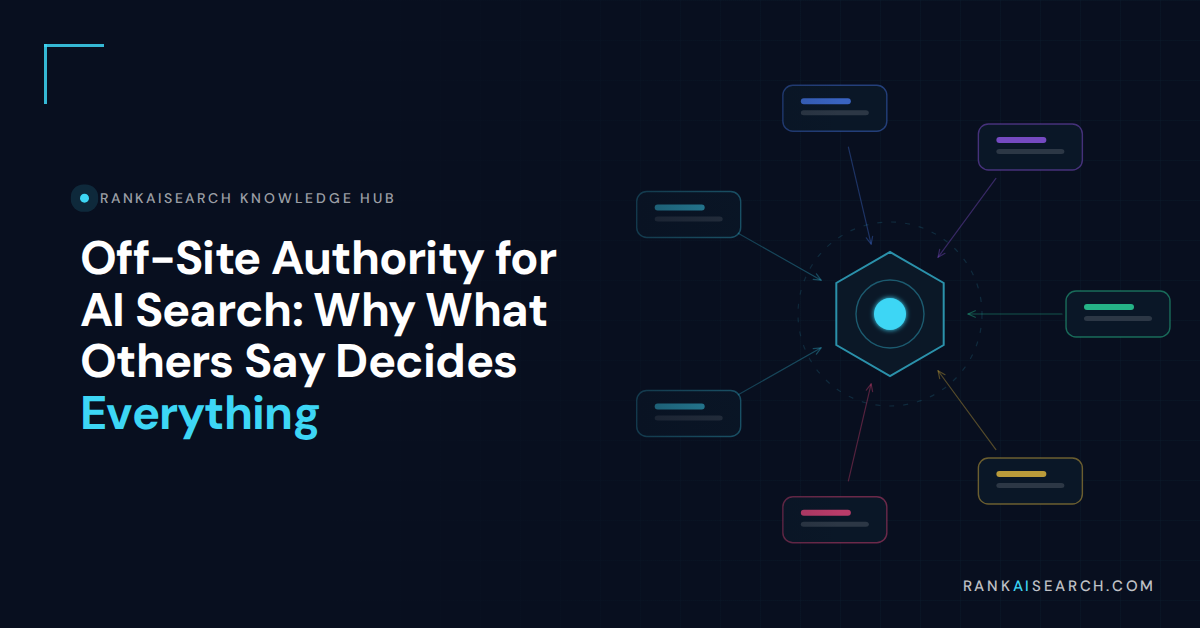
AI systems assemble answers about a brand from independent sources as much as from the brand’s own site. Off-site authority means earning consistent, credible descriptions of your business across the reviews, communities, publishers, and listings those systems actually retrieve, which is measured in mention lift rather than link counts.
Why Your Own Site Is Not Enough
The correlation between ranking well and being cited has broken down. Ahrefs analyzed 863,000 keywords and 4 million AI Overview URLs in early 2026 and found only 38% of cited pages also ranked in the organic top 10 for the same query, down from 76% in its July 2025 study. BrightEdge put the figure closer to 17%.
That leaves between roughly 62% and 83% of citations coming from pages outside the top ten, and a large share of those pages belong to someone else.
The Semrush 2026 AI Visibility Index, covering 126 million US prompts, found the gap from the other direction: on Gemini, the overlap between brands mentioned in an answer and the domains cited as evidence can be as low as 30%. A competitor’s roundup can be the reason your brand gets named.
You cannot optimize your way to a description written by someone else. That is the entire case for off-site work, and it is why on-site programs plateau.
The organizational consequence is usually the harder part. On-site work has an owner in most companies. Off-site work is distributed across public relations, partnerships, customer success, and whoever maintains directory listings, which frequently means nobody owns the outcome. Semrush found that 81% of organizations integrating SEO and AI visibility into one workflow reported traffic or lead gains from AI platforms, against 36% managing them separately, and off-site authority is where that split does the most damage.
How Models Weigh External Sources
Independent agreement carries more weight than self-description, for the obvious reason that self-description is free. A brand claiming to be the leading provider in its category is making a marketing statement. Six unrelated sources describing it that way is evidence, and systems composing answers behave accordingly.
Published studies disagree on exact shares while agreeing on the cast. Peec AI’s analysis of 30 million sources ranks Reddit first, followed by YouTube and LinkedIn. Goodie AI’s analysis of 58.6 million citations puts Wikipedia first at 3.4% citation share. Contently’s meta-analysis, drawing on Evertune’s 200 million prompts, found no single domain exceeds roughly 5% of total citations.
The disagreement is methodological rather than substantive. Some studies count the share of answers citing a domain at least once; others count each domain’s share of every individual citation. Both are legitimate measures of different things, which is why the same underlying reality produces figures ranging from 3.4% to 40% depending on the study.
Two conclusions survive all of them:
- User-generated and third-party platforms outrank brand-owned media. Corporate blogs and press releases do not appear near the top of any dataset.
- The tail is long. With no domain above about 5%, the overwhelming majority of citation opportunity sits outside the platforms nobody can compete with.
That second point reframes the strategy. Reddit and Wikipedia are not competitors to displace; they are part of the environment. The winnable contest is over the thousands of category-specific sources that collectively account for the remaining share, and those are reachable through ordinary corrections, listings, coverage, and participation.
Links, Mentions, and Corroboration Compared
These three are treated as one thing in most reporting and behave differently.
| Signal | What it is | Traditional SEO value | AI search value |
| Link | Hyperlink from another site | High, the core signal | Moderate, still useful |
| Unlinked mention | Brand named without a link | Discounted | High, the sentence is what gets read |
| Corroboration | Independent sources describing you consistently | Not measured | Highest, drives recommendation |
The shift matters operationally. A backlink in SEO and GEO still passes authority, but a model reading an article about your category is processing the sentence describing you rather than following the hyperlink. Coverage that names you accurately without linking is worth pursuing on its own terms.
It also changes what a successful outreach outcome looks like. Under a link-first model, coverage without a link was a partial failure worth negotiating over. Under a corroboration model, an accurate description in a credible publication is the outcome, and pushing a publisher for a link can cost goodwill for a marginal gain.
Identifying the Sources AI Retrieves in Your Category
General advice about authority is useless here. The question is which specific domains appear when someone asks your category’s questions.
Run this and record the answer:
- Take 20 prompts covering comparison, problem-led, and category-level questions, written the way buyers actually phrase them rather than in your internal vocabulary.
- Run each on three platforms, three times each.
- Log the cited domains, not just whether your brand appeared.
- Rank the domains by frequency. The top five to ten are your actual target list.
- Check your presence on each. Present and accurate, present and stale, or absent.
The output is usually surprising. Brands routinely discover that a niche industry publication or a specific review platform accounts for a large share of category citations while a general directory they pay for never appears at all. Understanding why answer engines prioritize certain brands starts with knowing which sources those engines are actually reading.
Re-run the exercise quarterly. Citation source mixes shift as platforms change their retrieval behavior, and a target list built a year ago may point at sources that have since stopped appearing. This is also the cheapest competitive intelligence available: the domains cited when a competitor is recommended tell you exactly where their authority is coming from.
Earning Coverage That AI Systems Reuse
Once the target list exists, the work is earning accurate presence on it. Ranked by cost and durability:
| Approach | Cost | Durability | Speed |
| Correcting existing listings and profiles | Very low | High | Weeks |
| Review platform presence and recency | Low | Medium | One quarter |
| Inclusion in roundups and comparison pages | Medium | High | One to two quarters |
| Original research and data | High | Very high | Two quarters plus |
| Earned editorial coverage | High | Very high | Two quarters plus |
Original research deserves particular attention because it compounds. Peer-reviewed testing found that content containing statistics and citations to reliable sources performs measurably better in generated answers, which means publishing data other people cite creates a second-order effect: your figures travel into other people’s content, and that content gets retrieved.
The corroboration threshold is the concept that ties this together. A single mention in one publication rarely changes how a system describes a brand. Consistent description across several independent sources does, because agreement between unrelated parties is the signal that raises confidence. This is why a scattered approach across many low-value placements underperforms a concentrated effort on the handful of sources your category’s answers actually draw from.
One further sequencing note. Corrections and listings can proceed immediately and in parallel with everything else, because they need no external agreement. Coverage and research require lead time, external schedules, and usually a budget approval, which means starting them in month one rather than month three is what determines whether results land inside the same fiscal year.
Start with corrections, not campaigns. Most brands have a dozen listings describing an older version of the business, and fixing those is faster and cheaper than earning anything new.
Original research deserves a second note on execution. The value is not in publishing a report; it is in publishing figures specific enough that other people need to cite them. A survey producing a number nobody else has, a dataset from your own operations, or an analysis of something only you can see all create citable facts. General commentary on industry trends does not, however well written.
Directories, Roundups, and Comparison Pages
When someone asks an AI for the best provider in a category, the system frequently reconstructs the answer from existing best-of articles, comparison pages, and directory listings rather than evaluating vendor sites directly.
That makes these placements a targetable asset:
- Find the lists that already exist for your category and check whether you are on them.
- Approach publishers with a reason to update. New data, a corrected fact, or a genuine change in your offering works. A request to be added does not.
- Get alternatives pages right. Competitors’ comparison content frequently gets retrieved, and being described inaccurately there is worse than being absent.
- Check inclusion criteria before pitching. Many roundups have published requirements, and meeting them is a faster route in than persuasion.
- Maintain directory listings actively. A profile created once and never updated becomes the stale source that contradicts your current positioning.
- Be honest about paid inclusion. Some placements are advertising. They can still be worth buying, but they should be judged on whether the source gets cited rather than on its domain metrics.
Alternatives pages deserve a specific tactic. Competitors publish comparison content describing your product, frequently inaccurately and always unflatteringly, and that content gets retrieved. You cannot have it removed, but you can publish your own accurate comparison covering the same ground, and you can correct factual errors politely through the publisher. A factual correction request has a far higher success rate than a request to be portrayed more favorably.
Review Platforms and Sentiment Signals
Review platforms serve a function in AI search that they did not serve in traditional SEO: they are evidence that a business is real, active, and currently operating.
Which platforms matter varies sharply by category and is worth determining rather than assuming. Software and B2B categories lean on dedicated review sites, consumer categories on retailer reviews and general platforms, and regulated professional services on credential registries alongside conventional reviews.
What matters:
- Presence on the platforms your category uses. This varies sharply between software, consumer, and professional services.
- Recency. A profile with strong reviews from three years ago signals a business that may no longer be trading.
- Volume relative to category norms, rather than in absolute terms.
- The language reviewers use, since it becomes source material for how models describe you.
- Responses to negative reviews, which demonstrate an active business and provide context a system can read.
Read your reviews as source text, not as a satisfaction metric. If reviewers consistently describe a service you no longer emphasize, that description is what AI systems will repeat.
This gives review requests a second purpose beyond ratings. Asking customers what problem you solved for them, rather than simply asking for a rating, produces review text that describes your actual value in the language buyers use. That text becomes source material, which makes the phrasing of your review request a small but genuine input into how AI systems describe you.
What to Stop Doing From Legacy Link Building
Several long-standing tactics now fail on their own terms or are explicitly ruled out.
| Practice | Status |
| Volume link acquisition sorted by domain metrics | Weak proxy for whether a source gets cited |
| Press release distribution | Rarely appears in citation datasets |
| Guest posts on low-quality networks | Google’s spam systems apply to generative responses |
| Manufactured brand mentions | Google states this is less helpful than it appears |
| Ignoring unlinked mentions | Discards a signal that now carries weight |
Google’s language is worth taking at face value: it states that seeking inauthentic mentions across the web is less helpful than it seems, and that its spam policies cover generative responses. There is no shortcut, which is inconvenient and also means the work is defensible once done.
None of this means link building is obsolete. Links from sources that genuinely get cited in your category remain valuable, and they carry the additional benefit of supporting rankings, which still feed retrieval on Google surfaces. What has changed is the selection criterion. Sorting prospects by domain authority optimizes for a metric that no longer predicts the outcome; sorting them by observed citation frequency in your category optimizes for the outcome directly.
Measuring Off-Site Work by Mention Lift
Link counts do not measure this. Build reporting around the outcome instead.
| Metric | What it tells you | Cadence |
| Mention frequency across a fixed prompt set | Whether you are entering answers more often | Monthly |
| Cited domain mix | Which sources are supplying the evidence | Monthly |
| Share of voice against named competitors | Whether you are gaining relative ground | Quarterly |
| Description accuracy | Whether corroboration is fixing the record | Quarterly |
| Target list coverage | Presence and accuracy on your priority sources | Quarterly |
Set the baseline before any work ships. The most common reporting failure in off-site programs is starting the work first and constructing the measurement afterward, which leaves no defensible before-and-after comparison at exactly the moment the budget comes up for review.
Semrush found that 45% of marketing leaders cannot accurately measure brand visibility inside AI-generated answers, and only 9% have tools covering all relevant metrics. Off-site work is particularly exposed to this, because its effects appear in answers rather than in analytics.
Report leading and lagging indicators separately. Target list coverage and description accuracy move first and are largely within your control. Mention frequency and share of voice move later and depend on other people publishing. Presenting them as one number produces a report that looks flat for a quarter while the underlying work is progressing normally.
Expect two quarters before the record shifts. Off-site authority accumulates on other people’s publishing schedules, which is why an AI link building program should be judged on mention lift and source coverage rather than on link volume, and why the measurement approach is worth agreeing before the work starts when you get in touch.
Frequently Asked Questions (FAQ) About Off-Site Authority for AI Search
Do backlinks still matter for AI search?
They still pass authority and still support rankings, which indirectly supports retrieval. What has changed is that unlinked mentions now carry weight too, because models read the sentence describing your brand rather than following the hyperlink. Judging off-site work by link volume alone misses most of the signal.
Which off-site sources should I prioritize?
The ones that actually get cited for your category, which you find by logging cited domains across a fixed prompt set rather than by assuming. The answer varies widely: software categories lean on review platforms and community threads, while advice-led categories lean on professional bodies and credential records.
Can I pay to be included in AI answers?
Not directly. Some roundups and directories sell placement, and those can be worth buying if the source is genuinely cited in your category. Manufactured mentions are a different matter, and Google states explicitly that seeking inauthentic mentions is less helpful than it appears.
How long does off-site authority take to affect AI visibility?
Corrections to existing listings can show within weeks. Earned coverage and review accumulation typically take one to two quarters to change how models describe you, because third-party sources update on their own schedules rather than yours.
How do I measure whether off-site work is paying off?
Track mention frequency across a fixed prompt set, the mix of domains cited as evidence, and the accuracy of how you are described. These move before referral traffic does, which makes them the leading indicators for work whose effects appear inside answers rather than in analytics.
Sources
- Ahrefs, via Search Engine Journal. “Google AI Overview Citations From Top-Ranking Pages Drop Sharply.” March 2026. 863,000 keywords, 4 million URLs.
- Semrush. “2026 AI Visibility Index.” June 2026. 126 million US AI search prompts.
- Peec AI, via Search Engine Land. “AI search engines cite Reddit, YouTube, and LinkedIn most.” March 2026. 30 million sources.
- Goodie AI. “Most Cited Domains in AI Search.” 58.6 million citations, October 2025 to March 2026.
- Contently. “Top 10 Sources LLMs Cite Most in 2026.” April 2026.
- Google Search Central. “Optimizing your website for generative AI features on Google Search.” Last updated July 10, 2026.
- Aggarwal, P., et al. “GEO: Generative Engine Optimization.” ACM SIGKDD 2024.