


How Schema Markup Boosts AI Search Visibility
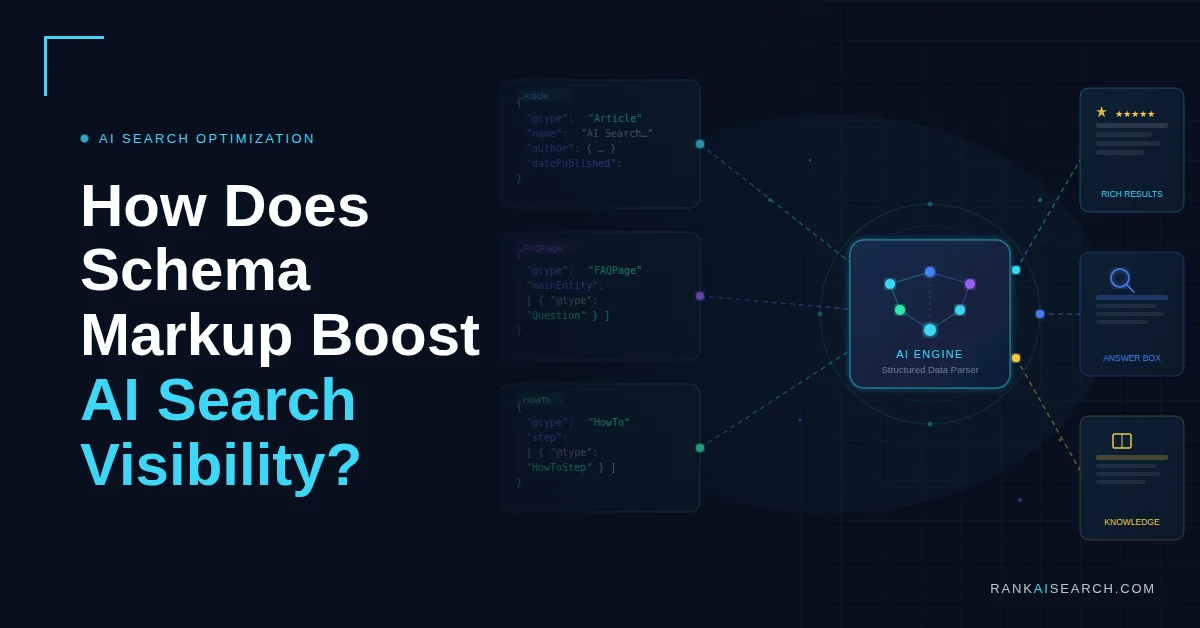
Schema markup gives AI search platforms the structured signals they need to extract, verify, and cite your content in generated answers. Without it, even well-written content risks being overlooked because language models must infer meaning rather than read it directly.
Google AI Overviews, Microsoft Copilot, Perplexity, and ChatGPT with browsing now mediate how millions of users discover answers every day. This guide covers which schema types drive AI citations, how to implement them correctly, and how to measure their impact.
What Is Schema Markup and Why Does It Matter for AI Search?
Schema markup is structured code added to a webpage that tells AI systems exactly what the content means, rather than requiring them to infer it from natural language. It converts human-readable content into machine-readable facts that language models can extract and cite with confidence.
Fewer than 12.4% of all registered domains implement schema.org structured data, leaving most of the competitive field unstructured (Source: W3Techs, 2024). That adoption gap is a direct citation opportunity for brands that invest in it now.
| Traditional SEO Focus | AI Search Focus |
| Keyword matching | Entity recognition |
| Backlink authority | Topical relationships |
| Page relevance signals | Contextual accuracy |
| Click-through rate | Citation probability |
How Do AI Platforms Use Schema Markup to Understand Your Brand?
AI platforms use schema markup to resolve entity identity, verify claims, and build the knowledge graph data they draw from when generating answers. Both Google and Microsoft have confirmed they actively use structured data for this purpose.
Microsoft’s Fabrice Canel confirmed at SMX Munich in March 2025 that schema markup helps Microsoft’s LLMs understand content for Copilot. Google confirmed in April 2025 that structured data “gives an advantage in search results” (Source: Search Engine Land, 2025).
Schema helps AI platforms in four specific ways:
- Identify your brand as a distinct entity with a verified name, logo, and category
- Extract content facts such as author, publication date, and topic without interpretation errors
- Match your offerings to user queries for products, services, and locations
- Build citation confidence by removing the ambiguity that causes AI systems to skip or misrepresent content
Schema markup doesn’t just make your content findable. It makes your brand a citable fact.
What Schema Types Matter Most for Answer Engine Optimization?
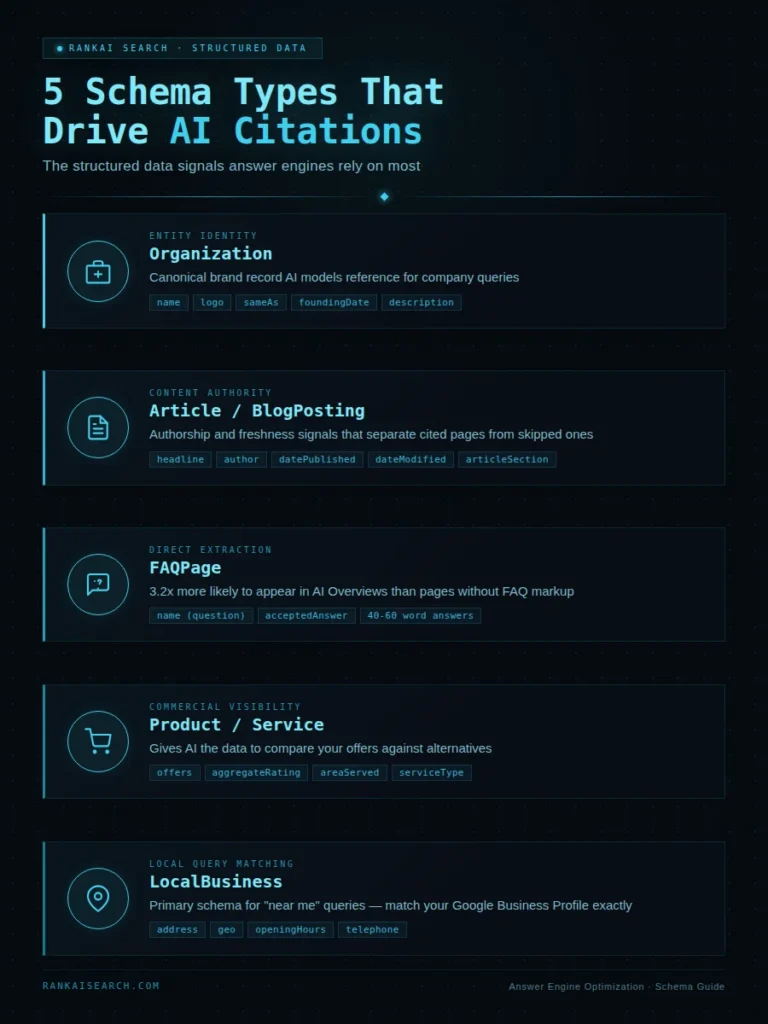
Answer Engine Optimization (AEO) is the practice of structuring content so AI platforms can extract and cite it directly in generated answers. Five schema types account for the majority of AI citation opportunities across commercial, informational, and local queries.
| Schema Type | Primary Use Case | Key Properties |
| Organization | Brand entity identity | name, logo, sameAs, foundingDate |
| Article / BlogPosting | Content citation and authorship | headline, author, datePublished, dateModified |
| FAQPage | Direct question-answer extraction | name (question), acceptedAnswer |
| Product / Service | Commercial recommendation visibility | name, offers, aggregateRating, areaServed |
| LocalBusiness | Location-based query matching | address, geo, openingHours, telephone |
Organization and Brand Schema
Organization schema establishes a canonical entity record that language models reference when users ask about companies in your space. It is the foundation of AI brand visibility.
Priority properties to implement:
- name: official brand name, consistent across all pages
- logo: hosted URL of your current logo image
- sameAs: links to Wikidata, LinkedIn, Crunchbase, and industry directories
- foundingDate, description, numberOfEmployees: context signals that help AI categorize your brand accurately
The sameAs property is the highest-leverage addition. Sites with clean entity disambiguation through sameAs identifiers saw measurable improvements in AI Mode citation rates following Google’s March 2026 update.
Article and BlogPosting Schema
Article schema optimizes content pages for AI citation by providing machine-readable authorship, freshness, and topic signals. Complete markup is what separates a page AI systems cite from one they skip.
Required properties for AI-optimized article markup:
- headline: exact match to the page H1
- author: linked to a persistent Person entity with its own schema
- datePublished and dateModified: freshness signals for time-sensitive queries
- image: representative image URL
- articleSection: topic category that supports topical authority mapping
Consistent author markup across multiple articles compounds over time. AI systems recognize repeated author entities and increase citation confidence for that source across related queries.
FAQ and Q&A Schema
FAQPage schema structures question-answer pairs for direct AI extraction, removing the interpretation step entirely. Pages with FAQPage markup are 3.2x more likely to appear in Google AI Overviews compared to pages without FAQ structured data (Source: Frase.io, 2024).
For AI-optimized FAQ answers:
- Keep each answer between 40 and 60 words
- Write answers that make sense independently, without surrounding page context
- Match the name property exactly to the visible question text on the page
- Avoid answers that prompt follow-up questions; incomplete answers reduce citation probability
Product and Service Schema
Product schema surfaces your offerings when AI platforms generate commercial recommendations. It gives language models the data they need to compare your products against alternatives and match them to specific user intent.
Core properties for commercial visibility:
- name, description, brand
- offers with price, priceCurrency, and availability
- aggregateRating with star rating and review count
For service businesses, use serviceType, provider, and areaServed. For legal, medical, or financial services, use subtypes like LegalService or FinancialService for more precise query matching.
LocalBusiness Schema
LocalBusiness schema is the primary schema type for location-based AI queries. AI platforms prioritize businesses with complete address and hours data when users ask about services near them or in a specific city.
Essential properties:
- address structured with streetAddress, addressLocality, and postalCode
- geo with latitude and longitude coordinates
- openingHours and telephone
- priceRange and acceptedPaymentMethod
Align every LocalBusiness schema property with your Google Business Profile. Discrepancies between schema markup and GBP data reduce AI citation confidence.
How Does Schema Markup Increase Your Chances of LLM Citation?
Schema markup increases citation probability by reducing the computational uncertainty AI systems encounter when deciding whether to trust a source. Explicit structured data removes the inference layer that causes AI platforms to skip or misrepresent content.
A controlled Search Engine Land experiment tested three nearly identical pages with the same content and keyword difficulty, varying only schema implementation. Only the page with well-implemented JSON-LD appeared in a Google AI Overview. The no-schema page failed to index at all (Source: GW Content, 2026).
One critical nuance: schema accuracy predicts citations more reliably than schema volume. A December 2024 study by Quoleady and Search Atlas found no correlation between the quantity of schema coverage and AI citation frequency. Accurate, complete markup that matches visible page content consistently outperforms broad but incomplete implementation.
Factors that increase citation probability:
- Complete property sets with no missing required fields
- Schema that reflects only what users can see on the page
- Consistent entity naming across all site pages
- Author markup linked to a persistent Person entity
- sameAs identifiers pointing to verified external profiles
How Do You Implement Schema Markup for Maximum AI Search Impact?
The two implementation decisions with the greatest impact on AI citation outcomes are format selection and property completeness. Getting both right before deployment avoids the compounding errors that cause AI platforms to ignore your structured data.
What Are the Technical Best Practices?
Use JSON-LD format exclusively. It sits in a single <script> block in your <head>, decoupled from your HTML, so template redesigns do not break your markup. JSON-LD reduces template-related breakage by approximately 60% compared to inline Microdata or RDFa. Pages with correct schema markup also earn up to 40% more rich-result impressions than unmarked pages (Source: xseek.io, 2026, citing Milestone Inc., 2023).
Implementation checklist:
- Place one JSON-LD block per page in the <head> section
- Use the most specific schema type available (BlogPosting over CreativeWork, LegalService over Service)
- Implement schema on every important page, not just the homepage
- Use consistent canonical URLs as entity identifiers across your site
- Never mark up content that is not visible to users
How Do You Validate and Test Your Schema?
Validate every implementation before publishing using:
- Google’s Rich Results Test at search.google.com/test/rich-results: checks syntax, required properties, and rich result eligibility
- Schema Markup Validator at validator.schema.org: checks format compliance and identifies structural errors
After deployment, test in live AI platforms. Run brand-related and topic-specific queries through Google AI Overviews, Bing Copilot, and Perplexity. Record whether your content appears and how it is cited. Real-world testing reveals gaps that validators cannot catch.
What Advanced Schema Strategies Give You a Competitive Edge?
The highest-leverage advanced schema tactic is entity disambiguation: explicitly linking your brand, authors, and products to verified external identifiers so AI systems can resolve who or what you are without guessing.
Advanced tactics ranked by impact:
- Cross-reference with sameAs: link Organization and Person entities to Wikipedia, Wikidata, LinkedIn, and Crunchbase
- Nest related entities: Person author inside Article, Product inside Organization
- Layer schema types on a single page: an article reviewing a product can carry both BlogPosting and Product schema
- Use knowsAbout on your Organization schema to signal topical authority to AI knowledge graph systems
- Implement industry-specific subtypes: MedicalBusiness, LegalService, FinancialService for niche query matching
Each tactic builds a richer entity profile that language models use when generating context-dependent answers, especially for comparison and recommendation queries.
How Does Schema Integrate with Broader AI Optimization Strategies?
Schema markup is one layer of a complete AI optimization strategy, not a standalone fix. RankAISearch (rankaisearch.com) is a global agency specializing in Answer Engine Optimization (AEO), Generative Engine Optimization (GEO), Large Language Model Optimization (LLMO), and traditional SEO. Its integrated approach combines schema implementation with semantic content strategy and entity-based topic clusters to build AI citation authority across all major platforms.
| Discipline | What It Does | Role of Schema |
| AEO (Answer Engine Optimization) | Structures content for direct extraction by AI answer engines | FAQPage and Article schema enable extraction without interpretation |
| GEO (Generative Engine Optimization) | Builds topical authority and entity relationships for generative AI | Organization and sameAs schema anchor your brand as a verified entity |
| LLMO (Large Language Model Optimization) | Embeds correct brand facts into AI training and retrieval pipelines | Accurate schema converts page data into structured statements during model training |
| Traditional SEO | Drives organic visibility and domain authority | Structured data amplifies ranking signals and unlocks rich result eligibility |
Schema without authoritative content produces limited citation gains. Content without schema leaves AI platforms guessing. Both are required for sustained AI search visibility.
How Do You Measure Schema Markup’s Impact on AI Search Performance?
Measuring schema’s impact requires tracking AI citation rates directly, not relying on traditional rank tracking alone. As of 2026, manual monitoring across AI platforms combined with Search Console data is the most reliable method available.
| Metric | What It Shows | How to Track |
| AI citation frequency | How often AI platforms reference your content | Manual monthly queries in Google AI Overviews, Perplexity, Bing Copilot |
| Rich result impressions | Whether schema is being processed by search crawlers | Google Search Console, filtered by Search Appearance |
| Non-branded click growth | Expanded topic visibility beyond branded queries | Google Search Console, comparing pre- and post-implementation periods |
| Knowledge Panel appearances | Brand entity recognition in Google’s knowledge graph | Manual branded search monitoring |
| AI-referred session volume | Traffic arriving from AI platform referrals | GA4, filtered by AI platform referral sources |
Run manual AI citation queries monthly using 10 to 15 topic-specific questions relevant to your content. Document citation appearances by platform, query type, and content source. This baseline is what you measure all subsequent schema changes against.
What Schema Markup Mistakes Hurt Your AI Search Visibility?
The most damaging schema errors are not syntax mistakes. They are content mismatches and stale data that cause AI platforms to distrust your structured signals entirely.
| Mistake | Impact | Fix |
| Missing required properties | AI receives partial data and reduces citation confidence | Implement full property sets for every schema type used |
| Schema that doesn’t match visible content | Triggers suppression or manual actions | Only mark up content users can actually see on the page |
| Inconsistent entity names across pages | Prevents AI from building a coherent entity profile | Standardize brand name, author names, and org identifiers site-wide |
| Outdated schema after business changes | AI surfaces incorrect information about your brand | Update schema the same day locations, prices, or services change |
| Generic schema types | Reduces query match precision | Use the most specific applicable type from schema.org |
| Duplicate schema blocks on the same page | Creates conflicting signals for AI parsers | Use one JSON-LD block per schema type per page |
What Is the Future of Schema Markup in AI-Powered Search?
Schema markup is shifting from a SERP display trigger to an AI trust and entity verification signal. Google’s March 2026 core update confirmed this: AI Mode now uses structured data to verify claims and resolve entity identity during answer synthesis, independent of whether a traditional rich result is displayed (Source: Digital Applied, 2026).
Emerging developments shaping schema strategy:
- New schema.org properties for content licensing, fact-checking status, and claim verification are in active development
- Proprietary structured data formats may emerge from major AI platforms optimized for their specific architectures
- Entity graph density will matter more than page-level markup; brands with the most interconnected, verified entity data will hold the strongest AI citation positions
- Schema drift detection is becoming a required workflow; markup that falls out of sync with actual page content can trigger suppression
The brands investing in comprehensive entity schema now are building infrastructure that compounds as AI search grows.
Frequently Asked Questions
What is schema markup and how does it help AI search engines?
Schema markup is structured code added to your website that gives AI search engines explicit, machine-readable information about your content, brand, products, or services. AI platforms read your schema to extract verified facts and cite your content with higher confidence in generated responses, rather than inferring meaning from natural language.
Which schema types are most important for answer engine optimization?
The five schema types with the highest impact on AI citations are Organization, Article (or BlogPosting), FAQPage, Product, and LocalBusiness. Organization schema establishes brand entity identity; Article supports content citation; FAQPage enables direct question-answer extraction; Product drives commercial visibility; LocalBusiness captures location-based queries.
How do I add schema markup to my website for AI visibility?
Add schema markup using JSON-LD format inside the <head> section of each page. Select schema types from schema.org that match your actual page content, complete all required properties, and validate using Google’s Rich Results Test before deploying. Implement across all important pages, not just your homepage.
Can schema markup guarantee my brand appears in AI-generated answers?
Schema markup cannot guarantee appearances. A December 2024 study by Quoleady and Search Atlas found no direct correlation between schema coverage volume and citation frequency. Schema works best when paired with high-quality, topically authoritative content. Together, they measurably increase citation probability compared to either approach alone.
How long does it take for AI platforms to recognize new schema markup?
Search crawlers typically reindex new schema within days to a few weeks. Full recognition across AI platforms takes longer because language model updates run on varying schedules. Expect several weeks before schema changes are consistently reflected across Google AI Overviews, Bing Copilot, and Perplexity.
Does schema markup work for all types of AI search platforms?
JSON-LD schema works across Google AI Overviews, Bing Copilot, Perplexity, and ChatGPT with web browsing enabled. Microsoft confirmed in March 2025 that schema helps Copilot’s LLMs understand content. Google confirmed that structured data gives an advantage in search results. JSON-LD is the most widely supported format across all major AI search systems.
What tools can I use to validate my schema implementation?
Use Google’s Rich Results Test at search.google.com/test/rich-results and the Schema Markup Validator at validator.schema.org. These tools check syntax accuracy, flag missing properties, and verify format compliance. After validation, test your implementation in live AI platforms by querying relevant topics and recording whether your content appears.
How often should I update my schema markup?
Update schema immediately when your content, products, services, or business information changes. For articles, update dateModified after significant revisions. For businesses, update address, hours, and contact data the same day changes take effect. Run a full site schema audit quarterly to catch drift before it reduces your citation probability.